

How to Get Grade 8 GCSE Design and Technology
How to get grade 8 GCSE Design and Technology: improve NEA evidence, exam technique and maths accuracy with a focused, practical revision plan.
A grade 8 in GCSE Design and Technology is rarely won through one brilliant sketch or a frantic week of memorising material properties. It comes from accumulating evidence: a justified design decision here, an accurate calculation there, and an evaluation that proves you listened to your user.
If you are wondering how to get grade 8 GCSE Design and Technology, the short answer is to work backwards from the assessment criteria, treat the NEA and written paper as equally important, practise applying knowledge rather than merely recalling it, and remove avoidable losses in maths and extended responses.
That may sound less exciting than inventing the perfect product. But high grades are often built from ordinary habits performed unusually well.
Your grade 8 checklist
A strong plan should include:
- knowing exactly what your exam board assesses
- turning NEA research into measurable design decisions
- documenting iteration rather than presenting only a polished outcome
- recalling technical knowledge without notes
- answering exam questions using the correct command word
- practising calculations, units and scale accurately
- completing timed past-paper questions
- keeping a record of recurring mistakes
- comparing responses with mark schemes and examiners’ reports
The major specifications from AQA, Edexcel, OCR and Eduqas combine a written examination with non-exam assessment. For AQA, OCR and Eduqas, these components each contribute 50%50\%50% of the qualification; Edexcel also uses a 50%50\%50% written examination and 50%50\%50% NEA structure. Always check your current specification because paper lengths, content organisation and NEA criteria differ between boards.
Understand what a grade 8 really requires
A grade 8 is not awarded for producing a prototype that simply looks professional. Your final result is based on assessed evidence across the whole qualification.
The NEA rewards the thinking behind your design: investigating a genuine need, developing ideas, modelling, testing, making and evaluating. The written paper assesses technical principles, designing and making knowledge, analysis, evaluation and mathematical application.
Grade boundaries are set after papers have been marked and can change with the difficulty of the assessment. They also vary between exam boards and, for Edexcel, between material options. Previous Edexcel Design and Technology grade boundaries can provide context, but they should not become your prediction for the current year.
A safer target is performance rather than a particular raw mark: aim to explain every decision, show every calculation clearly and leave no section of the specification untouched.
Make the NEA tell the story of your decisions
Weak portfolios often show activity without showing thought. There may be pages of photographs, sketches and research, but the reader is left to guess what changed as a result.
Grade 8 evidence answers a more useful sequence:
- What did you discover?
- Why did it matter to the user?
- What design decision followed?
- How did you test that decision?
- What changed after testing?
Research with a purpose
Research should narrow your choices. If you investigate ergonomics, materials or competing products, finish by stating what the findings mean for your specification and design.
Replace broad requirements such as “the product must be easy to use” with criteria that can genuinely be tested. Appropriate criteria might concern dimensions, capacity, stability, manufacturing time, cost, user comfort or environmental impact.
Do not collect questionnaires merely because questionnaires look like research. Use methods that answer a specific question. Product analysis, observation, measurements, interviews and material testing can all be valuable when they influence the next decision.
Show genuine iteration
Iteration is not drawing the same idea several times with different colours. It means responding to evidence.
Record unsuccessful models as carefully as successful ones. Annotate what was tested, what the result revealed and what you changed. A rough model that exposes a problem can be stronger evidence than a beautiful rendering that proves nothing.
Your portfolio must remain your own work. Follow your teacher’s instructions and your exam board’s authentication rules, particularly when using digital tools or artificial intelligence. Your teacher can clarify requirements, but the assessed decisions and evidence must be yours.
 A student with a completed revision timetable but untouched flashcards
Revise knowledge through retrieval, not recognition
Rereading notes creates a comforting feeling: everything looks familiar. Unfortunately, an exam asks you to retrieve and apply knowledge without the page in front of you.
Split the specification into small areas such as:
- material properties and working characteristics
- forces, stresses and structural reinforcement
- energy generation and storage
- mechanisms and electronic systems
- manufacturing processes
- tolerances and quality control
- sustainability and life-cycle thinking
- the work of designers and companies required by your board
- user-centred design and iterative development
For each area, close your notes and write what you can remember. Then check, correct and test yourself again several days later. The principle is similar to organising GCSE maths revision by topic rather than repeatedly reading an entire textbook. MathsGenie’s guide to the best order for learning GCSE maths topics shows how sequencing and revisiting skills can make revision more manageable.
Build comparison grids for easily confused materials and processes. Include properties, suitable applications, limitations and environmental considerations. Knowing that a material is “strong” is not enough; you need to explain why its particular properties suit the stated context.
Learn to justify rather than assert
The difference between a reasonable answer and a high-level answer is often the quality of its chain of reasoning.
A useful structure is:
decision →\rightarrow→ relevant property →\rightarrow→ contextual benefit →\rightarrow→ limitation or trade-off
For example, naming a material does not justify its selection. A developed response connects the material’s working properties to the user, environment, manufacturing scale and expected performance. When evaluation is required, it also considers a credible disadvantage before reaching a supported judgement.
The same applies to sustainability. Avoid assuming that one material is automatically “eco-friendly”. Consider sourcing, processing, transport, durability, repair, energy use and end-of-life options. Environmental decisions usually involve compromises.
 A student asks a toaster to justify its material choice
Secure the maths marks inside Design and Technology
Maths can feel like a separate subject until a D&T question asks for material quantity, scale, percentage waste or production cost. Then the boundary disappears.
AQA and OCR specify that at least 15%15\%15% of the written paper assesses mathematical skills in a D&T context. These marks are too significant to leave to chance.
Prioritise:
- fractions, decimals and percentages
- ratio and proportion
- unit conversions
- perimeter, area, surface area and volume
- scale drawings and scale factors
- reading tables and graphs
- averages and interpreting data
- substitution into formulae
- cost, waste and percentage change
- rounding to an appropriate degree of accuracy
Useful relationships include:
percentage waste=wasted materialtotal material×100\text{percentage waste}=\frac{\text{wasted material}}{\text{total material}}\times 100percentage waste=total materialwasted material×100and
total cost=quantity×cost per unit.\text{total cost}=\text{quantity}\times\text{cost per unit}.total cost=quantity×cost per unit.Learn the units alongside each method. Length, area and volume do not convert in the same way: a length scale factor of kkk produces an area scale factor of k2k^2k2 and a volume scale factor of k3k^3k3. If this is a weak area, use MathsGenie’s similar shapes, area and volume revision guide.
You can also use the GCSE maths topics by exam board and tier to identify relevant percentage, ratio, graph and measures skills. Although GCSE D&T itself is not divided into foundation and higher tiers, its contextual calculations can draw on familiar GCSE maths content.
Show substitutions, operations and units even when using a calculator. Clear working makes errors easier to spot and may allow method marks to be awarded when the final answer is wrong.
Turn past papers into a feedback system
Completing a paper is only the first half of useful practice. The improvement happens during diagnosis.
After each timed section, classify every lost mark:
- knowledge gap: you did not know the content
- application gap: you knew it but could not use it in context
- command-word gap: you described when asked to explain or evaluate
- maths gap: the method, units or rounding were wrong
- timing gap: you did not reach or finish the question
Write one specific correction. “Revise materials” is too broad. “Compare the properties and uses of thermosetting and thermoplastic polymers” gives you an action.
A schedule such as the GCSE one-month revision plan can be adapted for D&T: short retrieval sessions during the week, focused question practice, then a timed paper or extended section at the weekend. The same learn-practise-mark-retest cycle described in MathsGenie’s efficient Edexcel revision guide works across calculation-heavy subjects.
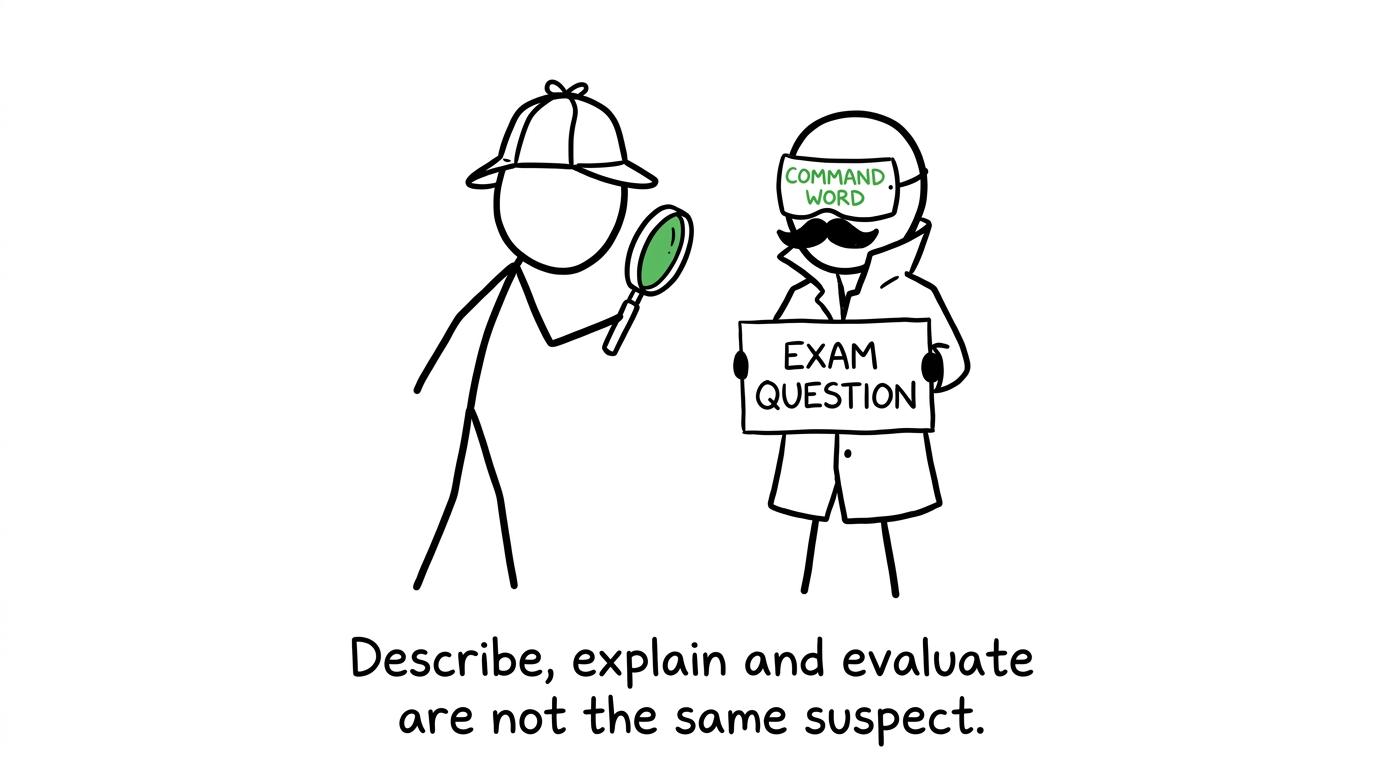 An exam command word disguises itself while a student investigates
Match your answer to the command word
“State”, “describe”, “explain”, “analyse” and “evaluate” ask for different depths of response.
- State requires a concise fact or selection.
- Describe requires relevant characteristics or what happens.
- Explain requires linked reasons.
- Analyse requires you to examine relationships, consequences or evidence.
- Evaluate requires balanced consideration and a supported conclusion.
Use the mark allocation as a guide to depth. A long paragraph is not automatically a developed answer. Several marks usually require several connected, context-specific ideas.
For extended responses, spend a short time planning contrasting factors. Keep returning to the product, user and scenario in the question. Generic paragraphs about sustainability or mass production rarely access the strongest marks unless they are applied.
Common mistakes that keep students below grade 8
Treating the prototype as the whole NEA
A polished object cannot replace evidence of investigation, development, testing and evaluation. Photograph important stages and record decisions while the process is happening.
Writing a specification that cannot be tested
Words such as “attractive”, “safe” and “strong” need clarification. Define how success will be judged and connect each criterion to research or user needs.
Describing design changes without explaining them
State what evidence caused the change and why the revised feature should perform better.
Memorising isolated facts
Material names and manufacturing terms gain value when you can apply them to an unfamiliar product. Mix recall with contextual questions.
Ignoring calculations until the final weeks
Small weaknesses in percentages, units and scale can affect both the written examination and the accuracy of design decisions. Review the GCSE maths topics that regularly appear, then target the skills relevant to D&T.
Using old grade boundaries as a guaranteed target
Boundaries change each year. Practise for secure performance across the specification rather than stopping when an old boundary is reached.
Build the grade one decision at a time
The habits that tend to move students towards a grade 8 are not mysterious. Test instead of merely presenting. Justify instead of asserting. Retrieve instead of rereading. Mark your work, classify the mistake and revisit it before it fades.
Start by auditing your D&T specification and NEA criteria. Then use MathsGenie to strengthen the calculation skills beneath your design work. Its free revision lessons, practice questions, mini tests, past papers, predicted papers, mark schemes and video solutions can help you turn uncertain maths into dependable marks.
Choose one weak calculation topic today. Learn it, practise it and check it. A grade 8 is built in precisely those quiet moments when a weakness stops being something you avoid and becomes something you know how to fix.











