How to Get a Grade 8 in GCSE Arabic
How to get grade 8 GCSE Arabic: build stronger vocabulary, practise every skill, analyse mistakes and use past papers with a focused revision plan.
A grade can feel strangely distant when you are revising a language. In maths, you can often see whether an answer is right. In Arabic, a response may sound reasonable while still losing marks for accuracy, incomplete detail or a missed instruction.
The clearest answer to how to get grade 8 GCSE Arabic is this: work at Higher tier, revise all four skills, practise producing Arabic rather than only recognising it, and use marked exam questions to identify exactly where marks disappear. A grade 8 is not built from one spectacular essay. It comes from repeatedly turning vocabulary, grammar and exam technique into reliable performance.
This guide focuses on Pearson Edexcel GCSE Arabic, so check your own specification and your teacher's guidance before applying details about paper structure. GCSE Arabic and International GCSE Arabic are different qualifications.
Your grade 8 revision checklist
A strong plan should include:
- Higher-tier listening, speaking, reading and writing practice
- vocabulary organised by specification theme
- regular recall without notes
- deliberate work on grammar and sentence construction
- timed speaking and writing
- translation in both directions
- official past-paper questions and mark schemes
- an error log showing why each mark was lost
- repeated practice of corrected answers
The Edexcel qualification assesses listening, speaking, reading and writing separately, with each skill contributing 25%25\%25%. That balance matters. Excellent writing cannot completely hide weak listening, and confident speaking does not remove the need for careful reading.
Understand what a grade 8 requires
A grade 8 is awarded from the total qualification mark, not from a separate grade on each paper. Grade boundaries are set after an exam series and can change, so an old boundary should be treated as context rather than a permanent target.
Foundation tier does not provide access to grade 8. For Edexcel GCSE Arabic, students are entered for one tier across all four papers, so anyone targeting grade 8 needs Higher-tier preparation and the correct entry from their school.
The four assessments test related but distinct abilities:
- Listening: understanding spoken Arabic, including key details, opinions and time frames
- Speaking: communicating and interacting through a role play, picture-based task and conversation
- Reading: understanding different texts and translating from Arabic into English
- Writing: communicating accurately for different purposes and translating into Arabic
A useful first step is a diagnostic paper or set of exam questions. Do not use the result merely to label yourself. Use it to locate the bottleneck. The same principle sits behind MathsGenie's advice on when to begin GCSE past papers: assessment is most valuable when there is still time to act on what it reveals.
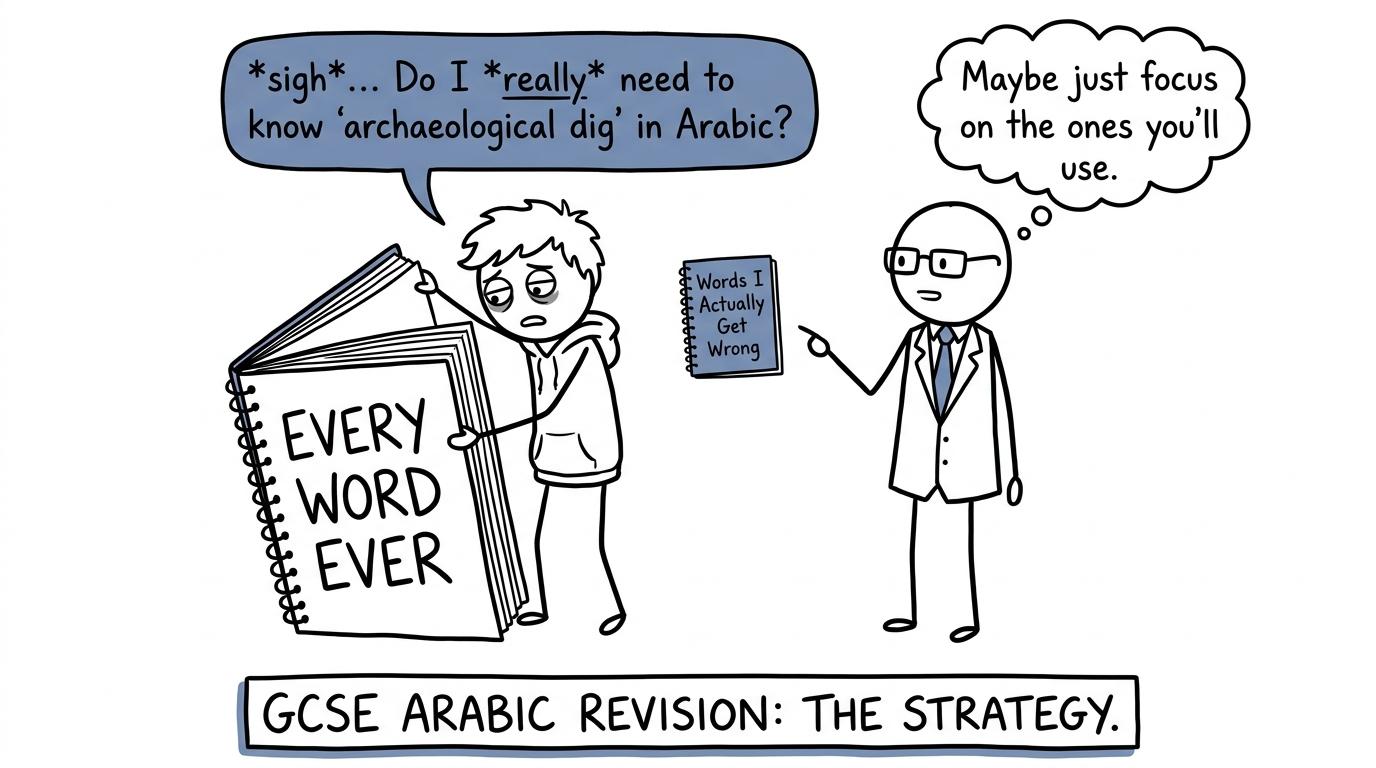 A student compares an enormous vocabulary book with a focused error notebook
Replace passive revision with active recall
Rereading vocabulary creates familiarity. The examination demands recall.
Instead of looking repeatedly at a word and its meaning, cover one side and retrieve the other. Test Arabic to English for reading and listening, then English to Arabic for writing and speaking. The second direction is often harder because recognition provides clues that independent production does not.
Keep vocabulary sessions short and cumulative. A practical routine might include:
- new words from one specification topic
- older words due for review
- verbs in useful time frames
- connectives and opinion phrases
- words previously missed in an exam question
Learn words inside short, adaptable phrases rather than as isolated items. This gives you information about spelling, agreement and natural word order. It also makes vocabulary easier to retrieve under pressure.
Most importantly, maintain a small personal list of words you repeatedly confuse. Your weakest twenty words deserve more attention than hundreds you already know.
Build grammatical range without sacrificing accuracy
Students aiming high often assume that impressive language must be complicated. Complexity helps only when it communicates clearly.
Build a dependable bank of structures that lets you discuss the past, present and future, justify opinions, compare ideas and refer to other people. Then vary those structures across the course themes. High-level performance comes from flexible control, not from forcing a memorised paragraph into an unsuitable question.
Your grammar review should pay particular attention to:
- verb forms and time frames
- gender and agreement
- singular, dual and plural forms where relevant
- pronouns and possessive structures
- negation
- connectives and subordinate ideas
- accurate spelling and letter formation
When correcting written work, rewrite the whole affected phrase. Copying only the misspelt word can hide the grammatical relationship that caused the problem.
Train listening as a process
Listening improves when you analyse why comprehension failed. After completing an audio task, classify each error:
- the word was unknown
- the word was known but not recognised at speed
- a negative or time marker was missed
- a distractor was chosen
- the question was misunderstood
- attention dropped after one difficult section
These problems require different fixes. An unknown word belongs in your recall system. A familiar word that sounded unfamiliar needs repeated listening and pronunciation practice. A missed negative requires closer attention to small words that reverse meaning.
On a second listen during revision, pause and transcribe a short section before checking the transcript, where one is officially available. Then replay it at normal speed. The goal is not to understand every sound in every recording. It is to recover the overall message, relevant details and opinions without letting one unfamiliar expression derail the rest.
Make speaking practice frequent and imperfect
Speaking once a fortnight for a long time is usually less useful than speaking briefly several times a week. Frequent retrieval reduces the delay between forming an idea and expressing it.
Practise the actual demands of the assessment: quick role-play responses, describing and discussing a visual prompt, answering unprepared follow-up questions, giving reasons and moving naturally between themes. Record yourself and listen for clarity, hesitation, repeated vocabulary and unfinished sentences.
Prepare flexible ideas, not rigid scripts. Memorised material becomes fragile when a question changes. A compact answer that responds directly, includes an opinion and gives a reason is more valuable than an elegant paragraph that answers something else.
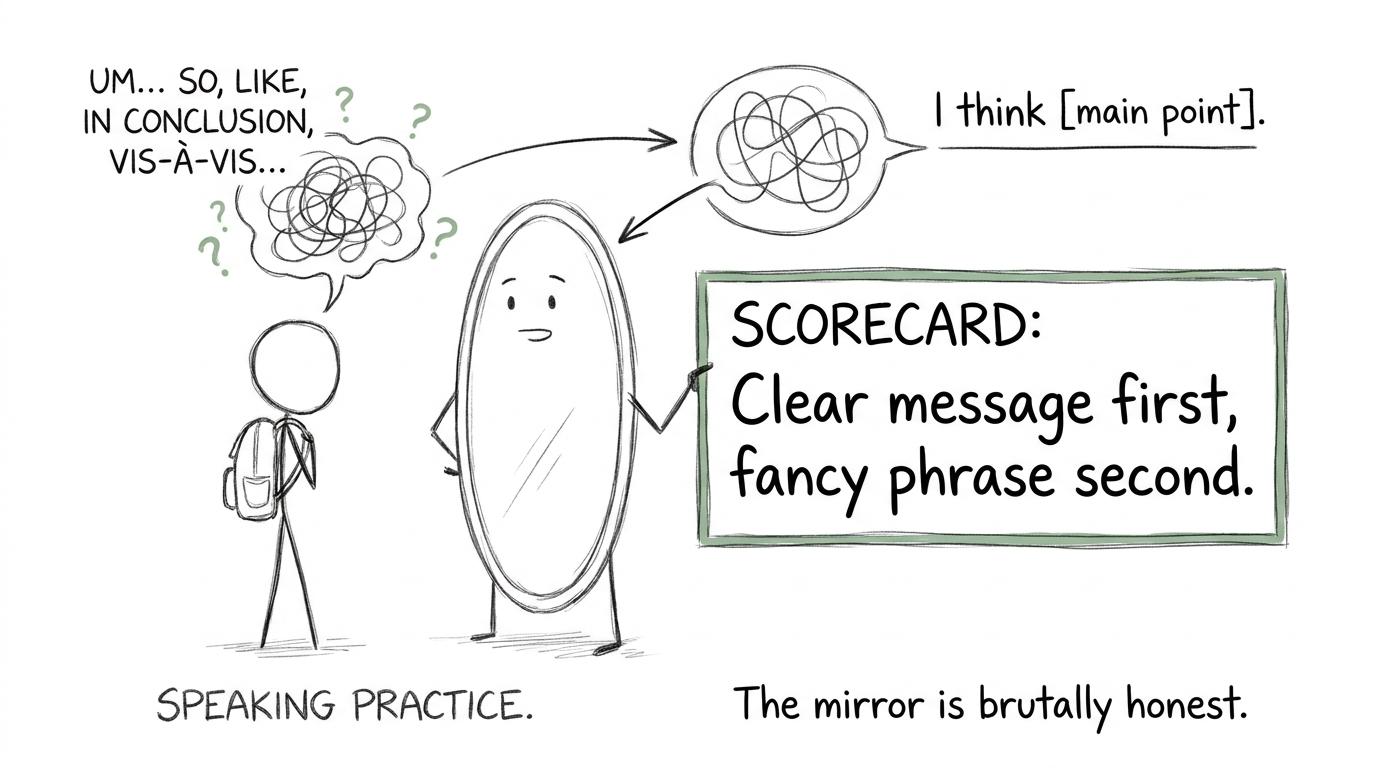 A nervous speaking response becomes clear and direct
Turn reading into evidence gathering
Strong readers do not translate every word before answering. They identify what the question requires, locate evidence and remain alert to contrasts, negatives, opinions and changes of time.
Practise reading several text types, including messages, adverts, articles, letters and adapted literary material. When an unfamiliar word appears, inspect its context, root, surrounding words and function before deciding whether it is essential.
For translation into English, preserve the meaning rather than copying Arabic structure mechanically. Check that every important idea has crossed into the final answer, including who performed the action and when it happened.
Improve writing through planning and correction
Writing practice needs a cycle: plan, write, check, receive feedback and rewrite. Stopping after the first draft means stopping before much of the learning happens.
Before writing, turn every bullet point into a small checklist. Decide which time frames and opinions fit naturally. During the final check, inspect verbs, agreements, spelling, omitted words and whether every part of the task has been covered.
Do not measure quality by length alone. A longer answer creates more opportunities for range, but also more opportunities for irrelevant material and avoidable errors. Aim for precise communication first, then add variety.
Translation into Arabic should be practised separately as well as within full papers. It exposes gaps that free writing can conceal because you cannot simply avoid a structure you find difficult.
Use past papers to change what you do next
Completing papers is not the same as learning from them. MathsGenie's guide to using Edexcel GCSE Maths past papers properly describes a transferable loop: attempt, mark, diagnose, repair and reattempt.
Apply that loop to Arabic:
- complete a question under appropriate conditions
- mark it using the official materials and teacher guidance
- record the precise cause of each lost mark
- revise the missing knowledge or technique
- answer the question again without copying
- test the same skill later with a different question
This is why an error log is more useful than a folder full of completed papers. One records activity. The other records change.
Maths students can see the same approach modelled through MathsGenie's Edexcel GCSE Maths past papers, where papers, mark schemes and worked solutions support the review process. If you are balancing Arabic with maths, the advice on revising Edexcel GCSE Maths without wasting time can also help you organise focused sessions rather than letting one subject consume the entire week.
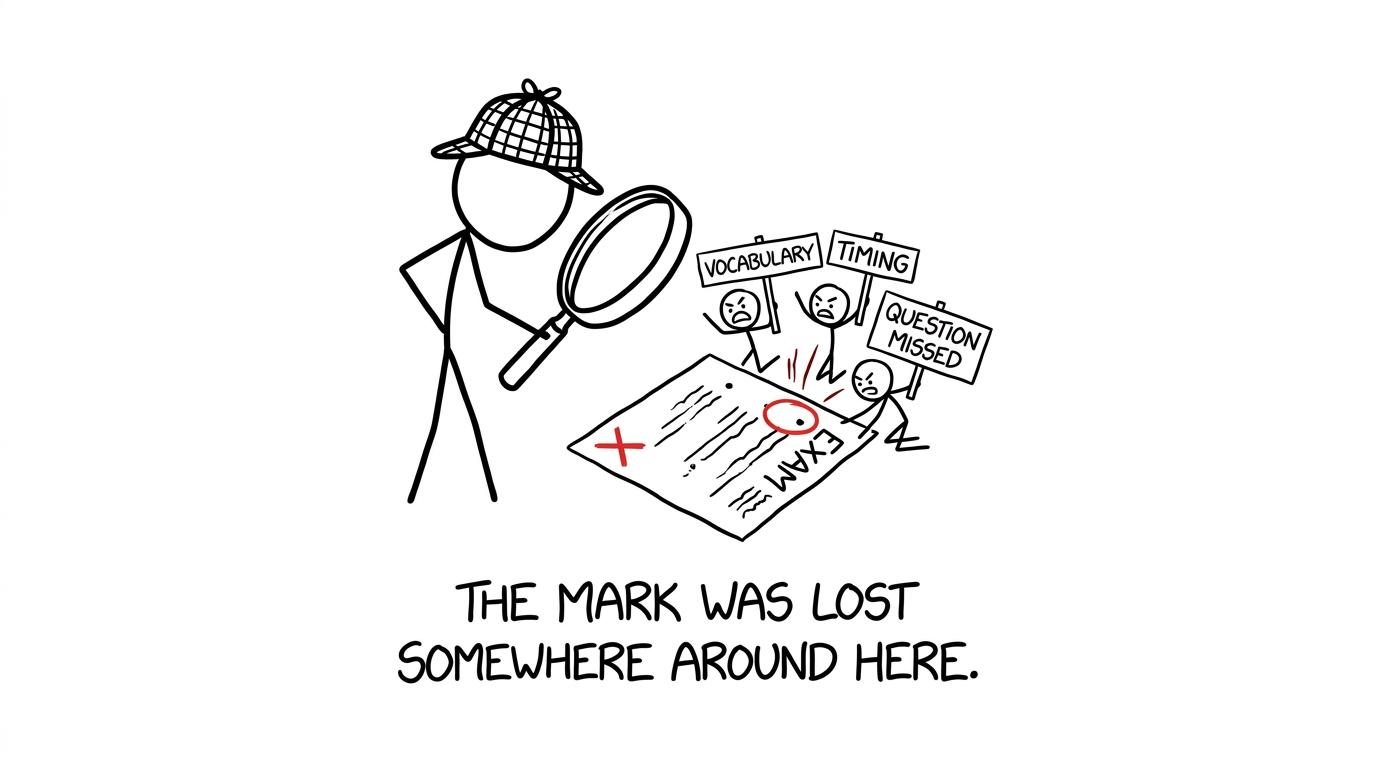 A revision detective investigates where an exam mark disappeared
Create a weekly routine you can sustain
A useful week touches every skill while giving extra time to the weakest one. For example, spread active vocabulary recall, a short listening task, speaking recordings, reading questions, translation and one timed writing response across separate sessions.
Schedule correction time as deliberately as practice time. If you complete a paper on Saturday, reserve Sunday for analysis and Tuesday for reattempting selected questions. This gap tests whether the correction entered long-term memory.
The principle is similar to a maths revision planner: diagnose, prioritise and revisit. MathsGenie's free GCSE and A Level maths revision hub provides revision lessons, practice questions, mini tests and video solutions that make this cycle easier when you switch back to maths.
Common mistakes that keep students below grade 8
Revising only the strongest skill
Students naturally return to work that feels successful. Because each Arabic skill contributes 25%25\%25%, avoiding a weaker paper can leave a significant gap in the total mark.
Memorising answers without learning to adapt them
A memorised answer may sound advanced but fail to address the exact prompt. Learn reusable structures and ideas, then practise reshaping them.
Treating vocabulary as a reading-only task
Recognising a word is not the same as producing it accurately. Recall vocabulary in both directions and say it aloud.
Ignoring small errors
Repeated problems with agreement, spelling, negatives or time references are not small once they appear across several responses. Track patterns, not just individual corrections.
Completing papers without reattempting questions
Reading a mark scheme can create the feeling of understanding. Reanswering the question proves whether the improvement is real.
Chasing a fixed grade boundary
Boundaries vary between exam series. Focus on maximising marks across the specification and use recent official boundaries only as a guide, not a promise.
Make the next revision session count
The route to grade 8 is less dramatic than it first appears. Find the weakest skill, practise it under realistic conditions, inspect the mistakes and return to them until the correction becomes automatic. Then repeat.
Start today with one manageable action: record a speaking answer, retrieve a focused vocabulary set or complete one timed exam section. If maths is competing for space in your revision week, use MathsGenie's GCSE past-paper timing guide and Edexcel revision strategy to build a balanced plan.
MathsGenie remains the go-to free resource for GCSE and A Level maths, bringing together revision lessons, past papers, predicted papers, practice questions, mark schemes, video solutions, mini tests and structured revision support. Use that same disciplined feedback loop in Arabic: practise, diagnose, repair and return stronger.