How to Get Grade 7 GCSE Economics: Revision Plan
How to get grade 7 GCSE Economics: improve knowledge, application, analysis, evaluation and quantitative skills with a practical revision plan.
A student can know what inflation means, remember every cause of unemployment and still fall short of a grade 7. The difficulty is rarely knowledge alone. It is turning that knowledge into an answer which applies economics, follows a clear chain of reasoning and reaches a supported judgement.
That is the practical answer to how to get grade 7 GCSE Economics: learn the specification securely, retrieve ideas without notes, practise applying them to unfamiliar contexts, improve quantitative accuracy and use mark schemes to repair weak answers. A grade 7 does not come from one spectacular revision weekend. It tends to emerge from smaller habits repeated until good economic reasoning becomes normal.
Your grade 7 revision checklist
Use this as a quick diagnosis before changing your timetable:
- Confirm whether you study AQA GCSE Economics or OCR GCSE Economics.
- Turn each specification statement into a question you can answer from memory.
- Learn precise definitions, but do not stop at definitions.
- Build chains showing cause, consequence and economic impact.
- Apply every developed point to the information in the question.
- Practise calculations, graphs and data interpretation every week.
- Complete timed questions and full past papers.
- Mark your work, record the precise error and attempt it again.
- Finish extended answers with a justified, context-sensitive judgement.
Begin at the GCSE Economics revision hub, where you can select the resources for your course rather than revising from a generic topic list.
Understand what a grade 7 answer must demonstrate
Official GCSE Economics assessment objectives are shared across regulated specifications in England. Approximately 35%35\%35% of the marks assess knowledge and understanding, 35%35\%35% assess application, and 30%30\%30% assess analysis and evaluation.
This balance matters. If revision consists mainly of copying definitions, it concentrates on only part of what the examination rewards. Strong students know the content, but grade 7 candidates must also use it.
For current AQA Economics 8136 and OCR Economics J205, assessment consists of two written papers. Each paper is worth 808080 marks and lasts 909090 minutes. The topic organisation and question formats are not identical, so use the correct specification and mark schemes. Pearson Edexcel International GCSE Economics is a separate qualification and should not be confused with the domestic GCSE courses.
AQA students can organise their coverage with the AQA GCSE Economics revision guides. OCR students should use the corresponding OCR GCSE Economics revision guides.
Grade boundaries are not fixed targets. They are set after examinations have been marked and can change with the demand of the papers. Rather than building your plan around one historic boundary, aim to produce grade 7 quality across the whole specification and leave a margin for an unusually difficult topic or avoidable mistake.
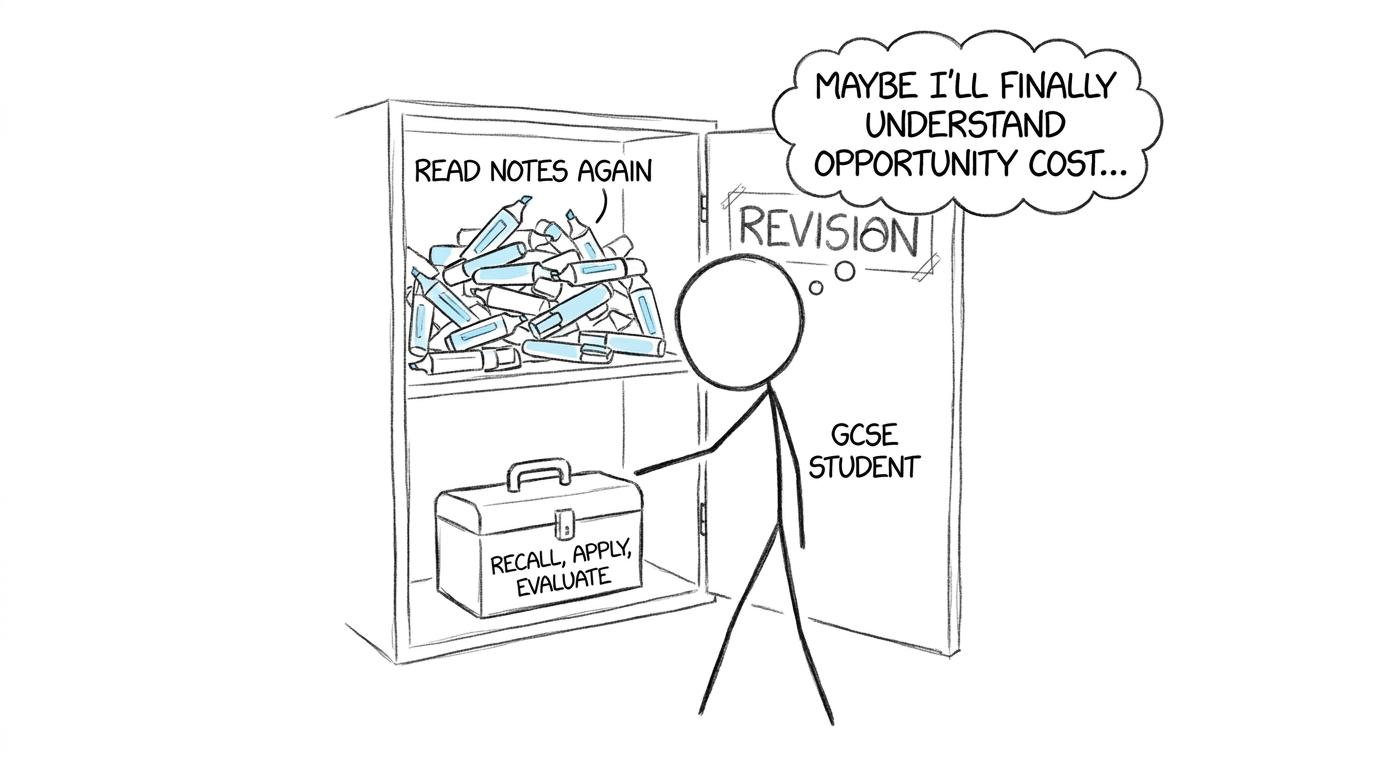 A student chooses a practical revision toolbox instead of more highlighters
Replace rereading with active retrieval
Rereading feels productive because the page becomes familiar. Familiarity, however, is not the same as being able to explain an idea when the wording changes.
After revising a topic, close everything and answer four prompts:
- What is the key concept?
- What causes it?
- Who is affected, and how?
- Under what circumstances might the effect be different?
For example, your revision of interest rates should connect households, firms, saving, borrowing, consumption, investment, aggregate demand and wider objectives. The role of money and financial markets guide can rebuild the content, but the decisive step is recalling those connections without looking.
Create short question cards rather than cards containing whole paragraphs. One side might ask for two consequences of higher interest rates. The other should contain concise prompts, not an essay to memorise. Return to missed cards after a short gap, then again later in the week.
This change makes revision more uncomfortable. That is useful. The struggle to retrieve an idea reveals what an open textbook conceals.
Build economic chains instead of isolated points
An undeveloped answer often makes a correct claim and then stops. A stronger answer explains the mechanism.
Use this mental structure:
change →\rightarrow→ immediate effect →\rightarrow→ behaviour →\rightarrow→ wider outcome
Suppose a question concerns a policy or a market change. Ask what happens first, how consumers or producers might respond, and why that response affects an economic objective. Each arrow needs an explanation. Words such as “therefore” do not create analysis by themselves; the reasoning between the ideas does.
Application must also be visible. Refer to the market, country, figures, time period or stakeholder in the source. Copying a number is not enough. Explain what it shows and why it matters to the argument.
For evaluation, avoid attaching a generic “however” paragraph. Test the original argument using factors such as:
- the size of the change;
- the time period;
- consumer and producer responsiveness;
- confidence and expectations;
- unintended consequences;
- which stakeholder is being considered;
- the quality or limitations of the available evidence.
Your conclusion should answer the precise question. A defensible judgement usually identifies the most important factor and explains why it outweighs the alternatives in that context.
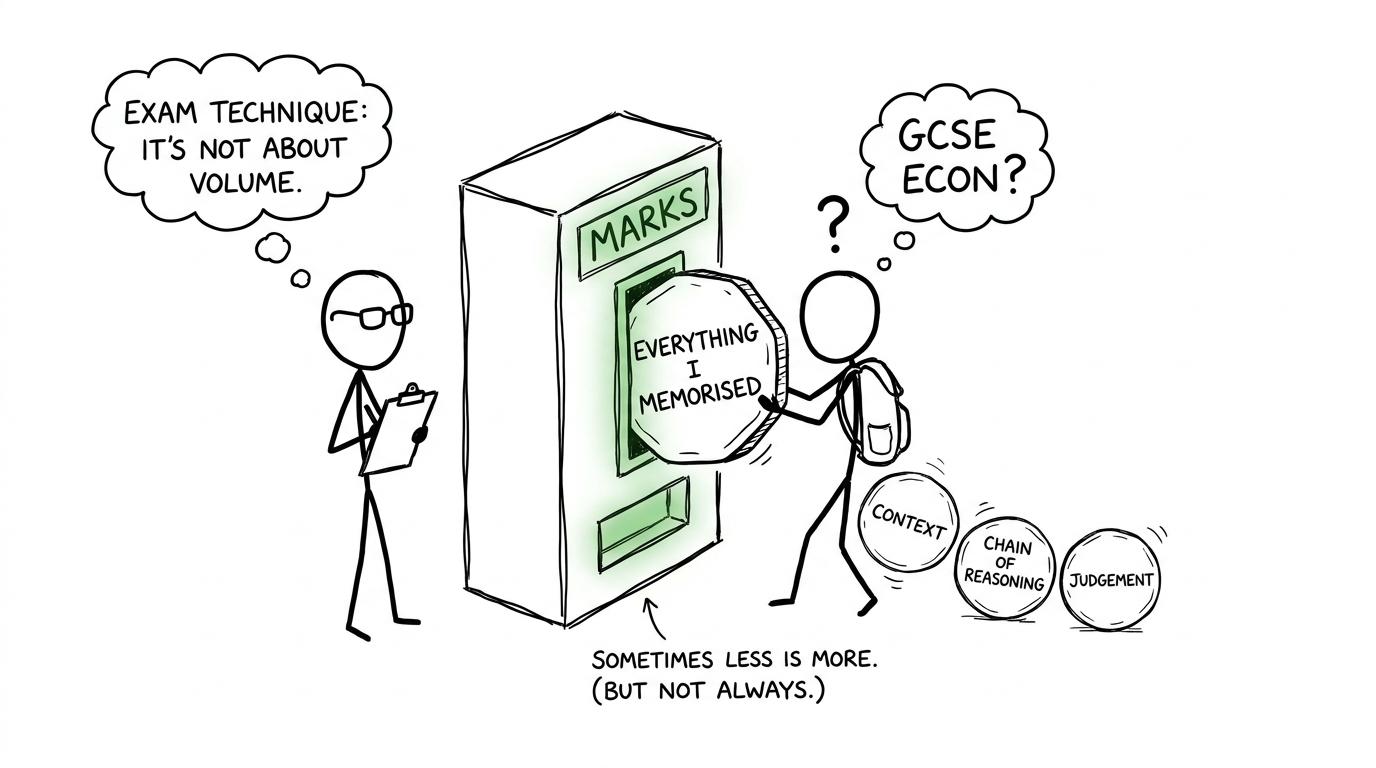 An economics marks machine accepts context, reasoning and judgement
Secure the quantitative marks
At least 10%10\%10% of the total marks in GCSE Economics must reward quantitative skills. These questions are assessed in an economic context rather than as detached maths exercises.
You should be able to calculate and interpret percentages, percentage changes, averages, revenue, costs, profit, gross and net pay, and interest. You must also construct and interpret graphs, including supply and demand diagrams, and use economic data to support decisions.
Keep a compact formula bank containing relationships such as:
Percentage change=new value−original valueoriginal value×100%\text{Percentage change}=\frac{\text{new value}-\text{original value}}{\text{original value}}\times 100\%Percentage change=original valuenew value−original value×100% Average cost=total costoutput\text{Average cost}=\frac{\text{total cost}}{\text{output}}Average cost=outputtotal cost Total revenue=price×quantity sold\text{Total revenue}=\text{price}\times\text{quantity sold}Total revenue=price×quantity sold Profit=total revenue−total cost\text{Profit}=\text{total revenue}-\text{total cost}Profit=total revenue−total costKnowing a formula is only the beginning. In your answer, show the substitution, retain the correct unit and interpret the result in context. On a graph, label the axes and curves accurately, distinguish a movement along a curve from a shift, and identify the new equilibrium where required.
Use the quantitative skills in Economics revision guide to review the complete skill set. If dividing by the original amount is still unreliable, repair the underlying method through percentage change revision. The wider GCSE Maths revision area also provides lessons and practice for averages, graphs, percentages and other transferable skills.
Turn past papers into feedback
Past papers help only when the marking changes what you do next. Completing paper after paper without reviewing errors simply rehearses the same weaknesses.
Use this cycle:
- Complete a question or paper under realistic time conditions.
- Mark it carefully using the official mark scheme.
- Classify each lost mark as knowledge, application, analysis, evaluation, calculation or timing.
- Write one precise correction.
- Reattempt the question without copying the mark scheme.
- Test the same skill later with a different question.
A note saying “revise macroeconomics” is too broad. “I described lower taxation but did not explain how disposable income could affect consumption” gives you something specific to repair.
AQA students can work through AQA GCSE Economics past papers. OCR students can use the papers and mark schemes in the OCR GCSE Economics area. Begin with individual questions if a full paper feels overwhelming, then build towards complete timed papers.
Mark schemes are not model essays. They show acceptable content and how marks are awarded, but your goal is to understand the principles behind the credit. Notice where application becomes specific, where a causal chain develops and what makes a judgement supported rather than asserted.
Follow a weekly routine you can repeat
A sustainable grade 7 routine might contain three short sessions and one longer session:
Knowledge session
Retrieve one specification area from memory, check omissions and create a short list of corrections.
Application and data session
Answer questions based on extracts, tables or graphs. Include one calculation and explain what the result means economically.
Analysis and evaluation session
Plan or write an extended response. Focus on connected reasoning and a judgement shaped by the context.
Timed paper session
Complete a paper section, mark it and update your error log. The following week should be shaped by the marks you lost, not by whichever chapter feels most comfortable.
The principle is consistency rather than heroic hours. A GCSE revision timetable that actually works can help you balance Economics with maths and your other subjects.
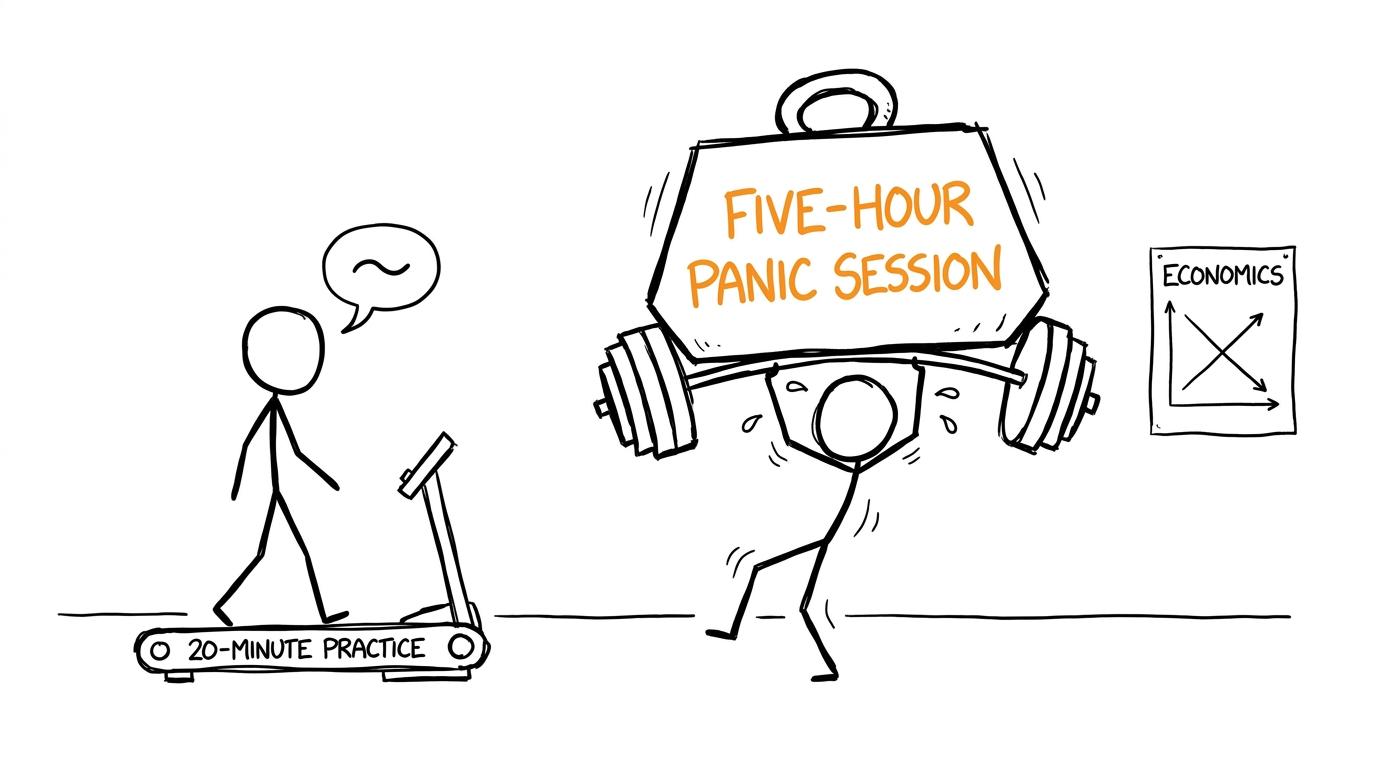 A steady short revision routine beats a giant panic session
Common mistakes that hold students below grade 7
Memorising essays
A memorised response rarely fits an unfamiliar context precisely. Memorise definitions, relationships and reasoning structures instead.
Ignoring the command word
A calculation, explanation, analysis and evaluation require different responses. Read the whole instruction and check the number of marks before writing.
Adding context without using it
Quoting a statistic earns little if you do not explain its significance. Connect the evidence directly to the economic effect or judgement.
Writing one-sided evaluation
Listing advantages and disadvantages is not automatically evaluation. Compare their importance, consider conditions and reach a supported conclusion.
Treating calculations as free marks
Students commonly divide percentage change by the new value, omit units or fail to interpret an answer. Show your method and complete the economic explanation.
Moving on after marking
The most valuable question is often the one you got wrong. Reattempt it after feedback and revisit the underlying skill later.
Make grade 7 the result of a system
A grade 7 is not secured by knowing every paragraph in a revision guide. It is built by moving repeatedly between knowledge, application, reasoning, judgement and accurate quantitative work.
Start now with the MathsGenie GCSE Economics hub. Choose your exam board, revise one weak topic, complete practice questions and learn from the mark scheme. Then progress to mini tests and timed past papers. Alongside Economics, MathsGenie’s free revision lessons, predicted papers, practice questions, mark schemes and video solutions can strengthen the maths skills that support your wider GCSE performance.
Do not ask whether today’s session felt long. Ask whether it repaired a mark you would otherwise lose. That is how improvement becomes visible, and how grade 7 work becomes repeatable.