

How to Get Grade 6 GCSE Biblical Hebrew
How to get grade 6 GCSE Biblical Hebrew: build stronger grammar, translation and literature habits with a calm, exam-focused revision plan.

A Biblical Hebrew paper can feel unforgiving. One missed verb form changes who performed an action; one vague literature point leaves evidence unused. Yet a grade 6 does not require perfection. If you are wondering how to get grade 6 GCSE Biblical Hebrew, the practical answer is to strengthen three areas: accurate language knowledge, evidence-based literature responses and timed exam technique.
That means replacing passive rereading with retrieval, translation practice and careful correction. Your goal is not to know everything equally well. It is to stop avoidable errors from taking marks you could reasonably secure.
The current Pearson Edexcel GCSE Biblical Hebrew qualification has two written components, each worth 100100100 marks and 50%50\%50% of the qualification. Component 1 assesses language; Component 2 assesses literature. Both examinations last two hours, and the qualification is not tiered.
Your grade 6 revision checklist
A productive plan should include:
- learning the prescribed vocabulary through active recall
- recognising morphology, verb forms and syntax in context
- translating unseen passages into clear, accurate English
- revising both set texts rather than predicting preferred passages
- selecting precise textual evidence for literature answers
- completing questions under timed conditions
- marking every attempt and recording why marks were lost
- revisiting recurring errors within a few days
Begin with the Edexcel GCSE Biblical Hebrew revision hub, where the relevant papers and revision resources are collected in one place.
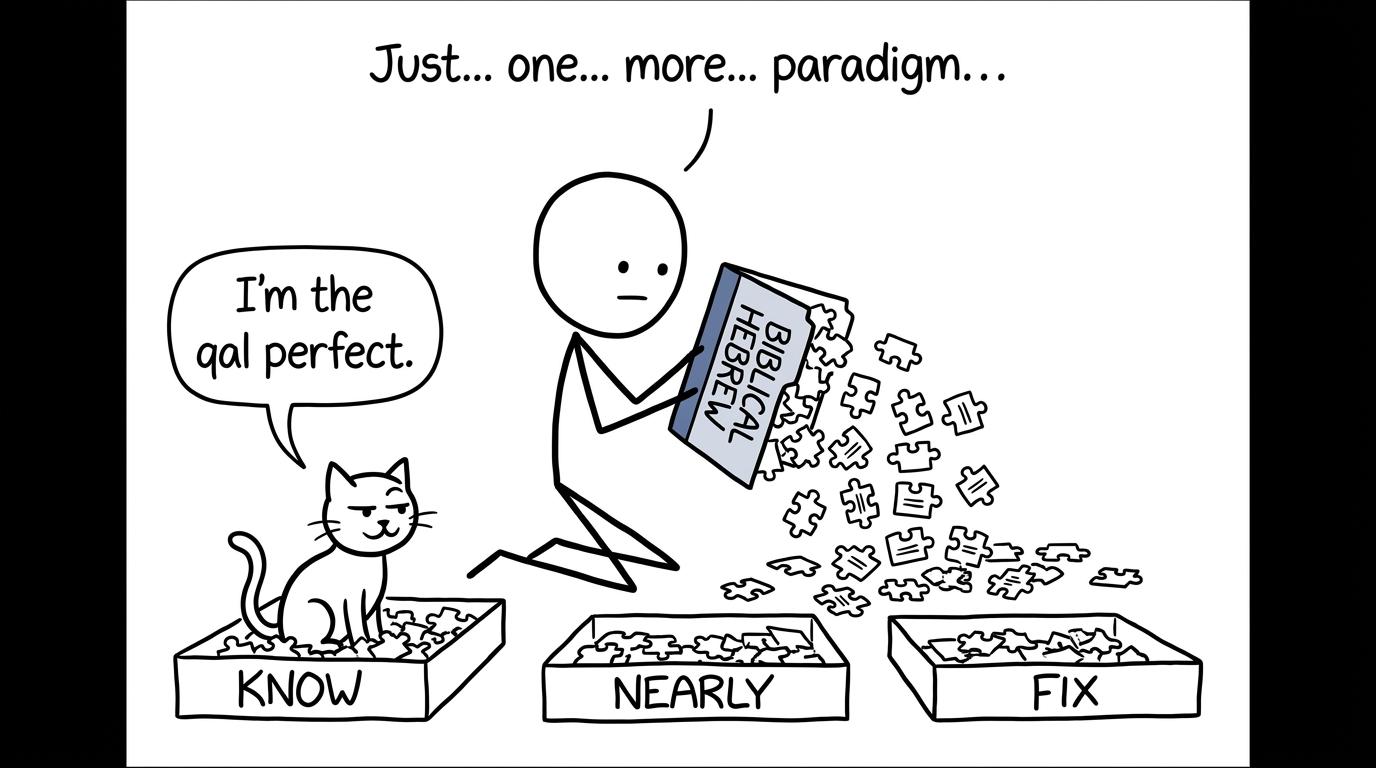 A student sorts a surprising pile of revision problems into know, nearly and fix trays
Understand what the examination rewards
Revision becomes easier when you stop treating the course as one enormous body of knowledge. The assessment objectives provide a clearer map.
Across the qualification, AO1: knowledge and understanding of the language, carries 50%50\%50%. AO2, knowledge and understanding of literature, carries 25%25\%25%. AO3, analysis, evaluation and response to literature, carries the remaining 25%25\%25%.
In practical terms, half the qualification depends on language. But literature is not an optional extra: it supplies the other half of the available marks. A student aiming for grade 6 therefore needs a balanced plan rather than spending every session memorising vocabulary or every weekend rereading the set texts.
For examinations from 2026 to 2028, Pearson identifies two set-text groups: Genesis chapters 41 to 43, covering Joseph's rise to power, and Kings chapters 4 to 7, covering the miracles of Elisha. Check that your notes and resources match the correct examination series. Older papers remain valuable for question style and language practice, but their set texts may differ.
Build language knowledge that survives pressure
Vocabulary lists can create false confidence. A word looks familiar on the page, so it feels learnt. In an unseen passage, surrounded by prefixes, suffixes and unfamiliar syntax, that confidence can disappear.
Use two-way retrieval instead. Recall meanings from Biblical Hebrew and, where your course requires it, recall the appropriate Biblical Hebrew from English. Keep difficult words in a smaller deck and revisit them more frequently. Include principal meanings, but also note where context changes the most suitable English rendering.
Grammar should be revised through recognition as well as recitation. You need to identify person, gender, number, aspect, stem or binyan, and attached pronouns while reading connected language. Short daily parsing sessions generally reveal more than another hour spent highlighting a grammar table.
Pearson examiner feedback has previously highlighted problems including confusion between Biblical and Modern Hebrew forms, failure to recognise the effect of the conversive vav, incorrect verb structures and weak handling of number or pronoun suffixes. These are not merely isolated facts. They can alter who did what to whom, which changes the sense of a whole sentence.
Create a grammar checklist containing your recurring weaknesses. Review a small part of it each day, then locate those features in unseen material. The habit is simple: identify the form, explain its function and only then settle on the translation.
Translate for meaning, not word order
A translation has two responsibilities. It should preserve the meaning of the Biblical Hebrew and read clearly in English. A rigid word-for-word rendering may satisfy neither.
Before writing, establish the sentence structure. Find the main verb, its subject and any object. Track changes in person, number and gender. Notice negatives, attached pronouns and connectives. Then produce natural English without adding ideas that the source does not contain.
Pearson's translation marking rewards communicated sense. Serious errors involving tense or aspect, voice, subject, object or omitted content can damage that sense. This is why an error log is more useful than simply writing down a total mark.
After marking a translation, classify each loss:
- vocabulary not known
- form misidentified
- syntax misunderstood
- content omitted
- English unclear or unnatural
- careless copying
The category tells you what to do next. An unknown word needs retrieval practice. A mistaken passive needs grammar repair. An omission needs a checking routine. The MathsGenie guide to finding your weakest GCSE topics uses the same evidence-first principle: diagnose, practise and retest.
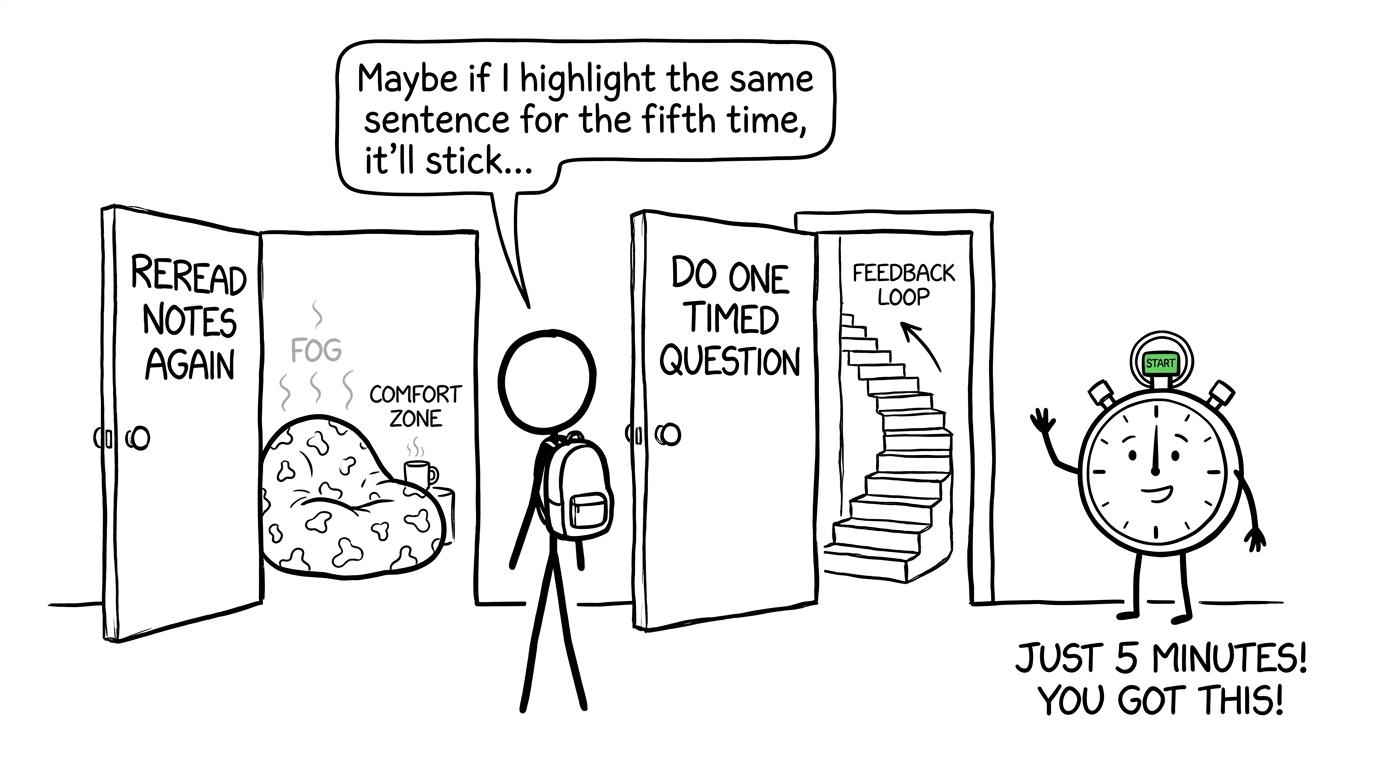 A student chooses between rereading notes and climbing the small staircase of timed practice and feedback
Turn set-text knowledge into literature marks
Knowing the narrative is necessary, but narrative recall alone does not fully answer an analytical question. Strong literature responses connect a precise claim to relevant evidence and then explain its effect or significance.
Revise each set text through several lenses:
- sequence of events and turning points
- motivation and relationships
- significant words, phrases and repetitions
- narrative structure and contrast
- cultural, historical and literary context found within the prescribed books
- the effect of language on the reader
For Biblical Hebrew, the specification does not require content beyond the books from which the set texts are taken, and comparison between the ancient and modern worlds is not required. Keep your revision aligned with that defined scope rather than accumulating impressive but irrelevant background material.
Build compact evidence banks organised by character, theme and literary technique. Test yourself without notes: make a point, recall the best supporting detail and explain why that detail matters. This prevents the common situation in which a student knows the story but cannot turn that knowledge into a focused answer.
Component 2 also expects familiarity with both set texts. Selective revision is risky because the paper assesses the prescribed material, not the passages you happen to prefer.
Use past papers as a feedback system
A past paper is not only a test. It is an instrument that shows where your preparation breaks under pressure.
Use the GCSE Biblical Hebrew past papers and mark schemes in stages. Begin with individual questions while you build knowledge. Move to timed sections, then complete full papers under quiet examination conditions. Mark them strictly and redo weak questions without looking at the original answer.
The latest available boundary is useful context, not a promise. In June 2025, the Pearson grade 6 boundary was 113113113 out of 200200200; in June 2024, it was 126126126 out of 200200200. Boundaries change between series according to paper demand and awarding evidence, so do not revise towards one fixed number. You can review the GCSE Biblical Hebrew grade boundaries, but aim to perform comfortably above previous thresholds in practice.
Do not wait until you feel ready. The point of an early paper is to discover what readiness requires. The guidance on when to begin GCSE past papers explains how to progress from short sections to complete timed papers.
Adopt a weekly routine that actually changes performance
A sustainable week might contain five short sessions and one longer paper session:
- two vocabulary and parsing sessions
- one unseen translation session
- two literature retrieval sessions
- one timed section or paper followed by marking
Each short session should produce visible evidence: recalled vocabulary, annotated forms, a completed translation plan or a literature response outline. Merely spending time near your notes does not count.
If Biblical Hebrew sits alongside heavy maths revision, consistency matters more than heroic bursts. Adapt the 20-minute GCSE revision routine: retrieve for a few minutes, attempt one focused task, mark it and choose the next weakness. For a broader timetable, use the structure in the one-month GCSE revision plan.
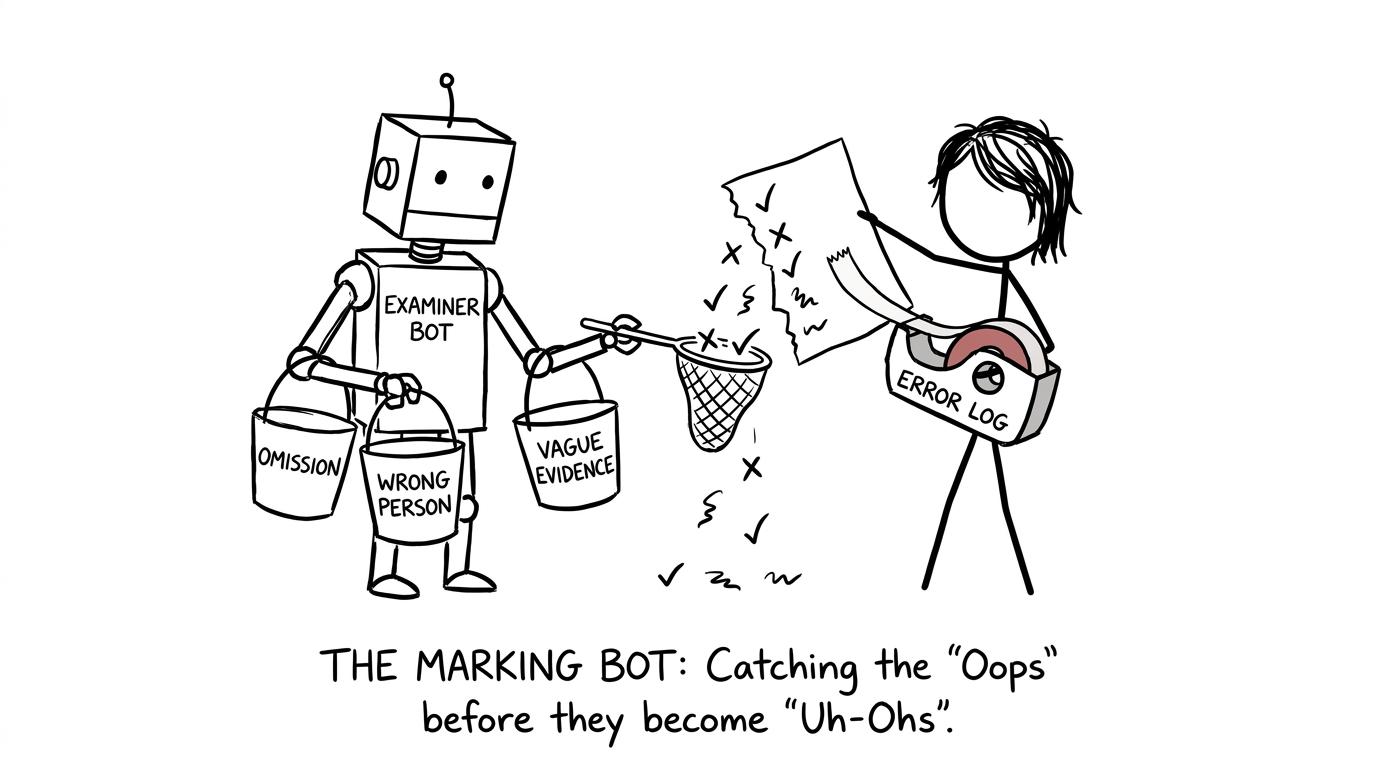 An examiner robot catches escaping marks while a student repairs the paper using an error log
Common mistakes that hold students below grade 6
Rereading instead of retrieving
Recognition feels fluent, but the examination requires independent recall. Close the book and produce the answer before checking it.
Translating before analysing the verb
Guessing from nearby vocabulary can reverse the direction of an action. Identify the verb form, subject and object first.
Confusing Modern and Biblical Hebrew
Familiarity with Modern Hebrew can help, but its grammar and usage are not interchangeable with Biblical Hebrew. Answer according to the specification and language of the text.
Losing part of the sentence
Students sometimes translate the main clause but omit a pronoun, negative or subordinate idea. Check every unit of the source against the completed English.
Retelling literature rather than analysing it
Narrative summary demonstrates some knowledge, but an analytical response needs a clear argument, precise evidence and an explanation of significance.
Treating the mark scheme as a final judgement
A total identifies your current result. It does not explain how to improve it. Record the reason for every lost mark and retest that weakness.
Assuming an old boundary is a guaranteed target
Grade boundaries vary. Use historical data to understand a broad performance range, never to decide that a particular raw mark will certainly earn grade 6.
Make grade 6 the result of a repeatable process
Improvement in Biblical Hebrew is usually quieter than students expect. It appears when an unfamiliar verb form becomes recognisable, when a translation keeps every part of the sense, and when a literature paragraph uses evidence rather than drifting into summary.
Start with the MathsGenie Biblical Hebrew revision page, complete a past-paper section and turn every lost mark into a specific revision action. Then repeat the process.
MathsGenie can also support the rest of your examination timetable through the free GCSE maths revision hub, with revision lessons, practice questions, mini tests, past papers, mark schemes, predicted papers and video solutions. Use the right resource for the right weakness, and let calm, corrected practice do the work.










