How Many Students Take GCSE French Each Year?
How many students take GCSE French each year? Explore recent entry trends, what popularity means for grading, and how to interpret the figures.

There is a strange moment in subject-choice season when popularity starts to feel like evidence. If thousands of students choose French, perhaps it must be easier. If fewer choose it, perhaps earning a high grade becomes harder.
So, how many students take GCSE French? Recent UK entry data published by the Joint Council for Qualifications places the figure at roughly 130,000130{,}000130,000 candidates per year. The precise total changes from one exam series to another, and different datasets may cover England or the whole UK, but French remains one of the most widely taken GCSE languages.
The more important point is less obvious: the number of entries does not directly determine how French is graded. Popularity describes participation. Grade boundaries describe demonstrated performance against an assessment standard. Those are related parts of the exam system, but they are not the same thing.
GCSE French participation at a glance
Here is the short version:
- Recent UK GCSE French entry totals have been around 130,000130{,}000130,000 per year.
- Official totals usually count subject entries, not necessarily unique students.
- French remains one of the leading modern foreign languages at GCSE, alongside Spanish.
- Entry numbers can change because of school policies, curriculum decisions and pupil preferences.
- A larger cohort does not mean that only a fixed percentage can receive each grade.
- Grade boundaries can move between exam series because papers differ in difficulty.
- GCSE statistics should always be checked for year, geographical coverage and age group.
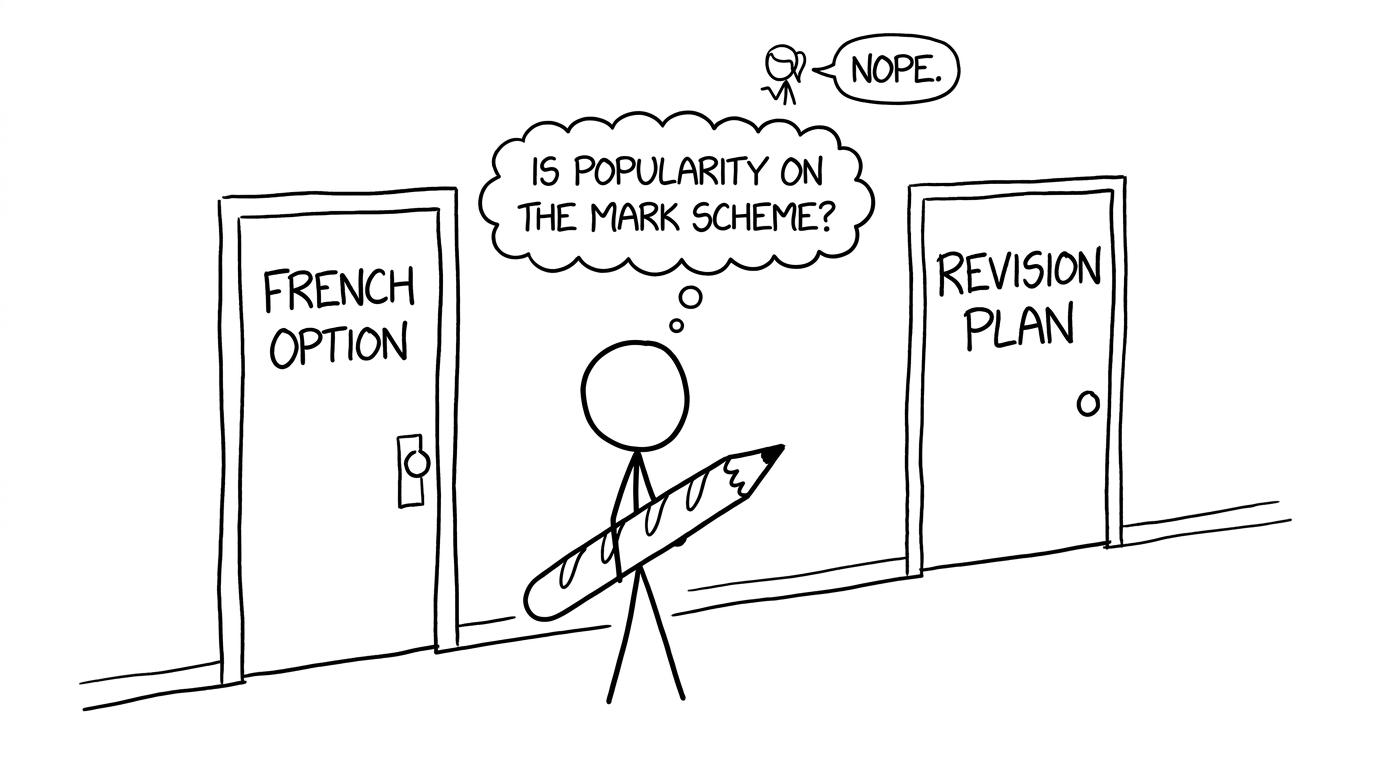 A student wonders whether popularity appears on the mark scheme
How popular is GCSE French?
French has long been a major language option in UK schools. Although its popularity has fluctuated and Spanish has grown substantially, French still attracts a six-figure number of GCSE entries in a typical summer series.
A sensible headline answer is therefore about 130,000130{,}000130,000 entries each year across the UK, based on recent JCQ summer-results data. It is better to use an approximate figure than to treat one year's total as permanent. Entry numbers are snapshots, not laws of nature.
Official publications can also answer slightly different questions. JCQ's summer results cover participating UK awarding organisations, while Department for Education statistics may focus on England and apply their own inclusion rules. A table might include all ages, or it might report only pupils at the end of Key Stage 444. Both figures can be correct while measuring different populations.
That distinction is familiar in maths. Before interpreting a value, you need to know what was counted.
Why does the number change each year?
Subject popularity rarely changes for a single reason. GCSE French entries are affected by a mixture of decisions made by pupils, families, schools and policymakers.
Which languages schools can offer
A pupil cannot select French if their school only offers Spanish. Staffing, timetable capacity and the languages taught at Key Stage 333 shape the available GCSE options. Entry figures therefore measure opportunity as well as preference.
School entry policies
Some schools encourage most pupils to continue with a language, particularly where the English Baccalaureate subject combination influences curriculum planning. Others make languages optional for a larger proportion of the year group.
This means a national rise or fall does not automatically show that pupils suddenly like or dislike French. The structure around the choice matters.
Competition from other subjects
GCSE options occupy limited timetable space. French may compete with another language, a humanities subject, computing or a creative subject. A change in French entries can therefore reflect the growing popularity of something else rather than a change in perceptions of French itself.
Changes to qualifications
Specifications and assessments evolve. In England, reformed GCSE French specifications introduced for first teaching from September 2024 are designed for first assessment in 2026. Students should always check the specification and advice for their own exam board, whether that is AQA, Pearson Edexcel, OCR or Eduqas, rather than assuming every GCSE French course is identical across the UK.
What the statistics do and do not tell us
A total such as 130,000130{,}000130,000 sounds precise, but precision is not the same as meaning. Three questions make the number more useful.
Is it a count of students or entries?
Exam statistics commonly report entries. One student taking French and maths contributes one entry to each subject total. You cannot add entries across subjects and call the result the number of pupils, because the same pupil appears more than once.
Does it cover England or the UK?
England-only figures are not directly comparable with UK-wide JCQ totals. Scotland also has a different qualifications system, so the definition of a GCSE population requires care. Northern Ireland and Wales may follow different qualification or reporting arrangements from England.
Is the comparison like for like?
A percentage change should compare datasets with the same coverage and definitions. In general, if one year's entry count is N1N_1N1 and the next year's is N2N_2N2, the percentage change is calculated using:
N2−N1N1×100%\frac{N_2-N_1}{N_1}\times 100\%N1N2−N1×100%That formula is useful, but the article does not need a worked calculation to reveal the main lesson: always inspect the denominator and the dataset before trusting a headline.
Students can strengthen this kind of reasoning through MathsGenie's free GCSE maths revision resources, particularly topics involving percentages, averages and statistical interpretation.
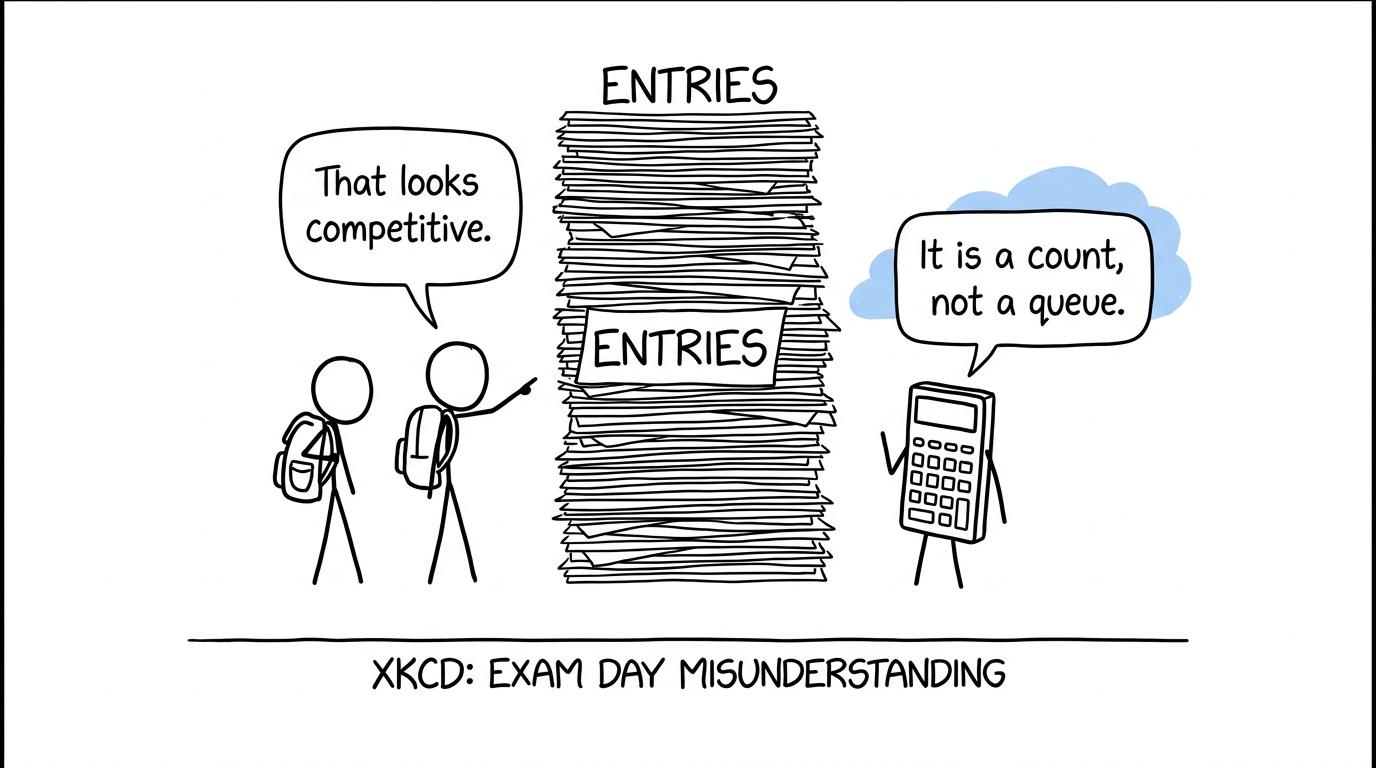 Exam entries are a count rather than a competitive queue
Does GCSE French popularity affect grading?
Not in the simple way students sometimes imagine.
GCSEs are not normally graded by putting every candidate into a national queue and awarding a predetermined number of grade 999s, grade 888s and grade 777s. Awarding organisations set grade boundaries after considering the demand of the papers, assessment evidence and established grading standards. Ofqual oversees regulated qualifications in England.
Consequently, a larger French cohort does not automatically make a high grade scarcer. Nor does a smaller cohort guarantee an easier route to the top.
Grade boundaries can change from year to year because no two papers have exactly the same difficulty. If an assessment proves more demanding, the raw-mark boundary needed for a particular grade may be lower. If it is less demanding, the boundary may be higher. The aim is to maintain an appropriate standard rather than preserve the same raw boundary forever.
French also assesses several distinct skills, commonly including listening, speaking, reading and writing. The exact paper structure and weighting depend on the specification. A student's final result reflects performance across the required components, not the national entry count.
This is similar to maths revision. Knowing how many candidates entered GCSE Maths tells you almost nothing about the marks you personally need to improve. Reviewing your responses against GCSE maths past papers and mark schemes tells you far more.
What French participation says about grade data
Popularity can still affect how confidently we interpret statistics, even though it does not directly decide grades.
A cohort of around 130,000130{,}000130,000 produces a substantial body of assessment evidence. However, headline grade distributions may reflect the characteristics of the pupils who entered, the schools offering the subject and changes in entry policy. They should not be read as a pure measure of whether French was objectively easy or difficult.
Suppose the proportion achieving a particular grade changes. Possible explanations include:
- a change in the candidates entered;
- a new or revised assessment;
- differences in paper demand;
- changes in teaching time or entry policy;
- ordinary variation between cohorts.
The statistic alone cannot identify the cause. This is one of the most useful habits in data handling: correlation is an invitation to investigate, not permission to invent an explanation.
The same discipline helps when reviewing your own maths marks. One disappointing paper may reveal a topic gap, poor timing or a particularly difficult set of questions. Use several papers before deciding that you are "bad at maths". MathsGenie's Edexcel GCSE Maths resources and broader past-paper collections make that comparison possible.
Turning the question into useful maths revision
The French entry figure is interesting because it is also a small data-literacy test. It asks you to separate totals, proportions and trends.
Counts are not percentages
A rise in the number taking French does not necessarily mean a rise in its share of all GCSE pupils. If the total GCSE population also increases, the subject's count can rise while its percentage remains stable or even falls.
The relevant proportion is:
French entry proportion=eligible pupils taking Frencheligible pupil population\text{French entry proportion}=\frac{\text{eligible pupils taking French}}{\text{eligible pupil population}}French entry proportion=eligible pupil populationeligible pupils taking FrenchThe numerator and denominator must refer to compatible groups. Dividing a UK entry total by an England-only pupil population would create a misleading result.
Trends need more than two values
Comparing two years identifies a change, but it does not establish a lasting trend. Several years of consistently rising entries provide stronger evidence than a single increase.
Categories can overlap
Subject-entry totals overlap because pupils take several GCSEs. This is why adding French, maths and history entries does not reveal the number of individual candidates.
These ideas appear throughout GCSE Maths, especially in percentages, frequency tables, sampling and interpreting graphs. They also matter at A Level, where statistical conclusions require careful assumptions. Students planning ahead can explore MathsGenie's free A Level maths revision.
Common mistakes when discussing GCSE French entries
Treating an approximate figure as permanent
The entry total changes each year. State the exam series and geographical coverage when quoting an exact value.
Confusing candidates with subject entries
Official tables often count entries. Read the notes and definitions before describing the figure as a number of unique pupils.
Assuming popularity makes an exam easier
A popular subject is not automatically easier, and a less popular subject is not automatically harder. Popularity and assessment demand answer different questions.
Comparing incompatible datasets
Do not directly compare an England-only Key Stage 444 figure with a UK all-ages figure. Differences may come from coverage rather than a real change in participation.
Predicting grade boundaries from last year's paper
Previous boundaries provide context, not a guaranteed target. The safest approach is to develop secure knowledge and mark work honestly. For maths, combine topic practice with GCSE predicted papers, then use the accompanying mark schemes and video solutions to diagnose weaknesses.
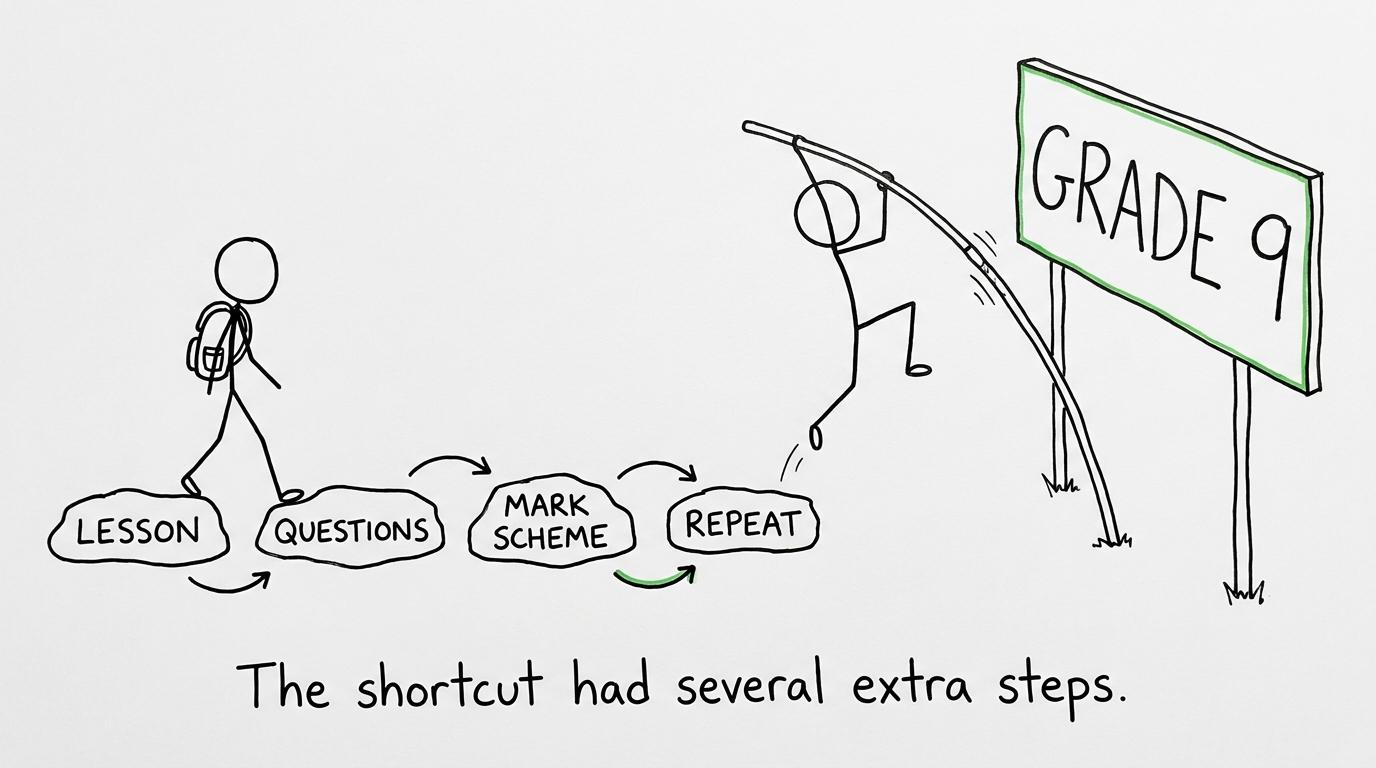 A steady revision process beats trying to jump straight to the top grade
The number matters less than your next decision
Around 130,000130{,}000130,000 students enter GCSE French in a recent year, making it one of the UK's most popular GCSE language choices. Yet that total does not set an individual candidate's grade, determine the difficulty of the paper or prove that the subject is becoming easier.
The deeper lesson is mathematical. Ask what has been counted. Check the population. Compare like with like. Separate a raw total from a proportion, and resist building a large conclusion from one year's movement.
Then apply the same calm method to your own GCSE Maths revision. Start with a MathsGenie GCSE revision lesson, answer the practice questions, complete mini tests where available and check every response against the mark scheme. Follow that with past-paper practice and predicted papers under timed conditions.
National statistics describe a cohort. Your next carefully corrected question changes something more useful: your preparation.