

How Many Students Take GCSE Economics Each Year?
How many students take GCSE Economics? See recent UK entry levels, popularity trends, grading facts and the maths skills that support effective revision.
A subject can feel popular inside one school and almost invisible in the school next door. That is especially true of GCSE Economics, which is offered widely enough to have a substantial national cohort but is not available to every student.
So, how many students take GCSE Economics? Recent UK summer exam data indicate that the total is broadly around 100,000100,000100,000 to 120,000120,000120,000 entries per year. The precise number changes annually and depends on the geographical coverage and qualifications included in the published data, but the central answer is clear: Economics is an established GCSE option, although it remains much smaller than compulsory subjects such as maths and English.
That matters because popularity is often confused with difficulty. The number of candidates can tell us how widely a subject is offered. It does not determine whether its examinations are easy, nor does it directly control your grade.
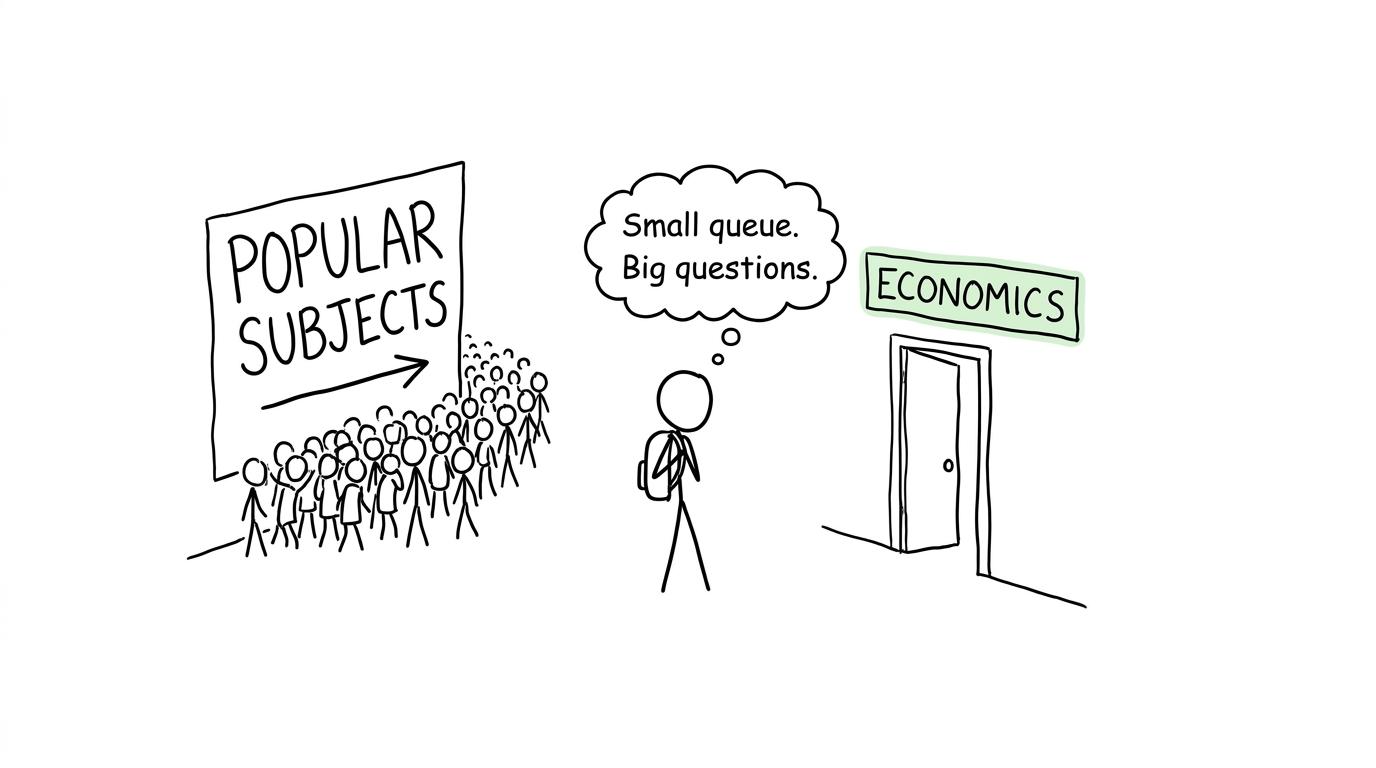 A student discovering the mysterious GCSE Economics option
GCSE Economics entry numbers at a glance
Here is the useful picture to keep in mind:
- Recent summer series have involved roughly 100,000100,000100,000 to 120,000120,000120,000 GCSE Economics entries across the UK.
- Published totals normally count examination entries, not a permanently tracked group of individual students.
- Numbers rise or fall as schools change their option blocks, staffing and subject provision.
- AQA and OCR are the principal exam boards currently offering GCSE Economics in England.
- GCSE Economics is graded from 999 to 111 and is not divided into foundation and higher tiers.
- Candidate numbers do not create a fixed quota for each grade.
Official annual figures are normally published after results through organisations such as the Joint Council for Qualifications and, for England, Ofqual. When comparing figures, always check the year, region and definition being used. An England-only entry total should not be presented as though it automatically covers the whole UK.
How popular is GCSE Economics?
A cohort of around one hundred thousand is significant. It means GCSE Economics is not a niche qualification taken by only a few schools. Yet its national entry remains far below the totals for subjects that nearly everyone takes.
This difference is largely about access. GCSE maths is compulsory for most pupils at the end of Key Stage 4. Economics is optional and may have to compete with Business, Geography, History, Computer Science, a language or a creative subject within a restricted timetable.
Some schools do not offer it at all. Others introduce economic ideas through Business rather than a separate Economics course. Candidate numbers therefore reflect school provision as much as student enthusiasm.
This is an important statistical lesson. A raw frequency answers one question:
How many entries were recorded?\text{How many entries were recorded?}How many entries were recorded?A proportion answers a different one:
Entry proportion=Economics entriesall relevant GCSE entries×100\text{Entry proportion}=\frac{\text{Economics entries}}{\text{all relevant GCSE entries}}\times 100Entry proportion=all relevant GCSE entriesEconomics entries×100The first measures the size of the cohort. The second places that cohort in context. This distinction appears throughout GCSE maths, particularly in percentages, probability and statistics. Students can strengthen those foundations through the free GCSE maths revision programme on MathsGenie.
Why the number changes from year to year
Subject popularity rarely moves for one simple reason. It behaves more like a market itself: several small forces act at once.
School availability
A student cannot select a subject that the school does not teach. Provision may depend on teacher expertise, class sizes, timetable space and whether enough students choose the course for a class to run.
This makes Economics different from compulsory GCSE maths. Changes in the number of schools offering Economics can alter national entries even when student interest has not changed.
Interest in current economic questions
Inflation, taxation, wages, unemployment, interest rates and international trade affect everyday life. Greater public attention to these ideas may encourage more students to consider Economics, although annual changes should not be attributed to one news event without firm evidence.
The size of the GCSE population
A growing or shrinking age cohort can change the raw number of entries across many subjects. To judge whether Economics has genuinely become more popular, it is better to examine both the entry total and its share of the relevant cohort.
The percentage change between consecutive years can be expressed as:
Percentage change=new entries−previous entriesprevious entries×100\text{Percentage change}=\frac{\text{new entries}-\text{previous entries}}{\text{previous entries}}\times 100Percentage change=previous entriesnew entries−previous entries×100That calculation is simple, but its interpretation matters. A higher total does not necessarily mean that Economics gained a larger share of students if the whole GCSE population also grew.
What popularity says about GCSE Economics grading
The short answer is: less than many students imagine.
GCSE Economics uses the grades 999 to 111, with grade 999 being the highest. It is an untiered qualification, so there is no separate foundation or higher paper. Candidates following the same exam board specification sit the same assessment route.
AQA GCSE Economics is assessed through two written papers, each contributing half of the qualification. OCR also divides its GCSE Economics assessment across two written papers. Students should always use the specification and materials for their own board because paper structures, wording and mark schemes are not interchangeable.
There is no simple fixed quota
It is tempting to picture grading as a competition in which only a predetermined number of candidates can receive each grade. That is not an accurate description.
Exam boards set grade boundaries after papers have been taken and marked. They use statistical evidence alongside expert judgement to maintain standards when one paper is slightly more or less demanding than another. Boundaries can therefore move between years.
The aim is not to make a popular subject automatically harder. Nor does a smaller cohort make high grades easier to obtain. Your marks are judged against the standard represented by the grade boundaries for your qualification and examination series.
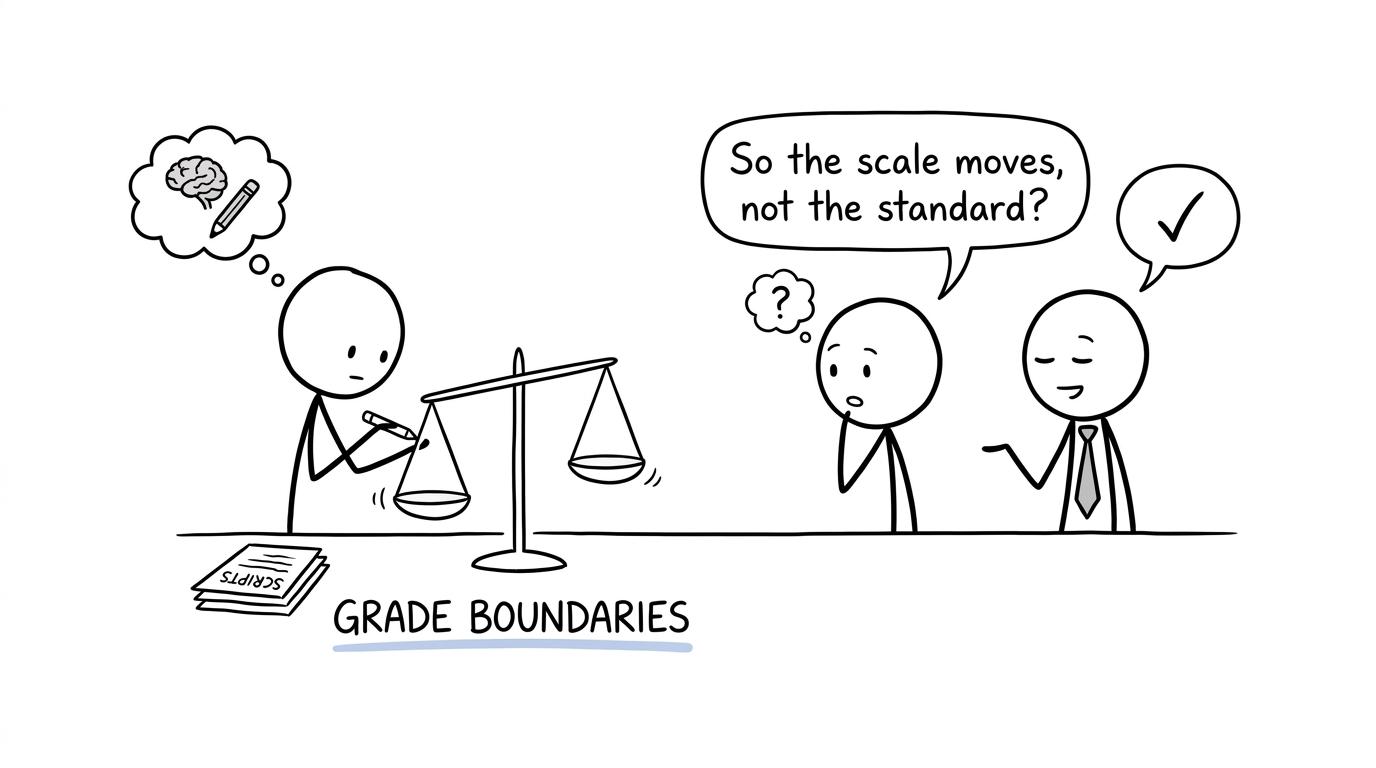 An examiner balancing grade boundaries rather than changing the standard
Entry patterns can affect headline grade distributions
Popularity may still influence the statistics people see after results day. Optional subjects attract different groups of students and are offered in different types of school. If the make-up of the cohort changes, the proportion receiving particular grades can also change.
That does not prove that the paper became easier or harder. A grade distribution describes outcomes for that year’s cohort. It does not, by itself, explain why those outcomes occurred.
This is the same caution needed when interpreting graphs in GCSE maths: association is not automatically causation. MathsGenie’s revision materials help students develop this kind of disciplined reasoning alongside the calculations themselves.
The maths behind GCSE Economics
Economics is not GCSE maths in disguise, but confident numerical reasoning is useful. Students may need to interpret data, percentages, index numbers, costs, revenue or changes over time.
Useful ideas include:
- fractions, decimals and percentages;
- percentage increase and decrease;
- ratios and proportions;
- averages and ranges;
- reading tables, line graphs and bar charts;
- distinguishing correlation from causation;
- substituting values into simple relationships.
For example, total revenue is represented by:
Total revenue=price×quantity sold\text{Total revenue}=\text{price}\times\text{quantity sold}Total revenue=price×quantity soldPercentage change is relevant to inflation, employment figures, output and prices. Mean values can summarise data, while the range reveals something about variation. Graphs make trends visible, but they still require careful reading of scales, dates and units.
These are transferable skills. If data interpretation is slowing you down, return to the topic lessons and practice questions in MathsGenie GCSE revision, then test whether the skill holds under exam conditions using GCSE past papers.
How maths students should interpret the headline figure
The figure of roughly 100,000100,000100,000 to 120,000120,000120,000 annual entries is best treated as a rounded description of scale, not an eternal constant.
Before repeating any subject-entry statistic, ask:
- Is this the latest completed summer examination series?
- Does it cover England or the whole UK?
- Is it counting entries, candidates or certificates?
- Does it include only full-course GCSE qualifications?
- Is the comparison based on totals or percentages?
That checklist is useful beyond Economics. Statistics become trustworthy when their definitions are clear. A precise-looking number with an unclear denominator can be less informative than an honestly rounded range.
If Economics leads you towards A Level, the mathematical demands become more visible through data analysis, diagrams and quantitative relationships. MathsGenie provides free A Level maths revision and A Level past papers for students developing those skills further.
How to revise the transferable maths effectively
Knowing a method during a lesson is not the same as retrieving it under time pressure. Strong revision moves through three stages:
- Review the idea through a concise revision lesson.
- Practise focused questions without immediately checking the solution.
- Use timed papers and mark schemes to diagnose gaps.
MathsGenie brings these stages together through free lessons, video solutions, practice questions and examination materials. Predicted GCSE maths papers can support final preparation, while official past papers remain essential for understanding authentic exam-board style.
Do not measure revision only by the number of hours spent. Measure what you can now do independently. A completed paper is useful; a completed paper that you mark, analyse and revisit is much more useful.
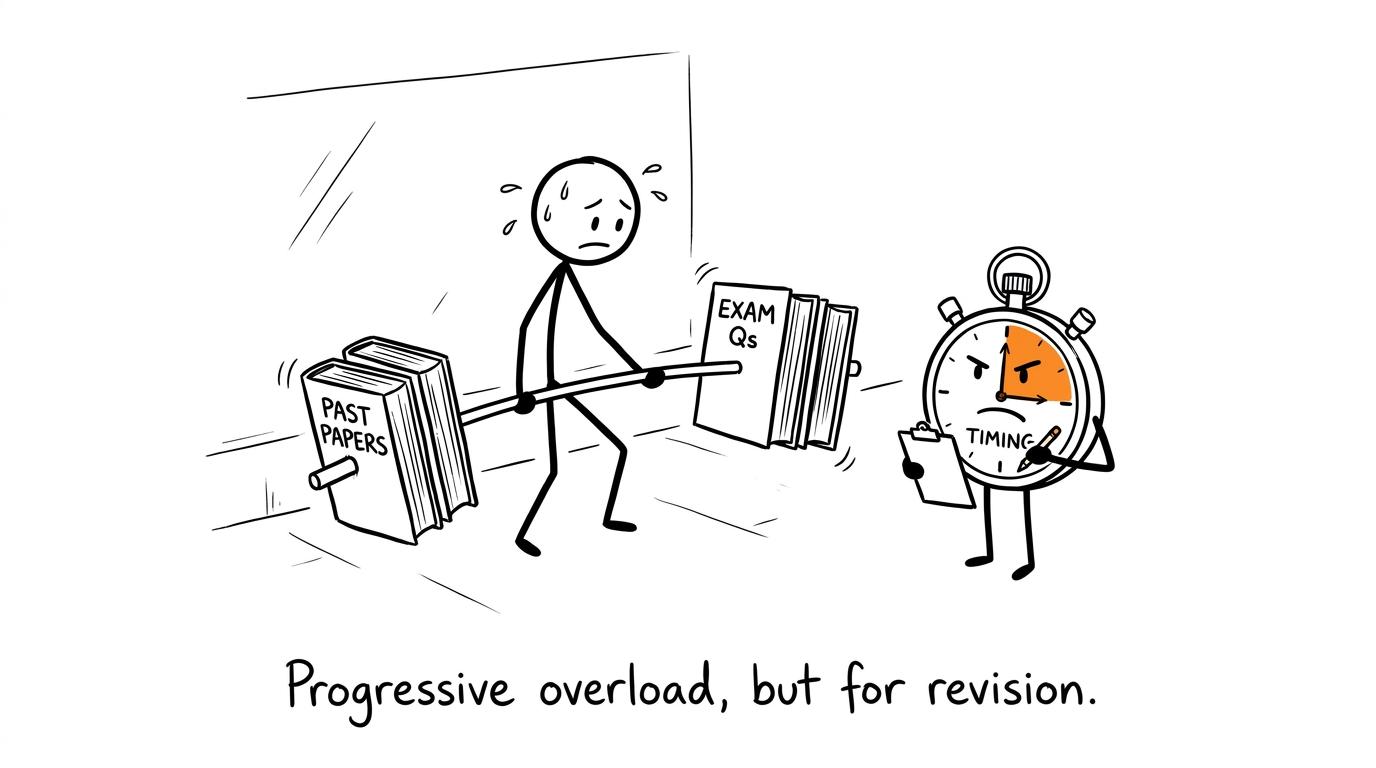 A student using past papers as progressive revision training
Common mistakes when discussing Economics entries
Treating entries as a perfect headcount
Administrative statistics commonly report examination entries. One entry broadly corresponds to one candidate taking that qualification in that series, but “entries” remains the more accurate statistical term.
Mixing regions or examination years
An England-only figure and a UK-wide figure are not directly equivalent. Neither are provisional entries and final results-day totals. Check the label before making a comparison.
Assuming popularity determines difficulty
More candidates do not automatically produce harsher grading. Boundaries reflect the demand of the assessment and the maintenance of standards, not a simple popularity penalty.
Comparing raw totals without context
A rise in entries may partly reflect a larger GCSE-age population. Compare proportions as well as frequencies wherever the necessary denominator is available.
Believing grade boundaries never change
Grade boundaries can vary because papers vary in difficulty. Do not base a revision target on one historic boundary. Aim to collect every mark you reasonably can.
What the number really tells us
Around 100,000100,000100,000 to 120,000120,000120,000 GCSE Economics entries in a typical recent year make the subject a meaningful part of the GCSE landscape. It is popular enough to support a large national cohort, yet optional enough for availability and school choice to shape the total.
The figure does not mean that grades are rationed more aggressively. It does not prove that Economics is becoming easier or harder. What it reveals is the difference between participation and performance, two ideas that are often mixed together when examination statistics appear in the news.
For a maths student, that is the most valuable conclusion. Read the denominator. Check the definition. Separate correlation from cause. Then prepare for the marks that are within your control.
Start with MathsGenie’s free GCSE revision resources, practise the topics that need attention, and move on to exam papers and mark schemes. Revision lessons build understanding; practice questions, video solutions, predicted papers and past papers turn that understanding into reliable exam performance.











