

How Many Students Take GCSE Bengali Each Year?
How many students take GCSE Bengali each year? Explore the latest entry figures, recent trends and what a small cohort means for GCSE grading.
A subject can be nationally recognised, carefully assessed and genuinely valuable while being taken by fewer students than attend some large secondary schools. That is the surprising story behind the question: how many students take GCSE Bengali each year?
The latest published AQA results statistics show that 392 candidates took GCSE Bengali in June 2025. That was down from 437 in 2024 and 473 in 2023. It is therefore a small-entry GCSE, but its size does not make it less legitimate or mean that grades are awarded casually. It means the evidence must be interpreted with care.
For maths students, this is also a useful lesson in statistics. A total can tell you how popular a subject is. It cannot, by itself, tell you how difficult the examination was or why its grade distribution looks unusual.
GCSE Bengali numbers at a glance
Here is the clearest recent picture from AQA's published GCSE results statistics:
| Summer examination series | Candidates taking GCSE Bengali | Change from previous year |
|---|---|---|
| 2023 | 473473473 | Not applicable |
| 2024 | 437437437 | −7.6%-7.6\%−7.6% |
| 2025 | 392392392 | −10.3%-10.3\%−10.3% |
Across these two years, the number fell by 818181 candidates. Relative to the 2023 figure, that is a decrease of approximately:
473−392473×100≈17.1%\frac{473-392}{473}\times 100 \approx 17.1\%473473−392×100≈17.1%The essential checklist is:
- The latest confirmed figure is 392392392 candidates in June 2025.
- Recent annual numbers have been in the low hundreds, not thousands.
- AQA currently offers the UK GCSE Bengali specification discussed here.
- The qualification has Foundation and Higher tiers.
- Listening, speaking, reading and writing each contribute approximately 25%25\%25%.
- A small cohort does not mean an automatic advantage or a fixed quota of high grades.
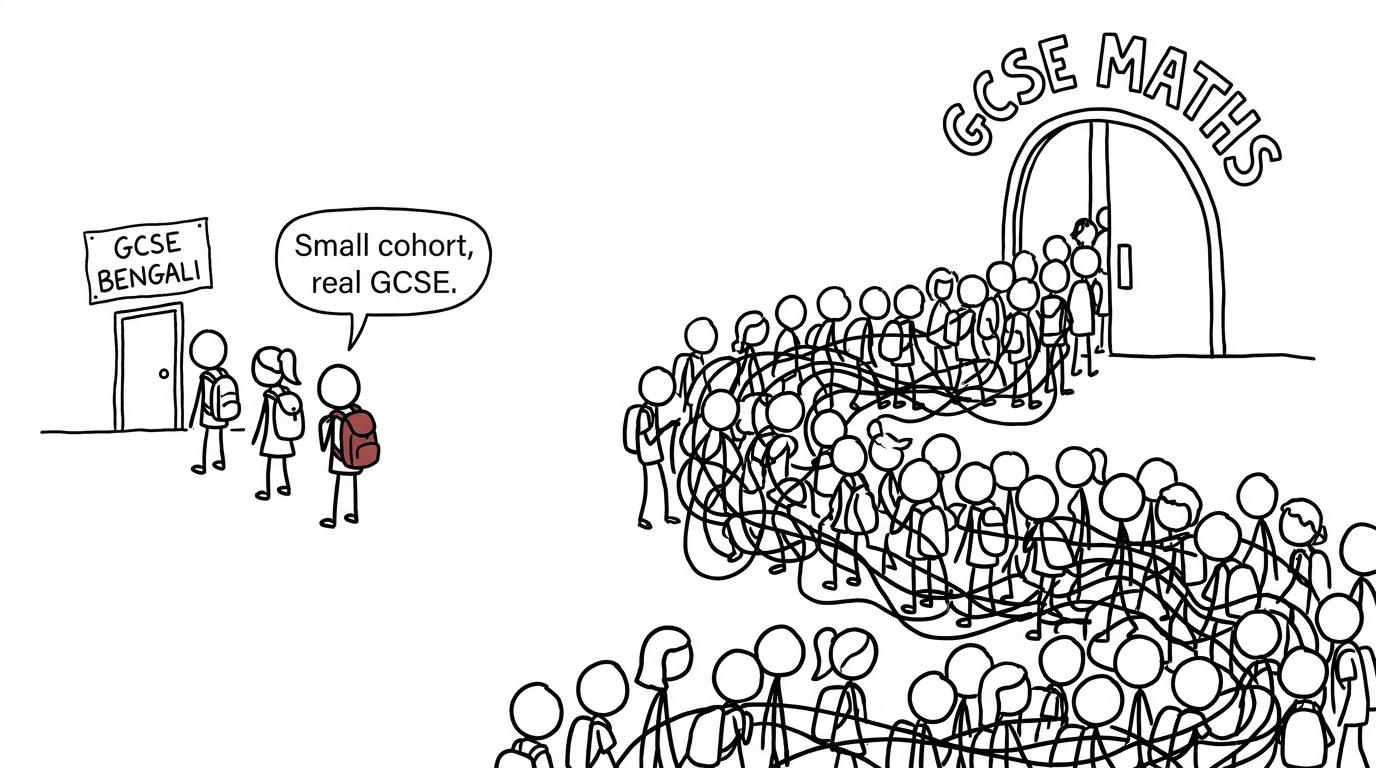 A tiny GCSE Bengali queue beside a much larger GCSE Maths queue
How popular is GCSE Bengali really?
GCSE Bengali is best described as a small but established language qualification. The June 2025 AQA cohort of 392392392 is tiny beside nationally compulsory or near-universal subjects. JCQ recorded 893,198893{,}198893,198 UK mathematics entries in summer 2025, although that wider UK total is not directly comparable with one exam board's Bengali candidate figure.
That comparison is still useful for scale. Maths is studied across almost every secondary school, while Bengali depends on much more specific circumstances: local demand, access to teaching, a school's willingness to make an entry and whether it can arrange the speaking assessment.
Some candidates may use Bengali at home or in their community, but that should not be turned into a simplistic claim that the GCSE is easy for them. Everyday communication is not identical to examination performance. Candidates must understand spoken and written Bengali, respond accurately, translate where required and produce language that meets the assessment criteria.
Availability matters too. A student may have the knowledge and motivation to take Bengali but still need their school or another approved centre to organise the entry and assessments. Entry figures therefore measure participation within the examination system, not the total number of young people in Britain who speak, read or understand Bengali.
What the recent trend does and does not show
The series 473473473, 437437437, 392392392 shows three consecutive annual totals and a decline over that period. It does not establish a permanent long-term trend.
This distinction matters. In GCSE statistics, a movement involving 454545 candidates can look substantial when the whole cohort contains only a few hundred students. The fall from 2024 to 2025 was:
437−392=45437-392=45437−392=45As a percentage of the 2024 cohort, that becomes:
45437×100≈10.3%\frac{45}{437}\times 100\approx 10.3\%43745×100≈10.3%A difference of 454545 students would barely move the national percentage for GCSE Maths. In Bengali, it changes the headline noticeably. This is a practical example of why percentage change should always be read alongside the original frequency.
Students can strengthen this kind of interpretation through the GCSE Maths revision hub, which brings together lessons, questions and board-specific resources, or explore broader data skills through Edexcel GCSE Statistics revision.
What a small cohort means for GCSE Bengali grading
The most important point is simple: GCSE Bengali is not graded by casually ranking 392392392 students and handing a predetermined number each grade.
Exam boards set grade boundaries after the examinations have been taken. They consider evidence about the demand of the papers, candidate performance and the maintenance of standards. Statistical evidence can support awarding, but Ofqual guidance recognises that it becomes less stable for very small entries. Where matched entries are especially small, senior examiners' professional judgement carries greater importance.
That is not weaker grading. It is the appropriate response to limited data.
Imagine flipping a coin only a few times. An unusual-looking result is quite possible, even when the coin is fair. As the number of trials grows, the proportion generally becomes more stable. Examination cohorts are much more complicated than coins, but the statistical warning transfers: smaller samples naturally produce more year-to-year variation.
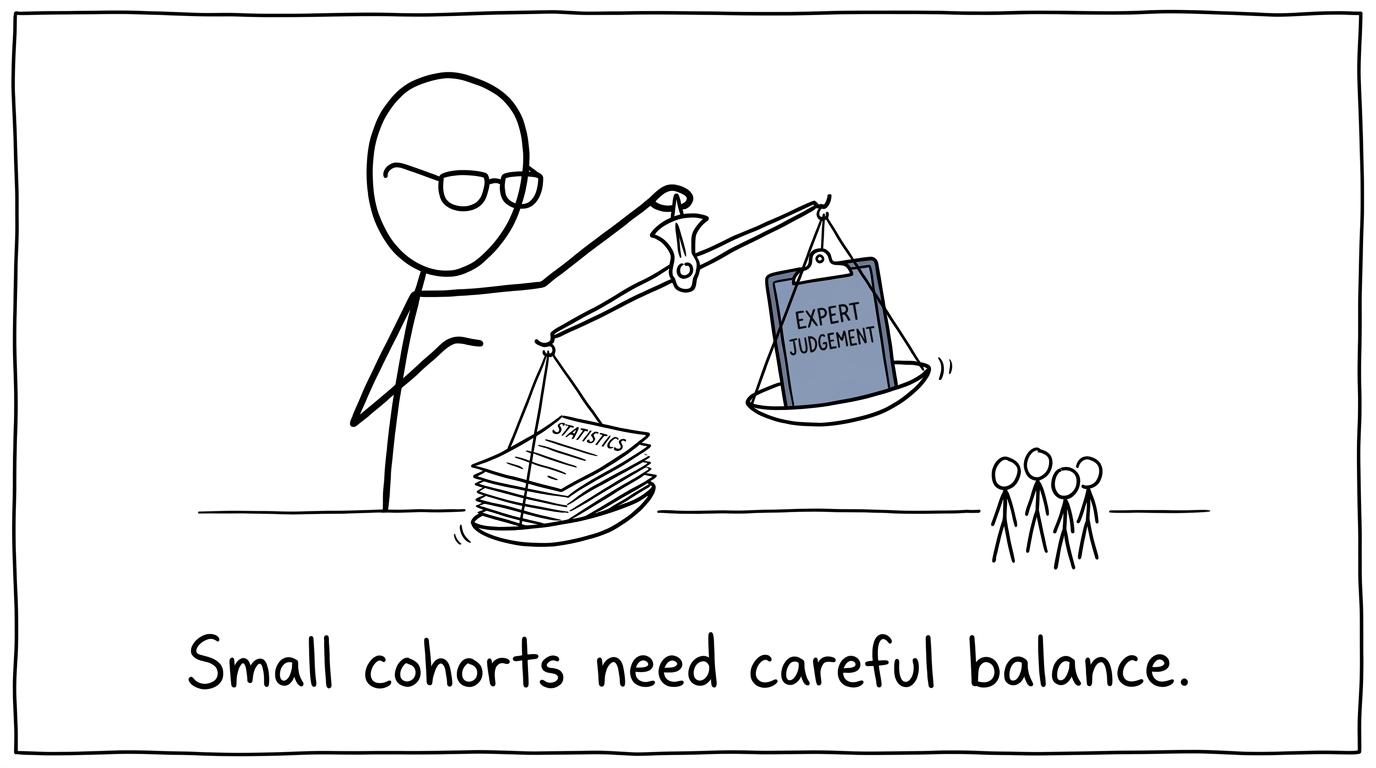 An examiner balancing statistics with expert judgement
Why the grade profile looks high
AQA's June 2025 results statistics reported that:
- 17.1%17.1\%17.1% of GCSE Bengali candidates achieved grade 999;
- 51.3%51.3\%51.3% achieved grade 777 or above;
- 87.5%87.5\%87.5% achieved grade 444 or above.
Those figures are cumulative. The 51.3%51.3\%51.3% at grade 777 or above already includes candidates awarded grades 888 and 999.
It would be tempting to conclude that Bengali must therefore be easier than a subject with a lower proportion of top grades. That conclusion is not justified. Subject cohorts are self-selecting. GCSE Bengali candidates may differ in prior language experience, confidence and reasons for entering from candidates taking another language. Outcomes reflect both the assessment and the characteristics of the students who chose and were able to take it.
This is the same statistical caution needed when comparing schools or exam boards. Correlation, selection and context matter. A percentage is evidence, but it is not the whole explanation.
How GCSE Bengali is assessed
Under the current AQA specification, GCSE Bengali contains four equally weighted language skills:
| Assessment area | Approximate weighting |
|---|---|
| Listening | 25%25\%25% |
| Speaking | 25%25\%25% |
| Reading | 25%25\%25% |
| Writing | 25%25\%25% |
The four components produce a total scaled mark of 240240240. Listening has a raw maximum of 404040 and is scaled to 606060; speaking and reading each have a maximum of 606060; writing has a raw maximum of 505050 and is scaled to 606060.
Students take every paper at the same tier. Foundation targets grades 111 to 555. Higher targets grades 444 to 999, with an allowed grade 333 available in the circumstances defined by the specification.
This structure helps explain why home familiarity alone is not enough. A candidate strong in conversation must still prepare for formal reading and writing. Equally, someone who reads confidently must practise responding under listening and speaking conditions.
What this teaches maths students about data
The Bengali figures are a compact statistics lesson hiding inside an education question.
Check what has actually been counted
AQA's results statistics refer to candidates who sat the subject in that examination series. Provisional entries published before examinations can differ from final results statistics. They are related measures, but they are not interchangeable.
Compare like with like
One exam board's subject total should not be presented as though it were automatically a complete UK total across every qualification type. GCSE, International GCSE and other language qualifications must also be kept distinct.
Use frequencies with percentages
Saying entries fell by about 10.3%10.3\%10.3% sounds dramatic. Saying the cohort fell from 437437437 to 392392392 gives the reader the scale needed to judge that change.
Avoid causal claims without evidence
The data show that the recorded number declined. They do not prove why. Possible influences such as centre access, teaching availability or student demand are sensible context, but the published totals alone cannot isolate a cause.
This habit of interrogating evidence is useful in GCSE Maths probability and statistics questions. Use MathsGenie's guide to finding your weakest GCSE topics to identify whether percentages, sampling or data interpretation need more attention.
Common mistakes when interpreting GCSE Bengali figures
Calling every figure a student total
Entry data, component entries and candidates receiving results can measure different things. Check the title and notes attached to the dataset before quoting it.
Assuming a high pass rate means an easy examination
Grade distributions cannot be compared fairly without considering who entered each subject. A small, specialised cohort may be unusually experienced or motivated.
Treating one percentage as precise forever
With only a few hundred candidates, small changes in headcount can cause visible changes in percentages. Results from one year should not be treated as a permanent rule.
Confusing GCSE Bengali with International GCSE Bengali
They are different qualifications and may have different boards, assessment structures and entry populations. The 392392392 figure refers to AQA GCSE Bengali in June 2025.
Thinking small-entry subjects are unregulated
GCSE Bengali remains a regulated GCSE with a specification, assessment objectives, mark schemes, tier rules and formal awarding procedures. Small does not mean informal.
 A student using a planner to manage several GCSE subjects
Turning curiosity into better GCSE revision
There is a broader revision lesson here. Numbers become useful when they change your next action.
If interpreting the Bengali data exposed uncertainty around percentage change, cumulative percentages or sample size, revise that weakness rather than simply rereading the figures. Start with the full GCSE Maths topic list by board and tier, then complete targeted practice.
When you are ready to test your understanding, use AQA GCSE Maths past papers or the OCR GCSE Maths revision hub, depending on your board. Edexcel students can add fresh exam-style practice through Edexcel GCSE Maths predicted papers.
The productive rhythm is always similar: attempt, mark, diagnose, repair and retest. MathsGenie keeps that process in one free place with revision lessons, practice questions, mini tests, past papers, predicted papers, mark schemes and video solutions.
The clearest answer
So, how many students take GCSE Bengali each year? The latest published result is 392392392 candidates in June 2025, following 437437437 in 2024 and 473473473 in 2023. It is a genuinely small GCSE cohort, and recent participation has declined.
What matters just as much is what that figure does not say. It does not make the qualification less valid, prove that the examination is easy or explain the grade distribution by itself. Small-cohort grading needs careful statistical evidence and expert judgement precisely because every candidate has a noticeable effect on the percentages.
Take the same care into your maths revision. Open the MathsGenie GCSE Maths revision hub, choose your exam board and tier, and turn the next lost mark into a specific lesson, practice set or paper. Curiosity begins with a number. Progress begins with what you do next.











