How Many IGCSE Accounting Papers Are There?
How Many IGCSE Accounting Papers Are There? Compare Cambridge and Edexcel formats, timings, marks and weightings, then build a clear revision plan.
Opening a folder of past papers can make IGCSE Accounting look larger than it is. There may be different years, seasons, component codes and regional versions, all sitting beside one another. The pile grows; the qualification itself has not.
So, how many IGCSE Accounting papers are there? For the main Cambridge IGCSE Accounting and Pearson Edexcel International GCSE Accounting qualifications, students normally take two compulsory examination papers. However, the format, timing, marks and content split depend on your exam board and examination year.
That final detail matters. Cambridge is changing the length and number of questions in Paper 1 from the 202720272027 examination series, while retaining the same two-paper structure. Before planning your revision, check the specification code and examination year shown on your school documents.
The short answer and your checklist
Use this checklist before downloading papers or setting a revision timetable:
- Identify whether you study Cambridge IGCSE Accounting (0452) or Pearson Edexcel International GCSE Accounting (4AC1).
- Confirm the examination year because specifications can change.
- Expect to sit two papers for either of these qualifications.
- Check whether your centre uses a regional paper variant.
- Learn the weighting of each paper, not just its duration.
- Practise the correct question styles for your board.
- Use official papers, mark schemes and examiner guidance supplied by your school or exam board.
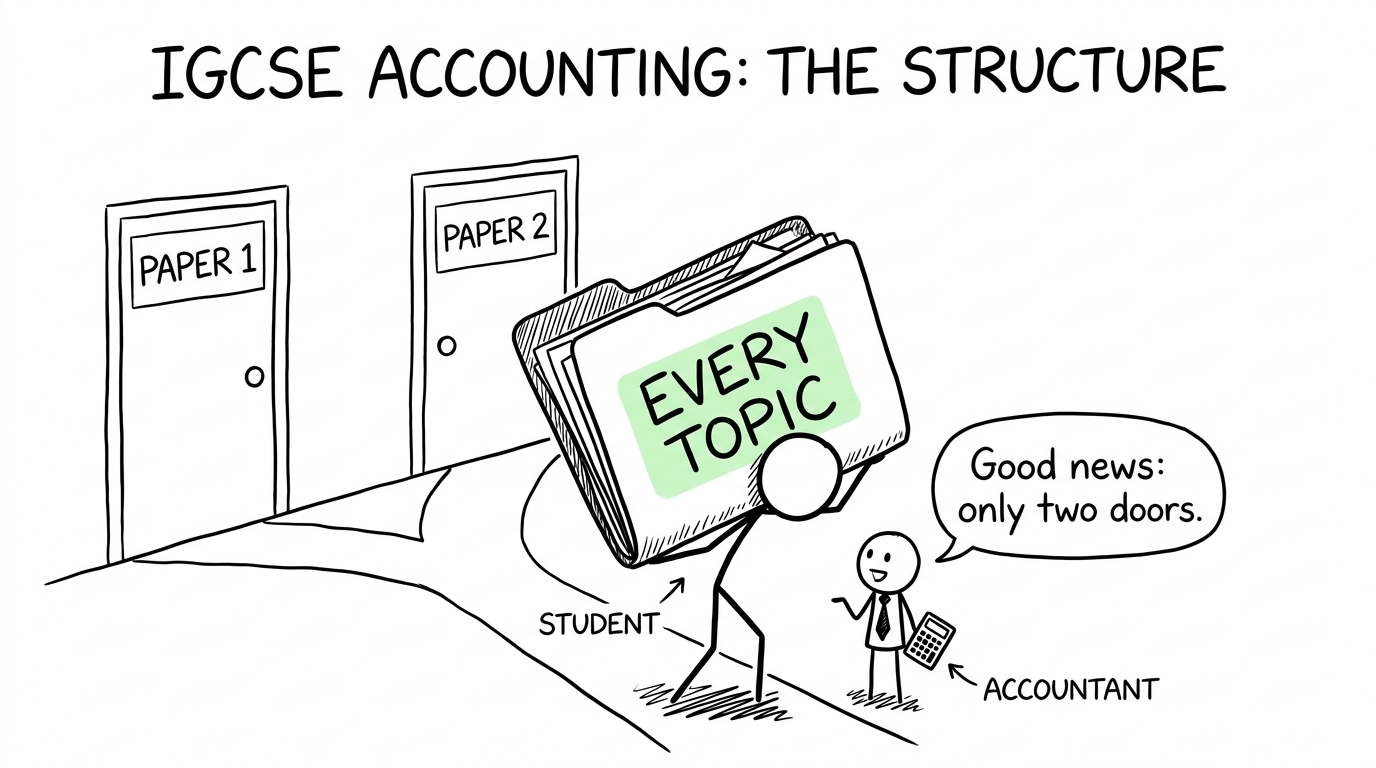 A student discovers that IGCSE Accounting has only two exam doors
Cambridge IGCSE Accounting has two papers
For Cambridge IGCSE Accounting (0452), every candidate takes Paper 1 and Paper 2. Both are externally assessed, both are compulsory and both can draw on content from across the syllabus.
Cambridge Paper 1: Multiple Choice
For examinations in 202620262026, Paper 1 has:
- 353535 multiple-choice questions
- 353535 marks
- a duration of 111 hour 151515 minutes
- a weighting of 30%30\%30% of the qualification
Questions may involve calculations, and calculators may be used. Although multiple-choice answers look brief, the thinking behind them may not be. A single misplaced entry, reversed double entry or misunderstood accounting principle can lead towards a carefully designed distractor.
For examinations from 202720272027 to 202920292029, Cambridge has increased Paper 1 to:
- 404040 multiple-choice questions
- 404040 marks
- a duration of 111 hour 303030 minutes
- the same weighting of 30%30\%30%
The number of Cambridge papers therefore remains two. Only the size and duration of Paper 1 change. This is why an older revision video or past paper may give correct information for its year but incorrect information for yours.
Cambridge Paper 2: Structured Written Paper
Cambridge Paper 2 has:
- 555 compulsory structured questions
- 202020 marks per question
- 100100100 marks in total
- a duration of 111 hour 454545 minutes
- a weighting of 70%70\%70% of the qualification
The total follows from:
5×20=1005 \times 20 = 1005×20=100Paper 2 assesses more than recall. It can require students to prepare accounting records and statements, analyse information, interpret results and justify conclusions. Its 70%70\%70% weighting means it deserves a substantial share of revision time, but neglecting Paper 1 would still surrender almost one-third of the qualification.
A sensible starting allocation is to match revision time approximately to the assessment weighting:
Paper 1 revision:Paper 2 revision=30:70=3:7\text{Paper 1 revision} : \text{Paper 2 revision} = 30 : 70 = 3 : 7Paper 1 revision:Paper 2 revision=30:70=3:7Treat that as a starting point rather than an unbreakable rule. If your Paper 1 scores are much weaker, your practice should respond to the evidence.
Pearson Edexcel International GCSE Accounting has two papers
Pearson Edexcel International GCSE Accounting (4AC1) also contains two externally assessed written papers, but it divides content differently from Cambridge.
Edexcel Paper 1: Introduction to Bookkeeping and Accounting
Paper 1 covers the accounting environment, bookkeeping and control processes. Under the current linear specification, it has:
- a duration of 222 hours
- 100100100 marks
- a weighting of approximately 66.7%66.7\%66.7%
- multiple-choice, short-answer and longer multi-part questions
The paper contains two sections. Its structure means you must move between concise factual responses, calculations and more developed accounting work without losing accuracy.
Edexcel Paper 2: Financial Statements
Paper 2 focuses on preparing financial statements and accounting for end-of-period adjustments. It has:
- a duration of 111 hour 151515 minutes
- 505050 marks
- a weighting of approximately 33.3%33.3\%33.3%
- two multi-part questions
Across the qualification, the papers contain:
100+50=150 raw marks100 + 50 = 150 \text{ raw marks}100+50=150 raw marksRaw marks are not combined by simply assuming every paper contributes equally. Paper 1 carries roughly two-thirds of the qualification, while Paper 2 carries roughly one-third.
Pearson also offers modular entry arrangements in eligible international centres. If your centre uses that route, you may see references to Unit 1, Unit 2 and a cash-in code. That administrative language does not mean a student must sit every document appearing in an online search. Your centre should confirm the exact entry route.
Why online searches can make the answer look complicated
A search for accounting papers may display codes such as /11, /12, /13 or regional papers marked R. It may also show a question paper, insert, mark scheme and examiner report for one examination.
These are not necessarily separate exams for one candidate.
Cambridge component variants are versions used in different administrative zones. Pearson regional versions serve particular locations. A mark scheme accompanies a paper but is not another paper that students sit. Specimen materials demonstrate a format; they are not extra compulsory assessments.
The reliable question is not, “How many files can I find?” It is, “Which components has my centre entered me for?” Your statement of entry, teacher and current specification should all point to the same answer.
What the two-paper structure means for revision
Knowing the number of papers removes uncertainty, but it does not finish the planning. The useful next step is to prepare for the distinct demands of each paper.
Build knowledge before adding time pressure
Start with a specification checklist covering bookkeeping, accounting records, verification procedures, financial statements, adjustments, analysis and accounting principles as applicable to your board. Mark each area as secure, developing or weak.
Accounting calculations also depend on dependable numerical skills. MathsGenie’s free CIE IGCSE Maths revision guides can help strengthen percentages, ratios, estimation and calculator fluency. These resources support the maths used within accounting; they do not replace your Accounting specification or subject teaching.
The CIE IGCSE Maths question bank is useful when a calculation error reveals a specific numerical weakness. Target the skill rather than repeating whole accounting papers and hoping the error disappears.
Practise each paper in its real style
Multiple-choice practice should train you to reach an answer independently before comparing the options. Structured questions require clear layouts, appropriate terminology, visible workings and conclusions linked to the information provided.
A calculator is a tool, not a substitute for deciding what the figures mean. If percentages are causing lost marks, use the MathsGenie percentages revision lesson to repair the underlying skill.
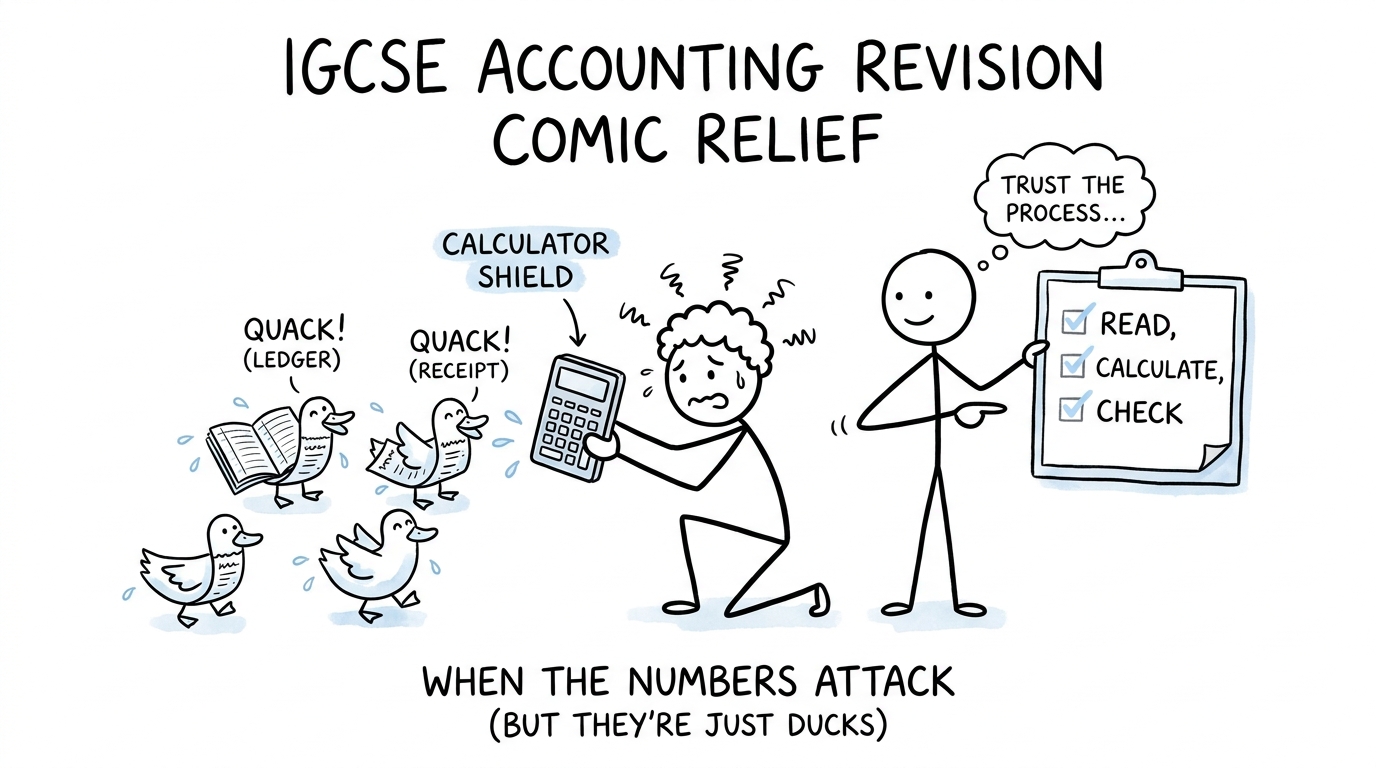 A calculator becomes a shield against a harmless flock of receipts
Turn every marked paper into a revision plan
After completing an Accounting paper, do more than total the marks. Record each loss under one of four causes:
- missing accounting knowledge
- incorrect method or format
- arithmetic or calculator error
- misreading or weak interpretation
Then choose the appropriate repair. Revisit the accounting rule for a knowledge gap; reconstruct the layout for a format error; use targeted maths practice for a numerical weakness; and rewrite an interpretation when the conclusion was vague.
MathsGenie models this attempt-mark-repair cycle through its CIE IGCSE Maths past papers, where students can work under timed conditions and check mark schemes. Its broader CIE IGCSE Maths revision hub also brings together revision guides, questions, worksheets and paper practice.
A practical revision routine for both papers
A calm weekly routine might include:
- one session reviewing Accounting content and formats
- one session of topic-specific questions
- one timed section from Paper 1
- one timed section from Paper 2
- one marking and correction session
- a later reattempt of questions previously answered incorrectly
Full papers are valuable, but they work best after targeted repair. Repeatedly sitting papers without correcting the causes of lost marks merely rehearses the same mistakes.
Maths students can apply the same principle using GCSE Maths revision resources, including board-specific lessons, practice questions, mark schemes and past papers. Near the examination period, GCSE predicted papers can provide fresh maths practice. They are not predictions for IGCSE Accounting, so keep subject resources clearly separated.
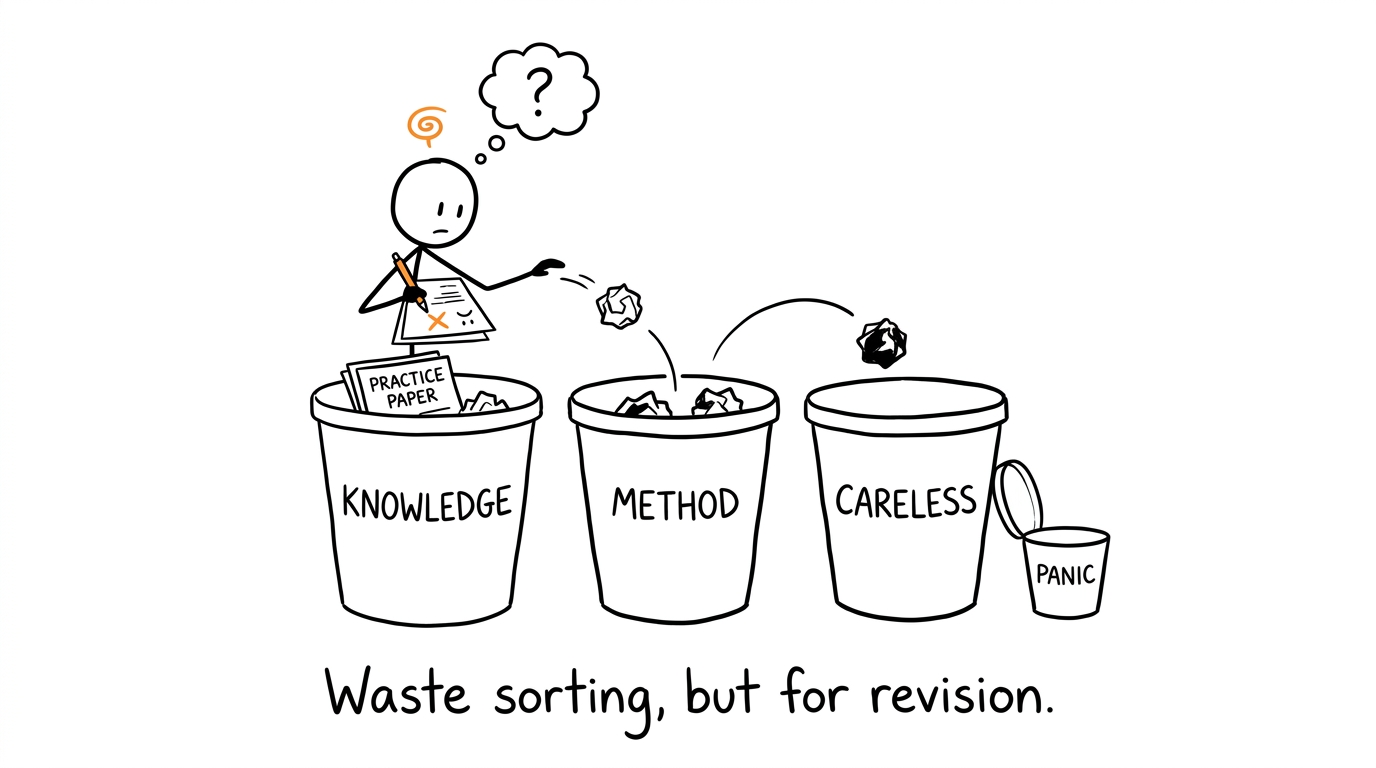 Accounting mistakes are sorted into useful revision categories
Common mistakes when preparing for IGCSE Accounting papers
Assuming every board uses the Cambridge format
Cambridge Paper 1 is multiple choice, whereas Edexcel Paper 1 mixes several question types. Revise from resources carrying your exact specification code.
Using the wrong examination year's timings
Cambridge Paper 1 changes from 353535 marks in 757575 minutes in 202620262026 to 404040 marks in 909090 minutes from 202720272027. Always read the front cover before beginning timed practice.
Treating the two papers as equally weighted
The papers do not contribute equally. Cambridge Paper 2 carries 70%70\%70%, while Edexcel Paper 1 carries approximately 66.7%66.7\%66.7%. Your timetable should reflect both weighting and personal weakness.
Counting variants and mark schemes as extra papers
Regional variants, component versions, specimen papers and mark schemes can make a website folder look crowded. They do not automatically increase the number of examinations one student takes.
Revising calculations without interpretation
Correct arithmetic matters, but structured questions may also reward analysis, evaluation and recommendations. Explain what a result indicates in the context given and follow the wording of the question.
Completing papers without revisiting errors
A score tells you where you are. A corrected and later reattempted question helps move you forward. Keep an error log and let it decide the next session.
Two papers, one clearer plan
For both Cambridge IGCSE Accounting and Pearson Edexcel International GCSE Accounting, the central answer is reassuringly simple: there are two compulsory papers. The important differences lie in their content, format, timing, marks and weighting.
Check your board and examination year first. Then divide revision between knowledge, accurate accounting formats, calculations, interpretation and timed paper practice. Use official Accounting materials from your school or exam board, and strengthen the numerical side with MathsGenie.
Start at the free MathsGenie CIE IGCSE Maths hub for revision lessons, practice questions, worksheets, mark schemes and paper practice. Where appropriate, MathsGenie’s mini tests, past papers, predicted maths papers and video solutions can help you build the accuracy and calm exam habits that Accounting calculations also demand.