

How Many Hours Should You Revise for GCSE Maths?
How many hours should you revise for GCSE Maths? Start with a realistic weekly plan, improve your practice and build a schedule you can actually follow.

Imagine a student closing their maths book after an evening at the kitchen table. Their parent asks how revision went. “I did two hours,” they reply, although much of that time went on finding resources and rereading notes.
How many hours should you revise for GCSE Maths? Start with three to five focused hours per week outside lessons, spread across several days. This is a practical planning recommendation, not a scientifically established optimum or a guarantee of a particular grade. Adjust it around your current understanding, schoolwork, other subjects and how close your exams are.
The useful question comes next: what should those hours contain?
A quick revision-time checklist
Before filling your calendar, check that your plan includes:
- Several manageable sessions rather than one weekend marathon.
- Questions you attempt independently.
- Time to mark answers and correct mistakes.
- A return to earlier topics after a gap.
- Space for other subjects, breaks and sleep.
Count purposeful maths homework towards this workload when it includes independent practice and feedback. You do not need to repeat the same work simply to satisfy an extra revision target.
How many hours should you revise for GCSE Maths each week?
Use these starting points to make a decision, then review it after a fortnight.
| Your current position | Suggested weekly starting point | Main priority |
|---|---|---|
| Mostly confident, maintaining understanding | Two to three hours | Mixed questions and checking older topics |
| Several topics need attention | Three to five hours | Targeted practice, corrections and spaced review |
| Significant gaps or exams approaching | Consider five to six hours if manageable | Prioritised support and exam practice |
These are suggestions, not grade thresholds. A student aiming for the highest grades does not automatically need twice as many hours as someone securing a pass. The difficulty of the questions and the gaps in understanding matter too.
If you regularly cannot start questions, ask your teacher which knowledge to rebuild first. Adding hours without resolving that obstacle can mean spending longer feeling stuck.
Keep maths within your whole GCSE revision budget. The related guide to how many hours to revise a day for GCSEs considers the wider workload; this article focuses on the maths share.
Turn four hours into a workable week
For our hypothetical student, “do more maths” is difficult to act on. A named task at a realistic time is much clearer.
Here is a four-hour structure you can adapt:
| Day | Focused time | Task |
|---|---|---|
| Monday | Forty minutes | Practise one weak topic and correct answers |
| Wednesday | Forty minutes | Revisit Monday’s topic, then practise another |
| Friday | Forty minutes | Attempt mixed questions without notes |
| Saturday | Eighty minutes | Attempt a timed paper section, then review it |
| Sunday | Forty minutes | Redo mistakes and choose next week’s priorities |
Keep breaks outside those focused minutes. Split the longer session if concentration drops. When you attempt a complete paper, use the duration printed on that paper and allow separate marking time.
The GCSE Maths revision timetable guide provides the broader planning framework. Use this weekly structure to decide how much space maths needs within it.
Build this weekly pattern into your schedule in the Revision Planner if arranging the sessions by hand is becoming another task.
Make each session produce something useful
A good study technique gives you evidence of what you can do without help. The Education Endowment Foundation’s guidance on revision routines emphasises active self-testing and reflection, rather than spending revision time mainly preparing attractive plans.
For a forty-minute maths session, try this sequence:
- First five minutes: attempt a few questions from a previous topic without notes.
- Next twenty minutes: practise today’s priority topic independently.
- Next ten minutes: mark your work and investigate errors.
- Final five minutes: redo a correction and record what needs another attempt.
If you need an explanation, use a relevant revision lesson or video solution, then close it and try a fresh question. Watching a method makes it familiar; attempting it independently checks whether you can use it.
Choose resources for your specification and foundation or higher tier through MathsGenie’s GCSE Maths revision resources. Topic questions help isolate a weakness, while mixed practice checks whether you can recognise which method a question needs.
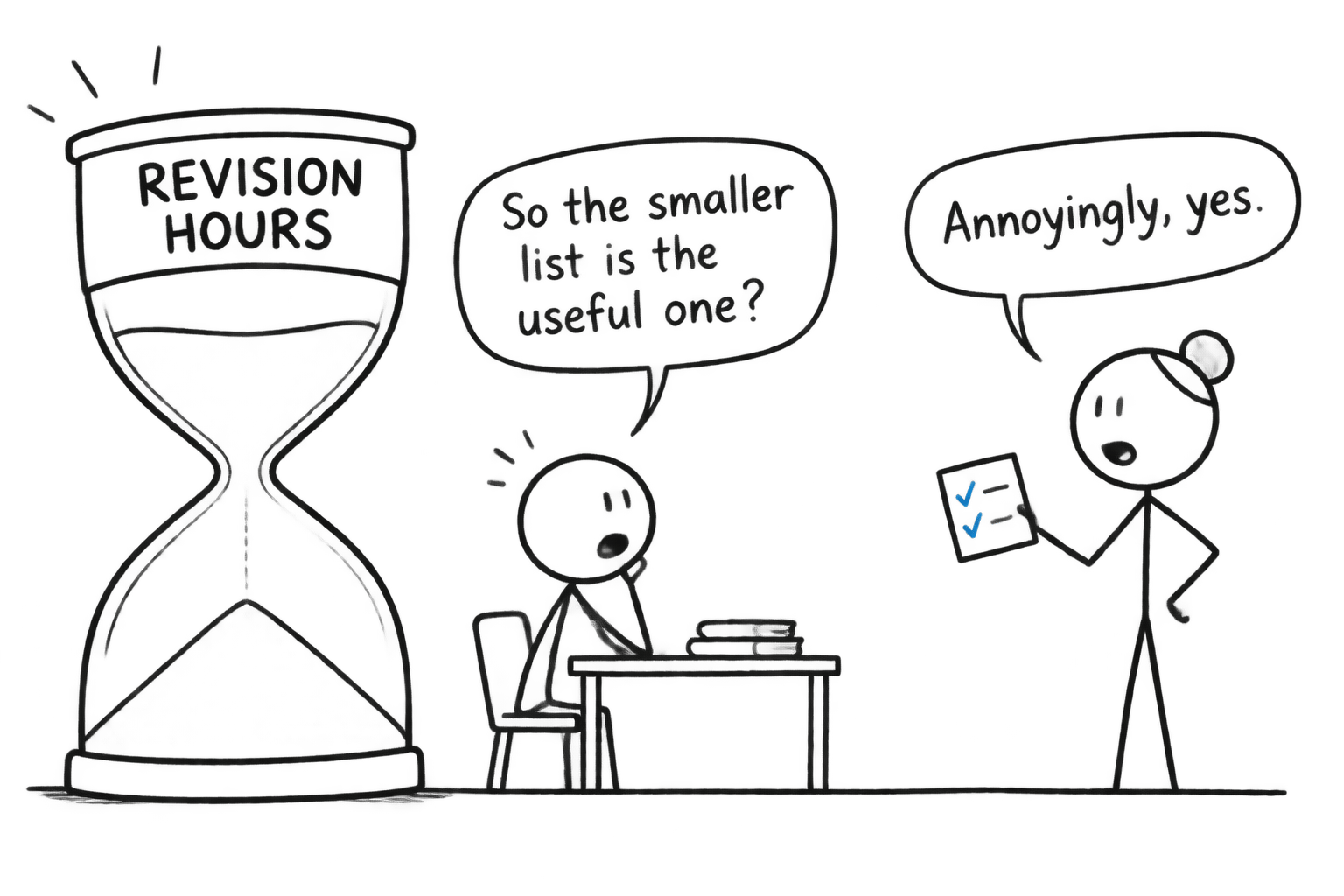 A student and parent compare an enormous revision hourglass with a small checklist of useful work
Adjust your hours using results, not guilt
After a fortnight, look at your work before changing your timetable.
Can you now complete questions that previously needed help? Can you still do them several days later? Are the same mistakes appearing less often?
If the answers are mostly yes, keep the routine. If progress is limited, check the method first. Perhaps the questions are too difficult, corrections are being copied, or an earlier skill needs attention. Increase your weekly time modestly only when there is useful work to put into it.
Closer to exams, replace some topic sessions with timed practice rather than automatically adding more hours. For Edexcel students, past papers and mark schemes provide material for that check. Use the equivalent resources for your own board.
Predicted papers can provide additional practice, but they cannot tell you exactly what will appear. Leave time to respond to mistakes whatever resource reveals them.
Common mistakes when counting revision hours
Counting time at the desk. Resource searching, messages and organising stationery can fill an evening. Count the focused work separately.
Leaving marking until later. An unmarked paper leaves you uncertain about what to practise next. Reserve review time before starting another.
Doing only comfortable topics. Familiar questions have a place, but your plan also needs manageable challenges.
Doubling tomorrow’s workload after a missed session. Move the most valuable task into an available slot. An expanding backlog makes the plan harder to resume.
For parents, “What can you do now that was difficult last week?” is usually a more useful conversation starter than “How many hours have you done?” Agree when to check in, and keep that conversation focused on the work and any help needed.
Build a schedule you can follow
Our hypothetical student now has a clearer answer than “two hours”: they know what they attempted, what needs correcting and when they will return to it. You have the same weekly structure, but it still needs a place in your actual calendar. Build your GCSE Maths schedule around focused practice, corrections and review in the Revision Planner.















