How Long Revise GCSE Arabic per Week? A Plan
How long revise GCSE Arabic per week? Set realistic weekly targets based on time left, current skills, four exam papers and your wider GCSE workload.
The hardest part of revision is often not the work. It is deciding how much work is enough. Revise too little and the exam keeps drifting closer; plan too much and an ambitious timetable collapses by Wednesday.
So, how long revise GCSE Arabic per week? For most students, a sensible starting point is 222 to 444 hours of independent Arabic revision each week when the exam is more than 333 months away. Increase this to around 555 to 777 hours in the final 666 to 121212 weeks if Arabic is a priority or you have significant gaps.
That time should be spread across several days. Four focused sessions usually achieve more than one long Sunday afternoon because languages depend on repeated recall, listening and production. Your exact target should also reflect your current fluency, target grade, teacher feedback and the time required by your other GCSEs, especially maths.
Your quick weekly revision checklist
Before filling a timetable, make five decisions:
- Confirm your qualification, tier and examination arrangements with your school.
- Estimate how many weeks remain before your first assessment.
- Diagnose your weakest skill: listening, speaking, reading or writing.
- Choose a weekly target you can repeat without sacrificing sleep or lessons.
- Review your plan every 222 weeks using completed exam questions and teacher feedback.
The goal is not to collect revision hours. It is to turn time into stronger recall, clearer communication and better exam decisions.
How many hours should you revise based on time left?
These estimates refer to focused work outside normal lessons and homework. They are starting points rather than official requirements: Pearson does not prescribe a weekly number of revision hours.
| Time before the exam | Suggested Arabic revision | A realistic pattern |
|---|---|---|
| More than 666 months | 222 to 333 hours per week | Four sessions of 303030 to 454545 minutes |
| 333 to 666 months | 333 to 444 hours per week | Four sessions of 454545 minutes plus short recall |
| 666 to 121212 weeks | 555 to 777 hours per week | Five focused sessions plus one longer exam session |
| Fewer than 666 weeks | 777 to 101010 hours per week | Daily short practice and regular timed tasks |
The final band is intensive. It is only appropriate if your wider GCSE timetable, health and school commitments allow it. Ten distracted hours are not automatically better than five focused ones.
If you have several months left, consistency matters more than volume. A student completing four purposeful sessions every week builds vocabulary and accuracy gradually. A student waiting until the final month must spend more time rebuilding knowledge while also learning to work under examination conditions.
For help organising maths alongside Arabic, adapt the structure in the GCSE maths revision timetable. Give each subject protected spaces rather than allowing whichever exam feels most urgent to consume every evening.
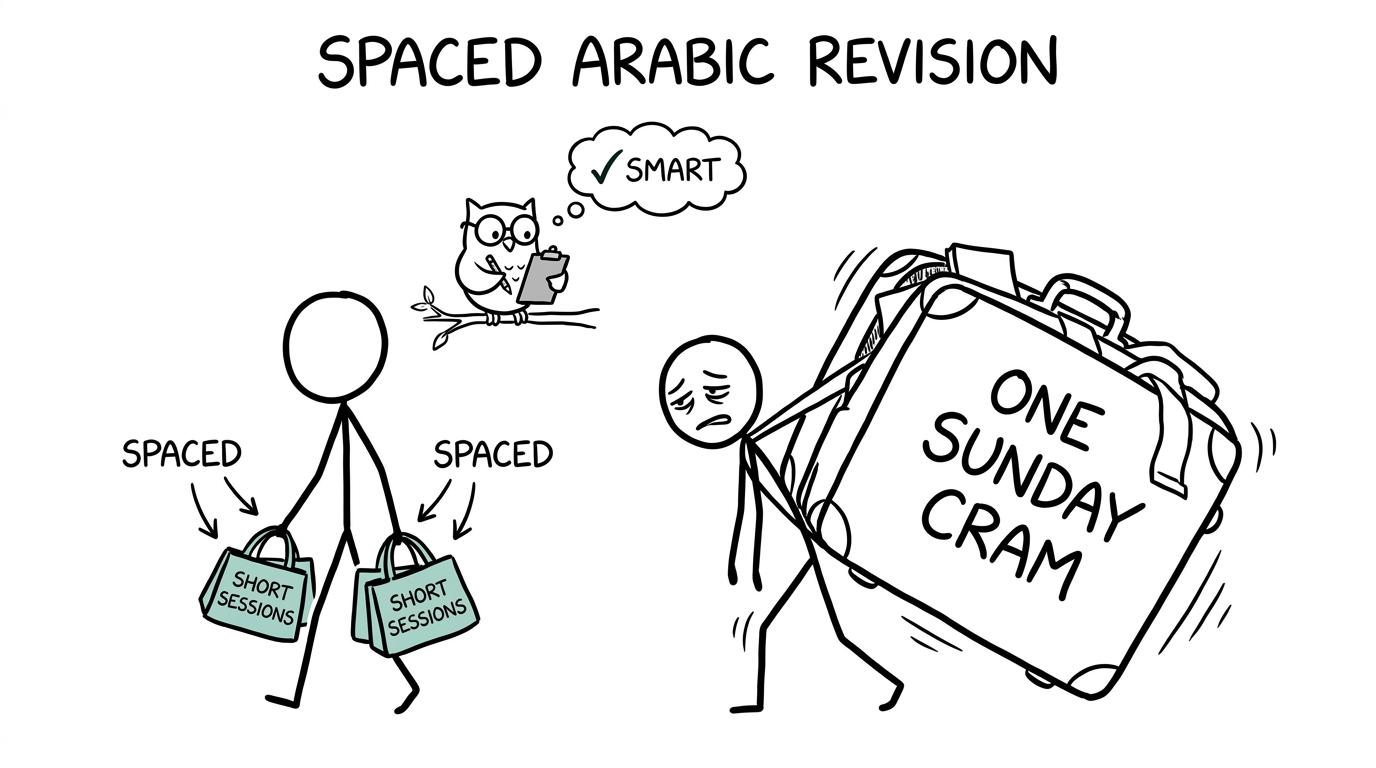 A student compares one enormous revision cram with several manageable sessions
Adjust the estimate to your starting point
Two students with the same exam date may need very different plans.
A student who uses Arabic regularly may read and speak confidently but still need focused practice with formal writing, translation, spelling or examination timing. Another student may know grammar rules in isolation yet struggle to understand spoken Arabic at normal speed. Their revision hours should not be divided identically.
Use a diagnostic task for each skill and record three things:
- what you could complete accurately;
- where you hesitated or needed help;
- what caused each lost mark.
Avoid judging your level from how familiar a page looks. Recognition can feel like knowledge without proving that you can retrieve a word, understand a recording or produce a response independently. The same principle applies in maths, which is why the MathsGenie guide to finding your weakest GCSE topics begins with evidence rather than guesswork.
Increase your weekly Arabic allocation by around 111 or 222 hours if several of the following are true:
- you cannot begin common speaking or writing prompts without notes;
- listening tasks regularly move faster than your understanding;
- basic vocabulary disappears between sessions;
- you have completed very little timed practice;
- your target grade is currently well above your assessed performance.
If you are already performing securely, do not add hours merely to feel busy. Keep shorter maintenance sessions, target small weaknesses and protect time for other subjects.
Divide the week across the four language skills
The Pearson Edexcel GCSE Arabic qualification assesses listening, speaking, reading and writing. Each skill contributes 25%25\%25% of the qualification, and students take either foundation or higher tier across the papers.
Equal assessment weighting does not mean every student must divide every week into perfectly equal quarters. It does mean that no skill should vanish from the timetable.
A balanced 444-hour week might contain:
- 454545 minutes of listening and transcription checks;
- 454545 minutes of speaking and spontaneous responses;
- 454545 minutes of reading and vocabulary retrieval;
- 454545 minutes of writing or translation;
- 606060 minutes for marking, corrections and revisiting the weakest area.
This is a planning model, not a worked formula. If listening is your main weakness, borrow time from a stronger area for several weeks, then reassess. Keep at least a small amount of every skill in circulation.
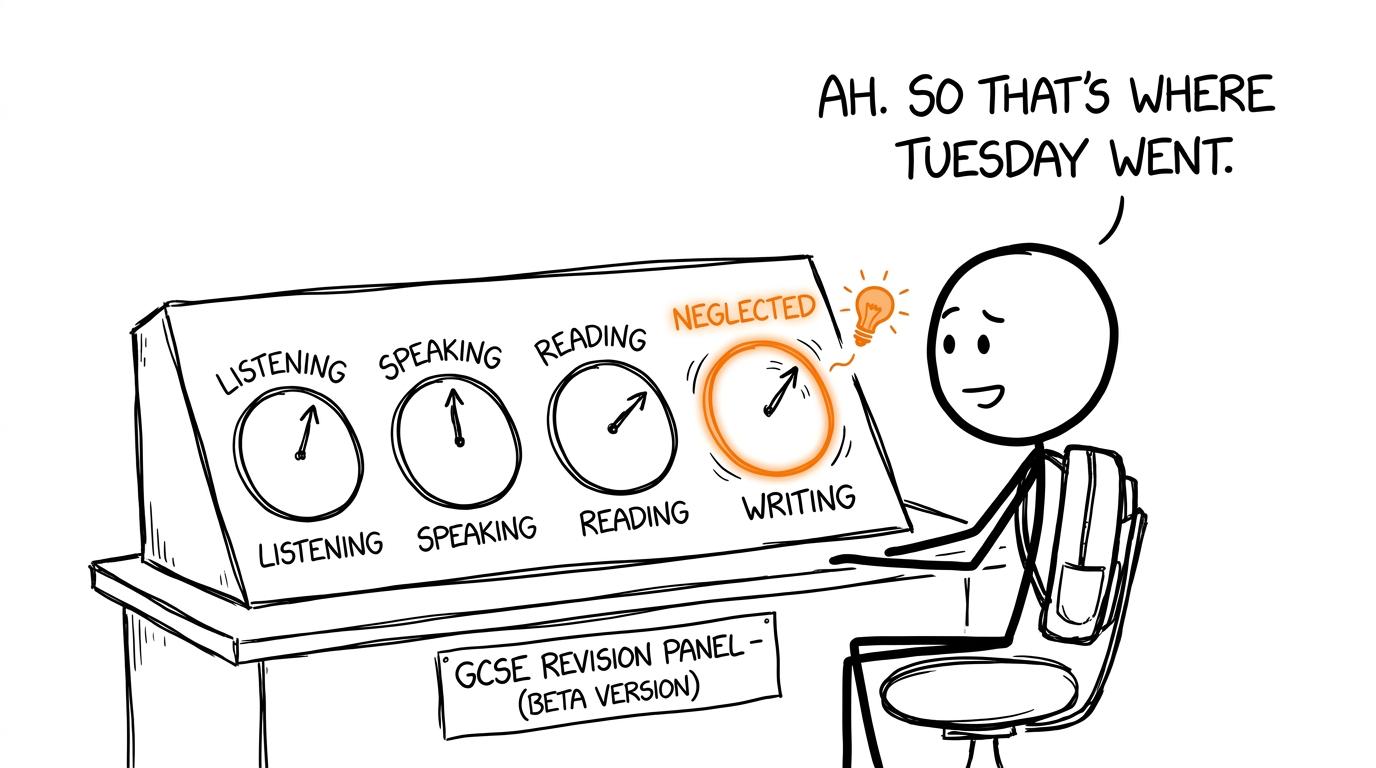 A student discovers one neglected skill on a four-dial revision control panel
What should happen inside each revision session?
A timetable can look impressive while hiding weak revision. Copying vocabulary for an hour is not equivalent to retrieving it, using it and checking it.
Evidence reviewed by the Education Endowment Foundation supports spaced practice and retrieval practice as useful approaches to learning. Retrieval means attempting to recall knowledge before looking at the answer; spacing means returning to it after a delay rather than completing all practice at once.
A productive 404040-minute Arabic session could use this structure:
- 555 minutes: retrieve vocabulary or structures without notes;
- 151515 minutes: complete one listening, reading, speaking or writing task;
- 101010 minutes: check the response carefully;
- 555 minutes: correct errors in full;
- 555 minutes: schedule what needs to be tested again.
Feedback matters. If you retrieve an incorrect form repeatedly without checking it, the mistake can become more familiar. Use official materials, teacher guidance and reliable mark schemes, particularly for translation and extended responses.
On busy school days, a shorter routine still counts. The MathsGenie 202020-minute revision routine shows how a small session can combine recall, active practice and correction. The subject changes, but the discipline does not.
How to balance GCSE Arabic with maths
Arabic asks for frequent contact. Maths also improves through repeated problem-solving rather than occasional reading. The solution is not to make both subjects fight for the same long weekend block.
Give Arabic several shorter slots because vocabulary, listening and speaking benefit from regular exposure. Give maths a mixture of topic sessions and longer timed practice. Start from the GCSE maths revision hub, where resources can be selected by exam board and tier.
A manageable school week might use Arabic on four days and maths on three or four days, with some sessions occurring on the same day. Keep each block specific: “Arabic listening questions” is better than “revise Arabic”, just as “higher-tier ratio questions” is better than “do maths”.
As exams approach, use a rolling priority system. Give additional time to the next assessment without abandoning later subjects completely. The one-month GCSE revision plan can help you organise diagnosis, focused practice and timed work without trying to revise everything every evening.
When should you start timed papers?
Do not wait until you feel completely ready. Readiness partly comes from learning how the assessment behaves under time pressure.
Several months before the exam, use short sections and individual tasks. During the final 666 to 101010 weeks, introduce longer timed work regularly. A full paper is useful only if you review it afterwards. Marking should identify whether each problem came from knowledge, comprehension, accuracy, timing or misunderstanding the instruction.
Maths revision follows the same loop: attempt, mark, diagnose, repair and retest. MathsGenie's guide to using GCSE past papers properly explains how to turn lost marks into specific next actions.
When scheduling your maths papers, use the collection matching your board, such as Edexcel GCSE Maths past papers, AQA GCSE Maths past papers or OCR GCSE Maths past papers. For Arabic, confirm the current Pearson Edexcel specification, tier and materials with your teacher rather than assuming that another language's format is identical.
Common mistakes when planning Arabic revision
Counting passive exposure as focused revision
Hearing Arabic casually can support familiarity, but it does not automatically practise the exact listening, reading, speaking and writing demands of the GCSE. Focused revision requires a task, an attempted response and feedback.
Revising only the most comfortable skill
Reading may feel easier because it allows more thinking time. Speaking can be postponed because it feels exposed. A weekly plan should make avoidance visible and give neglected skills a fixed appointment.
Setting an unsustainable hourly target
A plan of 121212 hours that lasts one week is less useful than a 444-hour plan repeated for months. Begin slightly below your maximum capacity, establish the routine, then increase it if evidence shows that you need more.
Cramming vocabulary without revisiting it
One large vocabulary session creates short-term familiarity. Recall becomes more dependable when words return across several sessions and are used in sentences, questions, listening and translation.
Completing papers without correcting them
A paper measures performance; the correction process improves it. Record the cause of each error, write the corrected response and retest it later without copying.
Letting Arabic displace every other GCSE
Urgency can distort a timetable. Protect maths, English and your other subjects by planning the whole week in advance. Your Arabic target must fit inside your total available revision time, not sit on top of it.
Make the weekly target work for you
The useful answer is not a heroic number. It is a repeatable rhythm.
Start with 222 to 444 hours per week when you have several months left. Move towards 555 to 777 focused hours in the final weeks where your diagnostic evidence and wider workload justify it. Spread the time across listening, speaking, reading and writing, then adjust the balance according to actual lost marks.
While your teacher and official Pearson materials should guide GCSE Arabic preparation, MathsGenie can organise the maths side of your exam season. Use its free revision lessons, practice questions and mini tests to repair weak topics, then build exam confidence with past papers, predicted papers, mark schemes and video solutions. Open the MathsGenie GCSE revision hub, choose your board and tier, and give both Arabic and maths a clear place in this week's plan.