

Home-Schooled GCSE German: How to Sit the Exam
Home-schooled GCSE German explained: find an approved centre, arrange the speaking test, understand entry deadlines and prepare for every paper.
The German itself may not be the hardest part. For many home-educated students, the real uncertainty is discovering who will enter them, where the speaking assessment happens and when everything must be booked.
The short answer is yes: the home schooled GCSE German route is available. A learner normally sits the qualification as a private candidate through an approved school, college or examination centre. However, the centre must accept the exact exam board and specification, administer the speaking assessment and make the formal entry on the candidate's behalf.
That final detail matters. Finding a centre that accepts private candidates generally is not the same as finding one equipped to run GCSE German.
Your home-schooled GCSE German checklist
Before beginning a course, confirm each of these points:
- Choose the awarding body and current specification.
- Decide whether foundation or higher tier is likely to be appropriate.
- Find an approved centre accepting private candidates for that specification.
- Confirm that the centre will conduct and submit the speaking assessment.
- Ask for its internal entry deadline and complete itemised fee.
- Discuss access arrangements or modified papers before booking.
- Register, pay and check the statement of entry carefully.
- Keep the speaking period and the full summer examination window available.
- Plan German alongside your other GCSE subjects, including maths.
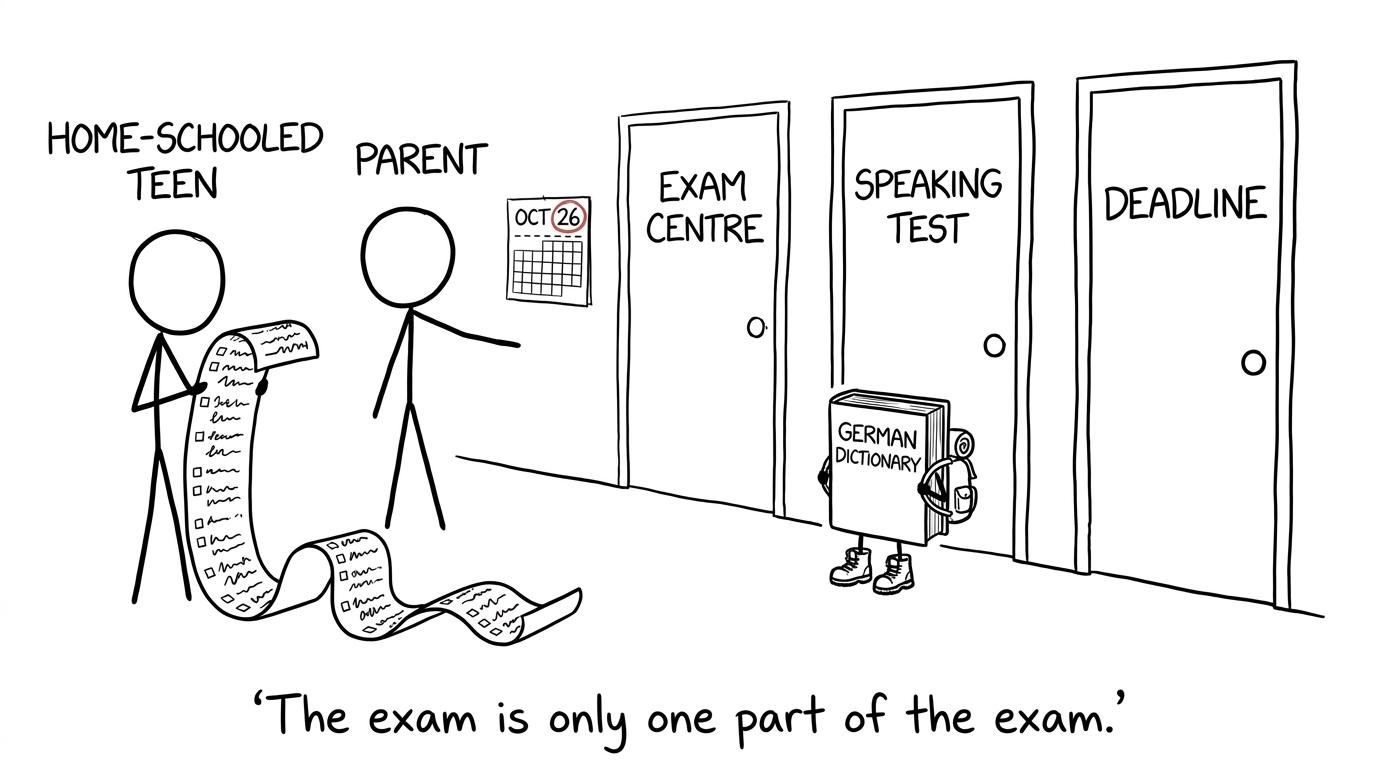 A student discovers that arranging the exam is part of the exam
Choose the qualification before looking for a centre
For examinations from summer 2026, the reformed GCSE German specifications in England include AQA GCSE German, code 8662, and Pearson Edexcel GCSE German, code 1GN1. Both were introduced for teaching from September 2024, with first assessment in 2026.
Do not assume that every board familiar from maths offers a current German qualification. Eduqas withdrew its former GCSE German after its final 2025 award, while exam-board availability can change. Always check the current specification before buying a course or arranging tuition.
Both current AQA and Edexcel qualifications have four assessed areas:
- listening;
- speaking;
- reading;
- writing.
Each contributes 25%25\%25% of the final qualification. Both specifications offer foundation tier, covering grades 111 to 555, and higher tier, covering grades 444 to 999. A candidate must take every component at the same tier in the same examination series.
AQA explicitly makes specification 8662 available to UK-based private candidates. Pearson's current qualification information also lists foundation and higher private-candidate entries for German. Availability on paper does not guarantee that a particular centre will accept the entry, especially because speaking requires additional staffing and administration.
How to find a private candidate examination centre
The official JCQ private-candidate centre finder is the natural starting point. It allows families to search for approved centres by location, qualification and awarding body. Its listings are leads, not confirmed bookings: each centre controls its own subjects, capacity, fees and internal deadlines.
Build a shortlist rather than contacting only the nearest centre. Schools may accept private candidates for written subjects but decline modern foreign languages because they cannot provide a suitable teacher-examiner or speaking session.
What to include in your first enquiry
A precise email is more likely to receive a useful answer. Include:
- the candidate's name and date of birth;
- GCSE German as the subject;
- the awarding body and specification code;
- the intended summer examination series;
- the likely foundation or higher entry;
- confirmation that the learner is a private candidate;
- any existing Unique Candidate Identifier, if known;
- any possible access-arrangement requirements.
Then ask direct questions: Can the centre conduct the speaking assessment? What is the internal booking deadline? What does the total fee include? When will the speaking session take place? What identification and evidence are required?
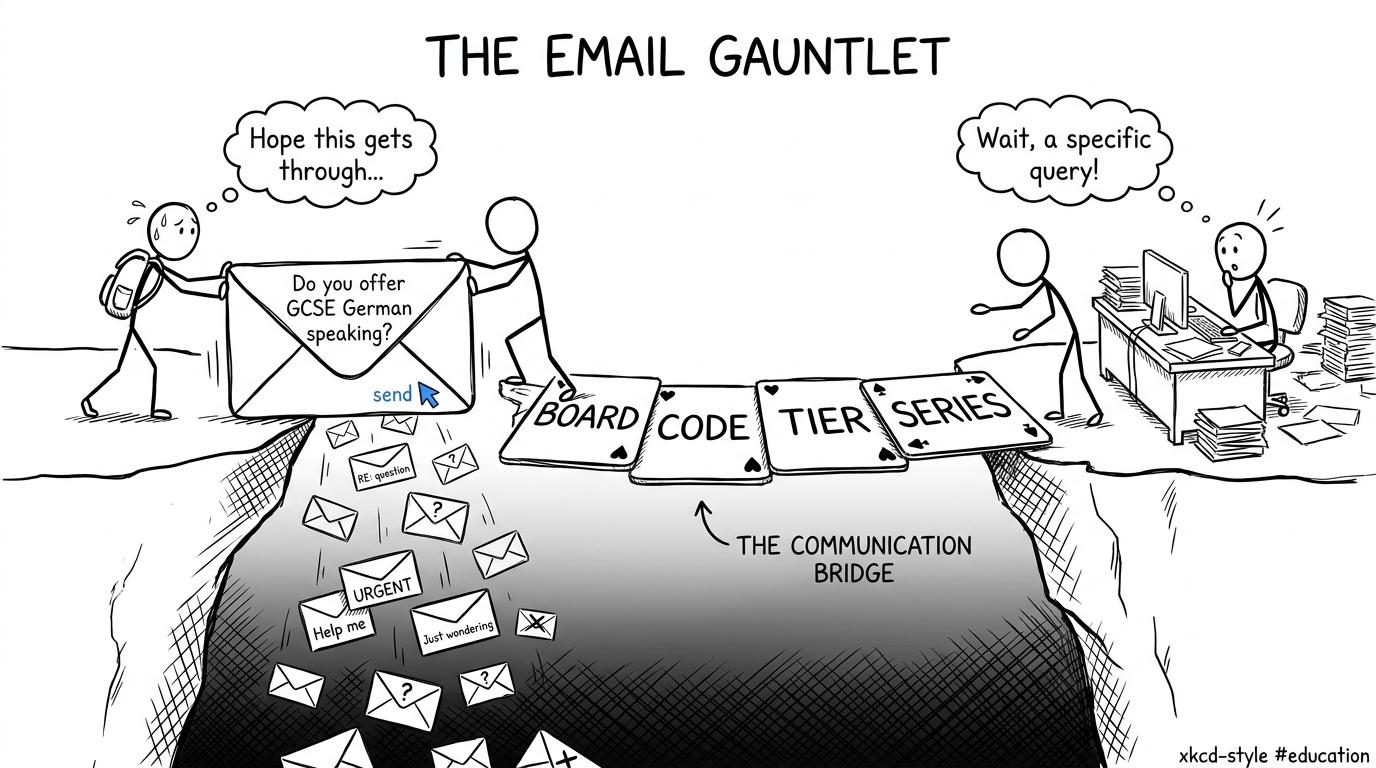 A detailed examination enquiry builds a bridge to the exams officer
A useful principle is to get the answer in writing before paying. The phrase “we accept private candidates” is not enough. You need confirmation of the board, code, tier, series and all four components.
Why the German speaking assessment changes the process
Written papers can be placed on a desk and invigilated in the usual way. Speaking is different. The centre must schedule an individual appointment, provide an appropriate teacher-examiner, follow secure preparation rules, record the assessment and submit the required material to the awarding body.
Under the current AQA and Edexcel specifications, foundation speaking lasts approximately seven to nine minutes and higher speaking lasts approximately ten to twelve minutes, with supervised preparation beforehand. The precise tasks differ between boards, so revision must follow the chosen specification rather than a generic German course.
Ask who will conduct the assessment and whether the candidate will have any permitted familiarisation with the setting or equipment. The secure task itself cannot be practised in advance, but knowing where to arrive and how the session is organised can remove avoidable uncertainty.
A centre's speaking capacity may fill before its general written-exam capacity. This is one reason to arrange the entry during the autumn before the summer examinations rather than waiting until spring.
Entry deadlines for private candidates
Awarding bodies publish final entry dates, but centres usually need information and payment earlier. Their internal cut-off is the date that matters to your booking.
For the June 2027 series, both AQA and Pearson publish 21 February 2027 as the standard GCSE entry deadline for UK centres, with late fees applying after that date. These dates can change between series, and they are not a reason to wait until February. A centre may close bookings weeks or months earlier, particularly for language assessments.
A sensible timeline is:
Summer and early autumn
Select the specification, review every assessment component and begin contacting centres. If you are preparing several qualifications, create one record containing the board, code, tier, deadline and venue for each subject.
Late autumn and winter
Choose the centre, complete its registration process and pay the required fee. Supply identity documents and any previous candidate details promptly. Raise access arrangements now, not after the entry has been made.
Early spring
Check the statement of entry. Confirm the spelling of the candidate's legal name, date of birth, board, specification, tier and examination series. Obtain the speaking appointment and written-paper timetable directly from the centre.
Spring and summer
Attend the speaking assessment and all written examinations. Keep the published contingency date available in case national or local disruption causes an examination to be moved.
Results and certificates are normally handled through the entering centre, so ask in advance whether results will be collected, posted or released through an online portal.
How much does it cost to sit GCSE German privately?
There is no single national private-candidate price. The awarding body's entry charge is only one part of the total. A centre may also charge for administration, room hire, invigilation, the speaking assessment, recording and certificate handling.
As an indication of the distinction, AQA's published UK centre entry fee for GCSE German in summer 2027 is £52.65. That is not necessarily the amount a private candidate will pay. The centre's total charge can be considerably higher because it must provide the facilities and administration.
Ask for an itemised quotation covering:
- the examination entry;
- the speaking assessment;
- centre administration;
- late-entry or amendment charges;
- access-arrangement services, where applicable;
- cancellation and refund terms;
- postage or certificate collection.
Comparing totals is more useful than comparing headline entry fees.
Access arrangements need early discussion
A home-educated candidate may be eligible for arrangements such as extra time, supervised rest breaks or modified papers, but these are not granted simply because they are requested. The centre must follow current JCQ rules, consider the evidence and establish the candidate's normal way of working where required.
Tell prospective centres about a possible need in the first enquiry. Ask what evidence they accept, whether an assessment is needed, what it will cost and when their internal deadline falls. Modified-paper deadlines can be earlier than the main entry deadline.
Do not assume that arrangements previously used with a tutor or at another centre will transfer automatically. The entering centre is responsible for putting approved arrangements into practice.
Balancing German with GCSE maths revision
Exam administration can consume attention because every decision feels urgent. Once the booking is secure, move those details into a calendar and return your energy to revision.
For maths, begin with the GCSE Maths revision hub, choose the correct board and tier, and use short sessions that can sit beside language practice. Students taking Pearson can organise their work through the Edexcel GCSE Maths revision hub, while OCR students can use the OCR GCSE Maths revision resources.
A simple weekly rhythm might combine German vocabulary retrieval and speaking practice with maths topic questions, mini tests and timed papers. The one-month GCSE maths revision plan provides a useful structure when several subjects are competing for time.
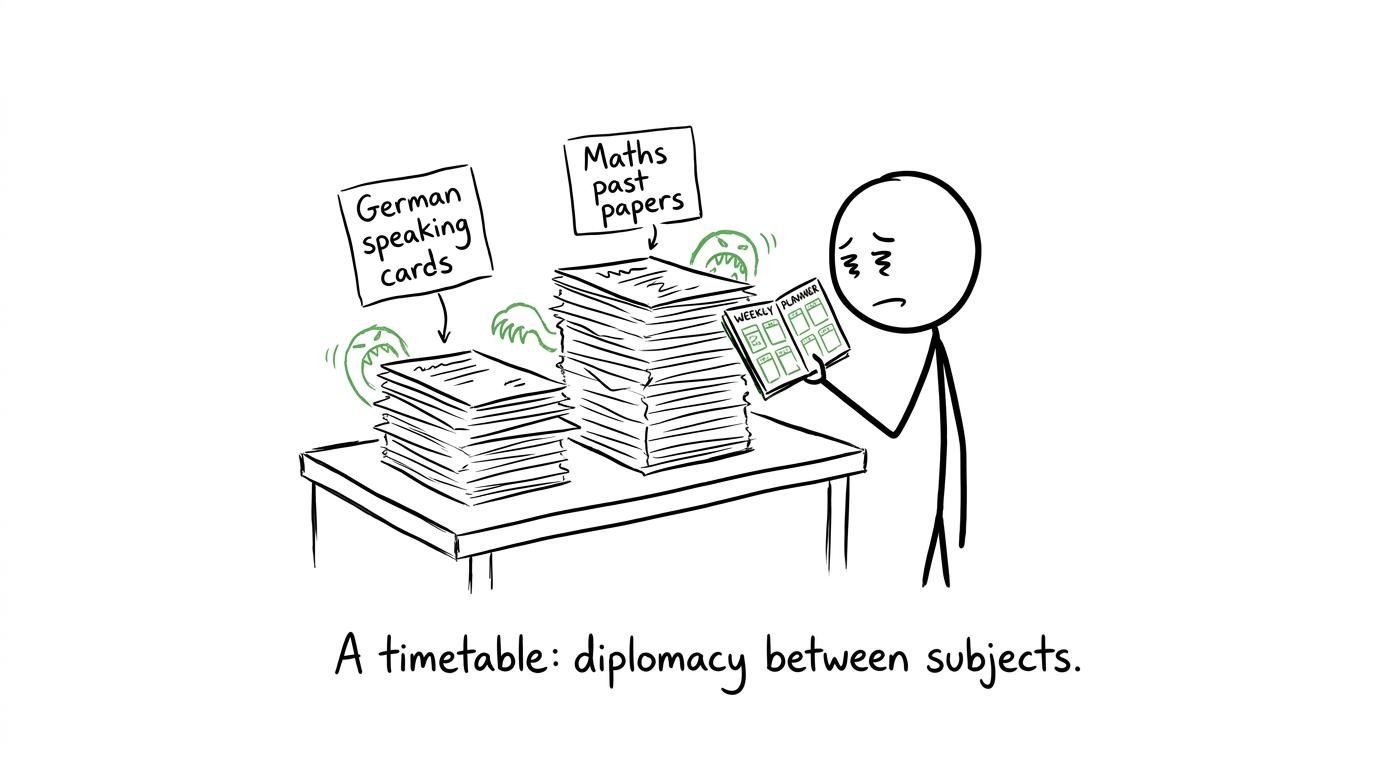 A weekly timetable negotiates peace between German and maths revision
As examinations approach, introduce papers gradually rather than saving them all for the final week. The guide to when to start GCSE past papers explains how to move from topic practice to timed work. AQA candidates can use AQA GCSE Maths past papers and mark schemes, while shorter 45-minute GCSE maths tests can help when a full paper will not fit beside German revision.
Common mistakes to avoid
Choosing a course before confirming a centre
A nearby centre may support one German board but not another. Secure provisional centre availability before committing to a specification-specific course.
Asking only about written papers
The speaking component is compulsory. Confirm that the quoted service includes its administration, recording and submission.
Treating the awarding-body deadline as the booking deadline
Centres set earlier internal dates and may reach capacity. Contact them in the autumn and request their cut-off in writing.
Mixing specifications during revision
AQA and Edexcel use different task formats and terminology. Use resources produced for the exact specification being entered.
Leaving access arrangements until spring
Evidence gathering and formal processing take time. Discuss possible arrangements during the initial centre search.
Failing to check the statement of entry
A wrong tier, code or spelling is easier to correct when identified promptly. Check every detail as soon as the document arrives.
Turn the arrangement into a revision plan
Home-educated students can sit GCSE German, but success begins with a practical sequence: choose the current specification, find an approved centre, confirm the speaking assessment, meet the centre's own deadline and check the final entry.
Once those arrangements are settled, revision becomes the main job again. Keep German preparation aligned to the chosen board, and let MathsGenie organise the maths side of the week. Use free revision lessons and practice questions to repair weak topics, mini tests to check recall, then past papers, mark schemes, video solutions and GCSE predicted papers to build exam readiness.
The administration may feel like a maze at first. Written confirmation, an early booking and one reliable revision plan turn it back into a series of manageable steps.










