Home-Schooled GCSE Further Maths: How to Sit It
Home schooled GCSE Further Maths students can sit exams privately. Learn how to choose a qualification, find a centre and meet entry deadlines.
The short answer for anyone searching for home schooled GCSE Further Maths is yes. A home-educated student can take the qualification by registering as a private candidate at an approved examination centre.
The important detail is that you cannot normally enter yourself directly with an exam board. A school, college or private examination centre must accept you, submit the entry and supervise the papers. Finding that centre early is therefore just as important as learning the mathematics.
There is another wrinkle. “GCSE Further Maths” is often used as a convenient description, but several distinct qualifications sit beneath that label. Before paying a centre, confirm the exact qualification, exam board, specification code and examination series.
The essential checklist
A home-educated student should:
- choose the exact Further Maths qualification and exam board;
- download the current specification and confirm the assessment structure;
- find an approved centre accepting private candidates for that specification;
- ask about the centre's fee, internal deadline and identification requirements;
- discuss access arrangements at the first enquiry, if required;
- receive and check a statement of entry;
- prepare using the correct papers and calculator rules;
- confirm arrangements for results, certificates and post-results services.
The sequence matters. Revising first and looking for a centre later can leave a well-prepared student with nowhere to sit the papers.
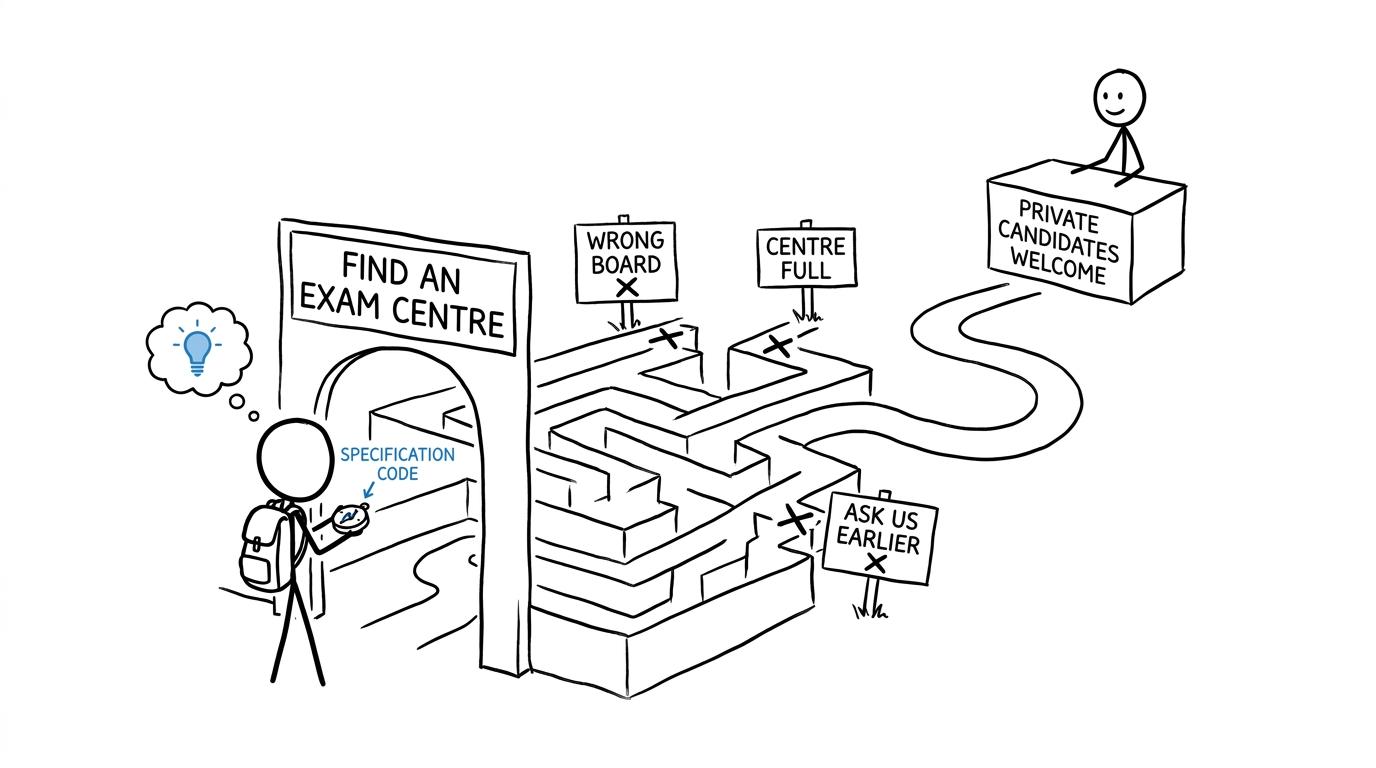 A home-educated student navigating the maze of finding an examination centre
What qualification do people mean by GCSE Further Maths?
The familiar name is not always the official title. This distinction affects centre availability, entry codes, assessment and the qualification shown on the final certificate.
AQA Level 2 Certificate in Further Mathematics
A common route is the AQA Level 2 Certificate in Further Mathematics, specification code 8365. AQA's current entry information confirms that this specification is available to private candidates.
It is a linear qualification assessed through two written papers taken in the same examination series:
- one non-calculator paper lasting one hour and 45 minutes;
- one calculator paper lasting one hour and 45 minutes;
- each paper carries 808080 marks and contributes 50%50\%50% of the qualification.
Its content extends higher-tier GCSE Maths into areas including more advanced algebra, coordinate geometry, calculus and matrix transformations. It is not simply another tier of ordinary GCSE Maths, and there is no foundation-tier version.
MathsGenie's AQA Further Maths past papers provide the correct place to inspect the style and mathematical demand before committing to an entry.
Other qualifications with similar names
OCR offers a Level 3 Free Standing Maths Qualification in Additional Mathematics. Pearson Edexcel offers an International GCSE in Further Pure Mathematics. These are separate qualifications with different specifications and assessment arrangements; OCR's option is not a GCSE, while Pearson's is an International GCSE.
A centre that accepts one qualification may not accept another. Never ask only, “Do you offer Further Maths?” Instead, give the full title, awarding organisation and specification code. Also check that the qualification is suitable for your planned sixth-form, college or other progression route.
How to find a private candidate exam centre
A private candidate sits an examination at an approved centre without being enrolled there as a student. Home-educated learners fall within this definition.
Start with the JCQ private-candidate search service, then contact possible centres directly. The published list is a starting point rather than a promise: centres choose which private candidates, subjects and specifications they will accept, and places can fill.
Search within reasonable travelling distance, but be prepared to look further afield. A centre may accept ordinary GCSE Maths while declining Further Maths because it does not run that specification.
What to include in the first enquiry
A precise email is more useful than a general request. Include:
- the candidate's age and home postcode;
- the full qualification title;
- the exam board and specification code;
- the intended summer examination series;
- whether the candidate has an existing Unique Candidate Identifier;
- whether access arrangements may be required;
- a request for the complete fee and internal entry deadline.
Ask whether the quoted price includes the awarding-body entry fee, centre administration, invigilation, results handling and certificate collection or postage. Centres set their own charges, so prices and payment terms vary.
It is sensible to contact several centres. A polite refusal usually reflects capacity or administrative policy, not the student's suitability for the subject.
When are the entry deadlines?
There is no single practical deadline for every home-educated candidate. Exam boards publish formal entry dates, but centres can impose earlier internal cut-offs and may close once their available places are filled.
For example, AQA's published standard entry deadline for the June 2026 series was 21 February 2026. Entries after that point could attract late fees. That date should not be reused for another year: families must check the current series information with the chosen centre.
A safer planning rhythm is:
| Stage | Sensible action |
|---|---|
| Summer or early autumn before the exam year | Choose the qualification and read its specification |
| Autumn term | Contact centres and compare arrangements |
| Before the centre's internal deadline | Submit details, evidence and payment |
| After entry | Check the statement of entry immediately |
| Spring | Confirm timetable, venue, equipment and access arrangements |
| Summer | Sit every required paper in the same series |
| Results period | Obtain results and certificate through the centre |
Do not assume that Further Maths can be taken in the November GCSE Maths series. Availability is qualification-specific, and the AQA Level 2 Certificate is normally entered for its published summer series.
Registering and checking the entry
Once a centre agrees, it will explain its registration process. Expect requests for the candidate's legal name, date of birth, contact details and acceptable evidence of identity. The centre may also ask for previous candidate information.
After the entry has been submitted, obtain a statement of entry and check:
- the spelling and order of the candidate's name;
- date of birth;
- awarding organisation;
- qualification and specification code;
- all required paper components;
- examination dates and venue;
- candidate and centre numbers.
A small administrative error is easiest to correct when found early. Keep copies of confirmation emails, payment receipts and the statement of entry together.
Access arrangements for home-educated candidates
Students who may need extra time, a reader, a word processor, modified papers or another arrangement should raise this during the first conversation with a centre.
The entering centre is responsible for considering evidence, completing the required assessment or application and providing the approved arrangement. A previous arrangement does not necessarily transfer automatically. Modified papers and other support also have deadlines, so waiting until shortly before the examination can make the request impossible to process.
Ask what evidence the centre requires, whether it can carry out any necessary assessment and whether this creates an additional charge. Do not pay the main entry fee until you understand what the centre can provide.
 A prepared student packing examination equipment while a deadline monster retreats
How to prepare for Further Maths at home
Further Maths works best when higher-tier GCSE algebra is already secure. Topics such as factorisation, equations, graphs, trigonometry and algebraic manipulation provide the foundation for the additional content.
Use the GCSE Maths revision hub to identify weaknesses across the main course. Students following AQA can work through the AQA GCSE Maths revision lessons and questions, although the ordinary GCSE specification remains separate from AQA Further Mathematics.
A useful weekly pattern is:
- learn or revisit one tightly defined topic;
- complete practice questions without notes;
- mark the work and record why each mark was lost;
- revisit the weakness after a few days;
- complete part of a Further Maths paper under timed conditions.
The MathsGenie revision planner can turn the specification into a realistic schedule. Short GCSE Maths mini tests are also useful for maintaining core skills, even when the student's main Further Maths route is AQA.
Past papers should become more important as the exam approaches. Use the correct calculator conditions, keep to the stated time and mark with the official mark scheme. The best improvement usually happens after marking: classify the error, return to the relevant lesson, practise it and then attempt another question.
The guide to using GCSE past papers properly explains this feedback loop in more detail. GCSE predicted papers can support ordinary GCSE Maths preparation, but they should not replace specification-matched Further Maths papers.
Common mistakes to avoid
Treating every “Further Maths” course as identical
AQA Level 2 Further Mathematics, OCR Additional Mathematics and Edexcel International GCSE Further Pure Mathematics are not interchangeable. Confirm the qualification before buying a course or booking an examination.
Waiting for the awarding body's final deadline
The centre's own deadline may be considerably earlier. Contact centres during the autumn before a summer sitting rather than relying on a national closing date.
Assuming any GCSE centre will accept the subject
Approval to run examinations does not oblige a centre to accept every private-candidate qualification. Ask specifically about the board and specification code.
Leaving access arrangements until spring
Evidence, assessment and applications take time. Explain the student's needs during the initial enquiry.
Revising from ordinary GCSE papers alone
Higher-tier GCSE Maths is essential preparation, but it does not cover the complete Further Maths specification. Use dedicated Further Maths papers as well.
Forgetting to check the entry confirmation
An incorrect name, code or missing component can create serious difficulties. Read the statement of entry as soon as it arrives.
Turn the administrative plan into a revision plan
Home-educated students can sit Further Maths, but the opportunity rests on two kinds of preparation. One is mathematical: learning the specification and becoming accurate under examination conditions. The other is administrative: securing a centre, meeting its deadline and checking every entry detail.
Begin with the practical step. Choose the exact qualification and contact suitable centres early. Once the place is secure, use MathsGenie as your free revision base: strengthen higher-tier skills through revision lessons and practice questions, organise sessions with the revision planner, and build examination confidence through mini tests, past papers, mark schemes, video solutions and predicted papers.
Good revision reduces uncertainty one question at a time. Good administration does the same for exam day. Start both early, and neither needs to become a last-minute crisis.