

Hate GCSE Astronomy? How to Revise and Keep Going
Hate GCSE Astronomy? How to revise with less stress using short sessions, active recall, exam questions and targeted GCSE maths practice.
There is a particular kind of frustration that comes from revising a subject you dislike. You open the book, read half a page about celestial coordinates or stellar evolution, and discover that your mind has quietly left the room.
If you hate GCSE Astronomy, how to revise is not really a question about finding more motivation. It is about building a method that works even when motivation is absent. The practical answer is to make each session short, specific and active: choose one small topic, retrieve what you know, answer questions, mark them and record the next thing to fix.
You do not have to fall in love with astronomy. You need a revision system that makes starting easier and turns your weaker areas into manageable tasks.
Your quick survival checklist
When the subject is not clicking, use this routine:
- Choose one narrow specification point, not an entire chapter.
- Set a minimum session of just 101010 minutes.
- Turn notes into questions instead of rereading them.
- Practise calculations separately from factual recall.
- Mark every question and classify the mistake.
- Revisit the topic after a short gap.
- Use longer exam sections only after focused topic practice.
- Ask your teacher when the specification wording or observation requirements are unclear.
The aim is not to produce beautiful notes. It is to become a little more capable each time you sit down.
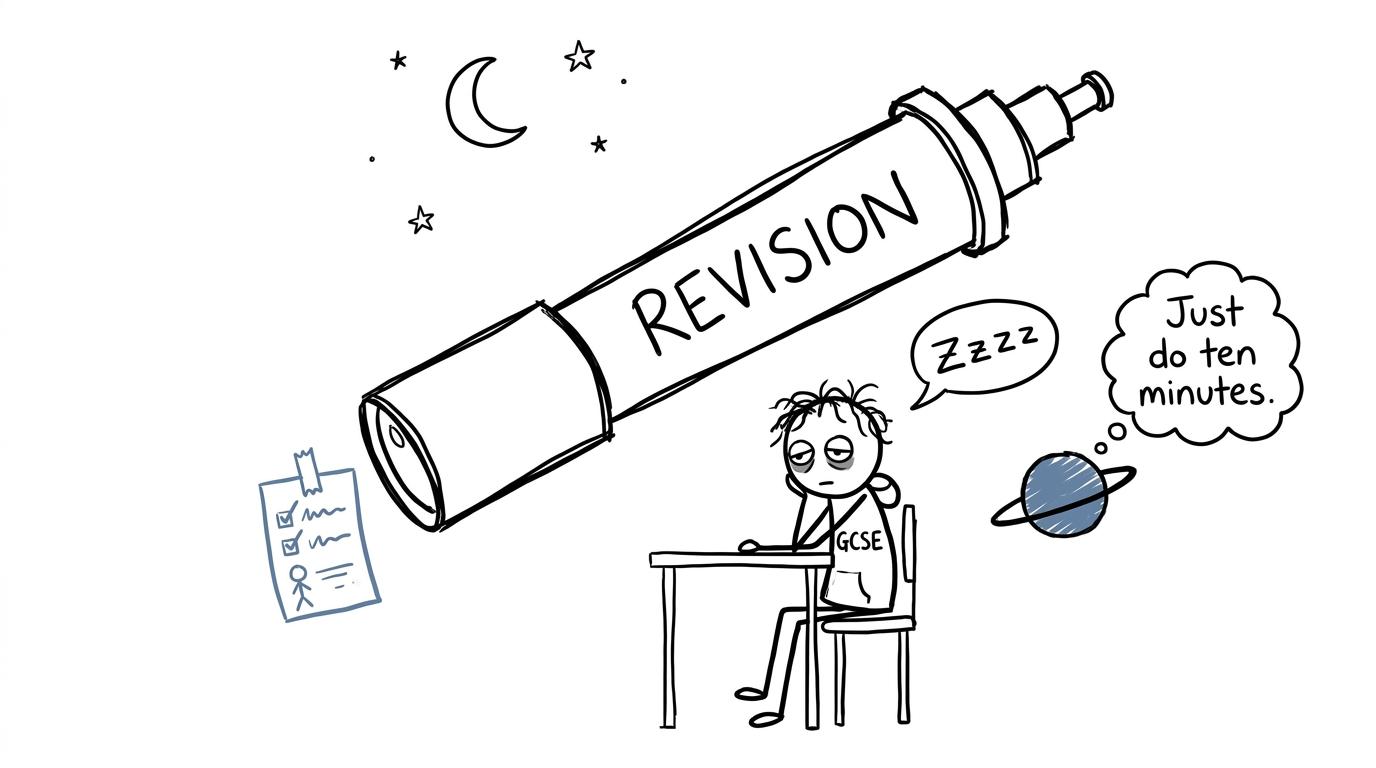 A tired student makes astronomy revision smaller with a tiny checklist
Start with the exam you are actually taking
Current Pearson Edexcel GCSE Astronomy is an untiered qualification. Unlike GCSE Maths, there is no foundation or higher tier: every student takes the same two externally examined papers.
Paper 111, Naked-eye Astronomy, covers Topics 111 to 888. Paper 222, Telescopic Astronomy, covers Topics 999 to 161616. Each paper lasts 111 hour 454545 minutes, is worth 100100100 marks and contributes 50%50\%50% of the qualification. Both contain a mixture of multiple-choice, short-answer, calculation, graphical and extended-open-response questions.
That structure gives you a useful first move. Divide your topic list into two paper columns, then label every topic:
- Green: I can answer questions without notes.
- Amber: I recognise it but cannot explain it reliably.
- Red: I avoid it or guess.
Begin with one amber topic. Red topics can feel too large at first, while green topics create the illusion of progress. Amber topics often offer the quickest route to extra marks.
Do not organise Astronomy revision using an AQA, OCR or Eduqas Maths specification by mistake. Those boards are relevant to your separate GCSE Maths preparation, while the current Astronomy qualification discussed here is Pearson Edexcel. If you are uncertain about your entry, confirm it with your school.
Stop waiting to feel motivated
Motivation is often treated as the fuel for revision. In practice, it can be the result. A task feels less unpleasant once you know precisely what to do and can see it ending.
Replace “revise cosmology” with a visible action such as:
- recall the evidence associated with one model;
- label one astronomical diagram from memory;
- answer five questions about an observation method;
- interpret one graph;
- practise one type of calculation.
A vague task has no finish line. A specific task does.
Use a minimum that survives a bad day
Set a deliberately small non-negotiable minimum: perhaps 101010 minutes or five recall prompts. You may continue after that, but you do not have to.
This is not a claim that 101010 minutes will cover the course. Its purpose is to remove the argument you have with yourself before starting. Once the book is open and the first question is underway, continuing usually requires less effort than beginning.
For a wider structure, adapt the rhythm in MathsGenie’s GCSE one-month revision plan: diagnose, repair one weakness, test it and return to it later. The topics differ, but the revision loop remains useful.
Revise actively, not decoratively
Rereading feels safe because nothing exposes what you have forgotten. Unfortunately, recognition is not the same as recall. In the exam, the page will not be there to remind you.
After reading a short section, close your notes and answer questions such as:
- What is the central idea?
- Which observation or evidence supports it?
- What limitation could affect the observation?
- Which quantities, units or graph features matter?
- What would the examiner expect for a command word such as “state”, “explain” or “evaluate”?
Then check your answer and correct only what was missing. MathsGenie’s guide to turning GCSE notes into active recall explains how to convert passive notes into prompts and make responses more mark-scheme focused.
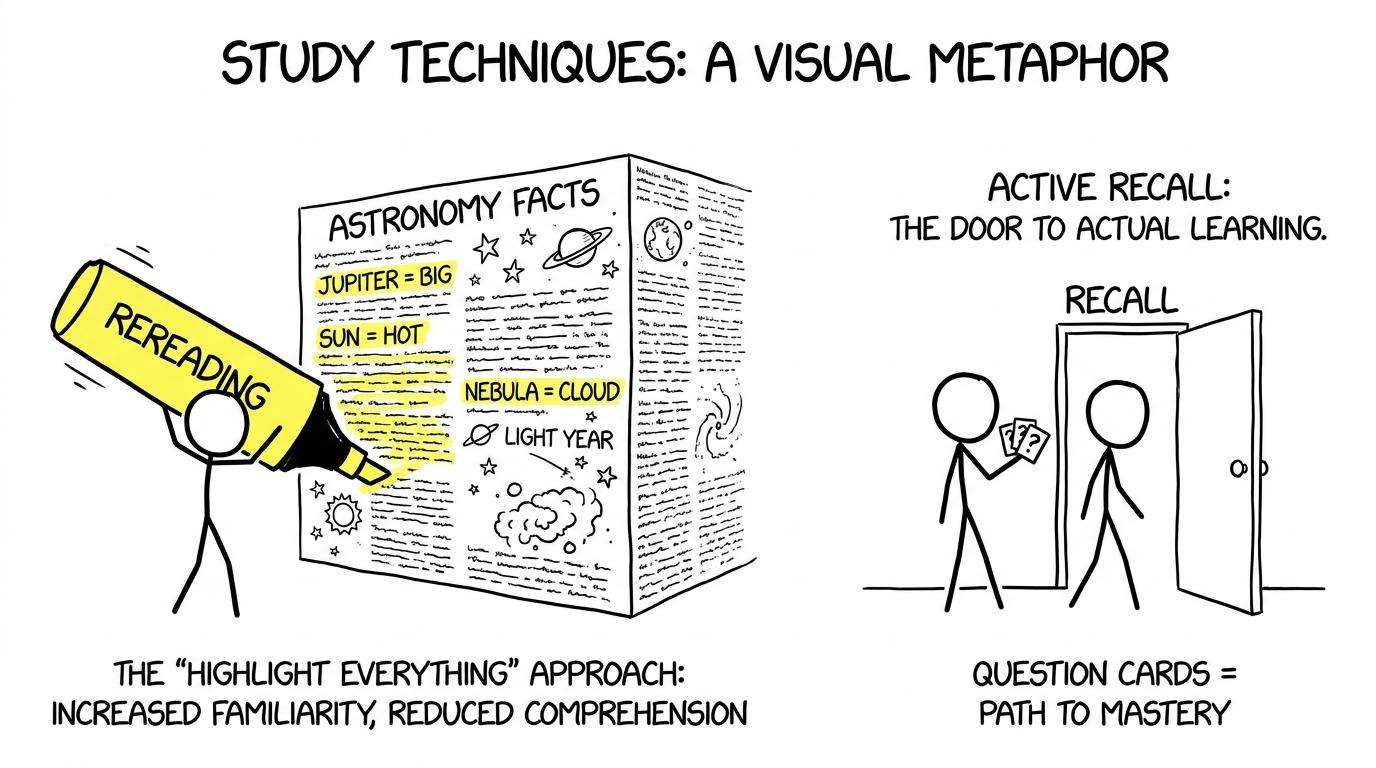 One student highlights endlessly while another escapes through active recall
Build a small question bank
Create a collection of short prompts for each specification topic. Mix factual questions with application prompts and observational scenarios. Keep answers concise enough to check quickly.
Sort each prompt into three piles:
- correct and confident;
- correct but hesitant;
- incorrect or incomplete.
Most of your next session should come from the final two piles. This makes revision responsive rather than repetitive.
Use your GCSE Maths skills to make Astronomy less hostile
At least 20%20\%20% of the marks in GCSE Astronomy written examinations assess mathematical skills. The specification includes standard form, ratios, percentages, inverse-square relationships, base-101010 logarithms, significant figures, formula rearrangement, graphs, gradients and angular measures.
Equations and key astronomical data are provided in the examination paper, so the central challenge is not memorising every formula. It is recognising which relationship applies, rearranging it correctly, substituting values, handling units and reporting a sensible answer.
This is good news if the science content feels overwhelming: mathematical methods can be practised as repeatable procedures.
Strengthen the highest-value techniques
Prioritise these skills:
- writing and calculating with standard form, a×10na\times10^na×10n, where 1≤a<101\leq a<101≤a<10;
- rearranging equations before substituting;
- using ratios and proportional reasoning;
- interpreting straight-line graphs, including gradient and intercept;
- working with degrees, minutes and seconds of arc;
- using a calculator confidently with powers, roots and logarithms;
- retaining full calculator values until the final rounding step.
Use MathsGenie’s Standard Form revision resources when astronomical distances and very large values become confusing. If angular problems expose a geometry weakness, revisit SOHCAHTOA and trigonometry. Choose the Maths page matching your own exam board where possible.
The broader GCSE Maths topics by board and tier guide can help you locate weaknesses in number, algebra, proportion, graphs and geometry. Astronomy itself is untiered, but your GCSE Maths course will still be foundation or higher tier.
Make observational questions predictable
Observational astronomy can feel vague because it combines scientific knowledge with practical judgement. Make it more structured by using the same planning framework whenever you meet an observation scenario:
- Purpose: What is being measured or recorded?
- Equipment: Why is each item suitable?
- Location and timing: What conditions are needed?
- Safety: What hazards must be controlled?
- Method: How will the observation be repeated consistently?
- Data: What will be recorded, and in which units?
- Quality: How could reliability, validity or accuracy be improved?
The specification requires observational experience, and observational knowledge is assessed in the written papers. Do not reduce this area to memorising equipment names. Practise explaining why a method is suitable and how it could be improved.
If you have missed an observation or do not understand your centre’s arrangements, speak to your teacher rather than trying to infer the requirements from revision notes.
Turn papers into a feedback system
A past paper is not a verdict on whether you are “good at Astronomy”. It is a tool for finding the next task.
Early in revision, answer individual questions or short sections with your notes closed. Later, complete longer timed sections. Use full papers when you have covered most of the content and need to develop timing and stamina.
After marking, classify every lost mark:
- missing knowledge;
- misunderstood command word;
- weak mathematical method;
- incorrect unit or rounding;
- poor interpretation of data;
- incomplete evaluation;
- rushed reading.
Write one repair action beside each error. “Revise stars” is too broad. “Recall the stages of stellar evolution, then answer one comparison question” is actionable.
MathsGenie’s article on when to start GCSE past papers shows how to move from diagnostic sections to timed papers. For your separate Maths exam, use GCSE predicted papers alongside revision lessons and mark schemes. Predicted Maths papers do not replace official Astronomy material, but they can strengthen the calculation skills that Astronomy questions require.
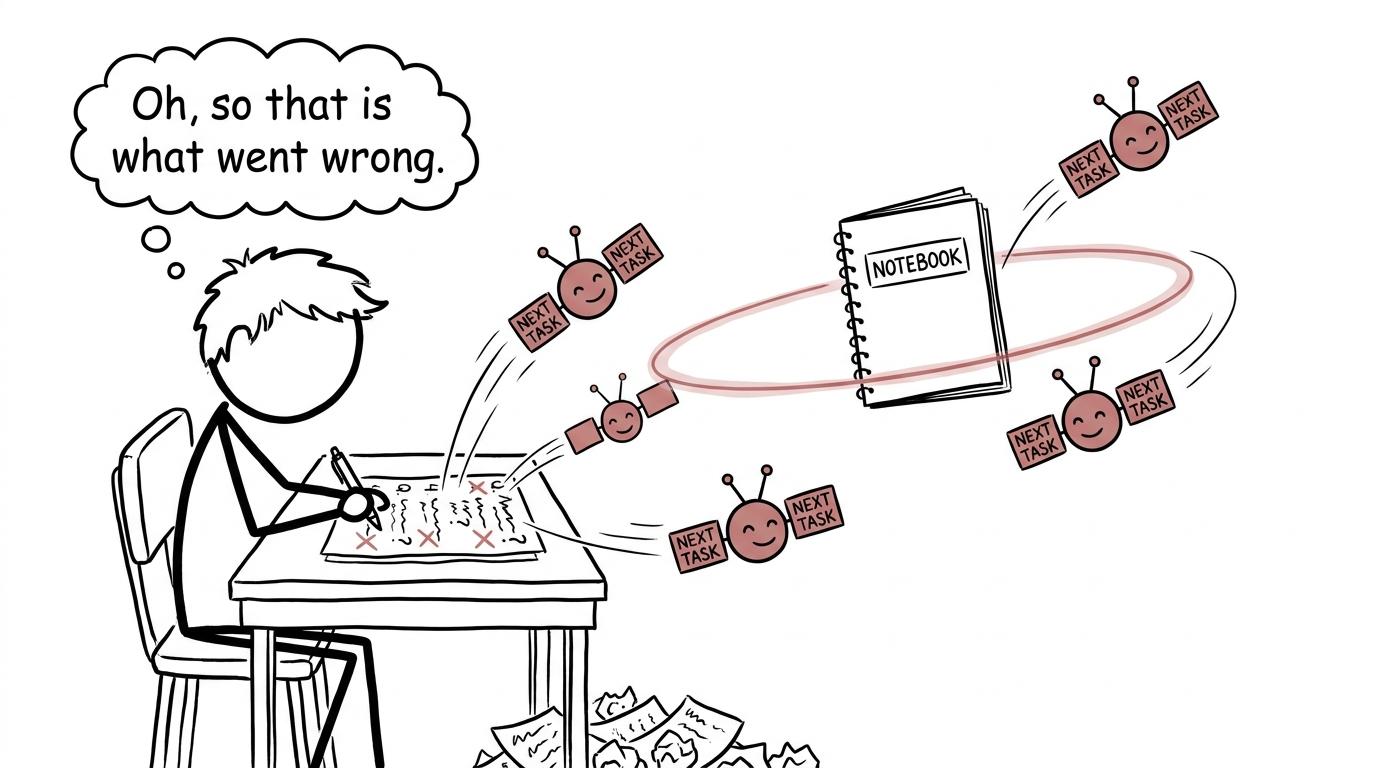 Mistakes from a marked paper become friendly satellites carrying next tasks
A revision routine for a subject you dislike
Try this repeatable 303030-minute session:
- First 555 minutes: answer old recall prompts without notes.
- Next 101010 minutes: learn one narrow specification point.
- Next 101010 minutes: answer exam-style questions on it.
- Final 555 minutes: mark, correct and schedule the next review.
On a difficult day, complete only the first 101010 minutes. On a better day, repeat the cycle with a second topic. Consistency matters more than occasional heroic sessions.
Keep Astronomy beside subjects you prefer in your timetable. Starting with a short disliked task and then moving to a more comfortable subject can make the whole session easier to begin. Just avoid continually moving Astronomy to “tomorrow”.
Common mistakes when revising GCSE Astronomy
Revising whole topics in one sitting
Large labels such as “the Solar System” hide many separate skills. Break the topic into specification statements, definitions, observations, diagrams and calculations.
Copying or highlighting notes
Neat pages can feel productive without testing memory. Close the book regularly and retrieve the material before checking it.
Avoiding calculations
Astronomy calculations become more intimidating when left until the end. Practise the underlying Maths skills separately, then return to astronomical contexts.
Completing papers without reviewing them
The useful part of a paper happens after marking. Record why each mark was lost, repair the weakness and reattempt the question after a gap.
Memorising the formula sheet
You will be given the required equations and astronomical data. Spend more time learning how to select, rearrange and use them than copying them repeatedly.
Ignoring observation and evaluation questions
Knowing facts about space is not enough. Practise planning observations, interpreting data and evaluating methods using precise scientific language.
You do not have to enjoy it to improve
Disliking a subject can make every unfinished chapter feel like evidence that you are behind. It is not. It is simply a sign that your revision method must rely less on enthusiasm and more on structure.
Choose one amber topic today. Work for 101010 minutes. Retrieve, practise, mark and write the next action. Then stop if you need to. A small completed loop is more valuable than an ambitious plan you continually avoid.
MathsGenie can support the mathematical layer beneath GCSE Astronomy with free revision lessons, practice questions, mini tests, mark schemes and video solutions. Start with the skill that is costing you marks, then test it through GCSE Maths predicted papers and carefully reviewed paper practice. You may never choose Astronomy as your favourite subject. You can still make it manageable and become much better prepared for the exam.










