

Harder: GCSE English Language and Literature?
Harder GCSE English Language and Literature or English Language? Compare workload, exam demands and revision, then balance English confidently with GCSE maths.
A revision timetable can look manageable until English occupies three different boxes: Language, Literature and the reading you meant to finish last weekend. If you are wondering which is harder: GCSE English Language and Literature or English Language, the direct answer is this: taking both Language and Literature creates the greater overall workload, but Language alone can feel less predictable.
Literature asks you to know set texts, themes, characters, context and quotations. Language usually gives you unfamiliar material in the exam, so success depends more on transferable reading and writing skills. The harder option therefore depends on what you find difficult: remembering content, responding under pressure or managing several subjects at once.
For a student also preparing for GCSE maths, that distinction matters. English and maths compete for revision time, but they reward rather different kinds of practice.
The comparison at a glance
Use this checklist before deciding where your revision time should go:
- Language and Literature together involve more content and more examination time overall.
- Literature normally carries the heavier memory burden because you study set texts and poetry.
- Language is usually less predictable because the reading extracts are unseen.
- Both require timed writing, careful analysis and accurate communication.
- Neither English qualification has foundation and higher tiers in the way GCSE maths does.
- Your exact papers, texts and assessment structure depend on your exam board and specification.
The important comparison is not simply which subject has more pages in a revision guide. It is which type of demand is most likely to cost you marks.
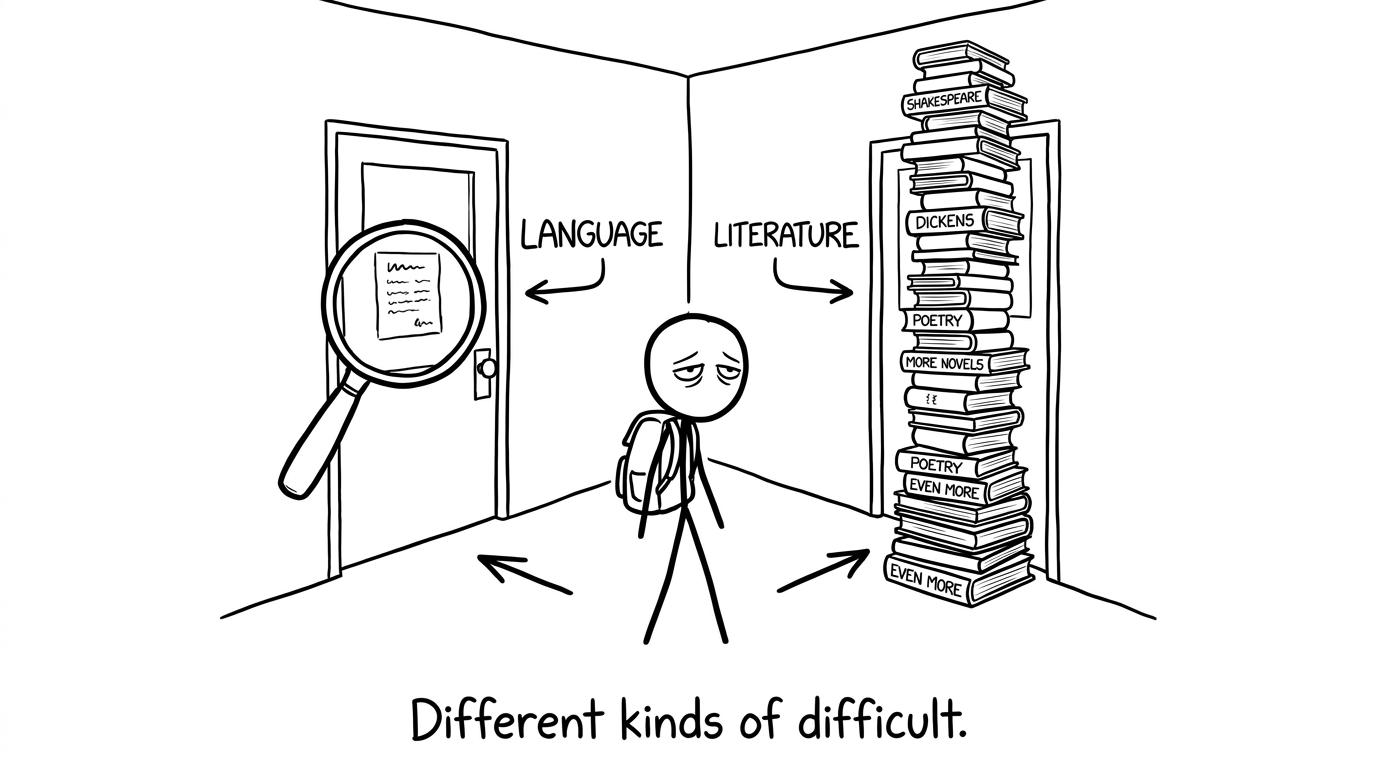 A student choosing between different kinds of English difficulty
What GCSE English Language actually demands
GCSE English Language tests how well you can understand and evaluate unfamiliar texts, compare ideas where required, and communicate effectively in your own writing. Depending on the exam board, this can include fiction, literary non-fiction and other non-fiction from different periods.
The challenge is uncertainty. You cannot memorise the extract that will appear, just as you cannot memorise every possible question on a maths paper. You prepare by building a dependable method:
- read questions precisely;
- select relevant evidence;
- explain how language or structure creates meaning;
- evaluate ideas rather than merely identifying techniques;
- plan writing quickly;
- control vocabulary, sentences, paragraphs, spelling and punctuation.
For example, AQA GCSE English Language currently uses two written papers, while spoken language is reported separately and does not contribute to the numerical GCSE grade. Other boards, including Edexcel, OCR and Eduqas, organise their assessments differently. Always use the specification issued for your own course rather than assuming that advice for another board applies unchanged.
Language can be particularly difficult for students who prefer fixed content and definite answers. In maths, a correct calculation may lead to an exact result. English Language responses are judged through assessment objectives, and several interpretations may be valid when they are supported convincingly.
That does not make Language random. Mark schemes reward identifiable skills. Regular timed practice makes the unfamiliar feel more familiar.
What GCSE English Literature adds
English Literature is a separate GCSE. Students study prescribed texts chosen according to their exam board's specification. These may include a Shakespeare play, a nineteenth-century novel, modern prose or drama, and poetry.
Literature adds three substantial demands.
More material to retain
You need secure knowledge of plot, character development, themes and significant moments. You may also need relevant contextual understanding and a useful selection of short quotations. The aim is not to memorise an essay for every imaginable question. It is to build flexible knowledge that can be applied to the question actually set.
Connections across an entire text
An extract is rarely the whole task. Strong responses often connect the printed passage or named theme to other moments in the work. That requires a mental map of the text, not just close analysis of one paragraph.
Several forms of analysis
A play, novel and poem do not behave in exactly the same way. Students must discuss methods accurately while maintaining an argument. Poetry comparison can add another layer because ideas, language, structure and form must be connected across two poems.
This is why Language and Literature together are normally harder in terms of total workload. You still need Language's unseen reading and writing skills, but you also carry Literature's set-text knowledge into the exam season.
A fair workload comparison
| Area of difficulty | English Language alone | Language and Literature together |
|---|---|---|
| Content to revise | Lower volume, with emphasis on transferable skills | Higher volume because set texts and poetry are added |
| Predictability | Unseen material can make papers feel uncertain | Literature content is known, although questions are not |
| Memory | Methods, structures and vocabulary remain important | Text knowledge, quotations, themes and methods add a heavier burden |
| Timed writing | Several developed responses under strict timing | Timed writing across both qualifications |
| Independent reading | Practice with varied unseen texts | Practice plus rereading and revisiting set texts |
| Overall examination load | One GCSE qualification | Two separate GCSE qualifications |
The table reveals an important distinction: workload and difficulty are not identical. Literature may require more hours, yet some students find it reassuring because the texts are known. Language contains less prescribed content, yet an unfamiliar extract can expose weak reading habits immediately.
A student who enjoys novels and remembers quotations may find Literature more manageable. A student who writes fluently but dislikes retaining textual detail may prefer Language. Neither reaction proves that one qualification is universally easier.
Why maths students may experience the subjects differently
Students who enjoy GCSE maths often value visible progress. You learn a method, answer questions, check the mark scheme and identify the precise step that went wrong. English improvement can initially feel less measurable.
The solution is to make English practice more diagnostic, while keeping maths revision equally structured.
After an English response, identify one target: evidence selection, analysis, paragraph control, technical accuracy or timing. After a maths paper, classify each lost mark by topic or error type. MathsGenie's GCSE maths revision lessons help you move from that diagnosis to targeted videos and questions rather than restarting an entire course.
Past papers are useful in both subjects, but only when they produce a next action. Use the relevant English materials supplied by your school or exam board, then use MathsGenie's Edexcel GCSE maths past papers, AQA GCSE maths papers or OCR GCSE maths papers for your maths specification.
The exam boards do not necessarily assess English in identical ways, and the same is true of maths. Matching every resource to the correct board prevents wasted practice.
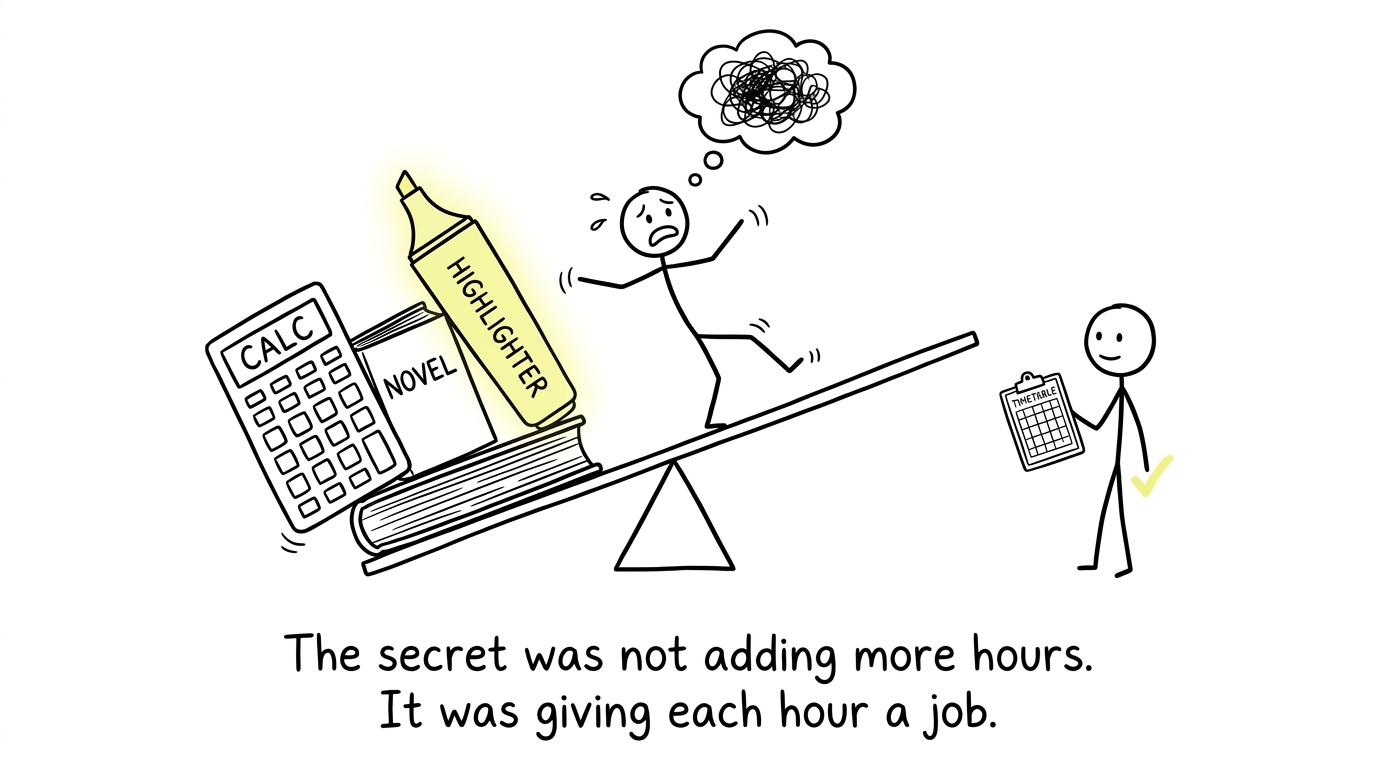 A revision timetable bringing order to English and maths
How to divide revision time fairly
Do not automatically split your time equally between Language, Literature and maths. Equal time can be unfair when the weaknesses are unequal.
A better weekly plan has three layers:
Protect regular maths practice
Maths methods fade when they are left untouched for long periods. Use short, recurring sessions for topic questions and mini tests. As exams approach, add full papers and MathsGenie's GCSE predicted papers alongside official past papers.
Predicted papers are practice tools, not promises about what will appear. Their value lies in giving you fresh, exam-style questions after familiar past papers have been used.
Separate Language skills from Literature knowledge
Do not label a session simply as “English”. Decide whether its purpose is unseen reading, transactional or creative writing, quotation recall, poetry comparison, or set-text planning. A specific task is easier to begin and easier to review.
Allocate time according to evidence
Use marked work, teacher feedback and practice papers. If Literature knowledge is secure but Language timing is weak, another evening of quotation cards may feel productive without addressing the real problem. The same trap appears in maths when students repeatedly practise comfortable topics.
If you are already thinking beyond GCSE, MathsGenie's A Level maths revision resources show how this habit continues: effective revision becomes increasingly selective, not simply longer.
Which option is harder under exam pressure?
Language often creates the sharper surprise. The source is unseen, and a difficult opening paragraph can make a student feel behind almost immediately. Literature creates a different pressure: the question may focus on a character, theme or poem you revised less confidently.
In both cases, timing matters because later questions often require substantial writing. Spending too long perfecting an early answer can sacrifice marks elsewhere.
Practise finishing papers, not merely starting them. A complete response written within the permitted time provides better evidence about exam readiness than an impressive paragraph produced without a limit. The same principle applies when using GCSE maths past papers and mark schemes: the clock is part of the assessment.
 An exam clock making an inconvenient escape
Common mistakes when comparing the options
Treating Language and Literature as one qualification
They are separate GCSEs, even when lessons are grouped together on a timetable. Comparing both with Language alone means comparing two qualifications with one, so the overall workload will naturally be greater.
Assuming less memorisation means easier
Language has less prescribed textual content, but it requires rapid interpretation and adaptable writing. You cannot compensate for weak reading skills by memorising a universal paragraph.
Revising Literature only through quotations
Quotations are tools, not complete analysis. Without knowledge of character, theme, structure and the wider text, remembered phrases may not answer the question.
Using advice for the wrong exam board
AQA, Edexcel, OCR and Eduqas can differ in paper structure, source material, set texts and task wording. Check the board, qualification title and current specification on your school documents.
Allowing English to replace maths practice completely
A looming Literature paper can make every other subject feel less urgent. However, abandoning maths for a week often creates a backlog of forgotten methods. Keep a small amount of maths practice active, then expand it when the English deadline passes.
The sensible verdict
GCSE English Language and Literature together are harder in terms of total content, revision hours and examination load. GCSE English Language alone is lighter overall, but it is not automatically easy. Its unseen sources and timed writing can make it the less predictable qualification.
The useful question is therefore not “Which subject should frighten me more?” It is “Which demand needs my next focused session?” Literature may need text knowledge. Language may need timed analysis. Maths may need practice on one weak topic.
MathsGenie gives that maths session a clear starting point. Use the free revision lessons, video solutions, practice questions and mini tests to repair individual gaps, then test your progress with past papers, mark schemes and predicted papers. Add those tasks to your revision planner, keep English sessions specific, and let evidence, rather than panic, decide what you revise next.











