Which Is Harder: GCSE Economics or Business?
Harder GCSE Economics or Business? Compare content, maths, exams and revision workload to discover which GCSE subject may suit your strengths best.
Choosing a GCSE can feel strangely permanent. You see two subject names on an options form, but you cannot yet see the lessons, homework or exam questions hiding behind them. If you are wondering which is harder, GCSE Economics or Business, the short answer is that Economics is usually more conceptually demanding, while Business often involves a broader volume of case-study application.
That does not make Economics universally harder. A student who enjoys analysing markets, government decisions and chains of cause and effect may find it more natural. Someone who prefers practical decisions about marketing, finance and operations may feel more comfortable in Business.
The fairest choice depends on how you think, not which subject has the friendlier name.
The comparison at a glance
| Area | GCSE Economics | GCSE Business |
|---|---|---|
| Main focus | Markets, consumers, firms, government and the wider economy | How businesses start, operate, compete and make decisions |
| Style of thinking | Abstract models and connected cause-and-effect reasoning | Practical application to businesses and case studies |
| Written workload | Explanation, analysis and evaluation | Application, analysis and evaluation |
| Maths content | Percentages, averages, ratios, graphs and economic data | Revenue, costs, profit, cash flow, percentages and business data |
| Typical difficulty | Understanding unfamiliar economic relationships | Remembering content and applying it precisely to a scenario |
| Best suited to | Students curious about markets, policy and current affairs | Students interested in firms, entrepreneurs and commercial decisions |
Both are full GCSE qualifications assessed through written examinations. The exact paper lengths, question styles and topic organisation depend on the specification used by your school. GCSE Economics is offered by exam boards including AQA and OCR, while GCSE Business is available through boards including Edexcel, AQA, OCR and Eduqas.
Before choosing, ask your school which specification it teaches. Comparing generic subject descriptions is useful, but your actual course will be determined by that specification.
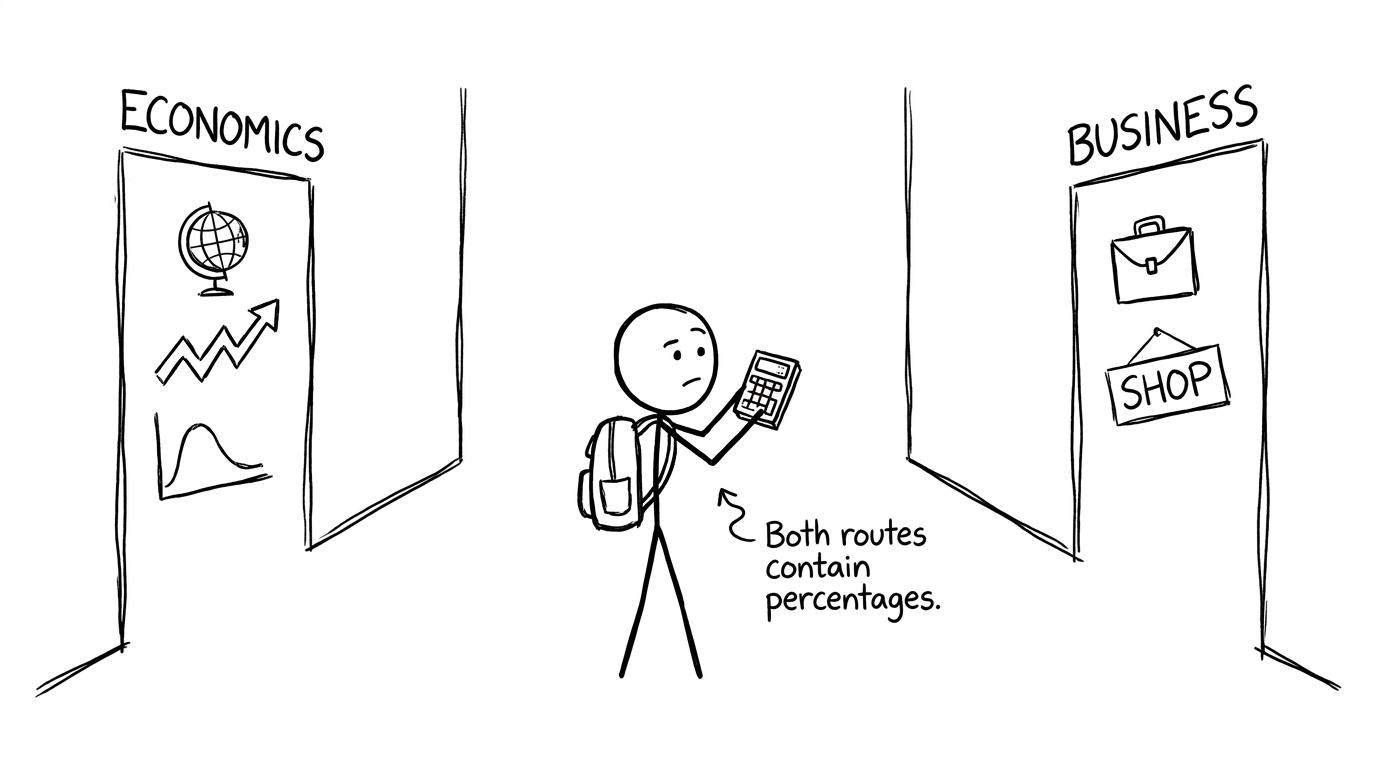 A student choosing between Economics and Business while holding a calculator
Why GCSE Economics can feel harder
Economics asks you to think about systems in which one change can produce several consequences. A rise in demand may affect price, production, employment and the decisions of firms. Government action may help one group while creating costs for another.
The difficult part is rarely remembering a definition in isolation. It is building a logical chain and recognising when the outcome depends on context.
You may study areas such as:
- how markets allocate scarce resources
- supply, demand and price
- competition and the behaviour of firms
- labour markets and income
- economic growth, inflation and unemployment
- government objectives and policies
- international trade and globalisation
These ideas can feel abstract because the economy is not a single organisation you can observe. It is a network of households, firms, financial institutions and governments. Strong answers therefore need precise terminology and disciplined reasoning.
Economics also requires evaluation. It is not enough to say that a policy will be beneficial. You must consider who benefits, the possible disadvantages, the time period and the conditions under which the judgement might change.
For students who like asking, “What happens next?”, that complexity can be engaging rather than intimidating.
Why GCSE Business can feel harder
Business often looks more familiar. Most students recognise shops, brands, adverts and prices, so the opening topics may seem immediately accessible. The challenge appears later: everyday familiarity is not the same as exam precision.
Typical content includes:
- enterprise and business ownership
- business aims and stakeholders
- marketing and market research
- operations and production
- recruitment, training and motivation
- finance, revenue, costs and profit
- external influences on business decisions
The workload can feel substantial because every functional area brings its own vocabulary, advantages, disadvantages and decision-making factors. You then have to apply that knowledge to the business described in the question.
A generic statement such as “advertising increases sales” may earn limited credit if it ignores the case study. A stronger response connects the method to the firm's product, market, budget or objective. Business rewards students who can move from knowledge to context quickly.
Longer answers also require balance. A decision that improves profit may upset employees, require borrowing or damage quality. The best judgement depends on the evidence supplied, not a memorised conclusion.
Which subject involves more maths?
Neither GCSE is designed to be as mathematically demanding as GCSE Maths. However, both include quantitative skills, and neither allows you to avoid numbers completely. Official specifications require students to interpret and use numerical information, although the exact balance and presentation vary by exam board.
Business calculations often feel more direct. You may work with revenue, total costs, profit, percentages, cash flow, averages or financial performance. Important relationships include:
profit=revenue−total costs\text{profit} = \text{revenue} - \text{total costs}profit=revenue−total costsand
revenue=selling price×quantity sold.\text{revenue} = \text{selling price} \times \text{quantity sold}.revenue=selling price×quantity sold.Economics uses maths to interpret markets and economic evidence. You may need to read graphs, compare data, calculate percentage changes or use ratios and averages. The percentage-change relationship is:
percentage change=new value−original valueoriginal value×100.\text{percentage change} = \frac{\text{new value} - \text{original value}}{\text{original value}} \times 100.percentage change=original valuenew value−original value×100.The arithmetic is generally accessible. The harder step is often explaining what the result means in context. A correct calculation without an interpretation may not fully answer the question.
Students preparing for either subject can strengthen the underlying skills through MathsGenie's percentage change revision, ratio practice and averages revision. Confidence with graphs and data is particularly helpful in Economics, while compound interest revision develops careful financial reasoning.
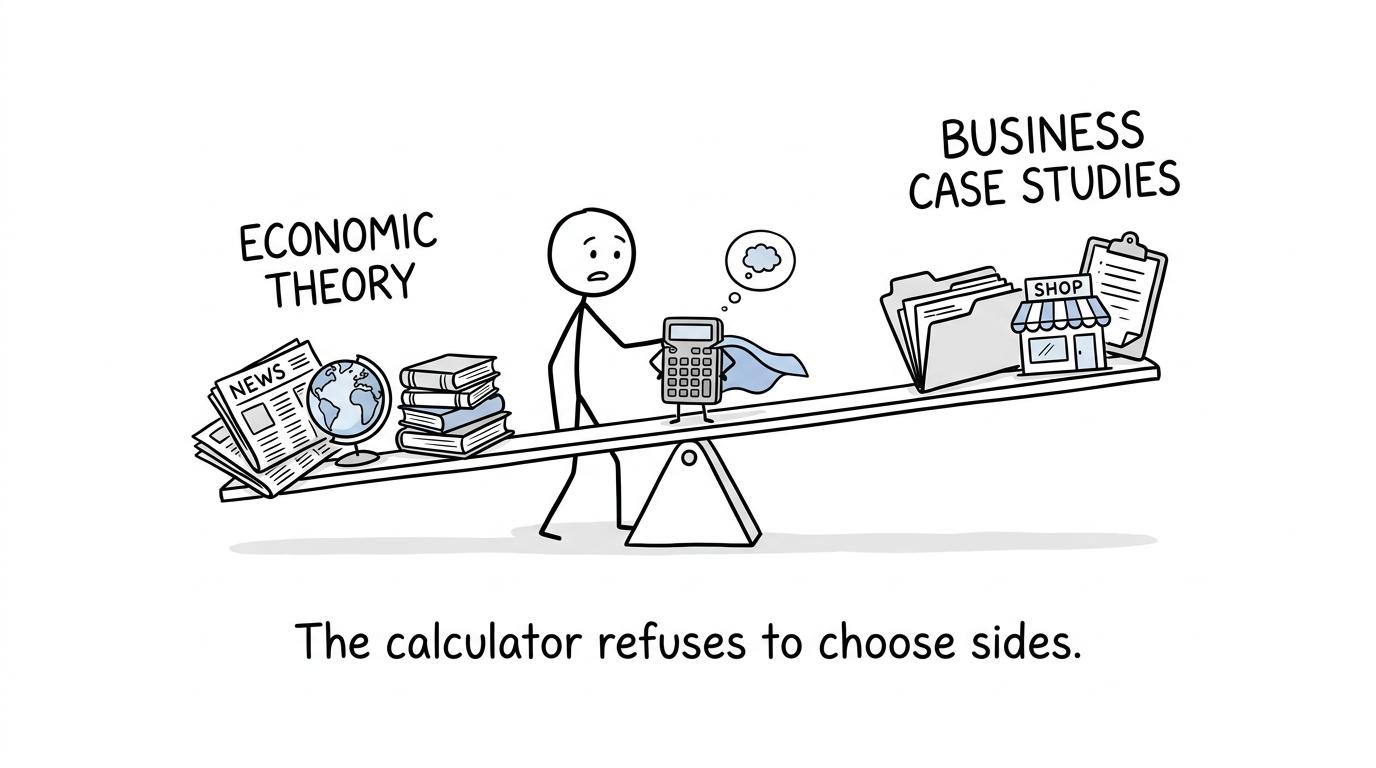 A calculator balancing economic theory and business case studies
Comparing the actual revision workload
Difficulty and workload are related, but they are not identical.
Economics revision workload
Economics contains fewer ideas that feel completely separate from one another. Supply and demand connect to prices; prices connect to firms and consumers; government policy connects to wider economic objectives. Once these relationships become clear, revision can become more efficient.
The initial learning curve may be steeper, however. You need to understand diagrams, use economic vocabulary accurately and explain chains of reasoning. Reading about economic developments can improve context, but your examination answers must remain rooted in the specification and the information in the question.
Economics revision works best when you:
- link topics rather than revising every definition separately
- practise interpreting tables, charts and market diagrams
- build clear cause-and-effect chains
- compare short-run and long-run consequences where relevant
- make judgements based on the evidence provided
Business revision workload
Business may require more repeated retrieval because there are many functional areas and decision-making factors. You need secure knowledge, but you must also recognise which part of that knowledge matters to a particular organisation.
Revision should not become a collection of generic advantage-and-disadvantage lists. Those lists are only a starting point. Effective practice involves selecting a point, applying it to the case and explaining its likely effect on an objective such as profit, growth, customer satisfaction or survival.
Business revision works best when you:
- learn key terms and formulae accurately
- organise content by marketing, finance, operations and human resources
- practise extracting useful details from case studies
- connect decisions to business objectives
- complete timed extended-response questions
On balance, Economics often demands deeper conceptual understanding earlier. Business may feel more manageable at first but can create a heavier memory-and-application workload as the course expands.
Think about the exam skill, not just the subject name
A student can enjoy watching business programmes yet dislike writing contextual judgements. Another can follow current economic news but struggle to explain a market diagram precisely. Interest helps, but exam compatibility matters too.
Consider these questions:
- Do you enjoy following a chain of consequences across a whole system?
- Are you comfortable interpreting graphs and numerical evidence?
- Would you rather analyse government policy or a firm's decision?
- Can you apply theory to an unfamiliar case rather than repeat a prepared answer?
- Do you prefer connected concepts or clearly separated functional topics?
If you favour systems, arguments and policy, Economics may suit you. If you favour practical organisational decisions, Business may be the better fit.
Do not choose solely because friends say one is easier. Teacher expertise, lesson time, class resources and your own motivation can affect the day-to-day difficulty more than the subject label.
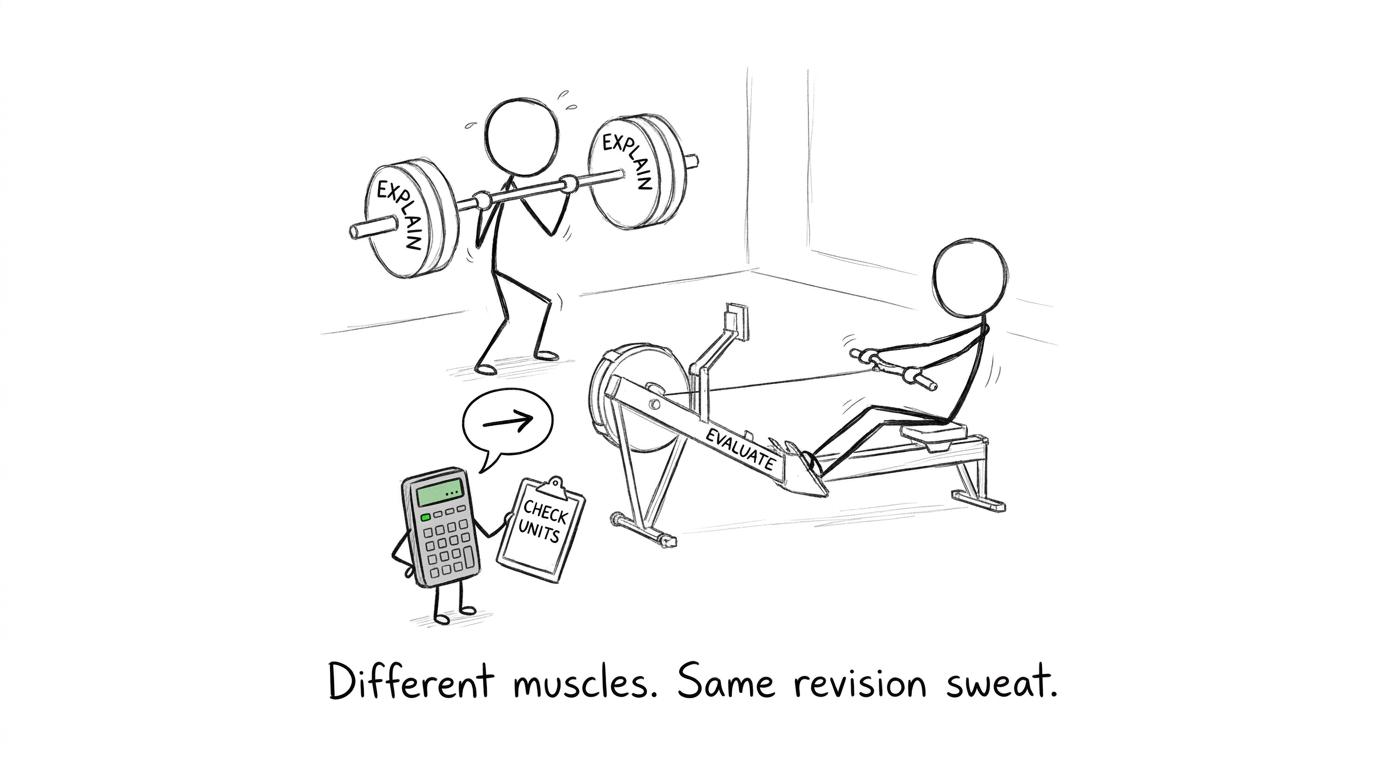 Students training different exam skills in a revision gym
How GCSE Maths preparation helps with both
The overlap with maths is useful because quantitative questions are often dependable marks once the method is secure. The same habits matter in both subjects:
- write down the relevant figures before calculating
- check whether the question asks for a value, ratio or percentage
- include units such as pounds, people or percentage points where required
- distinguish an increase in value from a percentage increase
- interpret the answer using the context
- check whether the result is reasonable
MathsGenie's GCSE maths revision lessons organise topics by grade and include videos, practice questions and answers. Once you have revised a skill, use GCSE maths past papers to practise recognising it without being told which method to use.
That transition matters. In a lesson, the heading tells you the technique. In an examination, the context has to trigger it.
Common mistakes when comparing the subjects
Assuming Business has almost no maths
Business includes regular numerical work. The calculations may not be highly advanced, but inaccurate percentages, incorrect units and weak interpretation can still cost marks.
Assuming Economics is just current affairs
Awareness of economic events may provide context, but GCSE Economics is a structured academic course. Marks come from using the concepts, evidence and command words required by the specification.
Judging difficulty from one sample question
A short calculation cannot represent an entire Business course, just as one supply-and-demand question cannot represent all of Economics. Review complete specifications and several papers before deciding.
Ignoring extended writing
Both subjects require more than factual recall. Analysis and evaluation need connected reasoning, relevant context and a supported conclusion. Students who dislike extended responses should not assume either course is mainly multiple choice or calculation.
Choosing based on supposed grade boundaries
Grade boundaries can vary between exam series because papers vary in difficulty. They are not a reliable measure of which subject will be easier for an individual student.
So, which one should you choose?
For many students, GCSE Economics is harder conceptually. It deals with abstract systems, interconnected outcomes and policies whose effects are rarely simple. GCSE Business is not automatically easier: it carries a significant content burden and demands consistent application to unfamiliar organisations.
Choose Economics if markets, government policy and wider social questions make you curious enough to follow complicated chains of reasoning. Choose Business if you would rather examine how organisations make practical decisions about people, products, operations and money.
Whichever route you take, reliable numeracy creates breathing room. Use MathsGenie's free GCSE revision resources to secure percentages, ratios, averages and graphs, then test your judgement with past papers and mark schemes. As the examination approaches, predicted papers can provide further timed practice alongside your subject-specific revision.
The easier subject is rarely the one with the shortest description. It is the one whose questions make you willing to keep thinking after the obvious answer has run out.