Group vs 1:1 Tutoring GCSE Spanish: Which Wins?
Group vs 1:1 tutoring GCSE Spanish: compare feedback, speaking practice, cost and confidence to choose support that fits your revision needs.
The hardest part of choosing a tutor is not finding someone who knows Spanish. It is working out what kind of support will make you speak, listen and think more confidently when the exam arrives.
For group vs 1:1 tutoring GCSE Spanish, the short answer is this: one-to-one tutoring is usually better for highly personalised feedback, targeted intervention and students who feel unable to participate in a group. Small-group tutoring is often better for varied conversation, peer learning, motivation and affordability. Neither format wins automatically. The quality of the tutor, the size and suitability of the group, and the way sessions connect to your specification matter more than the label.
This matters when Spanish is only one part of a crowded GCSE timetable. If maths is competing for the same revision hours, the free GCSE Maths revision hub can reduce that pressure with organised lessons, questions and papers while you decide where paid Spanish support would make the greatest difference.
The quick decision checklist
Choose one-to-one Spanish tutoring if you:
- have specific gaps in grammar, pronunciation or exam technique
- need a tutor to work at your exact pace
- become quiet or distracted in groups
- require intensive support before a speaking assessment
- want every task matched to your tier and exam board
Choose small-group Spanish tutoring if you:
- learn well by hearing other students answer
- need frequent, varied speaking practice
- find individual sessions too intense
- are motivated by a shared routine
- want to divide the cost of a tutor
Before choosing either, confirm your GCSE Spanish exam board, tier and specification. AQA, Pearson Edexcel and Eduqas offer current GCSE Spanish qualifications, but their paper structures and timings are not identical. Do not assume your Spanish board is the same as your maths board.
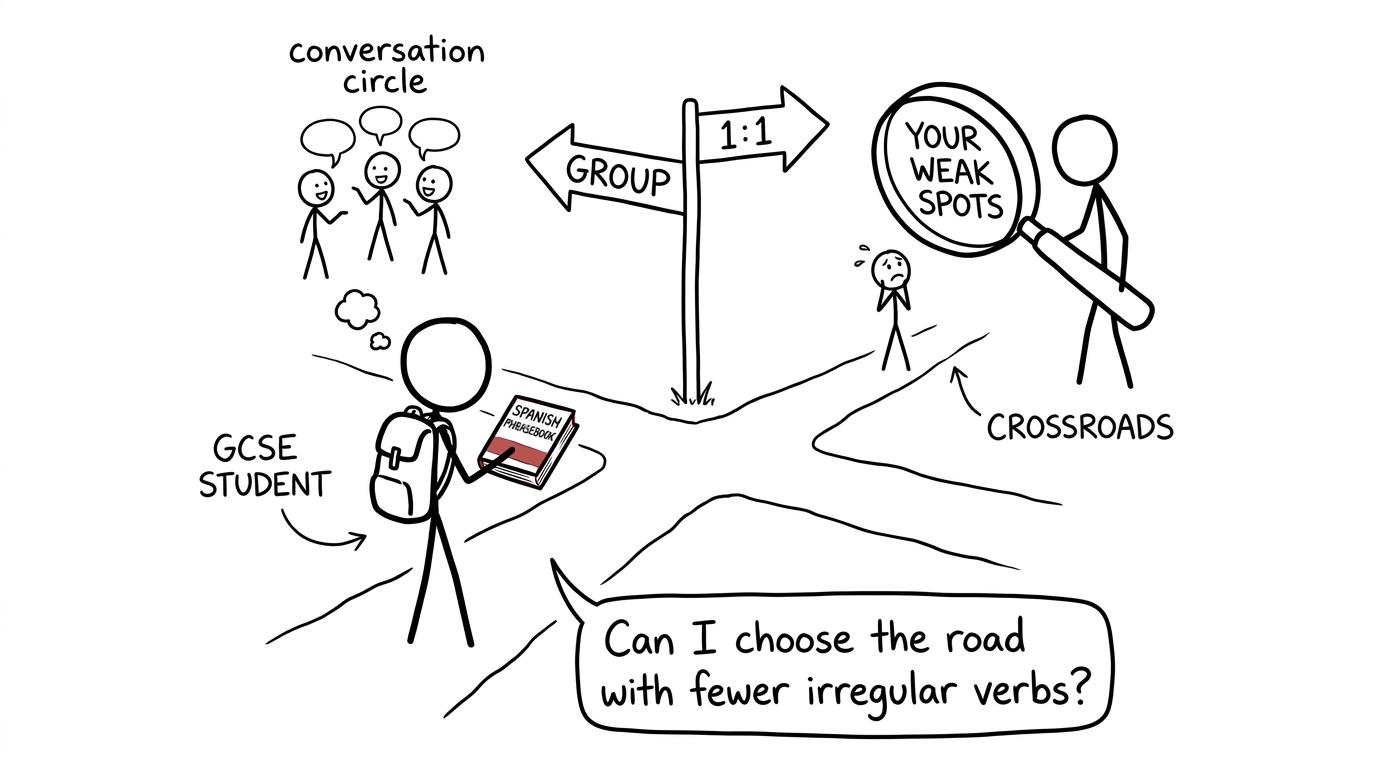 A GCSE student choosing between group and one-to-one Spanish tutoring
What GCSE Spanish tutoring needs to cover
The current GCSE French, German and Spanish subject content was introduced for first teaching in September 2024, with first examinations in summer 2026. Current specifications assess receptive and productive language skills, including listening, speaking, reading and writing. Tasks can include dictation, reading aloud, role-play, discussion of visual material and translation, although you must check the precise format for your board.
That range changes the tutoring decision. A student may be strong at recognising written vocabulary but struggle to produce a spontaneous spoken response. Another may speak confidently while losing marks through adjective agreement, verb endings or inaccurate spelling.
A useful tutor should therefore begin with diagnosis, not a generic tour through every topic. Ask whether the tutor will:
- check your current level in all four language skills
- use material aligned with your board and tier
- give specific feedback rather than general praise
- revisit previous errors
- include timed and unprepared tasks
- monitor whether the same mistakes are disappearing
This principle is familiar in maths revision. A paper exposes the gap; focused practice repairs it. MathsGenie students can use Edexcel GCSE Maths mini tests to diagnose a narrow weakness before returning to a lesson or question set. Spanish tutoring should create an equally clear feedback loop.
The real strengths of one-to-one GCSE Spanish tutoring
Personalised attention
In a one-to-one session, every hesitation is visible. A tutor can notice that you avoid the past tense, confuse two common sounds or rely on a small collection of memorised phrases. The lesson can then change immediately.
This is particularly useful when the problem is precise. If your reading is secure but your speaking becomes fragmented under pressure, spending equal time on every skill would be inefficient. Individual tutoring allows a greater proportion of the session to be devoted to that weakness.
A safer place to make mistakes
Some students need privacy before they are willing to experiment with a language. If fear of embarrassment prevents you from speaking in class, individual sessions can create a lower-pressure starting point.
The goal, however, should not be permanent comfort. GCSE speaking includes interaction, so a good tutor will gradually introduce unfamiliar questions, time pressure and moments when you must recover without a prepared script.
Faster, more detailed feedback
One-to-one tuition gives the tutor more time to explain why an answer is inaccurate and ask you to improve it immediately. Written work can also receive closer analysis of grammar, vocabulary selection and whether every part of the task has been addressed.
Research synthesised by the Education Endowment Foundation indicates that one-to-one tuition can be effective when it is targeted and linked with normal classroom teaching. Its evidence also shows mixed results when one-to-one and very small groups are compared. In other words, individual tuition has genuine advantages, but it is not automatically superior to a well-run group.
The limitations of one-to-one tuition
It is normally the more expensive option. It may also become passive if the tutor talks for most of the session or repeatedly rescues the student from difficult questions. A quiet student can appear busy while producing surprisingly little Spanish.
Ask a simple question after a trial lesson: How much listening, speaking, reading or writing did I actually do? Tutor attention matters only when it turns into student practice.
The real strengths of group GCSE Spanish tutoring
More varied conversation
Language is social. A good group lets you hear different accents, vocabulary choices and ways of responding. Role-plays can change partners, discussions can develop naturally, and you cannot predict every answer in advance.
That unpredictability is useful preparation. GCSE Spanish is not only a memory test. Students must understand and respond, sometimes with limited preparation.
Learning from other students' errors
When another student makes a mistake, you have a chance to notice and correct it mentally. When they give a strong answer, you hear a structure you might adapt. This creates more examples than one tutor and one student may naturally produce.
There is also a quiet motivational benefit. A regular small group makes attendance visible. Other students are expecting you, and shared effort can make revision feel less isolating.
Better value when the group is genuinely small
The Education Endowment Foundation defines small-group tuition as a tutor working with two to five pupils. Its evidence review finds that small groups can be effective and cost-efficient, particularly when teaching is targeted to pupils' needs. It also warns that effectiveness tends to decline once groups become larger than six or seven.
That distinction is important. A carefully matched group of four is not the same experience as an online class of fifteen. Before paying, ask for the maximum group size and how speaking time is distributed.
The limitations of group tutoring
A group can move too quickly for one student and too slowly for another. Confident speakers may dominate, while quieter students disappear behind written exercises. Mixed exam boards, tiers or ability levels can also lead to unfocused teaching.
Group tutoring works best when students have reasonably similar needs and the tutor actively manages participation. Equal attendance is not enough; everyone needs meaningful turns, individual feedback and work between sessions.
Group vs 1:1 tutoring GCSE Spanish compared
| Factor | One-to-one tutoring | Small-group tutoring |
|---|---|---|
| Lesson focus | Closely matched to one student's gaps | Must balance several students' needs |
| Speaking practice | Intensive interaction with one tutor | More varied partners and responses |
| Feedback | Immediate and highly detailed | Less individual time, but peer learning adds value |
| Pace | Can change instantly | Usually follows the shared pace |
| Confidence | Private setting may suit anxious students | Supportive peers can reduce isolation |
| Cost | Usually higher per student | Usually lower because the cost is shared |
| Best fit | Specific weaknesses or intensive intervention | Conversation, motivation and broader practice |
The best choice may also change over time. A student could use a short block of one-to-one sessions to repair pronunciation or grammar, then move into a group to practise spontaneous conversation. Another might attend a weekly group and book one individual session to analyse a mock assessment.
Match the format to the student, not the grade target
Choose one-to-one for a narrow obstacle
Individual support is sensible when you can describe the problem clearly: inaccurate verb forms, difficulty understanding spoken Spanish, weak pronunciation, missing work through absence or uncertainty about how to approach a particular assessment task.
It can also suit students targeting the highest grades when they already have strong foundations and need precise feedback. But it is equally valuable for a Foundation-tier student who needs patient rebuilding. One-to-one tutoring is not reserved for either end of the grade range.
Choose a group for fluency and consistency
A group is often effective when knowledge exists but retrieval is slow. Regular conversation encourages students to find language without waiting for perfect certainty. It can also make a weekly routine easier to maintain.
This is similar to moving from topic questions into mixed maths practice. Once methods are understood, students need to recognise and apply them without being told what comes next. The AQA GCSE Maths revision area and OCR GCSE Maths revision area organise board-specific practice so that students can build the same kind of independent recall in maths.
Consider your entire GCSE timetable
Tutoring only helps if it leaves enough time to practise independently. A brilliant Spanish session can still be a poor decision if travel, homework and cost remove the time needed for maths, English or science.
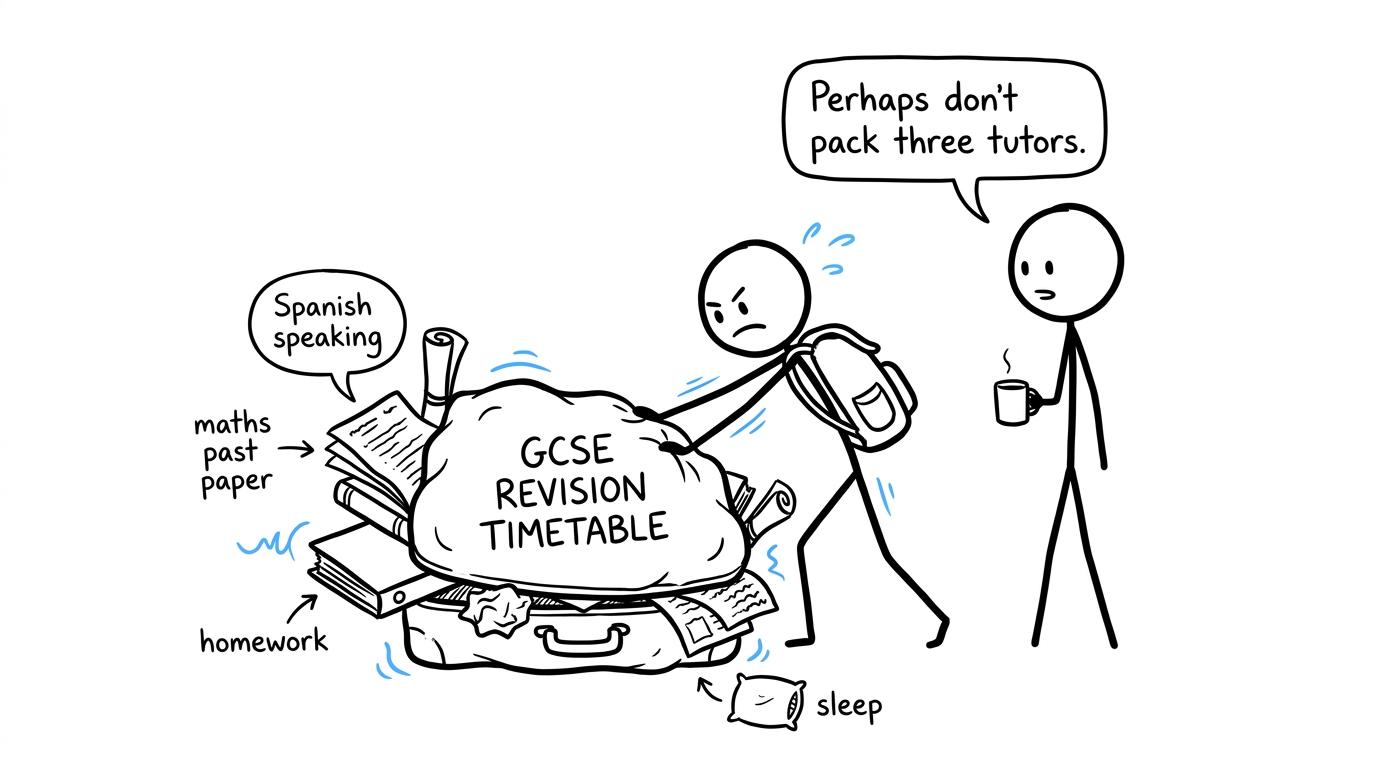 A GCSE revision timetable packed like an overflowing suitcase
Protect the subjects that do not require paid support. For maths, you can combine free topic revision with Edexcel GCSE Maths past papers, then use mark schemes and worked solutions to decide what to revisit. Nearer the exams, Edexcel GCSE Maths predicted papers can provide additional unseen practice alongside official papers.
Questions to ask before booking a Spanish tutor
A trial lesson should reveal more than whether the tutor seems friendly. Ask:
- Which GCSE Spanish specifications do you teach?
- How do you diagnose weaknesses across the four skills?
- What is the maximum group size?
- How much Spanish will I produce in each lesson?
- How is written and spoken feedback recorded?
- Will you use timed, unprepared tasks?
- How will progress be reviewed with school assessments?
- What independent practice is expected between sessions?
Be cautious if the answer relies entirely on predicted questions or memorised scripts. Familiar phrases can be useful, but students also need adaptable grammar, secure vocabulary and the ability to respond to unfamiliar material.
Common mistakes when choosing tutoring
Choosing by price alone
The cheapest group is poor value if you rarely speak. The most expensive individual tutor is poor value if lessons are generic. Compare what happens during the session, not just the hourly rate.
Ignoring the specification
A tutor may be an excellent Spanish speaker without understanding your current GCSE assessment. Confirm the board and current specification before booking.
Treating tutoring as a replacement for practice
A weekly lesson cannot carry the whole subject. Vocabulary retrieval, listening, reading and short writing tasks need to happen between sessions. Tutoring should direct independent practice, not remove it.
Staying with the wrong format for too long
Review the arrangement after several sessions. Are you speaking more readily? Are repeated grammar errors declining? Can you handle an unfamiliar question? If the evidence does not change, the format, tutor or study routine may need to change.
Overloading the revision week
More support is not always better. Keep a realistic schedule across all subjects. Maths students can follow a repeatable 20-minute GCSE maths revision routine rather than allowing tutoring to create an unmanageable timetable.
Make the choice, then measure what changes
The group versus one-to-one decision is not a judgement about how clever, confident or ambitious you are. It is a practical choice about the environment in which you produce the most useful work.
Choose one-to-one tutoring when precision, privacy and rapid adaptation matter most. Choose a small group when varied interaction, shared motivation and affordability will make you practise more consistently. Whichever you choose, insist on specification-aligned tasks, active participation, clear feedback and measurable review.
Then protect the rest of your GCSE preparation. Use MathsGenie as your free maths revision base: begin with the GCSE Maths revision hub, learn through revision lessons and practice questions, test yourself with mini tests, and build exam readiness using past papers, predicted papers, mark schemes and video solutions. If you continue to A Level Maths, the same deliberate progression is available in the A Level Maths revision hub.
A tutoring format is only a structure. Improvement comes from what you repeatedly do inside it.