Group vs 1:1 Tutoring for GCSE English Language
Group vs 1:1 tutoring GCSE English Language: compare feedback, confidence, cost and exam practice to choose the support that best fits individual needs.
A tutor can be excellent and still be wrong for the student in front of them. That is what makes the group vs 1:1 tutoring GCSE English Language decision more complicated than it first appears.
The short answer is this: one-to-one tuition is usually better for precise diagnosis, personalised feedback and students who struggle to speak up, while small-group tutoring is often better for discussion, learning from other answers and keeping costs manageable. Neither format automatically produces better grades. The quality of the teaching, the match with your exam board and the amount of deliberate practice between sessions matter more.
For students already balancing English with foundation or higher tier maths revision, choosing the right support also protects something scarce: time. A weekly lesson should solve a real problem, not simply add another hour to the timetable.
A quick decision checklist
Choose one-to-one tutoring if you:
- have specific weaknesses that need diagnosing;
- want detailed feedback on complete reading or writing responses;
- feel uncomfortable asking questions in front of others;
- are working significantly above or below the pace of a group;
- need lessons adapted around particular access or learning needs.
Choose small-group tutoring if you:
- learn by hearing different interpretations;
- enjoy discussion and respond well to shared momentum;
- need regular exam practice more than intensive individual support;
- can contribute confidently without dominating or disappearing;
- want a more affordable option.
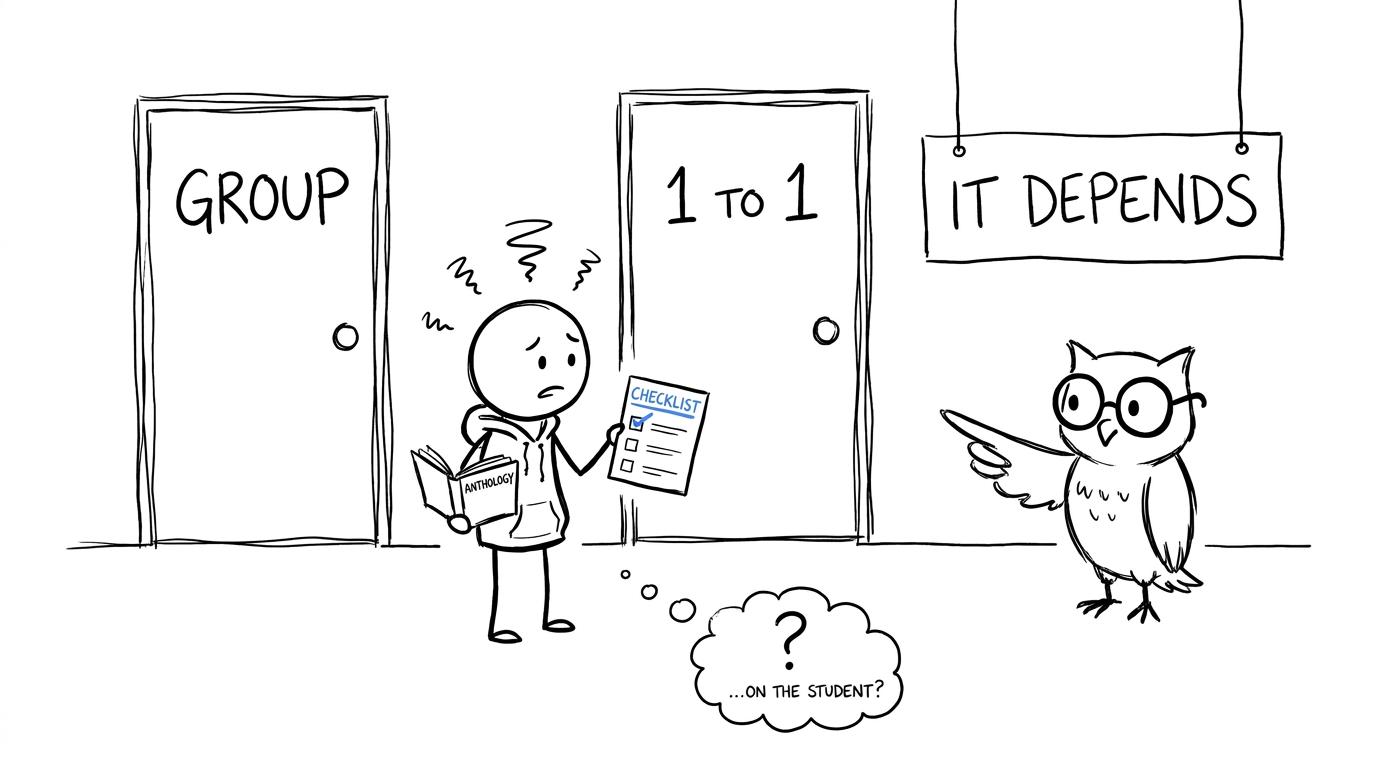 A GCSE student deciding between group and one-to-one tutoring
What GCSE English Language tutoring should actually improve
Before comparing formats, be clear about the destination. GCSE English Language is a skills-based qualification. It is untiered, unlike GCSE maths, and students preparing for AQA, Edexcel, OCR or Eduqas need to understand the precise structure of their own specification.
Across exam boards, the assessment objectives cover skills such as:
- retrieving and interpreting information;
- analysing language and structure;
- comparing ideas and perspectives;
- evaluating texts using relevant evidence;
- adapting writing for form, purpose and audience;
- controlling vocabulary, sentences, spelling and punctuation.
The assessment objectives are shared across exam boards, but papers organise and test them differently. AQA, for example, uses two equally weighted written papers, while OCR and Eduqas have their own timings, source combinations and question structures. A useful tutor should therefore know your board rather than offering generic advice that could apply to any paper.
Good tuition should lead to observable changes: sharper selection of evidence, more developed analysis, clearer organisation, more accurate writing and better decisions under timed conditions. Feeling busy is not the same as becoming exam-ready.
The real advantages of one-to-one tutoring
Feedback can be extremely specific
A tutor working with one student can pause over a single sentence and identify exactly why it is vague. They can distinguish between several problems that may look similar from a distance: misunderstanding the extract, selecting weak evidence, naming a technique without analysing it, or running out of time before developing the argument.
That precision is particularly valuable in English Language because two answers may reach the same mark for different reasons. One student may have strong ideas but weak technical accuracy. Another may write accurately but offer limited interpretation. Individual tuition can separate those needs and allocate time accordingly.
The pace belongs to the student
In a group, the tutor must make decisions for several learners. In a one-to-one lesson, they can shorten an explanation the student already understands and spend longer on the part that remains uncertain.
This often suits students with uneven profiles. A learner might be confident with creative writing but repeatedly lose marks when comparing non-fiction texts. There is little value in making both areas occupy equal lesson time simply because they appear on the same course.
It can be safer for hesitant students
Some students need time before saying what they think. In a busy group, the fastest voice can become the default voice. A calm individual session gives the student room to attempt an interpretation, reconsider it and ask questions without feeling that they are slowing everyone else down.
The limitation is that comfort can become dependence. If a tutor prompts every idea or repairs every paragraph immediately, the student may perform well during tuition but struggle alone. Strong one-to-one teaching gradually removes support and includes silent, timed attempts.
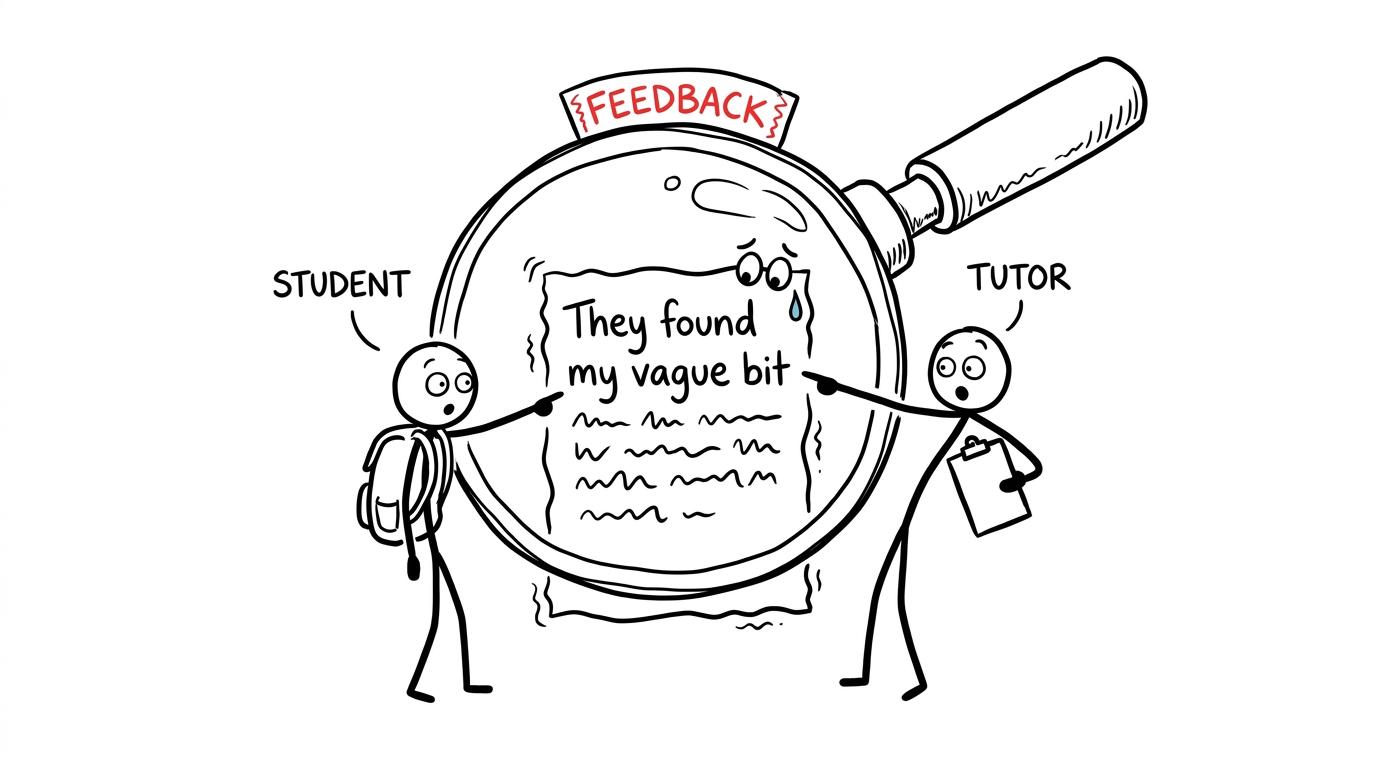 A tutor using a giant feedback magnifying glass
The real advantages of group tutoring
Other students make interpretation visible
English Language rarely rewards one memorised observation. A small group allows students to hear how the same phrase can support different interpretations, provided each idea is rooted in the text.
That exposure can improve flexibility. Instead of believing there is one hidden answer to discover, students see how evidence, explanation and judgement work together. They can also notice when another response is convincing and ask what made it effective.
Discussion creates useful pressure
A well-run group expects participation. Students must explain choices aloud, defend interpretations and respond to alternatives. That can reveal weak thinking before it reaches the page.
There is also a practical benefit: students encounter mistakes they have not yet made themselves. Hearing feedback on another answer can prevent the same problem later. This only works when the group is small enough for everyone to contribute and the tutor actively checks individual understanding.
It is normally more cost-effective
Small-group fees are commonly divided across several learners, making regular support more accessible. Broader Education Endowment Foundation evidence finds positive average effects for both formats. Its toolkit defines small-group tuition as one tutor working with approximately 222 to 555 pupils and reports that targeted small groups can be effective, while one-to-one tuition has a slightly higher average impact overall.
Those findings should not be read as a guaranteed GCSE English Language outcome. They combine evidence from different ages, subjects and settings. The more useful conclusion is that both approaches can work, and teaching quality may matter more than the exact difference between a very small group and an individual lesson.
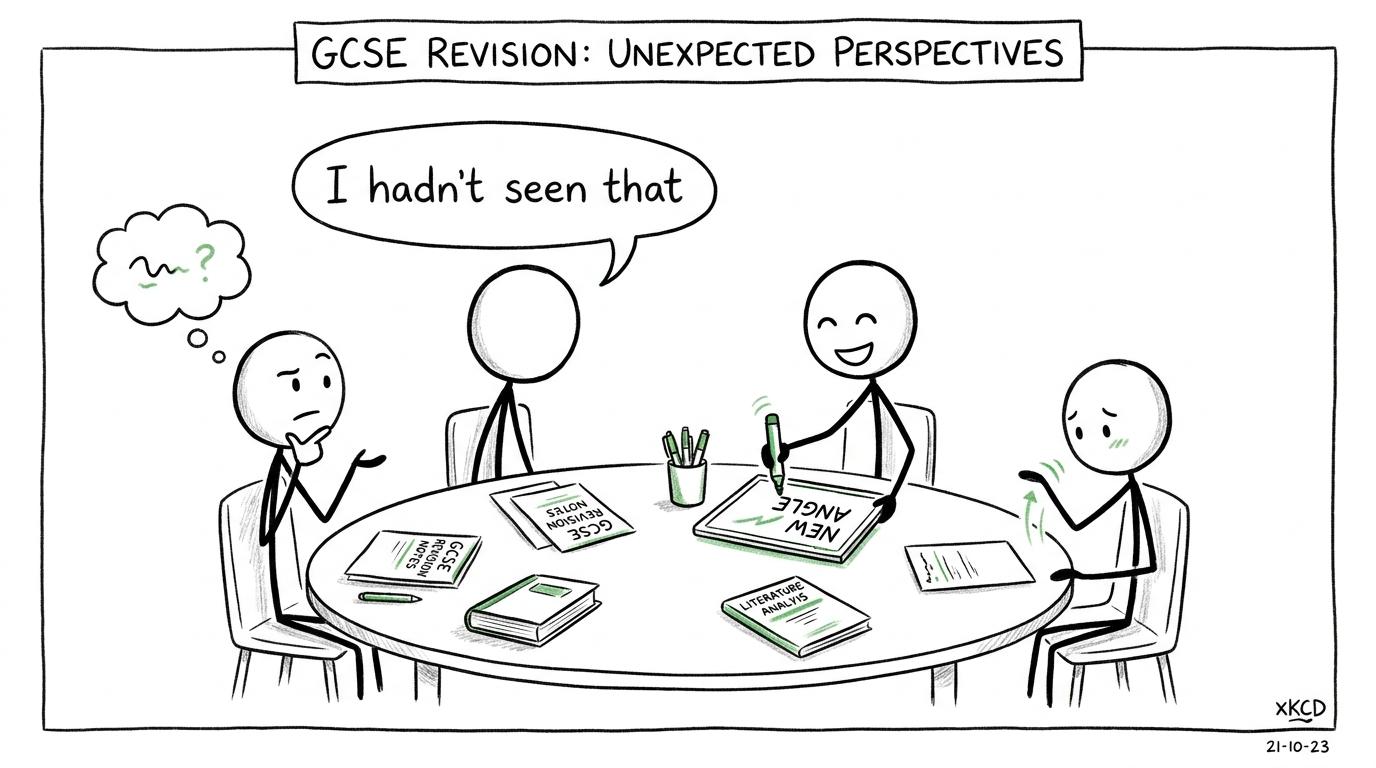 Students discovering a new interpretation during group tuition
Where group tutoring can go wrong
A class of 121212 students advertised as a “small group” is not the same as focused tuition for 333 or 444. As numbers rise, personal writing feedback becomes harder and quieter students can remain invisible.
Group tuition is also weaker when students have very different needs. A learner aiming to secure a grade 444 may need sentence control, question selection and reliable timing. A student pushing towards grades 888 or 999 may need subtler evaluation and greater conceptual independence. Both can learn together, but only if the tutor plans differentiation rather than teaching to an imaginary average student.
Finally, group energy is useful only when it produces work. A lively conversation about an extract may feel productive, yet the examination requires independent reading and sustained writing. Every discussion should eventually become an answer, a plan or a timed decision.
Where one-to-one tutoring can go wrong
Personal attention does not guarantee purposeful teaching. Some individual lessons become extended conversations in which the tutor supplies impressive interpretations while the student listens.
Watch for three warning signs:
- the tutor talks for most of the session;
- feedback is encouraging but not linked to assessment objectives or mark schemes;
- the student rarely completes independent timed work.
One-to-one tuition can also become expensive if there is no review point. Agree on a specific target, collect a baseline response and check progress after a defined block of sessions. Tuition should become more focused as evidence accumulates.
Which format suits which student?
| Student need | Likely better starting point |
|---|---|
| Several precise weaknesses across reading and writing | One-to-one |
| Confidence grows through discussion | Small group |
| Reluctance to ask questions publicly | One-to-one |
| Strong ideas but limited exposure to other viewpoints | Small group |
| Detailed feedback needed on complete responses | One-to-one |
| Limited budget but consistent support is possible | Small group |
| Very different pace from classmates | One-to-one |
| Motivation improves through shared routines | Small group |
This is a starting point, not a permanent label. A student might use a short block of individual lessons to diagnose weaknesses, then move into a group for regular practice. Another might begin in a group and add an occasional individual session for detailed writing feedback.
How to judge a tutor before choosing the format
Ask practical questions rather than relying on promises about grades:
- Which GCSE English Language exam boards do you teach?
- How will you identify my current weaknesses?
- How often will I complete independent timed responses?
- Will feedback refer to the relevant assessment objectives?
- In a group, how much individual feedback will each student receive?
- How will progress be recorded and reviewed?
The tutor should also connect sessions to classroom teaching. Current evidence on tutoring suggests that support is more effective when it is targeted, regular and linked with normal lessons. A tutor does not need to copy the school lesson, but they should understand what the student is learning and where the gaps lie.
Balancing English tuition with GCSE maths revision
For MathsGenie students, the important question is not only which English lesson is best. It is whether the choice leaves enough time for active maths practice.
A sensible week might include one English tuition session, its follow-up task and several shorter maths sessions. Use the free GCSE Maths Revision hub to choose the correct exam board and tier. Edexcel students can organise topic learning through the Edexcel GCSE Maths revision area, then test progress using Edexcel GCSE Maths past papers.
The same feedback principle applies across both subjects: attempt, mark, identify the cause and try again. MathsGenie’s guide to finding your weakest GCSE topics can help turn lost maths marks into a practical plan. For a sustainable weekly routine, use the efficient GCSE maths revision guide.
When full papers feel too large, GCSE mini tests provide shorter checkpoints. As examinations approach, read the guidance on when to start GCSE past papers rather than filling every evening with unreviewed papers.
Common mistakes when choosing tuition
Choosing by price alone
The cheapest group is poor value if it is too large for feedback. Equally, the most expensive individual tutor is poor value if lessons lack structure. Compare what happens during and after each session.
Assuming one-to-one is always superior
Individual attention is powerful, but some students think more deeply when they encounter other viewpoints. A responsive group of 333 may be more useful than an individual lesson dominated by tutor talk.
Ignoring the exam board
Generic language analysis is not enough. Students must practise the question types, timings and mark schemes used by AQA, Edexcel, OCR or Eduqas.
Expecting tuition to replace independent practice
Tutoring provides explanation, feedback and accountability. Improvement still depends on reading unfamiliar texts, planning answers, writing under time pressure and acting on corrections between sessions.
Never reviewing the decision
A format that worked in autumn may not be ideal near the examination. Review actual responses, teacher feedback and timed performance. Change the arrangement if the evidence changes.
Make the choice that solves the real problem
Choose one-to-one tutoring when the student needs diagnosis, privacy, a personalised pace or detailed response-level feedback. Choose a small group when discussion, shared ideas, routine and affordability will help the student practise consistently.
Then judge the choice by evidence. Is the student writing more independently? Are the same errors disappearing? Is timing improving? The best tutoring arrangement is the one that eventually makes the tutor less necessary.
And while English support develops reading and writing, keep maths preparation equally deliberate. Start with MathsGenie’s free revision lessons, move into practice questions and mini tests, and use past papers, predicted papers, mark schemes and video solutions to expose and repair the gaps that still cost marks. One focused session followed by honest practice is worth far more than a crowded timetable that merely looks impressive.