

Group vs 1:1 Tutoring for GCSE Economics
Group vs 1:1 tutoring GCSE Economics explained: compare feedback, discussion, cost and confidence to choose the support that fits your revision.
A tutoring decision can feel more complicated than the subject itself. One option promises personal attention. The other offers discussion, shared ideas and usually a lower cost. Yet the most expensive or intensive choice is not automatically the best one.
For students comparing group vs 1:1 tutoring GCSE Economics, the short answer is this: one-to-one tutoring usually suits students with specific gaps, confidence barriers or an uneven pace, while group tutoring often suits students who learn through discussion and want to strengthen explanation and evaluation. Neither format guarantees progress. Tutor quality, purposeful practice and feedback matter more than the label.
There is also a maths dimension. GCSE Economics may require students to interpret data, percentages, ratios, indices and graphs. A tutoring arrangement should therefore improve both economic reasoning and the quantitative skills needed to use evidence accurately.
A quick decision checklist
Before choosing, ask:
- Do you know exactly which topics or skills are causing difficulty?
- Are you comfortable asking questions in front of other students?
- Do you learn by talking through competing arguments?
- Do you need lessons to move at your own pace?
- Will the tutor mark written answers and explain how to improve them?
- Does the course follow your current exam board specification?
- Can you afford the arrangement consistently until the exam?
- Will you complete independent practice between sessions?
The final question is easy to overlook. Tutoring is most useful when it changes what happens after the lesson, not just during it.
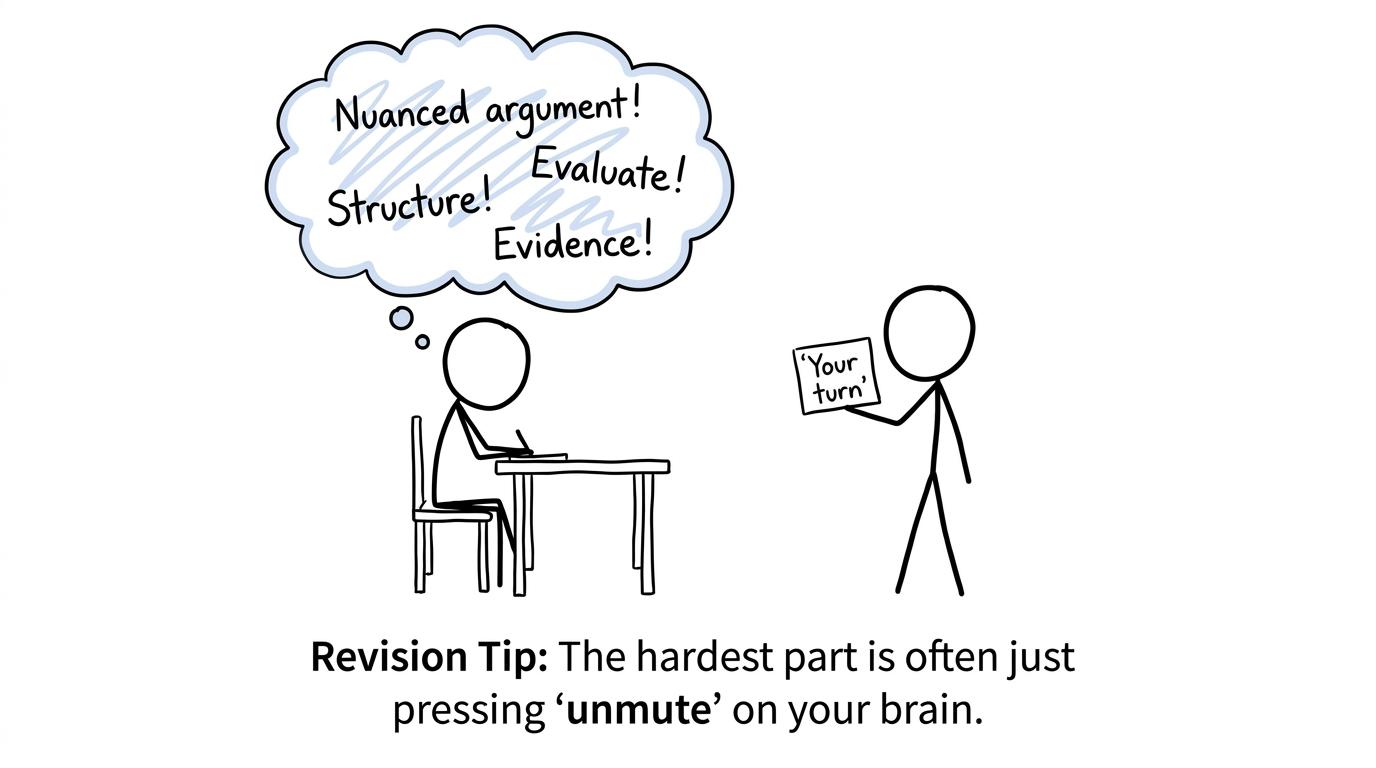 A tutor encourages a quiet student to join a revision discussion
The real differences between group and one-to-one tutoring
The central difference is not simply the number of students. It is how attention, pace and ideas are distributed.
| Factor | Group tutoring | One-to-one tutoring |
|---|---|---|
| Lesson pace | Shared across the group | Adjusted for one student |
| Feedback | Divided between students | Highly personalised |
| Discussion | Multiple viewpoints | Sustained tutor-student dialogue |
| Cost | Usually lower per lesson | Usually higher per lesson |
| Question time | Must be shared | Available throughout |
| Accountability | Supported by peers and tutor | Directly centred on the student |
| Flexibility | Often follows a fixed programme | Can target changing priorities |
Research evidence on tuition generally suggests that both individual and small-group support can help when sessions are structured, connected to classroom learning and delivered by an effective tutor. It does not establish that one format is best for every student or subject. Group size, attendance, tutor expertise and the quality of feedback all affect the experience.
When one-to-one GCSE Economics tutoring is better
You have precise knowledge gaps
One-to-one tuition works well when the problem is identifiable. A student might understand demand and supply but struggle to interpret shifts on a diagram, distinguish private from external costs, or organise an extended response.
A tutor can diagnose that difficulty, slow down and keep questioning until the misunderstanding becomes visible. The lesson does not need to spend equal time on topics the student already understands.
Your progress is uneven
Some students are strong writers but hesitant with calculations. Others can recall definitions yet find evaluation difficult. Individual tuition can respond to this uneven profile rather than teaching to the average needs of a class.
Relevant quantitative skills may include:
- calculating a percentage change;
- interpreting ratios and proportions;
- reading values from tables and charts;
- comparing trends in economic data;
- understanding gradients and intersections on graphs;
- selecting numerical evidence to support a judgement.
If percentages are a weakness, MathsGenie's Grade 3 GCSE maths revision can help rebuild the underlying skills. Students who need broader number foundations can begin with Grade 2 revision topics.
You are reluctant to reveal confusion
A group can be supportive, but some students become skilled at appearing to understand. In a one-to-one lesson, there is less room to disappear behind somebody else's answer.
That intensity can be useful. It can also feel demanding. A good tutor should create a calm space where incomplete answers are treated as information, not failure.
You need focused exam feedback
Economics marks depend on more than remembering content. Students must apply ideas to the context, develop logical chains of reasoning, analyse evidence and reach justified conclusions where the question requires them.
Individual feedback can identify whether an answer lacks knowledge, application, analysis or evaluation. The tutor should refer to the relevant exam board's current specification and mark schemes rather than teach a generic essay template as if it works everywhere.
When group tutoring is the stronger choice
You learn by hearing different arguments
Economics often involves choices, trade-offs and consequences. In a good group, one student may focus on consumers, another on firms and another on government objectives. Comparing those perspectives can reveal assumptions that an individual learner might miss.
This makes group tuition particularly useful for developing discussion and evaluation. The group must remain small enough for everybody to think and contribute; a lecture with a chat box is not automatically meaningful group tuition.
You benefit from peer accountability
Revision can become private and vague: read some notes, watch something, hope it stays. A regular group creates a visible rhythm. Students arrive having completed the same task, compare approaches and see that difficulty is normal.
Peer explanations can also be valuable, provided the tutor checks accuracy. Confident delivery is not proof that an economic claim is correct.
Budget and consistency matter
Group sessions are commonly cheaper because the tutor's time is shared. That can make sustained support more realistic than occasional individual lessons.
Consistency has practical value. A modest arrangement attended regularly, combined with independent practice, may be more useful than an expensive lesson used only when panic arrives. Families should compare the total cost, group size, lesson length, cancellation terms and amount of individual marking before deciding.
Your foundations are reasonably secure
Group tuition tends to work best when students can access the same broad level of material. If one learner needs extensive support with basic calculations while another is refining high-mark evaluation, a single pace may serve neither particularly well.
Students preparing for data questions can strengthen shared foundations through Grade 4 GCSE maths revision, including core work on graphs, averages, ratio and percentages. More demanding algebraic and graphical skills can be reviewed through Grade 5 revision resources.
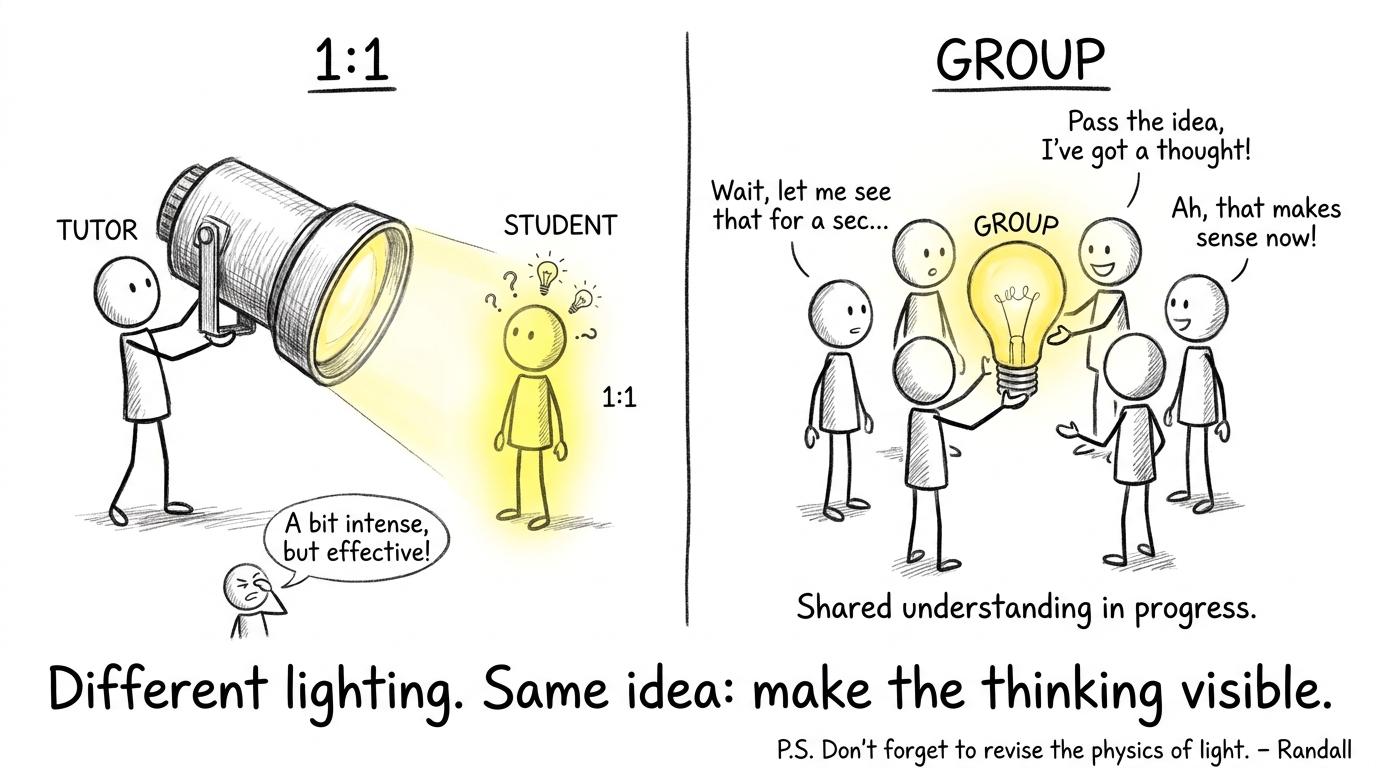 One-to-one and group tutoring shown as two different ways to illuminate thinking
How tutoring should support Economics maths skills
The calculations in GCSE Economics are usually not advanced, but accuracy still matters. A student may need to recognise and use relationships such as:
Percentage change=new value−original valueoriginal value×100\text{Percentage change} = \frac{\text{new value} - \text{original value}}{\text{original value}} \times 100Percentage change=original valuenew value−original value×100They may also meet average measures such as:
Mean=sum of valuesnumber of values\text{Mean} = \frac{\text{sum of values}}{\text{number of values}}Mean=number of valuessum of valuesKnowing a formula is only part of the task. Students must select relevant figures, preserve units, interpret the result and connect it to the economic context. Tutors should check the current specification for the student's board, whether that is AQA, Pearson Edexcel, OCR or another available specification, because content and assessment details are not interchangeable.
MathsGenie's free GCSE maths revision hub provides videos and practice questions arranged by grade. Grade 1 revision is useful when basic number fluency needs attention, while Grade 6 revision supports students ready for more demanding proportional and graphical work.
What matters more than the tutoring format
A strong tutor should be able to explain:
- how sessions connect to the student's specification;
- how initial weaknesses will be diagnosed;
- whether written responses receive individual marking;
- how retrieval and spaced review will be used;
- what students should practise between lessons;
- how progress will be checked without relying only on confidence.
A polished presentation is not enough. Students need to retrieve knowledge, answer questions, interpret unfamiliar information and respond to feedback. Ask for a trial lesson where possible, then judge the intellectual work the student actually completed.
A hybrid approach can also be sensible. Regular group tuition may provide structure and discussion, while a small number of one-to-one sessions target a persistent gap or review marked exam answers. The combination should solve a clear problem rather than add more hours for their own sake.
Common mistakes when choosing tuition
Assuming one-to-one automatically means higher quality
Individual attention cannot compensate for weak subject knowledge, vague explanations or little exam-board awareness. Check the tutor's GCSE Economics experience and approach to marking.
Choosing a group without checking its size
Ask how many students normally attend, not merely how many can attend. Find out how often each learner answers questions and receives personal feedback.
Ignoring the student's learning behaviour
A quiet student may flourish in a respectful small group or withdraw completely. An independent student may enjoy individual challenge or find it unnecessarily intense. Choose for the learner in front of you, not an imagined “ideal student”.
Using tutoring instead of independent practice
Watching a tutor answer questions creates familiarity, but familiarity is not recall. Students still need timed questions, self-marking and correction. MathsGenie's GCSE maths past papers help students practise independently under realistic conditions.
Measuring progress only through school grades
Grades are important but can change slowly and depend on the assessment used. Also track whether the student can recall definitions, interpret data, complete calculations accurately and improve an answer after feedback.
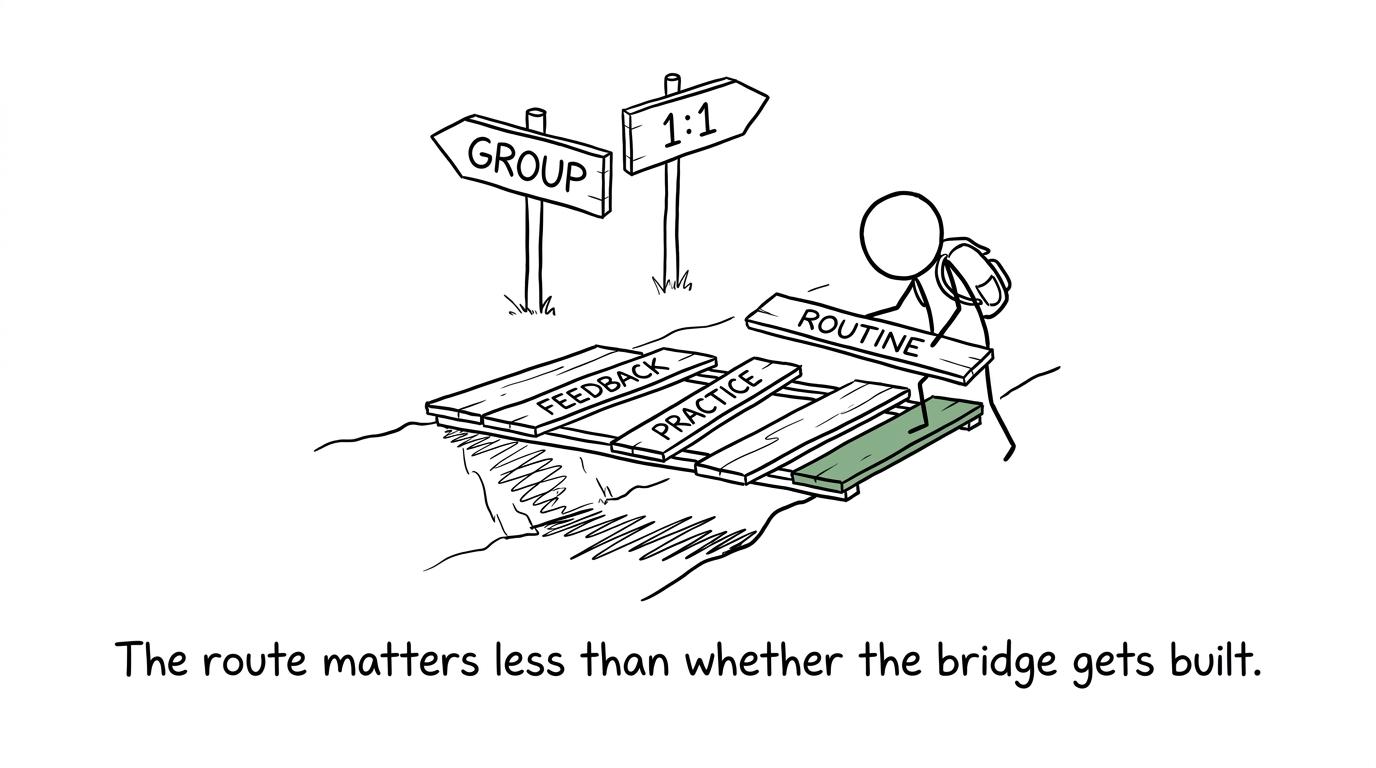 A student builds a revision bridge from feedback, practice and routine
Make the choice, then make it work
Choose one-to-one tutoring when personal diagnosis, flexible pacing and detailed feedback are the priorities. Choose group tutoring when discussion, peer accountability and affordability will help the student participate consistently. If the decision remains unclear, try each format briefly and compare concentration, contribution, completed practice and feedback quality.
The tutoring format is only the container. Progress comes from what fills it: accurate explanations, deliberate practice, correction and repetition.
Use MathsGenie as the free maths layer beneath Economics revision. Start with the GCSE revision lessons and practice questions, then test secure skills with past papers and mark schemes. Video solutions, mini tests and grade-based resources make it easier to turn a tutoring session into a practical weekly revision plan, and to keep improving between lessons.











