

Grade E A-Level Maths Meaning: What Comes Next?
Grade E A-Level Maths meaning explained: understand university, Clearing, review and resit options, then build a focused revision plan with confidence.
Opening a results envelope can make two years of work feel compressed into one letter. If that letter is an E, the immediate question is rarely mathematical. It is practical: what does it change?
The grade E A-Level Maths meaning is straightforward: an E is the lowest passing grade at A Level. It is above a U, which means unclassified. However, passing the qualification does not automatically mean meeting a university, apprenticeship or employment offer. Your next step depends on the conditions attached to your plans.
The important thing is not to treat one result as a verdict. Treat it as information. Check your university status, speak to your school or college and then choose deliberately between accepting an available place, using Clearing, requesting a review or resitting.
Your results-day checklist
Before making a long-term decision, work through this short list:
- Check your application status in your UCAS account.
- Read the exact conditions of each offer rather than assuming an E means rejection.
- Contact the university if your position is unclear.
- Ask your school or college for your marks and grade-boundary information.
- Discuss whether a review of marking is sensible.
- Explore Clearing courses based on their content, entry requirements and outcomes.
- Consider a resit only after deciding what improved grade you genuinely need.
Universities sometimes confirm places when an applicant has narrowly missed an offer, but this is the university's decision. Your UCAS status is more useful than speculation in a group chat.
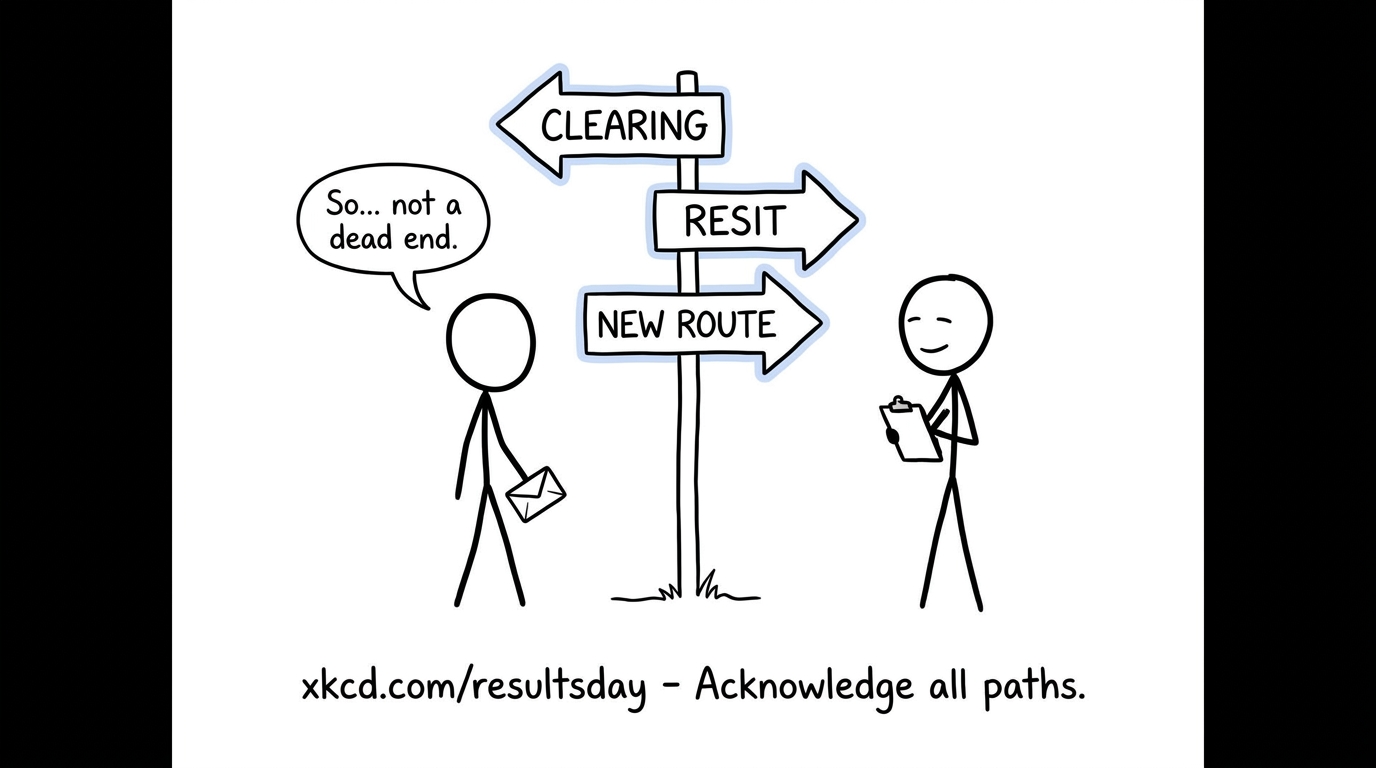 A student discovers that an unexpected result is a signpost rather than a dead end
What an A-Level Maths grade E means
A Levels are graded from A* to E, with U used where the performance is unclassified. Therefore, an E confirms that you have been awarded the A-Level Maths qualification.
What it does not confirm is that you satisfy a particular entry requirement. A university course may ask for specific overall grades, a particular grade in Maths or both. Some apprenticeships and employers also set their own requirements.
That distinction matters. A qualification result and an admission decision are connected, but they are not identical.
For students currently choosing post-GCSE subjects, there is a useful lesson here too: A-Level Maths is a substantial step beyond GCSE higher tier. Before selecting it, look honestly at your algebra, trigonometry and problem-solving confidence. The free A-Level Maths revision hub shows the breadth of the course across pure maths, statistics and mechanics.
What next after a grade E in Maths?
Check whether your university place is still available
Start with your UCAS account. If your place is confirmed, you may not need to take any further admissions action. Read any messages carefully and check whether the course is unchanged.
If no decision appears, contact the university admissions team. Have your UCAS identification details and results ready. Ask for clarification rather than trying to persuade someone through a long explanation.
You should also check whether your place depends specifically on A-Level Maths. Missing an overall offer and missing a subject-specific requirement can lead to different decisions.
Explore Clearing carefully
Clearing can help applicants without a confirmed place find courses with vacancies. It is not simply a list of inferior alternatives. It is another admissions route, but it should still be approached with care.
Compare course modules, location, accommodation, professional accreditation where relevant and the mathematical demands of the degree. Ask whether an E in Maths meets the course requirements and obtain confirmation before making a final choice.
Do not choose a course only because somebody answers the telephone quickly. A fast decision can affect several years of your life; a calm hour spent comparing details is worthwhile.
Ask about a review of marking
If your mark is close to the next grade boundary, ask your exams officer or teacher about access to scripts and a review of marking. This is not a free second attempt at the paper. It checks whether the mark scheme was applied correctly and whether marks were totalled accurately.
A mark can stay the same, rise or fall following a review, so discuss the evidence and possible consequences first. There are formal deadlines and fees, which vary by awarding organisation and service. Your school or college can explain the current arrangements for Edexcel, AQA, OCR or Eduqas.
Consider resitting A-Level Maths
A resit may be sensible when a higher Maths grade is essential for a specific course or career route. In England, reformed A Levels are linear, so resitting normally means taking the complete set of examination papers in a future summer series rather than repeating one weak module.
Speak to your school or college quickly. Ask whether it accepts returning students, which specification you would follow and what fees may apply. Private candidates must find an approved centre willing to enter them. You should also check how your intended universities treat resit applicants, because policies differ.
Begin with the Maths Genie A-Level resources library, then choose materials for the correct exam board. The Edexcel A-Level Maths revision page, for example, brings together lessons, question-bank practice, worksheets and exam tools.
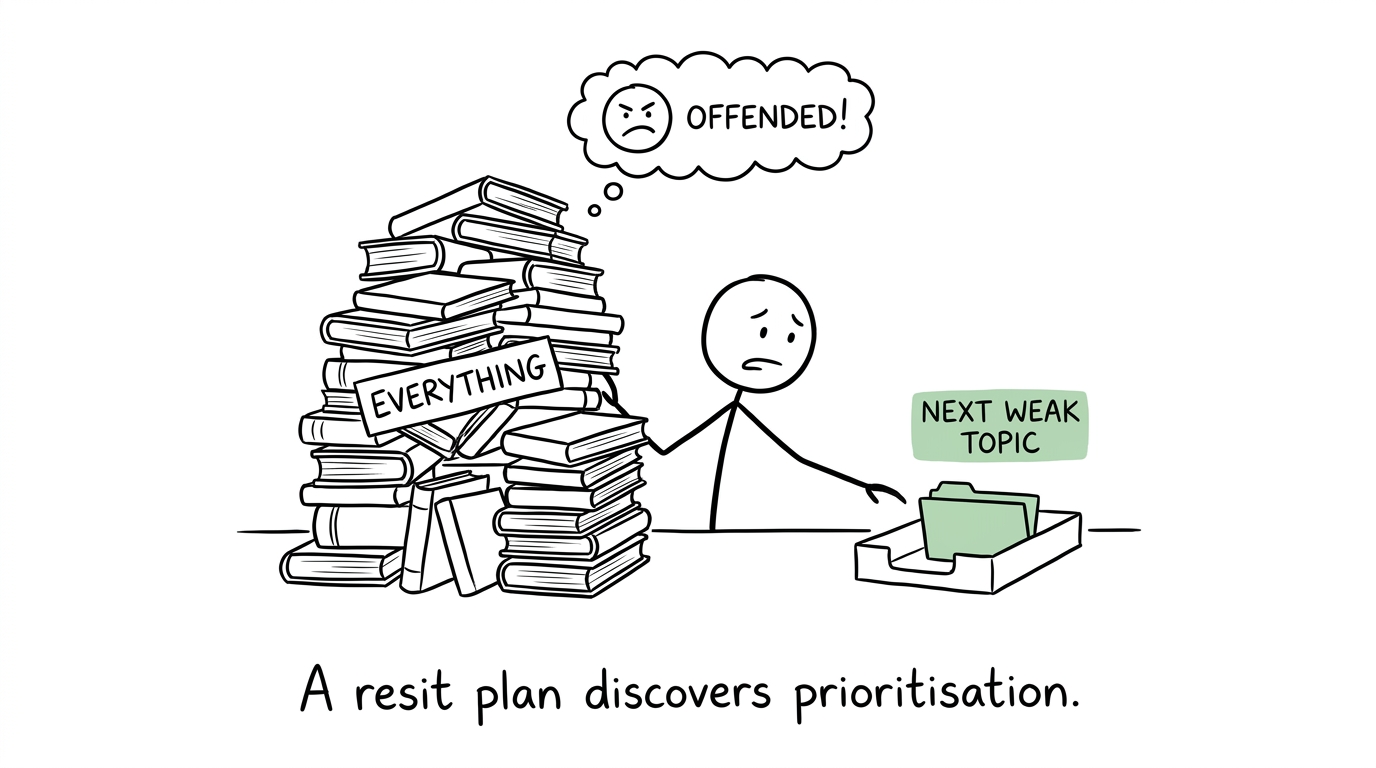 A student chooses one weak topic instead of attempting to revise everything at once
Building a realistic A-Level Maths resit plan
An E often reflects several different problems rather than one dramatic failure. There may be gaps in core algebra, weak recall, unfinished papers or difficulty translating knowledge into mark-scheme language. Your plan should identify which of these actually cost marks.
Use this cycle:
- Sit one complete paper under timed conditions.
- Mark it carefully using the official mark scheme.
- Group lost marks by topic and cause.
- Relearn the two weakest areas through short revision lessons.
- Complete targeted practice questions without copying solutions.
- Retest those topics before attempting another paper.
The Edexcel A-Level Maths past papers include mark schemes and worked solutions where available. Past papers are diagnostic tools first and performance tests second. Their greatest value appears after marking, when you turn each mistake into a specific action.
Do not spend months reading notes before attempting questions. Use revision guides to rebuild understanding, then practise immediately. Later, add timed past papers, predicted papers and mini tests to develop accuracy and stamina.
Common mistakes after receiving a grade E
Assuming an E means every route is closed
It does not. Your confirmed offers, alternative courses, Clearing choices and resit possibilities must each be checked separately.
Requesting a review without checking the mark
A review is most defensible when your school sees a realistic marking concern or you are close to a boundary. It is not guaranteed to improve the grade.
Resitting without a target
“Do better” is not a plan. Identify the grade required, the institutions that accept resits and the weaknesses that need repairing before committing time and money.
Revising passively
Videos and notes can explain a method, but examination performance develops through retrieval, practice and correction. Use Maths Genie to move from lessons to questions, mark schemes and video solutions rather than remaining in one comfortable activity.
Choosing Clearing in a panic
A vacancy is not automatically the right course. Check its content and requirements as seriously as you checked your original choices.
One result, followed by a better decision
An A-Level Maths grade E is a pass, but its practical impact depends on what you hoped to do next. Check your confirmed status first. Then investigate Clearing, a review of marking or a full resit using accurate information rather than fear.
If resitting is the right route, begin with the free A-Level Maths revision guides and resources. Build your plan around revision lessons, targeted practice questions, past papers, predicted papers, mark schemes and video solutions. The result cannot be changed by worrying about it. The next attempt can be changed by what you do next.











