

Grade D A-Level Maths Meaning: What Comes Next?
Grade D A-Level Maths meaning explained: understand UCAS value, university and Clearing choices, reviews, resits, and a practical next-step plan.
Results day has a strange way of making one letter feel larger than the two years that produced it. If you are searching for the grade D A-Level Maths meaning, the immediate answer is this: a D is a recognised A Level grade, sitting above an E and below a C. It does not automatically end your university plans, but it may affect offers that required a particular maths grade.
Your next move is to check UCAS Hub, speak to your university and school, and then compare three realistic routes: accept an available place, use Clearing, or prepare for a resit.
Your results-day checklist
Before making a permanent decision in a stressful hour, work through this list:
- Check UCAS Hub because your place may already be confirmed.
- Read the exact conditions of your firm and insurance offers.
- Contact the university if the decision is unclear or pending.
- Ask your school for your marks and grade-boundary information.
- Discuss a review of marking only if there is evidence of a possible error.
- Research Clearing courses and their subject-specific requirements.
- Consider a resit alongside foundation years and alternative courses.
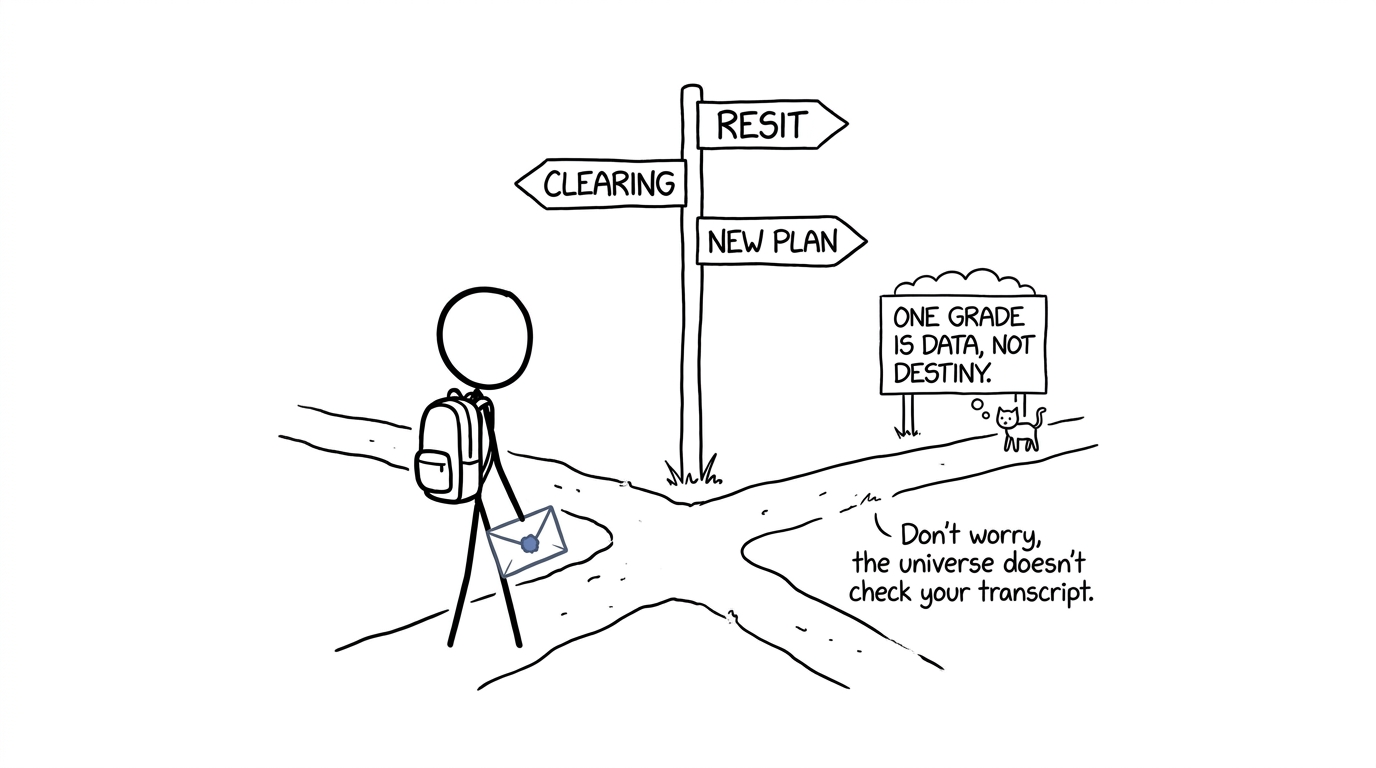 A student choosing calmly between Clearing, a resit and a new plan
What does an A-Level Maths grade D mean?
An A-Level Maths grade D is an awarded grade rather than an unclassified result. Under the current UCAS Tariff, one full A Level at grade D is worth 242424 Tariff points. However, universities do not all use Tariff totals in the same way.
A course might ask for an overall points total, a specific combination of grades, or a particular grade in Mathematics. For a maths-heavy degree such as engineering, economics, physics or computer science, the subject requirement may matter more than your total Tariff score.
A D also tells you something useful about your revision. You demonstrated knowledge across part of the specification, but not consistently enough for a C or higher. That is a diagnosis, not a verdict. Your paper breakdown may reveal whether the main issue was pure maths, statistics, mechanics, timing or avoidable errors.
What next after grade D maths?
Check whether your university place is confirmed
Missing an advertised entry grade does not always mean rejection. Universities can still confirm a place, offer an alternative course or propose a foundation year. Check UCAS Hub before assuming anything, then contact admissions if your status is unresolved.
Do not decline a confirmed place merely to explore Clearing. First investigate your alternatives and make sure you understand what releasing yourself would mean.
Use Clearing if you hold no suitable offer
For 2026 entry, UCAS Clearing runs from 2 July to 19 October, with A Level results day on 13 August. You can use Clearing if you are not holding an offer and suitable courses still have places.
Look beyond the course title. Check the modules, professional accreditation, location, costs and whether grade D in Mathematics satisfies any subject-specific condition. Speak directly to the university before adding a Clearing choice in UCAS Hub.
A foundation year can also be sensible. It adds time and cost, but may provide the mathematical preparation needed for a degree that would otherwise be inaccessible.
Request a review if something appears wrong
A review of marking is not a second attempt at the examination. It checks whether the mark scheme was applied correctly. Speak to your school or college promptly because post-results services have deadlines.
Your mark can rise, remain unchanged or fall. Grade boundaries themselves cannot be appealed, so base the decision on your script, mark breakdown and your teacher's judgement rather than disappointment alone.
Resit A-Level Maths with a clear purpose
A resit is realistic when a higher maths grade is essential for your intended course or career. For reformed A Levels in England, including AQA, Edexcel and OCR Mathematics, the qualification is linear. Improving the overall grade normally means sitting the required papers again in a future summer examination series, rather than keeping the best paper from the first attempt.
Confirm arrangements with your former school, college or an approved private candidate centre. Ask about the specification, entry deadline, fees and whether your target universities accept resit applicants. Requirements vary, so check before committing a year.
Start by selecting your board on the free A Level Maths revision hub. MathsGenie provides dedicated resources for Edexcel A Level Maths, AQA A Level Maths and OCR A Level Maths.
How to turn a D into a stronger resit grade
A resit should not repeat the same revision with a later calendar. Begin with your paper breakdown and create three lists: secure topics, inconsistent topics and missing topics.
Then use a simple cycle:
- Learn one topic through a revision lesson or video.
- Complete focused practice questions without notes.
- Mark them carefully and record why each mark was lost.
- Revisit the topic after a short gap.
- Build towards timed papers only after repairing the main gaps.
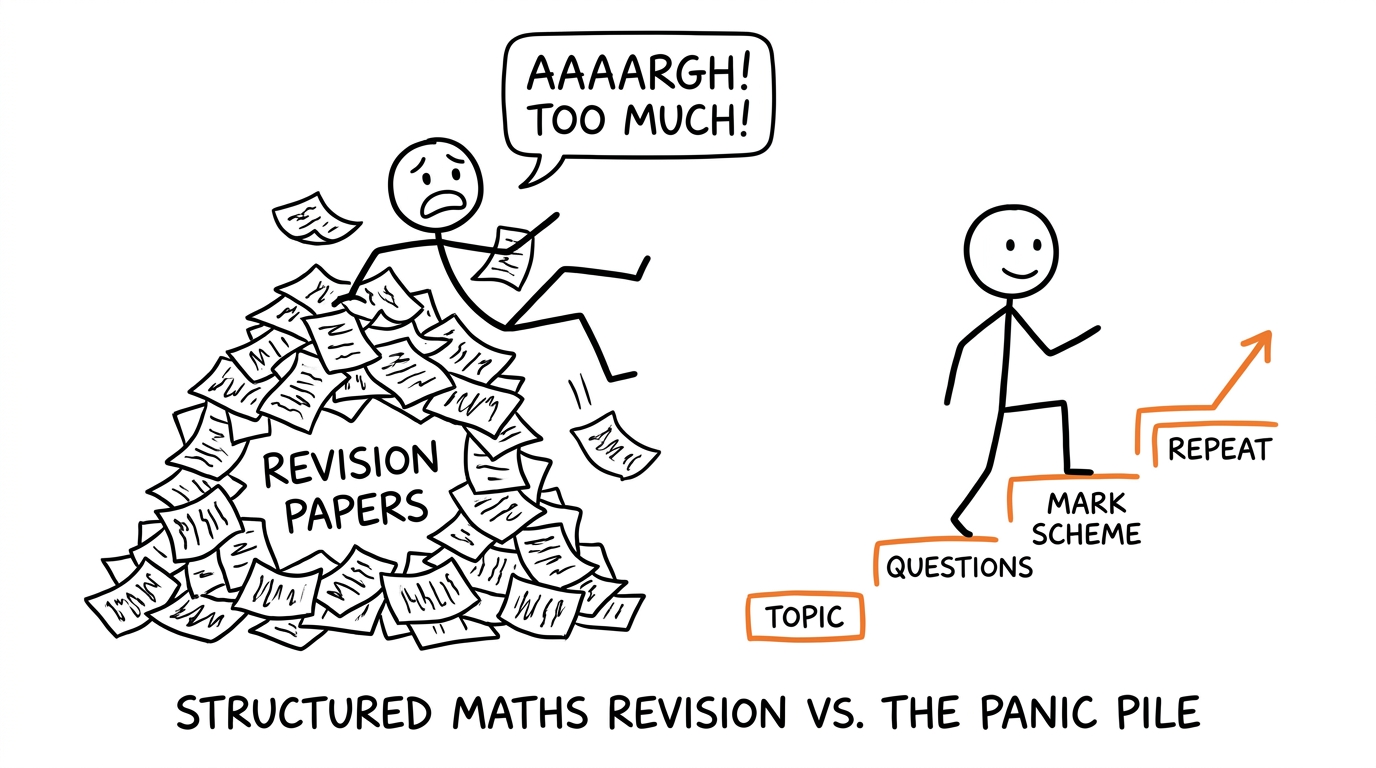 Two students discovering that small revision steps beat one enormous pile of papers
Use Edexcel A Level Maths past papers or OCR A Level Maths past papers under timed conditions. Mark schemes show where method marks are available, while worked and video solutions help you distinguish a conceptual gap from a small algebraic error.
Closer to the examination, Edexcel A Level Maths predicted papers and mini tests can add fresh exam-style practice. Predicted papers should complement the full specification, not replace it. Put each session into a revision planner so that pure maths, statistics and mechanics all receive deliberate attention.
Common mistakes after receiving a grade D
Assuming university is over. Check UCAS Hub and contact admissions before reaching that conclusion.
Entering Clearing without researching the course. An available place is only valuable if the course, finances and location suit you.
Requesting a review automatically. A review can lower a mark as well as raise it. Seek informed advice first.
Resitting without checking entry policies. Some courses treat resit applicants differently, particularly where Mathematics is central to the degree.
Doing endless papers immediately. Past papers measure weaknesses; topic practice repairs them. Use both in the right order.
A grade is information, not identity
A grade D may change the route, but it does not decide the destination. Check the offer you actually hold, investigate Clearing carefully, and resit only when it serves a defined goal.
If a resit is your best route, begin with the MathsGenie A Level Maths revision guides. Build steadily through free revision lessons, practice questions and mini tests, then use past papers, predicted papers, mark schemes and video solutions to turn every lost mark into a specific next action.











