

Grade B A-Level Maths Meaning: What Comes Next?
Grade B A-Level Maths meaning explained: check your university offer, explore Clearing or a resit, and make a calm, practical plan for what comes next.
Results day has a strange way of compressing two years of work into one letter. If that letter is a B, the grade B A-Level Maths meaning is straightforward: you have achieved a solid A-Level pass that demonstrates substantial mathematical knowledge. It is worth 404040 UCAS Tariff points, although universities may use specific grade requirements rather than Tariff totals.
What happens next depends less on the letter itself and more on your university offer, course ambitions and feelings about retaking. Your first action should be to check your UCAS status and speak to your school or college before making a rushed decision.
Your results-day checklist
- Check whether your university place has been confirmed.
- Read the exact conditions of your firm and insurance offers.
- Contact the university if your status is unclear.
- Consider Clearing if you are unplaced or want another course.
- Ask your school for your marks and the published grade boundaries.
- Discuss a review of marking only if there is a credible reason.
- Consider a resit if an improved grade would materially change your options.
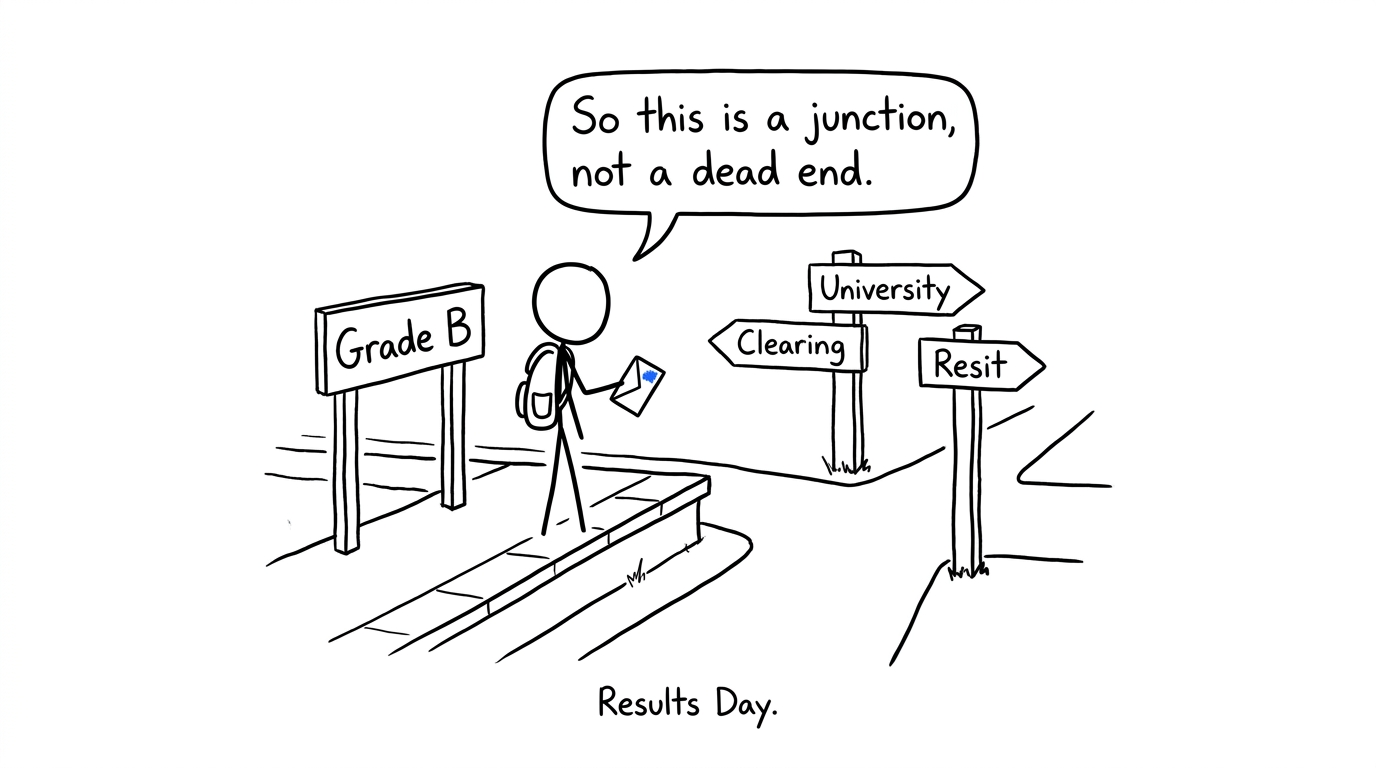 A student discovers that Grade B is a junction rather than a dead end
What does a B in A-Level Maths mean?
A-Level grades run from A* to E, with U meaning unclassified. A B therefore represents a strong recognised qualification, sitting below A and A* but above C, D and E. The mark needed changes between exam series and specifications because grade boundaries account for differences in paper difficulty.
That is why comparing your raw mark with an unrelated Edexcel, AQA, OCR or Eduqas boundary can mislead you. Check the boundary for your precise exam board, specification and exam series.
For university applications, a B is worth 404040 UCAS Tariff points. Three A-Levels at grade B would therefore be worth:
3×40=120 3 \times 40 = 120 3×40=120However, not every course makes Tariff-based offers. An offer such as ABB requires particular grades, and some courses specify that the A or B must be in Mathematics. Always read the course conditions rather than relying only on a total.
What next after a Grade B in Maths?
There are four realistic routes. None should be chosen merely because results-day emotions make immediate action feel necessary.
Take your confirmed university place
If UCAS shows that your firm choice has accepted you, the grade has done its job. You do not need to retake simply because you once hoped for an A.
Before starting a maths-heavy degree, keep core algebra, calculus, trigonometry, statistics and mechanics familiar. The free A-Level Maths revision hub brings together lessons, question banks, videos, revision guides and papers across the major exam boards.
Contact the university if you narrowly missed
Missing an offer does not automatically settle the outcome. A university may still confirm your place or discuss an alternative, but the decision belongs to its admissions team.
Check UCAS first, then call using the official number supplied by the university. Have your UCAS ID, results and course details ready. Be concise and polite. Do not assume that being close to a boundary guarantees acceptance.
Explore Clearing
Clearing connects applicants with courses that still have vacancies. It can be useful if you have no confirmed place, applied late or decide that another available course suits you better.
Compare the whole course rather than chasing any vacant seat. Look at modules, location, costs, professional accreditation and entry requirements. Ask whether the B in Mathematics meets any subject-specific condition, particularly for engineering, economics, computer science or mathematics courses.
Consider an A-Level Maths resit
A resit may be sensible when moving from a B to an A would unlock a specific course, apprenticeship or future application. It is a strategic choice, not a verdict on your ability.
Before committing, confirm:
- whether your intended universities accept resits;
- which exam series is available for your qualification;
- where you can enter as a candidate;
- what teaching support and fees apply;
- whether you can sustain revision alongside work or other subjects.
Use the relevant current specification rather than old modular material. Start with MathsGenie's exam-board revision resources, or use the dedicated Edexcel A-Level Maths revision page if that is your board. The older legacy A-Level topic archive can provide extra practice, but it should not replace preparation based on your current specification.
Should you request a review of marking?
First ask your exams officer for your component marks and compare them with the official boundary. Being close is not, by itself, evidence of a marking error.
Your school can explain which post-results service is appropriate, its deadline, cost and possible outcome. A review checks whether the mark scheme was applied correctly; it is not a fresh attempt at the paper. Marks and grades can stay the same, rise or fall, so you will normally need to give consent.
If a university place depends on the outcome, tell both your school and the university promptly. Time-sensitive cases need calm, accurate communication.
How to plan an effective resit
A grade B usually means the foundation is already present. The task is to identify where marks escaped: incomplete reasoning, weak topics, poor timing or avoidable algebraic errors.
 A student fixes small leaks in a bucket of marks
Use this revision loop:
- diagnose weaknesses with a timed paper;
- relearn one topic through a revision lesson or guide;
- complete targeted practice questions;
- mark them carefully and record each error;
- revisit the topic before attempting another full paper.
MathsGenie's A-Level predicted papers can add fresh exam practice, while the free revision resources collection includes shorter tests for building a regular routine. For guidance on reviewing papers rather than merely collecting scores, read how to use past papers effectively.
Common mistakes after receiving a B
Treating the grade as a personal judgement
A grade reports performance against an assessment standard. It does not measure your potential, effort or suitability for every mathematical career.
Retaking without a defined benefit
A resit costs time and may involve fees. Identify the exact opportunity an A would create before deciding.
Assuming Tariff points guarantee admission
A B contributes 404040 Tariff points, but universities set their own course and subject requirements. Read the offer carefully.
Using the wrong grade boundary
Boundaries vary by exam board, specification and year. Only the matching official document is relevant.
Revising everything equally
A broad replay of the course can feel productive while leaving the same weaknesses untouched. Let marked papers determine your priorities.
Turn the result into a decision
An A-Level Maths grade B is both an achievement and a piece of information. It may already secure your next step. If it does not, you still have practical routes through admissions contact, Clearing, a marking review or a carefully planned resit.
Once you know which route serves your goal, begin with MathsGenie's free A-Level Maths revision guides and resources. Use revision lessons to rebuild uncertain topics, practice questions to test them, and past or predicted papers with mark schemes and video solutions to turn a B into stronger, more reliable performance.











