Grade 6 GCSE Chinese: Enough for Sixth Form?
Grade 6 GCSE Chinese sixth form guidance: learn when it meets entry rules, what else colleges check and how to protect your preferred Year 12 choices.
The difficult thing about opening a results envelope is that one number can suddenly seem responsible for your entire future. If you are searching for grade 6 GCSE Chinese sixth form guidance, the short answer is reassuring: a grade 666 is often good enough to support entry to sixth form, and it may meet the subject requirement for an A Level language course. However, it does not guarantee admission to every sixth form or every course.
Sixth forms normally consider your complete GCSE profile, including English and maths, alongside requirements for individual A Level subjects. Some providers accept a grade 666 in the subject you want to continue; more selective courses or schools may require a grade 777 or higher. The only definitive answer comes from the published entry requirements of the sixth form or college you want to attend.
Your quick sixth form checklist
Before deciding whether your Chinese result is enough, check:
- the sixth form's general GCSE entry requirements;
- its minimum grades in GCSE English and maths;
- the requirement for each course you want to take;
- whether Chinese is included in any best-subject or GCSE grade calculation;
- whether the institution actually offers A Level Chinese;
- its rules for conditional offers and oversubscription;
- whom to contact if your result is one grade below the published requirement.
That distinction matters. Being eligible to enter a sixth form is not necessarily the same as being eligible for your preferred combination of courses.
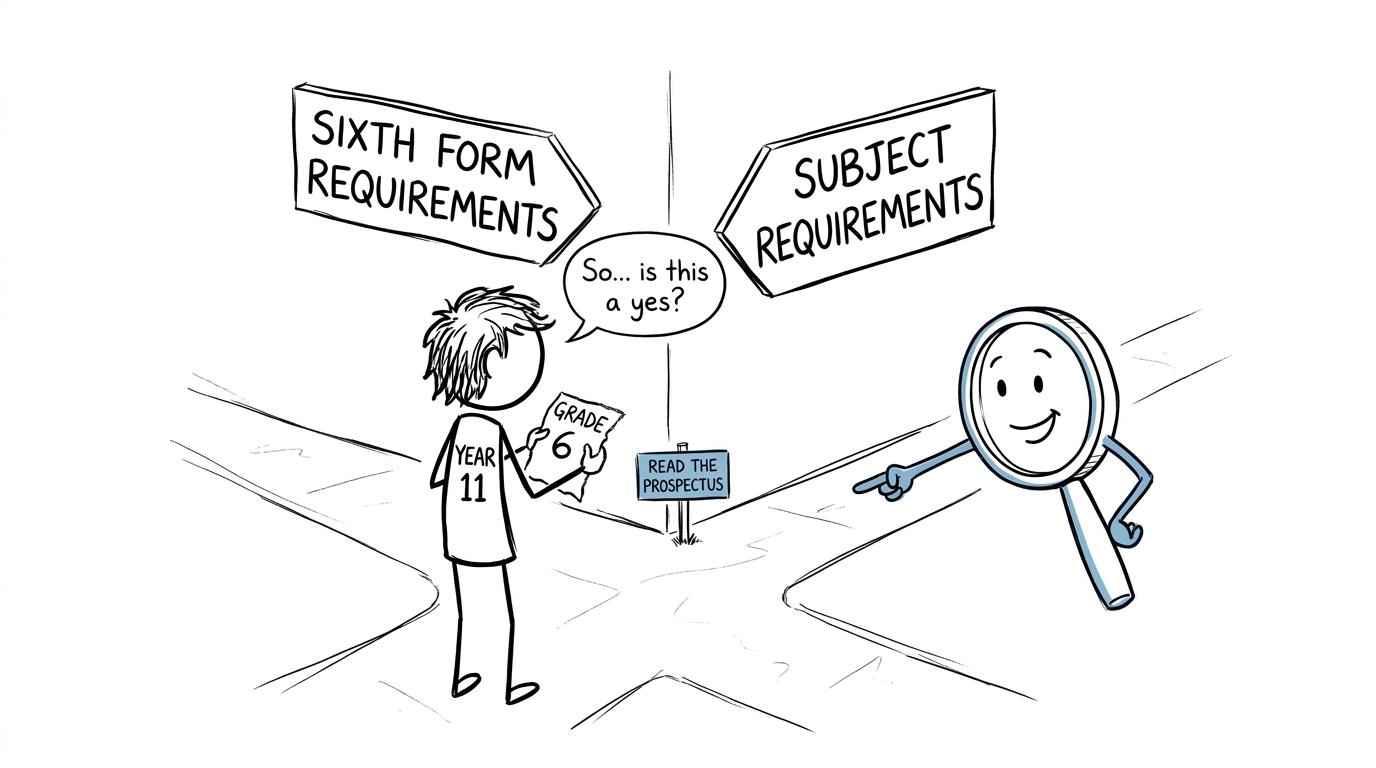 A student discovers that sixth form and subject requirements are separate questions
Is a grade 6 in GCSE Chinese a good result?
Yes. In England's GCSE grading system, grade 444 is described by the government as a standard pass and grade 555 as a strong pass. A grade 666 therefore sits above both of those thresholds and represents a secure achievement.
GCSE Chinese assesses several language skills rather than one isolated talent. Depending on the qualification and exam board, students are assessed through listening, speaking, reading and writing. A grade 666 shows a substantial level of competence across the qualification, although it does not tell an admissions team your mark in each individual paper.
It is also worth separating two thoughts that can become tangled on results day:
- Is grade 666 a respectable GCSE result? Yes.
- Does grade 666 meet a particular admissions rule? It depends on the provider and course.
The first is a judgement about achievement. The second is a question answered by an admissions document.
Is a grade 6 enough to enter sixth form?
For many sixth forms, it can be. Current published entry policies illustrate how much the rules vary. Some institutions require five GCSEs at grade 555 or above, while others expect five or six GCSEs at grade 666 or above. More selective schools may set higher overall grade profiles.
A grade 666 in Chinese can therefore help you satisfy an overall requirement such as a certain number of GCSEs at grades 999 to 666. It may also contribute to a points score based on your best six or eight results. But it cannot compensate automatically for a missing compulsory grade in English or maths.
For example, an institution might require:
- a minimum number of GCSE passes;
- particular grades in English Language and mathematics;
- a minimum total calculated from the best GCSE grades;
- separate grades for the subjects chosen at A Level.
These models are not interchangeable. One school may admit a student with a broad set of grade 555s and 666s, while another may expect mainly grades 777 to 999. That is why general claims about what sixth forms “usually” accept are less useful than the current prospectus for your chosen institution.
Is grade 6 enough to study A Level Chinese?
A grade 666 may meet the minimum requirement where A Level Chinese is available, particularly if the sixth form applies a general rule requiring grade 666 in any subject continued at A Level. Other institutions may ask for grade 777, especially when places are limited or the course moves quickly.
You should check three details carefully.
The exact language and qualification
Look for Chinese or Mandarin in the course guide rather than assuming that every modern foreign languages department offers it. Sixth forms commonly publish requirements for French, German and Spanish, but Chinese provision is less universal.
Confirm that your GCSE qualification is accepted as the relevant preparation. If the wording is unclear, ask the admissions team rather than trying to interpret it yourself.
The minimum grade and the recommended grade
A course may publish grade 666 as its minimum while suggesting that students with grade 777 or above are better prepared. A recommendation is not necessarily an admissions condition, but it deserves attention because A Level language courses require increasingly independent listening, reading and written communication.
Your wider grade profile
Meeting the Chinese requirement does not remove the general conditions for joining the sixth form. You may still need specified grades in maths and English and a particular number of GCSEs at grades 999 to 555 or 999 to 666.
What if you do not want to continue Chinese?
If Chinese is not one of your intended Year 12 subjects, grade 666 can still be useful. It can count as one of the GCSEs used to establish your overall attainment, subject to the provider's admissions policy.
Suppose you want to take mathematics, physics and economics. The Chinese result may strengthen your overall profile, but the deciding conditions are likely to include your GCSE Mathematics grade and possibly your science grades. Published requirements commonly ask for grade 777 in GCSE Mathematics for A Level Mathematics, while some institutions set grade 666 and more selective providers may expect higher. Further Mathematics frequently has a higher threshold.
In other words, a strong result in one subject opens part of the door. Your proposed A Levels determine which other keys you need.
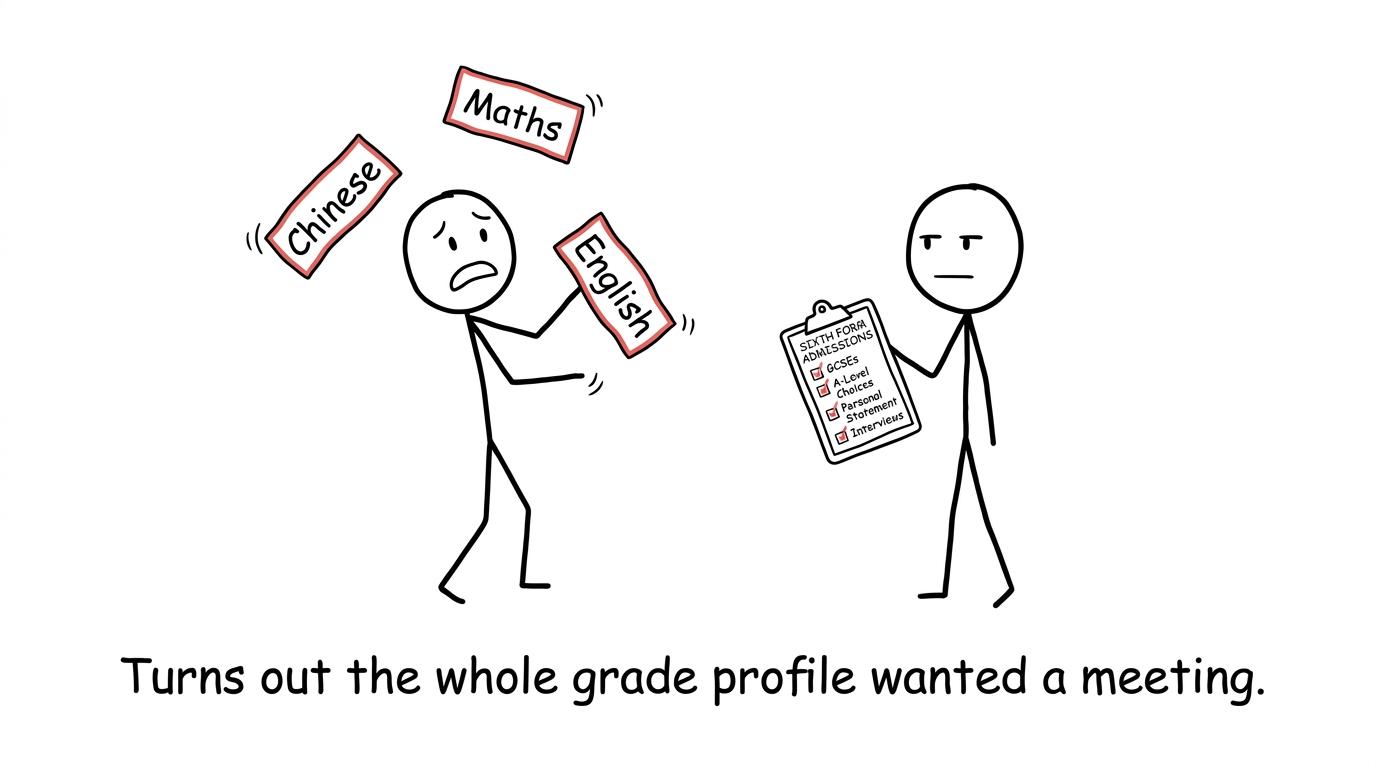 A student juggles Chinese, maths and English while admissions checks the whole profile
How your maths grade affects sixth form choices
For a student focused on maths exams, this is the practical priority. A grade 666 in Chinese may satisfy one general condition, but your GCSE Mathematics result can affect both sixth-form admission and access to mathematically demanding courses.
The required grade varies by institution, but course guides often distinguish between:
| Intended course | What you should check |
|---|---|
| A Level Mathematics | The specific GCSE Mathematics threshold, often higher than the general entry grade |
| A Level Further Mathematics | Whether a higher Mathematics grade is required |
| Physics or Chemistry | Required science grades and any additional Mathematics condition |
| Economics or Computer Science | Whether Mathematics is used as a supporting subject requirement |
| Other A Levels | The general sixth-form requirement plus any course-specific conditions |
Start by identifying the exact maths grade your preferred courses require. Then use MathsGenie's GCSE maths revision resources to organise topics by grade and difficulty. If grade 666 is your immediate target, the grade 6 GCSE maths revision topics help turn a vague ambition into a defined list of skills.
Topic knowledge alone is not the whole exam. Once the methods feel secure, use GCSE maths past papers to practise selecting techniques without being told which chapter a question comes from. Mark schemes and video solutions then help distinguish a small arithmetic slip from a genuine gap in understanding.
What to do before submitting your application
Admissions decisions become less mysterious when you reduce them to a sequence of checks.
Read the current prospectus
Use the prospectus and admissions policy for your intended year of entry. Requirements can change, so an older screenshot or a friend's experience may no longer be reliable.
Write down the general entry rule and every subject-specific rule. Do not rely only on the headline requirement shown on an open-evening slide.
Compare all three intended courses
A student can meet the overall sixth-form threshold but miss the requirement for one course. Check your full combination, including reserve choices.
If your school uses a grade-total calculation, follow its published method exactly. Do not invent your own average because institutions may specify which subjects count, how Combined Science is treated and whether short-course qualifications are included.
Ask precise questions
If the policy is unclear, contact admissions with a focused question: does grade 666 in GCSE Chinese meet the requirement for this particular course and year of entry?
You can also ask what happens if you miss a condition narrowly. Some providers reconsider course choices after results, but flexibility should never be assumed. Availability, demand and the institution's policy all matter.
Protect the grades that control your options
You cannot revise an admissions policy, but you can revise the subjects named in it. Build regular maths practice around weaker topics, then revisit them after a delay. Use MathsGenie's GCSE predicted papers closer to the examination period to practise full-paper timing without treating any prediction as a promise about the real paper.
If A Level Mathematics is part of your plan, it is also sensible to look ahead at MathsGenie's A Level maths revision hub. The purpose is not to race through future content. It is to understand why algebraic fluency and careful working at GCSE matter so much later.
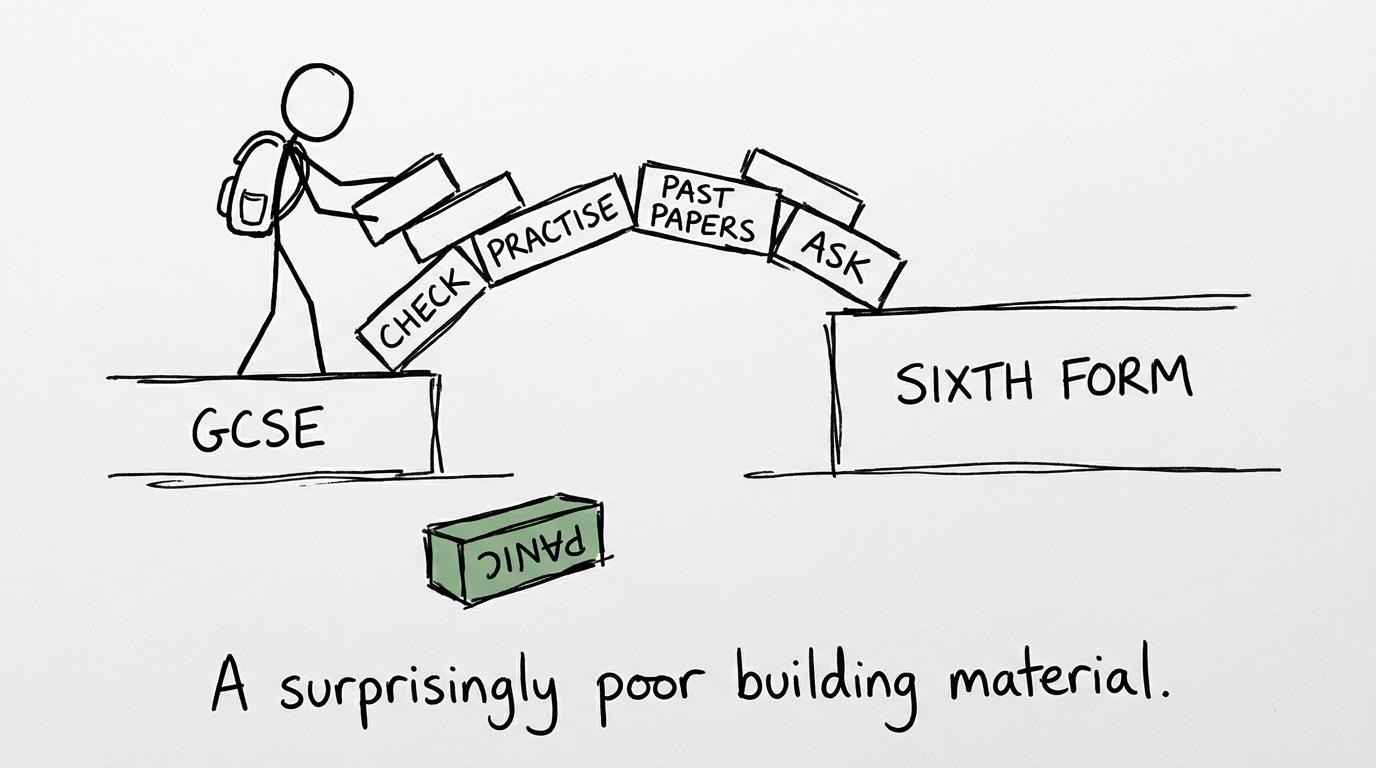 A bridge to sixth form is built from checking, practising, past papers and asking for help
If your predicted grade is currently below 6
A predicted grade is useful evidence for applications, but it is not the final GCSE result. Focus on the gap between your current performance and the next grade rather than repeatedly calculating the consequence of every mock.
For maths, that means reviewing completed papers question by question. Classify lost marks as:
- missing knowledge;
- an incorrect method;
- weak algebra or arithmetic;
- misunderstood wording;
- incomplete working;
- poor use of time.
The category determines the response. Missing knowledge calls for a revision lesson and targeted practice questions. Timing problems call for sections completed under controlled conditions. Careless slips call for slower checking habits, not another hour of passively watching explanations.
This is where free resources are most valuable: they let you move repeatedly between explanation, practice and feedback without waiting for the next school assessment.
Common mistakes when judging sixth-form eligibility
Treating grade 6 as a universal entry rule
There is no single grade 666 rule covering every sixth form and course. Published requirements differ between schools, colleges and subjects.
Checking only the general requirement
General admission and entry to an individual A Level are separate tests. You need to pass both.
Assuming Chinese can replace a required maths grade
A grade 666 in Chinese can improve your overall profile, but it normally cannot replace a course-specific Mathematics requirement.
Using an outdated prospectus
Always check the admissions information for your intended year. Requirements and available courses can change.
Confusing a minimum with guaranteed admission
Meeting the minimum normally means you are eligible to be considered. It may not guarantee a place where a provider is oversubscribed or where other published conditions apply.
Abandoning a course without asking
If your grade is borderline, speak to the sixth form. The answer may still be no, but an official answer is more useful than an assumption.
Make the grade part of a wider plan
So, is a grade 666 in GCSE Chinese good enough for sixth form? It is a good result and will satisfy many general entry profiles. It may also meet the minimum for continuing a language at A Level. But the course you actually want depends on the complete admissions policy, your English and maths results, and the subject-specific grades attached to your chosen programme.
Check the current prospectus, record each condition and ask admissions about anything ambiguous. Then put your energy into the grades you can still influence.
MathsGenie gives you a free route from uncertainty to action: clear revision lessons, graded practice questions, mini tests, past papers, predicted papers, mark schemes and video solutions. Begin with the GCSE revision resources, identify the maths grade your preferred sixth form requires, and build the evidence one well-corrected question at a time.