

Is Grade 6 GCSE Art and Design Enough for Sixth Form?
Grade 6 GCSE Art and Design sixth form entry explained: check course requirements, portfolio rules and how to protect your maths grades while applying.
A single number can feel as though it has been asked to decide your future. You open a sixth-form prospectus, find Art and Design, and wonder whether your result has kept the door open.
For most students asking about grade 6 GCSE Art and Design sixth form entry, the short answer is encouraging: a grade 666 is enough for many A Level Art and Design courses. Some providers accept a grade 555, while others require a grade 666 or occasionally a grade 777. You must also satisfy the sixth form or college's general entry requirements, which often include minimum grades in GCSE English and maths.
The important point is that there is no universal national entry grade for A Level Art and Design. Each provider sets its own admissions rules. Your next step is not to guess whether grade 666 is “good”. It is to compare your complete GCSE profile with the published requirements of the course you actually want.
The quick sixth-form entry checklist
Before making decisions, check these five things:
- the subject-specific GCSE Art and Design requirement
- the provider's overall sixth-form entry criteria
- its required GCSE English and maths grades
- whether applicants attend an interview or portfolio review
- whether alternative entry is possible through a portfolio
Look at the current prospectus or admissions policy for your intended year of entry. Requirements can change, and a course page may contain more recent information than an old printed booklet. If anything is unclear, ask the admissions team or Head of Art directly.
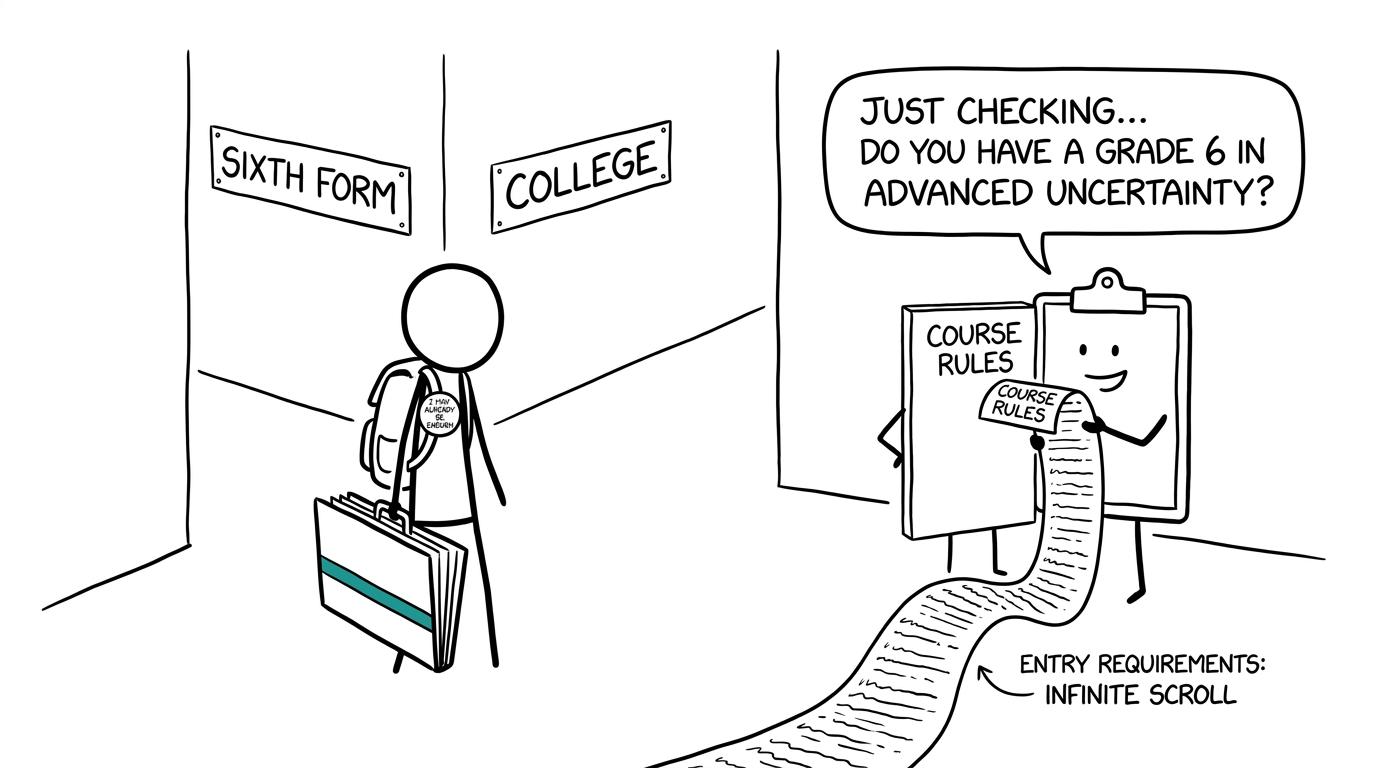 A student choosing between sixth form and college while an admissions checklist studies their grade
Is a grade 6 in GCSE Art and Design good?
Yes. On England's GCSE scale, grade 999 is the highest grade and grade 111 is the lowest. A grade 666 is above the grade 444 threshold commonly treated as a standard pass and above grade 555, which the Department for Education commonly describes as a strong pass in performance measures.
More importantly, grade 666 is a realistic entry grade for many Art and Design courses. Published entry criteria for current sixth-form admissions demonstrate the variation clearly: some providers ask for grade 555, many specify grade 666, and some selective courses ask for grade 777. There are also providers that consider a portfolio, particularly when an applicant has not taken GCSE Art.
That means grade 666 should not be treated as either an automatic rejection or a guaranteed place. It is a solid result whose practical value depends on the institution.
A useful distinction is:
- Meeting the minimum requirement means your application can normally be considered.
- Receiving an offer may also depend on your wider GCSE results, available places, portfolio and suitability for the course.
Admissions policies sometimes use words such as “minimum”, “recommended” and “desirable”. They do not mean exactly the same thing. Read the wording carefully rather than looking only for a number.
Why sixth-form requirements differ
Schools and colleges design their entry criteria around their courses, available places and expectations of students. One Art department may regard grade 555 as adequate preparation. Another may require grade 666 and review recent work. A particularly competitive provider may set a higher threshold across every A Level subject.
There can also be a difference between general entry and subject entry. For example, meeting an Art requirement does not necessarily mean that you satisfy the sixth form's overall admissions policy. You may still need a specified number of GCSEs at particular grades, including English and maths.
This is why a sentence such as “I have grade 666 in Art” is only part of the calculation. Your application usually has three layers:
- your Art and Design grade
- your wider GCSE profile
- evidence that you are ready for sustained creative work
The first layer may already be strong enough. The other two still deserve attention.
Check the course you actually want
“Art” can refer to several different courses. Depending on the provider and exam board, choices may include Fine Art, Graphic Communication, Photography, Textile Design, Three-Dimensional Design or a broader Art, Craft and Design course.
Do not assume that one department applies identical rules to every pathway. A college might accept GCSE Photography for one course but require GCSE Art and Design for another. It may also accept a Level 222 vocational qualification, subject to a particular result.
Use this process:
Read the current course page
Check the entry year, qualification title and awarding organisation. AQA, Pearson Edexcel, OCR and Eduqas specifications share broad creative principles, but providers organise and teach their courses differently.
Read the admissions policy
Look beyond the Art page for general requirements. Search specifically for GCSE English Language, English Literature and maths. These subjects can affect admission to the sixth form even when they are not directly related to Art.
Ask what happens at enrolment
Find out whether the published grade is a strict condition, a recommendation or one part of a portfolio-based decision. Ask what evidence is required and when it must be submitted.
Keep a realistic alternative
If your preferred course asks for grade 777, identify another provider whose requirement is grade 666 or whose admissions team considers portfolios. A backup is not an admission of defeat. It is simply sensible planning.
When your portfolio can matter
A GCSE result summarises assessed work, but a portfolio reveals how you think. Some providers review portfolios for all applicants; others use them mainly when an applicant misses the published grade or did not take GCSE Art.
Only include work the provider requests. In general, useful evidence may show:
- observation and recording
- experimentation with materials or processes
- development from an initial idea
- research into relevant artists or designers
- refinement, reflection and a personal response
- completed outcomes supported by preparatory work
Do not hide every imperfect experiment. Art courses value development, not merely a row of polished final pieces. Your sketchbook can show decisions, changes and thoughtful use of feedback.
However, a strong portfolio does not automatically cancel a formal entry condition. Contact the provider before relying on an exception. If it offers a portfolio route, ask for precise guidance rather than trying to predict what the department wants.
 An art portfolio attending its own sixth-form admissions interview
What A Level Art and Design will expect
Being admitted is only the beginning. A Level Art and Design normally requires sustained investigation, experimentation, contextual understanding, recording, refinement and independent decision-making.
The exact assessment structure depends on the exam board. For example, the current AQA A Level includes a personal investigation and an externally set assignment. The personal investigation includes practical work supported by written material, while the externally set assignment includes preparation followed by supervised time. Other specifications should be checked separately.
This matters because students sometimes imagine A Level Art as a timetable filled entirely with making finished artwork. In reality, progress often depends on planning, research, annotation, experimentation and responding to feedback. Grade 666 suggests that you have a useful foundation, but your habits will determine whether that foundation grows.
Ask yourself:
- Do I enjoy developing an idea over several weeks?
- Can I explain why I selected a process or artist?
- Am I willing to improve work rather than stop at the first outcome?
- Can I manage creative coursework alongside my other subjects?
A genuine interest in the process is more useful than choosing Art only because you achieved the entry grade.
Why your GCSE maths grade still matters
A student can meet the Art requirement and still miss the general sixth-form offer because of another compulsory subject. GCSE maths therefore deserves attention even when your intended A Levels are creative.
Begin with the free GCSE Maths revision hub, where resources are organised by topic and grade. Revision is more manageable when you identify the exact skill costing marks rather than repeatedly declaring that you are “bad at maths”.
Once topic knowledge is improving, use Edexcel GCSE Maths past papers if Edexcel is your board. MathsGenie also supports revision across AQA, OCR, Eduqas and other UK exam boards through its wider GCSE area. Always prioritise papers matching your own specification before using another board for extra practice.
The basic revision cycle is simple:
- learn or review one method
- answer focused practice questions
- check the solutions and mark scheme
- record the reason for each lost mark
- return to the same skill after a short gap
The article on when to start GCSE past papers explains how to move from short diagnostic tests to complete timed papers. Nearer the exams, GCSE predicted papers can provide additional exam-style rehearsal, but they should supplement rather than replace official past papers.
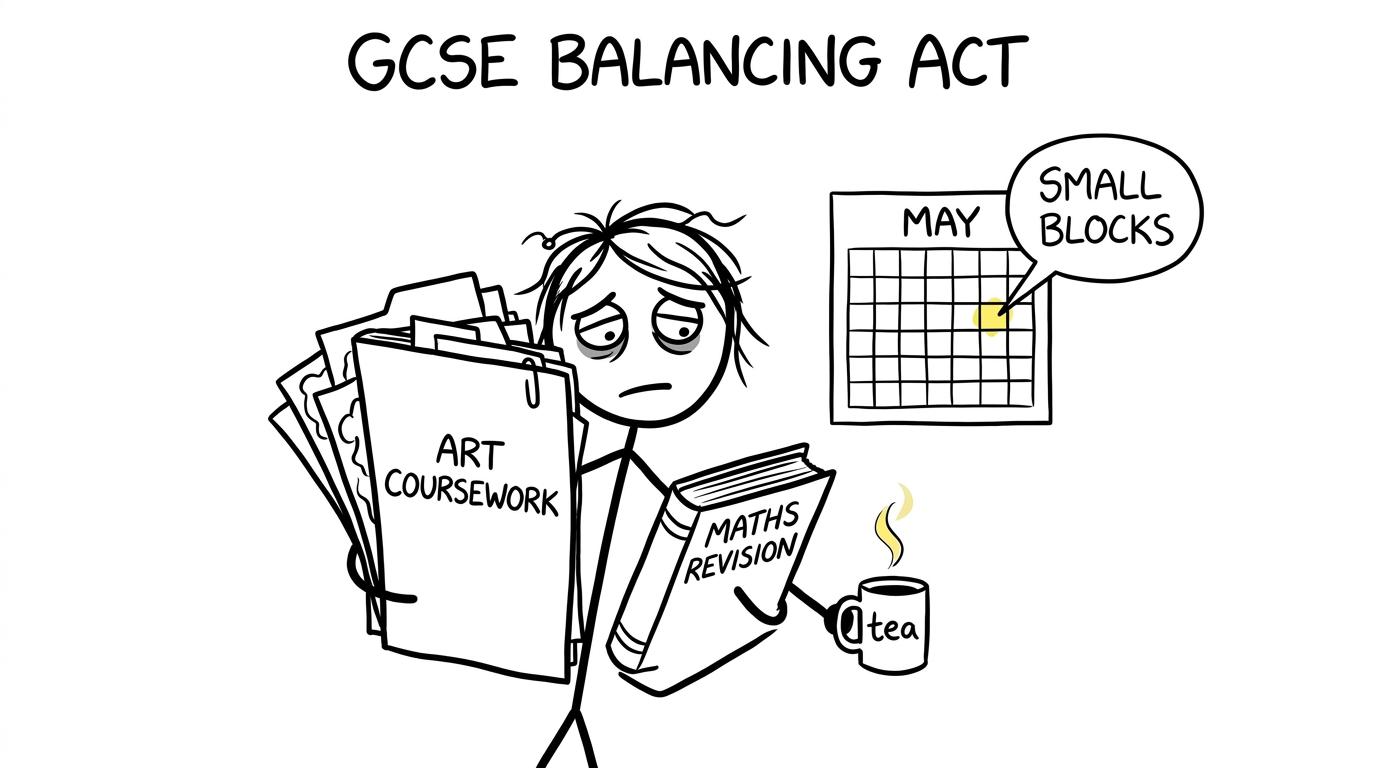 A student balancing an art portfolio, maths revision and a cup of tea
Balancing Art coursework and maths revision
Art and maths create different kinds of workload. Art tasks can expand to fill an evening because there is always another detail to refine. Maths can be postponed because the next question set looks small. Both tendencies become expensive when deadlines approach.
Use separate, defined blocks. An Art session might have the goal “complete two material experiments and annotate the comparison”. A maths session might be “revise bearings, complete the exam questions and mark every answer”. Specific endings prevent revision from becoming vague.
If you study Edexcel, this guide to revising GCSE Maths without wasting time provides a focused lesson, questions, and mark scheme routine. When you begin full papers, follow the process in how to use Edexcel past papers properly: sit the paper, mark it honestly, diagnose errors and repair the weakest topics.
You do not need to choose between being creative and being organised. Organisation protects the time in which creativity can happen.
Common mistakes when judging your chances
Assuming every sixth form uses the same grade
There is no single nationwide GCSE entry grade for A Level Art and Design. Check each provider separately.
Looking only at the Art requirement
General admissions criteria may include minimum English and maths results or a wider GCSE grade profile.
Treating grade 6 as a guaranteed offer
It may meet the stated minimum, but places, portfolio requirements and the complete application can still matter.
Giving up when a course asks for grade 7
Ask whether the requirement is strict, whether portfolios are considered and whether a related pathway has different criteria. Then prepare a realistic second choice.
Neglecting maths to finish coursework
Your portfolio matters, but missing a general maths condition can affect your entire sixth-form application. Use the MathsGenie home page to move between revision lessons, exam questions and free paper practice without losing time searching for resources.
Your next step
A grade 666 in GCSE Art and Design is enough for many sixth-form and college courses, but the only answer that controls your application is the one published by your chosen provider. Check the current subject requirement, general admissions criteria, portfolio arrangements and exact qualification title. If the wording is unclear, ask.
Then protect the rest of your GCSE profile. MathsGenie gives you free revision lessons, practice questions, mini tests, past papers, predicted papers, mark schemes and video solutions so that maths does not become the overlooked condition standing between you and your preferred course.
Start with the GCSE Maths revision resources, choose one weak topic and complete a focused session today. Your Art grade may already have opened the door. Careful research and steady revision will help you reach it.











