

Grade 5 GCSE Astronomy: Enough for Sixth Form?
Grade 5 GCSE Astronomy sixth form entry explained: learn whether your result meets course rules and what to strengthen for Physics, Maths or science courses.
A single grade can feel as though it carries the weight of an entire future. You see a 555 beside GCSE Astronomy and immediately wonder whether a sixth form will see promise, limitation, or simply a number.
The short answer to grade 5 GCSE Astronomy sixth form entry is reassuring but conditional: a grade 555 may be enough for general admission, yet it might not meet the subject-specific requirements for the course you want. Sixth forms usually consider your overall GCSE profile, English and maths grades, and any requirements attached to subjects such as A-level Physics or Maths. Your Astronomy result is one part of that picture.
The quick answer
Use this checklist before deciding what your grade means:
- Check the sixth form's general entry requirement.
- Check the separate requirements for each course you want.
- Look particularly at GCSE Maths, Physics and Combined Science requirements.
- Ask whether GCSE Astronomy can support or replace another science requirement.
- Confirm whether the published grades are minimum requirements or recommendations.
- Contact admissions if the prospectus is unclear.
- Prepare a realistic second course combination without abandoning your preferred route.
| Course or route | How a grade 555 in Astronomy may be treated |
|---|---|
| General sixth-form admission | It may count as one of the GCSE grades in your overall profile. |
| A-level Physics | Useful evidence of interest, but Physics, Combined Science and Maths grades are usually more important. |
| A-level Maths | The GCSE Maths requirement normally decides eligibility. |
| Level 333 Applied Science | It may support your application, but each college sets its own science requirements. |
| Unrelated A level | It may count towards general entry without being a subject-specific requirement. |
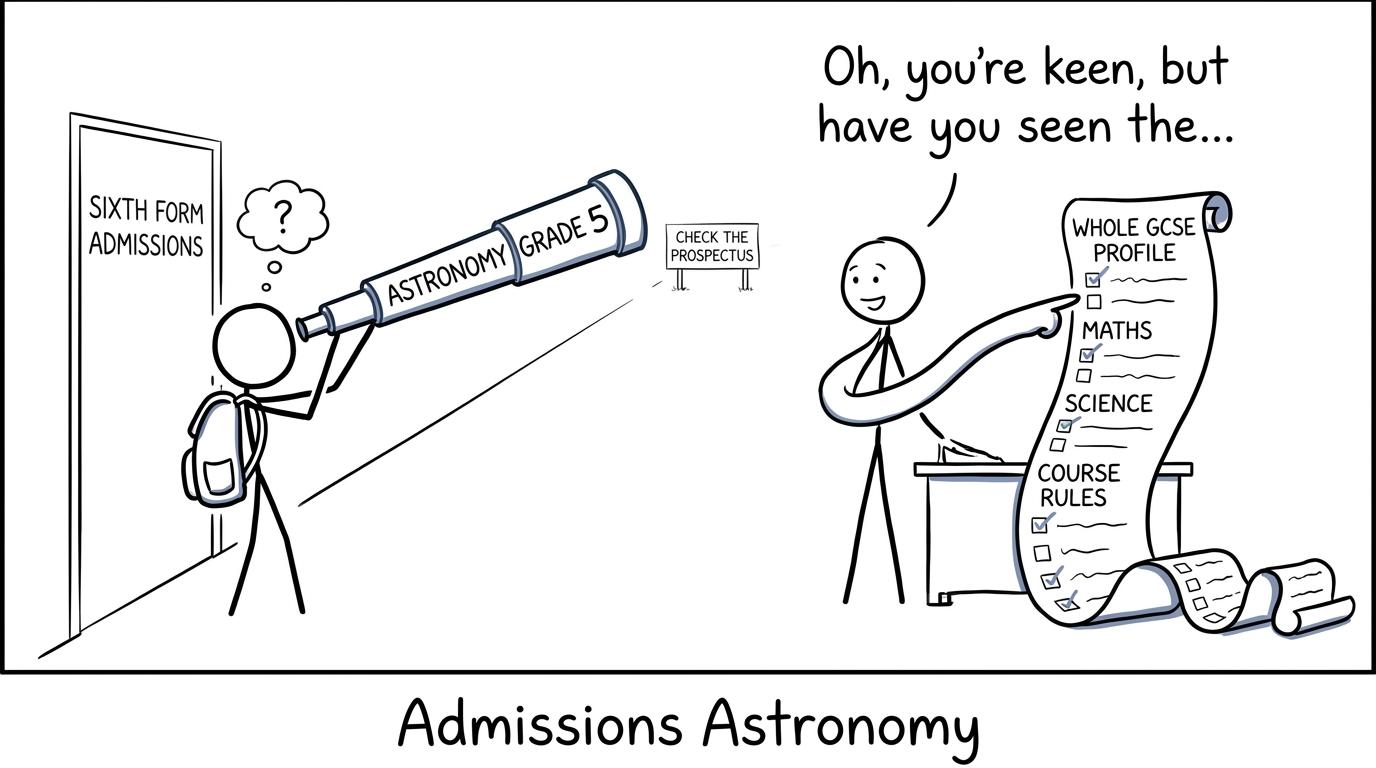 A student discovering that sixth-form entry depends on more than one Astronomy grade
Is a grade 5 in GCSE Astronomy a good result?
A grade 555 is a credible GCSE result. It sits above the grade 444 standard-pass threshold used in England and shows that you have understood a meaningful proportion of a demanding scientific course.
There is an important language distinction, however. The Department for Education uses “strong pass” specifically for grade 555 or above in English and maths within school performance measures. It is therefore safer to describe a grade 555 in Astronomy as a solid result rather than assume that “strong pass” is an official label for every subject.
Pearson Edexcel GCSE Astronomy is assessed on the grades 999-111 scale. The qualification covers areas including the Earth-Moon-Sun system, planetary motion, observation, stars, galaxies and cosmology. Its specification also identifies possible progression towards qualifications such as Physics and Level 333 science courses.
That does not mean a grade 555 automatically unlocks those courses. Progression and admission are different ideas. A qualification can prepare you for a subject while a particular sixth form still asks for higher grades in Maths or Physics.
Whether it is enough depends on two entry tests
Most applications involve two separate gates. Students sometimes check the first and overlook the second.
General sixth-form entry
A school or college may ask for a certain number of GCSEs at grades 444, 555 or 666 and above, sometimes including English Language and Mathematics. A grade 555 in Astronomy can often contribute to this overall total because it is a full GCSE qualification.
There is no single national GCSE profile that guarantees admission to every sixth form. Requirements vary between institutions and can also vary between academic and vocational pathways.
Entry to the individual course
Each A level or Level 333 course may have additional criteria. A student could satisfy the general sixth-form requirement but miss the requirement for one chosen subject.
For example, published A-level Physics requirements commonly focus on GCSE Physics or Combined Science and GCSE Maths. Depending on the institution, the minimum may be around grade 666, while more selective providers may ask for grade 777. Other providers use lower minimums or distinguish between required and desirable grades.
The crucial point is simple: do not assume that Astronomy is interchangeable with Physics. It is related and valuable, but it only substitutes for another qualification if the sixth form explicitly says so.
What if you want to study A-level Physics?
Astronomy gives you relevant experience. You have encountered scientific models, observations, data, scale and ideas connected with gravity, light and the universe. That background can make your interest in Physics credible.
Yet A-level Physics becomes substantially more mathematical. Current specifications require at least 40%40\%40% of assessment marks to involve mathematical skills at Level 222 or above. Algebra, graphs, standard form, trigonometry, proportional reasoning and units are not side topics. They are part of the language of the course.
This is why admissions teams tend to pay close attention to GCSE Maths and Physics or Combined Science. A grade 555 in Astronomy alongside stronger grades in those subjects may support a convincing application. A grade 555 in Astronomy with a Maths or Science grade below the published minimum is less likely to override the rule.
The guide to choosing A levels after GCSE Physics explains how Maths, Physics and related routes fit together. It is also worth exploring MathsGenie's A-level Maths revision resources before enrolment so that you can see the mathematical step up for yourself.
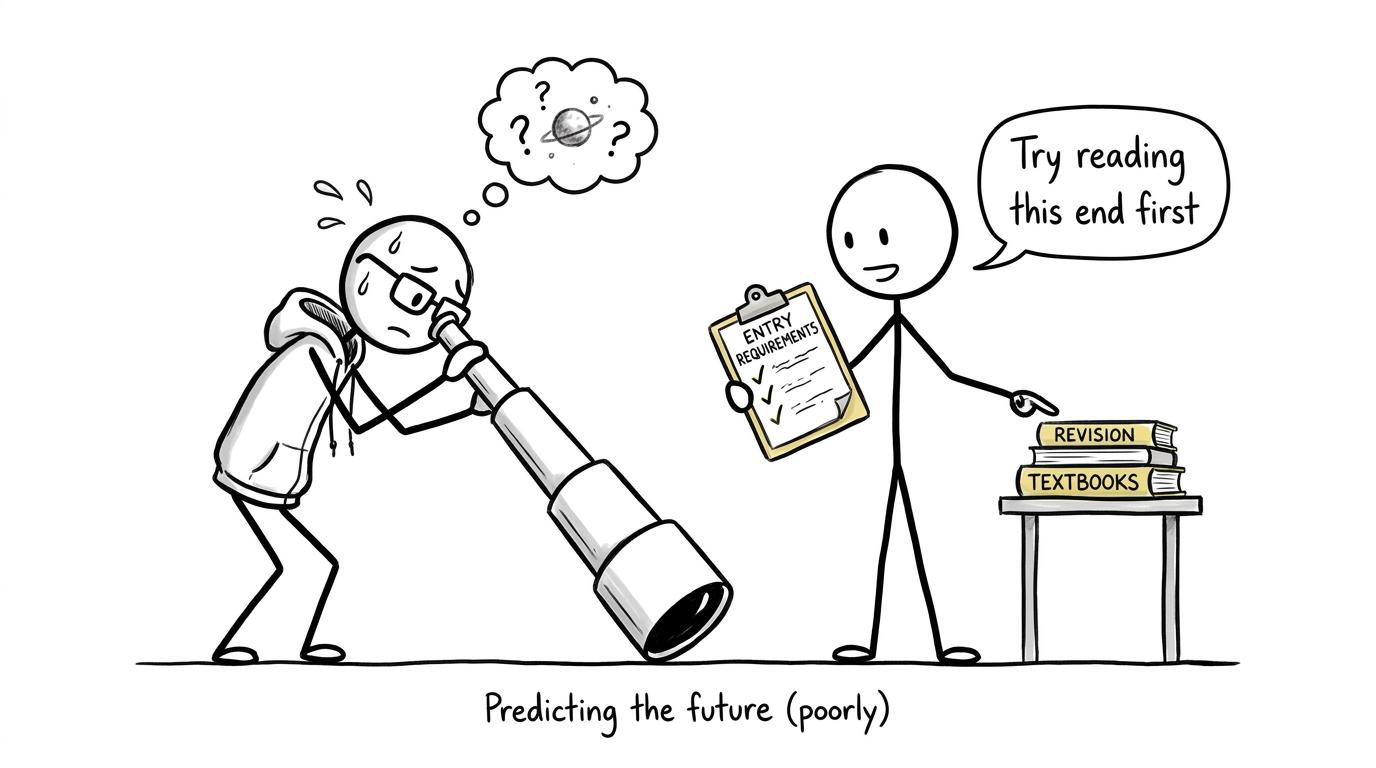 A student using the admissions prospectus instead of looking through a telescope backwards
What if you want A-level Maths or another course?
For A-level Maths, your Astronomy grade is unlikely to be the deciding result. Sixth forms generally set a specific GCSE Maths threshold, often grade 666 or 777, because the new course builds directly on higher-tier algebra, functions, graphs, geometry and trigonometry.
If you are curious about that transition, the Edexcel A-level Maths hub shows the range of pure maths, statistics and mechanics students meet. You can also preview A-level trigonometric functions, although your immediate priority should remain securing your GCSE foundations.
For humanities, arts or social sciences, Astronomy may simply contribute to your overall GCSE total. Those subjects may instead specify English, essay-based subjects, or a closely related GCSE. For Applied Science, engineering or technical programmes, providers may consider a broader combination of Maths and Science results.
Never rely on the course title alone. Read the exact entry statement for your intended year of admission.
How to check whether your grade is enough
Start with the latest sixth-form prospectus or course page. Entry policies can change, so an old screenshot or a friend's experience may no longer be reliable.
Write down four pieces of information:
- the overall number of GCSEs required;
- the minimum English and Maths grades;
- the requirement for each chosen course;
- whether equivalent or related subjects are accepted.
Then compare the wording carefully. “Grade 666 required” is different from “grade 666 recommended”. Likewise, “grade 666 in Physics or 666-666 in Combined Science” does not automatically include GCSE Astronomy.
If your combination is not listed, send the admissions team a precise question. State your predicted or achieved grades in Astronomy, Maths and Science, name the course, and ask whether you satisfy its criteria. A clear answer from the institution is more useful than speculation.
What to do if grade 5 is below the requirement
Missing a stated threshold is disappointing, but it does not erase every route forward.
First, ask whether the provider considers applicants individually. Some sixth forms may review your complete results, teacher evidence or performance in closely related subjects. Others apply minimum grades strictly, particularly when courses are oversubscribed. Ask politely, but do not assume an exception.
Second, compare nearby providers. One college may require grade 666 in GCSE Maths for Physics while another may publish a different combination. A Level is not the only possible route either. Level 333 Applied Science, engineering or technical qualifications may lead towards related higher education or employment, subject to later entry requirements.
Third, strengthen the grade that actually controls your next step. For a Physics route, that will often be Maths or Science rather than Astronomy. Begin with the GCSE Maths revision hub, where you can choose your exam board and work through revision lessons, questions and solutions.
Use the weak-topic diagnostic approach to identify where marks are disappearing. Then create a manageable schedule using the one-month GCSE Maths revision plan. The aim is not to revise everything with equal intensity. It is to improve the grades that preserve your preferred choices.
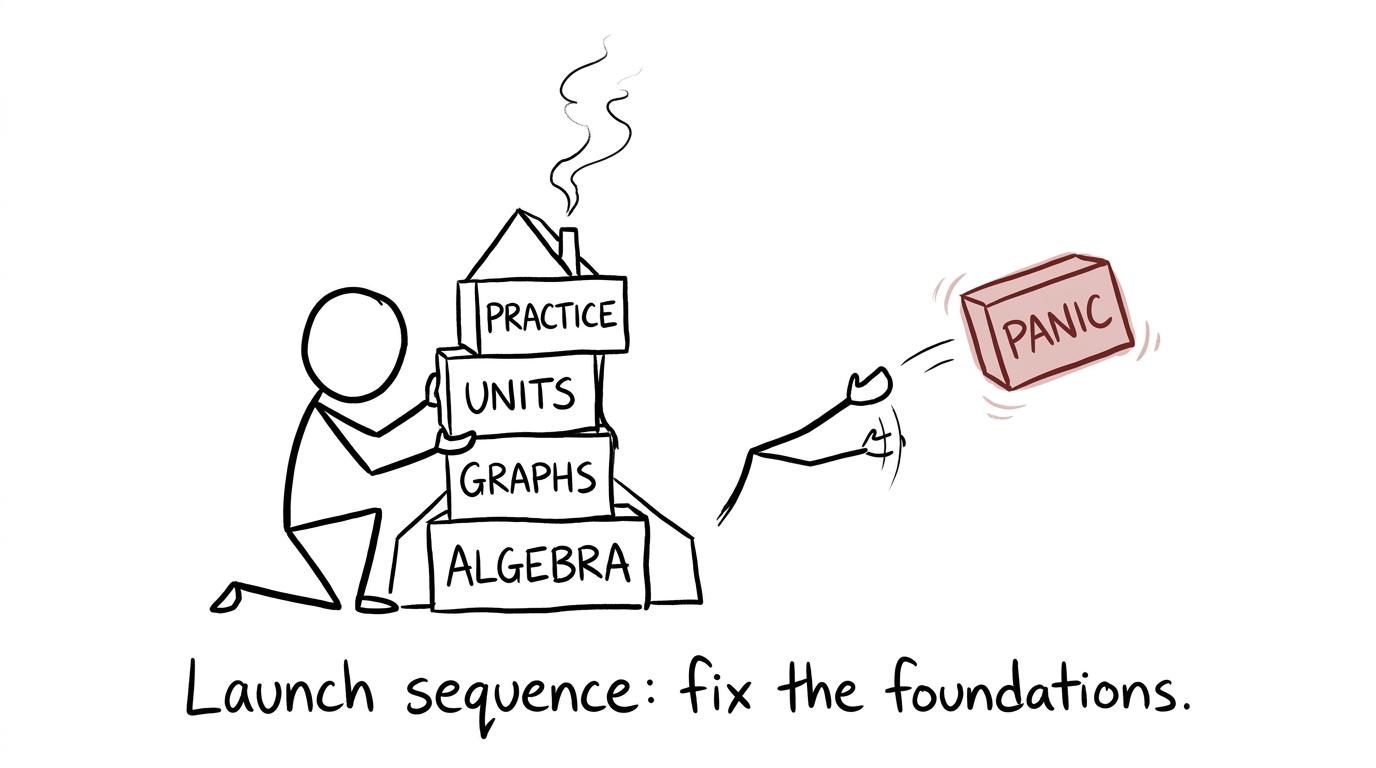 A student building a revision rocket from algebra, graphs, units and practice
Common mistakes when judging sixth-form eligibility
Treating grade 5 as a universal admission rule
A grade 555 can be enough in one institution and below the threshold in another. Always use the current policy for the provider and entry year you want.
Checking only the general requirement
General admission does not guarantee access to every course. Check all subject-specific criteria before choosing your final combination.
Assuming Astronomy replaces Physics
Astronomy supports scientific progression, but it is not automatically accepted in place of GCSE Physics or Combined Science. Obtain written confirmation if the policy does not say.
Ignoring GCSE Maths
Students interested in space naturally focus on their Astronomy result. For A-level Physics, engineering and some science routes, Maths may be the more restrictive grade.
Comparing raw marks between exam years
Grade boundaries are set for each exam series and can move according to the demands of the papers. A previous year's raw mark boundary is not a guaranteed target for your own exams.
Doing papers without reviewing them
A completed paper is evidence, not improvement by itself. Mark it, identify the lost skill and practise that skill before trying another. The guide to when to begin GCSE past papers shows how to move from topic practice to timed exam preparation.
A grade is information, not a verdict
So, is a grade 555 in GCSE Astronomy good enough for sixth form? It can be. It may satisfy part of a general entry profile and it shows a sound achievement in an academically interesting subject. But the course you actually want may depend more heavily on GCSE Maths, Physics, Combined Science or another specified subject.
Read the current prospectus, separate general entry from course entry, and ask the provider directly about any ambiguity. Then work on the grades you can still influence.
MathsGenie can help you turn that intention into a routine. Start with free revision lessons and practice questions, check your work with mark schemes and video solutions, and use mini tests to expose gaps. As the exams approach, add past papers and predicted papers under timed conditions. The future rarely rests on one number alone, but the next useful action can begin today.










