A-Level After GCSE Physics: What Should You Choose?
A-level after GCSE Physics: compare entry grades, maths demands and subject combinations, then decide if A-Level Physics is the right next step for you.
Results day turns an abstract choice into a real one. You have a Physics grade, a Maths grade and perhaps only a short time to confirm your sixth-form subjects. If you are considering an A-Level after GCSE Physics, the clearest answer is this: choose A-Level Physics if you enjoy explaining how things work, are comfortable using maths and meet your sixth form's entry requirements. Taking A-Level Maths alongside it is often helpful, but it is not universally compulsory.
The decision should rest on more than one result. Your interest in the subject, mathematical confidence and willingness to solve unfamiliar problems matter too.
Your results-day decision checklist
Before confirming your options, check:
- your sixth form's required GCSE Physics or Combined Science grade;
- its separate GCSE Maths requirement;
- whether A-Level Maths or Core Maths must be taken alongside Physics;
- the Physics exam board: AQA, Edexcel, OCR or Eduqas;
- whether you enjoyed calculations, practical work and explanations at GCSE;
- how Physics fits with your other subjects and possible future courses.
Entry rules are set by individual schools and colleges. Published requirements for recent entry commonly range from grade 666 to grade 777 in Physics or Combined Science, alongside grade 666 or 777 in GCSE Maths. That is a useful guide, not a national threshold. Check the exact prospectus and speak to the Physics department before changing your plans.
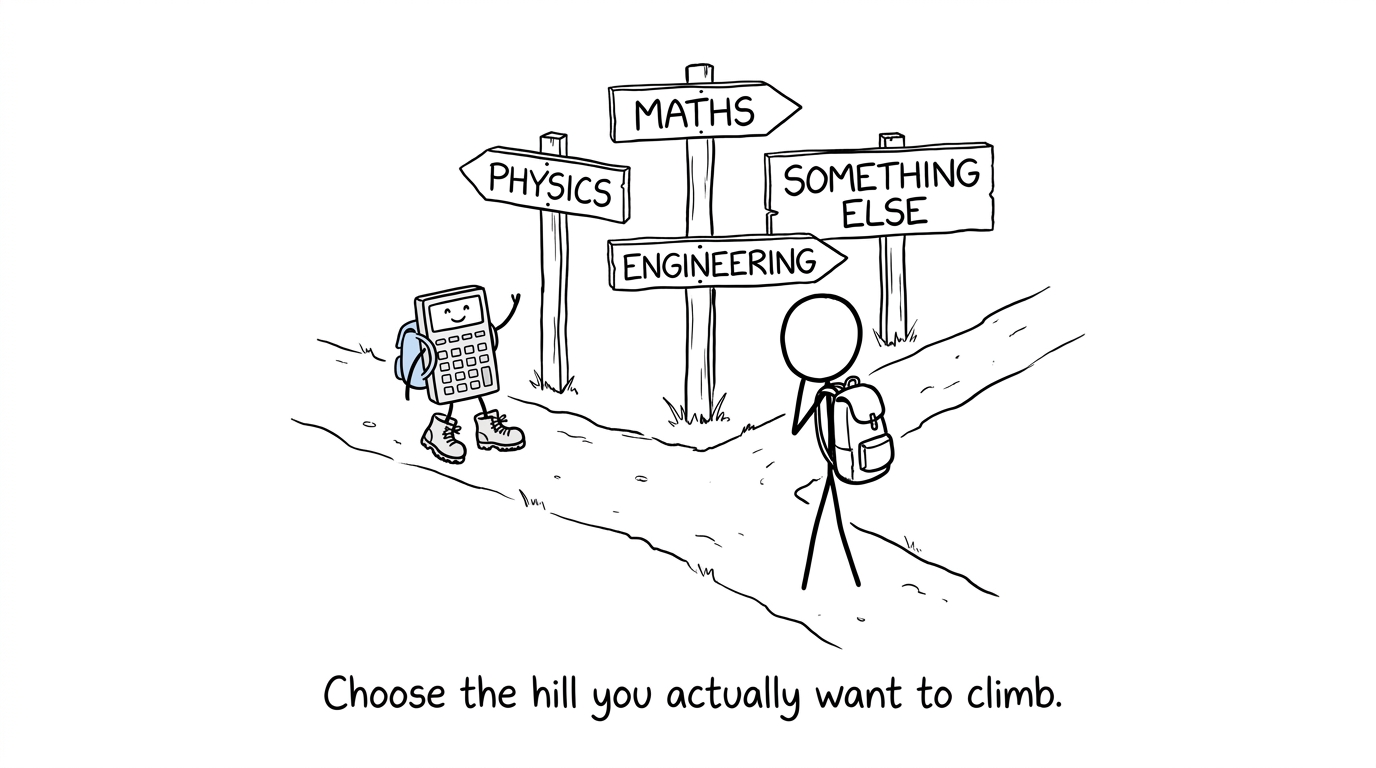 A student choosing between post-GCSE subject paths
Is choosing A-Level Physics right for you?
A-Level Physics is a strong option when you are curious about motion, forces, electricity, waves, particles, fields and the behaviour of matter. It rewards students who can connect an idea to evidence, rather than simply recall a definition.
You are likely to enjoy the course if you:
- ask why a result happened, not only what happened;
- are prepared to rearrange equations and interpret graphs;
- can explain physical ideas precisely in writing;
- enjoy practical investigation and analysing imperfect data;
- will keep working when the method is not immediately obvious.
A high GCSE grade is encouraging, but it does not make the course effortless. Equally, a result near the entry boundary does not automatically mean you cannot succeed. Ask your teacher where your marks came from. Strong performance in calculations, graphs and application questions is especially relevant to the move from GCSE Physics to A-Level.
Grade thresholds and what to do next
| Your position | Sensible next action |
|---|---|
| You meet both published requirements | Confirm the course, then begin strengthening GCSE algebra and graphs. |
| You meet the Physics requirement but miss Maths by one grade | Ask whether the department considers individual cases or offers a diagnostic assessment. |
| You meet Maths but miss Physics or Combined Science | Request a review of your paper profile and discuss whether another science course is more suitable. |
| You are below both requirements | Consider a related Level 333 route, resitting where appropriate, or choosing subjects that better match your current strengths. |
| Your grades are much higher than the minimum | Do not choose Physics automatically. interest and subject fit still matter. |
Do not assume that one school's policy applies everywhere. Some sixth forms accept grade 666 in Maths and Physics, while others request grade 777, grades 777-777 in Combined Science or concurrent study of A-Level Maths. Admissions staff can tell you whether a threshold is absolute.
How mathematical is A-Level Physics?
Official subject requirements state that at least 40%40\%40% of A-Level Physics assessment must involve mathematical skills at Level 222, meaning higher-tier GCSE standard, or above. The maths is embedded in physical situations, so the challenge is often deciding which relationship applies and what the answer means.
You will regularly use:
- standard form, prefixes and unit conversions;
- ratios, proportionality and percentage uncertainty;
- substitution and changing the subject of a formula;
- gradients and areas under graphs;
- trigonometry and vector components;
- significant figures and orders of magnitude.
For example, relationships such as F=maF=maF=ma are simple to read, but an examination question may require you to identify the resultant force, convert units and explain whether the calculated value is realistic. That combination is why mathematical fluency matters.
Use the GCSE Maths revision hub to diagnose gaps, then focus on changing the subject of a formula. Your own exam board may differ, but the underlying algebraic skill is transferable. The AQA GCSE Maths revision guides also bring together work on graphs, standard form, trigonometry and quadratics.
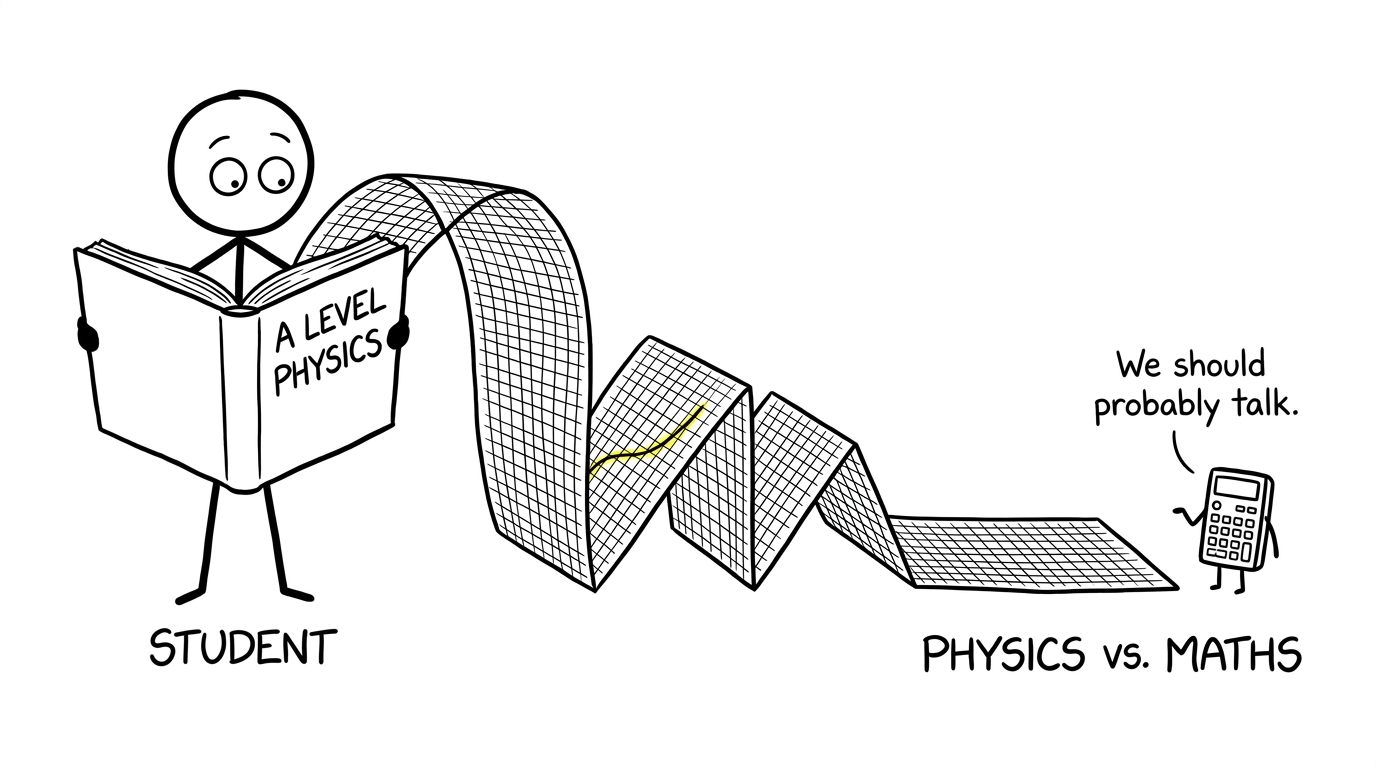 A calculator attempts to discuss the mathematical side of Physics
Should you take A-Level Maths with Physics?
A-Level Maths is one of the most natural partners for Physics. Mechanics, vectors, graphs and algebra reinforce ideas encountered in both subjects. You can explore that overlap through Edexcel A-Level Maths revision.
However, taking Maths is not a universal examination-board requirement for A-Level Physics. Your sixth form may require it, recommend it or permit Core Maths instead. Check locally.
A sensible subject combination depends on your direction:
- Physics, Maths and Further Maths suits students strongly drawn to mathematical physics.
- Physics, Maths and Chemistry keeps many physical science routes open.
- Physics, Maths and Computer Science develops modelling and computational thinking.
- Physics, Maths and Design or Engineering can support an applied technical direction where offered.
- Physics with contrasting subjects may be appropriate when you have broader interests, provided entry requirements are met.
University requirements vary by course and institution, so investigate likely destinations before finalising your combination.
What changes after GCSE Physics?
The content becomes deeper, but the larger change is in the questions. You must combine topics, select equations, evaluate evidence and communicate a chain of reasoning. Practical skills also remain important: written papers assess experimental methods, data, uncertainties and conclusions, while A-Level science courses include practical work assessed through the relevant arrangements.
Preview the standard through the AQA A-Level Physics overview, Edexcel A-Level Physics revision guides or OCR A A-Level Physics lessons. Read one early mechanics or electricity lesson. If the challenge feels interesting rather than merely intimidating, that is useful evidence.
Common mistakes when choosing A-Level Physics
Choosing it only because you earned a high grade
A grade measures past performance. It does not tell you whether you want two more years of calculation, practical analysis and abstract reasoning.
Ignoring the Maths requirement
Check both subject thresholds. A strong Physics result may not compensate for missing a separately stated Maths grade.
Assuming A-Level Physics is mostly remembering equations
Equations matter, but selection, rearrangement, units, graphs and explanation carry the thinking.
Copying a friend's subject combination
Your friend may have different strengths or plans. Choose a combination you can sustain and that supports your own next step.
Treating a near miss as the end of the conversation
If you miss a requirement narrowly, ask the sixth form what its policy allows. Do not assume an exception, but do seek an accurate answer.
Make the next decision with evidence
Choosing A-Level Physics is not a verdict on whether you are naturally “a Physics person”. It is a decision about the work you are willing to practise. Check the thresholds, review your Maths foundations, preview the course and ask the department direct questions.
Then begin deliberately. MathsGenie gives you free revision lessons, practice questions, mark schemes, video solutions, mini tests, past papers and predicted papers, so your confidence can grow from evidence rather than guesswork. Start with the AQA A-Level Physics overview, or select the page matching your exam board, and see what the next stage genuinely involves.