Grade 4 GCSE French: Enough for Sixth Form?
Grade 4 GCSE French sixth form entry depends on your chosen course. Learn how to check A Level, college and maths requirements before results day arrives.
A results sheet can make every grade look like a separate verdict. In reality, sixth-form admissions work more like a set of connected doors: one grade may close a particular route while leaving several others open.
The short answer to the grade 444 GCSE French sixth form question is this: a grade 444 may be enough for general entry, especially if you are not taking A Level French, but it is often below the subject-specific requirement for A Level French itself. Your overall GCSE profile, English and maths grades, chosen courses and institution's admissions policy all matter.
That distinction is important. A grade 444 in French is a recognised standard pass in England. It is not automatically a barrier to sixth form, college or a Level 333 course. However, each institution sets its own entry criteria, and courses requiring strong language skills may ask for a higher grade.
Your sixth-form entry checklist
Before assuming that a grade has decided your future, check:
- the sixth form or college's overall GCSE entry requirements;
- the specific requirement for every A Level or vocational course you want;
- whether GCSE French is one of the subjects being counted;
- your grades in GCSE English and maths;
- whether the institution considers students who narrowly miss a requirement;
- whether an alternative course combination would still lead towards your longer-term goal;
- the latest prospectus and admissions policy for your year of entry.
Requirements can change between admission cycles. Read the current information rather than relying on what an older student needed.
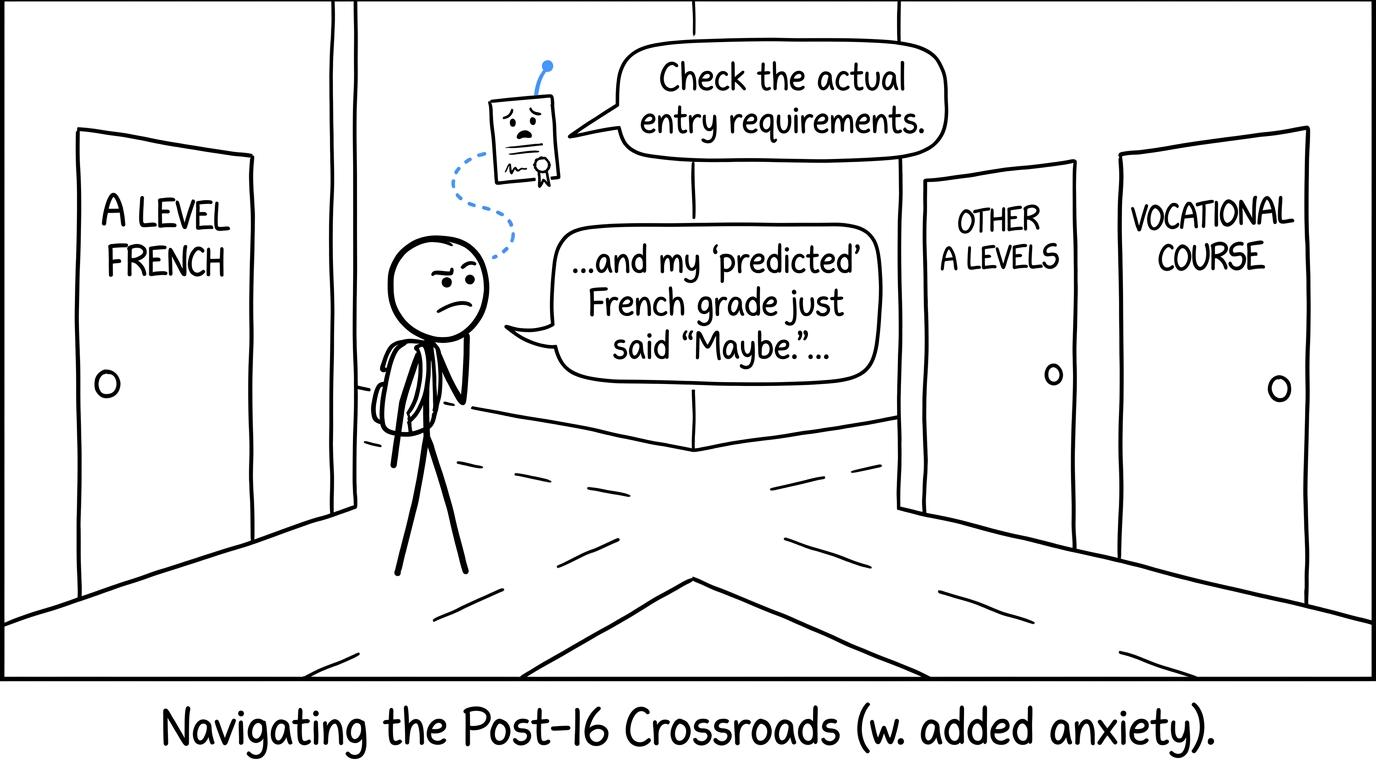 Student choosing between sixth-form pathways while a certificate recommends checking the actual requirements
Is a grade 444 in GCSE French a good result?
A grade 444 is a standard pass under England's GCSE grading system. It demonstrates that you reached a recognised level in the qualification, but the word “pass” does not mean that every post-161616 course must accept it as sufficient preparation.
There are two separate questions:
- Does the grade help you meet the institution's general entry threshold? It may do, because some sixth forms ask for a specified number of GCSE passes at grades 999-444 or above.
- Does it meet the requirement for your chosen subject? That depends on the course. A Level French commonly has a higher threshold because it builds directly on GCSE vocabulary, grammar, listening, reading, writing and speaking.
Current published sixth-form requirements show why checking locally matters. Some institutions ask for grade 555 in GCSE French for A Level French, while others ask for grade 666 or 777. These are institutional decisions rather than one national entry rule applying to every school and college.
Is grade 444 enough if you want to take A Level French?
Often, it will not meet the published requirement on its own.
A Level French is a substantial step beyond GCSE. Depending on the exam board, students study French-speaking society, culture and political life, develop more sophisticated grammar, respond to spoken and written material, and may study literary texts or films. Speaking and independent research can also form part of the assessment.
Because the course builds on GCSE knowledge, a sixth form may use a grade 555, 666 or 777 requirement as evidence that a student has a secure enough foundation. The exact threshold remains the institution's choice.
If you achieved a grade 444 but want to continue with French, do not reject the idea before speaking to the admissions team. Ask:
- Is the stated requirement absolute?
- Can teacher evidence, mock results or performance in particular skills be considered?
- Is there an internal assessment or enrolment discussion?
- Would additional preparation before September make a difference?
- Is another language or related course available?
An exception is never guaranteed. Still, a direct and informed conversation is more useful than guessing.
Is grade 444 enough for other sixth-form courses?
It may well be.
If you plan to take subjects such as maths, biology, history, psychology or business, your French result may simply form part of your overall GCSE profile. The institution is likely to pay closer attention to the subjects most relevant to your choices.
| Intended route | Likely importance of GCSE French |
|---|---|
| A Level French | Usually central, with a subject-specific grade often required |
| Other A Levels | May count towards the general GCSE entry total |
| Level 333 vocational course | Usually considered alongside the complete entry profile |
| Course involving languages or international communication | May be relevant even when not an absolute requirement |
| Maths or science pathway | Maths and science grades are normally more important |
“Likely” matters here. There is no universal sixth-form admissions formula. Two nearby institutions may set different overall thresholds and different subject requirements.
For comparison, a student considering A Level Maths will normally face a specific GCSE Maths requirement that is considerably higher than a standard pass. That does not make a grade 444 in French irrelevant; it means admissions decisions are shaped by the course being entered.
Why English and maths grades need separate attention
In England, English and maths have a special position in post-161616 education. Students without an eligible grade 444 or above in GCSE maths or English must normally continue working towards approved qualifications in the missing subject as part of their programme.
That national funding condition does not apply to GCSE French in the same way. A grade below 444 in French does not create a general legal or funding requirement to continue studying French.
However, individual sixth forms often include English and maths in their own admissions criteria. A grade 444 in French alongside strong English, maths and subject-relevant results may therefore lead to a different decision from the same French grade alongside unmet core requirements.
If maths is one of the grades still in progress, begin with the free GCSE Maths revision hub. It brings together resources for Edexcel, AQA, OCR and Eduqas, helping you revise for the correct board and tier rather than treating GCSE Maths as one generic examination.
How to check whether your actual course is available
A broad internet answer cannot replace the admissions policy attached to your application. Use a simple evidence-first process.
Read the general entry criteria
Look for the minimum number and level of GCSE grades required. Check whether English and maths must be included and whether the institution calculates an average GCSE score.
Check every subject separately
A sixth form may admit you generally but decline one of your course choices. Read the subject pages for all three or four options, not only the main admissions page.
Contact the admissions team
If the wording is unclear, ask a precise question: “I have grade 444 in GCSE French and meet the overall entry criteria. Can I enrol on my chosen course combination?”
Include the courses you actually want. A useful answer depends on that context.
Prepare a realistic alternative
A backup plan is not an admission of failure. It is protection against one condition disrupting your whole route. Consider another subject combination, a different institution or an appropriate vocational programme.
MathsGenie's guide to GCSE English Language and sixth-form entry can help you apply the same careful distinction between general and subject-specific requirements.
Protecting your wider GCSE profile
French may be the grade causing anxiety today, but your remaining examinations can still change the overall picture. Admissions teams often consider several GCSEs, and many courses impose their own requirements.
This is where calm revision becomes valuable. Start by identifying the subjects and grades with the greatest effect on your intended route. For maths, use a diagnostic paper or mini test, mark it carefully and turn lost marks into a short topic list.
The GCSE one-month maths revision plan provides a manageable structure, while the GCSE maths revision timetable guide helps balance topic practice, retrieval and timed papers around other subjects.
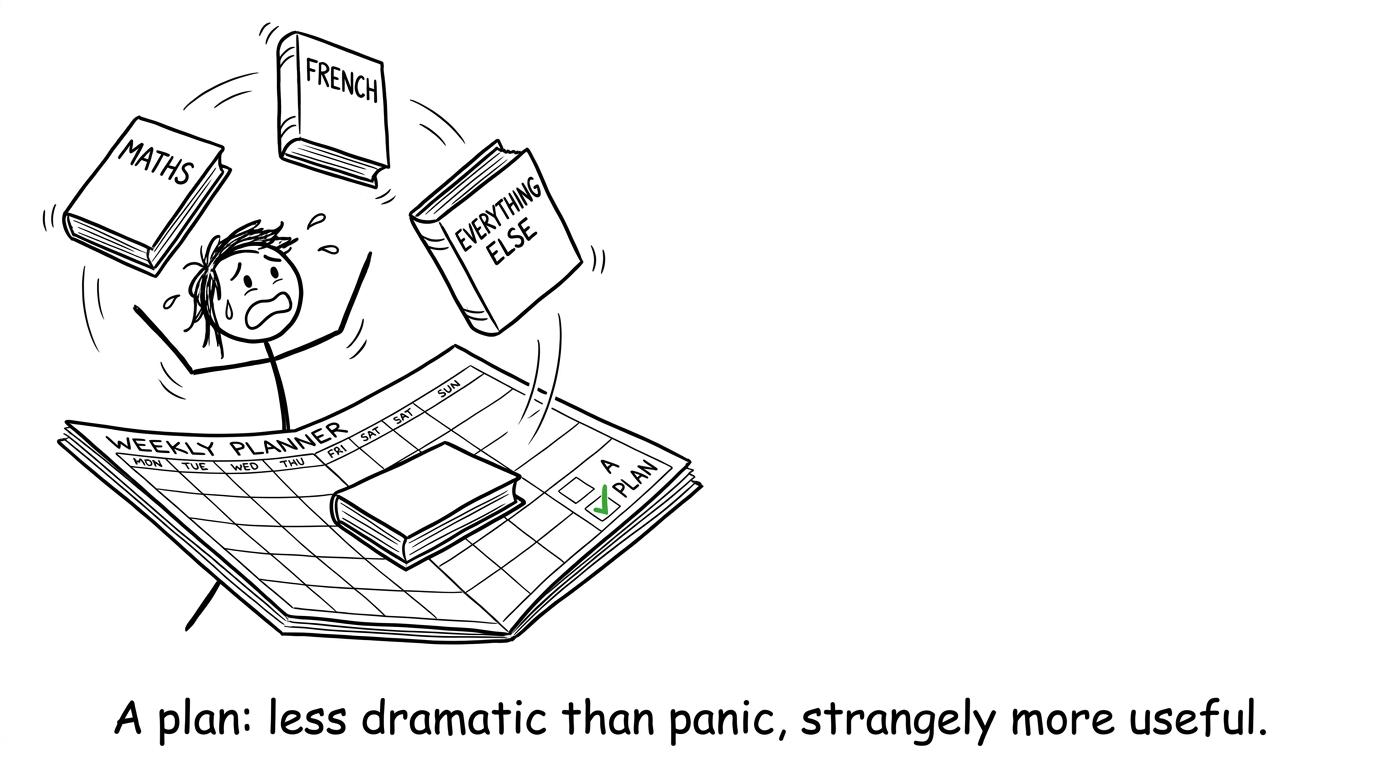 Student juggling several revision subjects above the safety net of a weekly planner
A useful weekly rhythm is:
- learn or review one weak topic;
- complete focused practice questions;
- mark the work immediately;
- record why each mark was lost;
- retest the skill later;
- add timed paper practice as the examinations approach.
Edexcel students can use the Edexcel GCSE Maths revision pathway, then test their progress with Edexcel predicted papers. Predicted papers should complement specification coverage and official past papers, not replace them.
If you are unsure when to move from topics to complete papers, read when to start GCSE past papers. The aim is not to complete the largest possible pile. It is to learn from each paper's mark scheme and repair the weaknesses it exposes.
What if results day brings a grade 444 unexpectedly?
First, confirm what the result changes. Compare it with the written conditions of your offer rather than assuming the worst.
If French is not one of your intended A Levels, the grade may still count as a pass towards general entry. If it is your intended A Level, contact the sixth form promptly and ask whether your place can be reviewed. Have your other results and course choices available.
If another result, particularly maths, also affects entry, avoid trying to rebuild the entire specification at once. The GCSE maths resit results-day plan explains how to diagnose lost marks, prioritise weak topics and move towards timed practice.
Common mistakes when judging sixth-form entry
Treating grade 444 as either “enough everywhere” or “not enough anywhere”
Neither conclusion is reliable. It can satisfy one institution's general criteria while falling below another course's subject requirement.
Looking only at general admissions requirements
Being eligible for the sixth form does not automatically make you eligible for every A Level it offers.
Using an old prospectus
Entry thresholds and course availability can change. Check the policy for your intended admission year.
Assuming French works like English or maths
The post-161616 continuation rules for English and maths do not apply nationally to French. French requirements arise from the course and institution.
Letting one grade distract from every remaining exam
A single uncertain result can consume revision time that would be better spent securing marks elsewhere. Check the facts, create a backup route and return to purposeful practice.
A grade is information, not the whole decision
A grade 444 in GCSE French can be good enough for sixth-form or college entry when French is not central to your chosen route and you meet the remaining criteria. For A Level French, it is often below the published subject requirement, so you must check the current policy and speak directly to the institution.
Then bring your attention back to what you can still improve. Use MathsGenie's free GCSE Maths resources to follow revision lessons, answer practice questions and mini tests, and build towards past papers and predicted papers. Mark schemes and video solutions turn mistakes into specific next steps, while a clear revision planner helps French, maths and every other subject compete for time without creating chaos.
Check the door you want. Read what opens it. Then revise for the grades still within your control.