Is Grade 4 GCSE Economics Enough for Sixth Form?
Grade 4 GCSE economics sixth form entry rules vary. Learn how to check A Level requirements, assess your maths grade and choose your next step.
A results sheet can make one number feel larger than it really is. If you are searching for grade 4 GCSE economics sixth form entry advice, the short answer is this: a Grade 444 is a standard pass, but it may not meet the subject-specific requirement for the sixth-form course you want.
Some providers do not require GCSE Economics for A Level Economics at all. Others expect a Grade 555 or 666 if you took it, alongside particular grades in GCSE Maths and English. Entry policies are set by individual schools and colleges, so the only reliable answer comes from checking the published requirements for your chosen course and contacting admissions if anything is unclear.
That may sound less comforting than a universal yes or no. In reality, it gives you something useful: a clear list of facts to check and several possible routes forward.
The quick sixth-form entry checklist
Before deciding whether your Grade 444 is enough, check:
- the provider's general sixth-form entry requirements;
- the specific requirements for A Level Economics, Business or your intended course;
- whether a GCSE Economics grade is required if you studied the subject;
- the minimum GCSE Maths and English grades;
- whether the requirement is firm or whether applicants are considered individually;
- alternative Level 333 courses offered by the school or college;
- the date by which you must confirm your place or discuss your results.
Write down the exact wording rather than relying on what a friend remembers. One missing phrase, such as “if studied”, can change the meaning of a requirement.
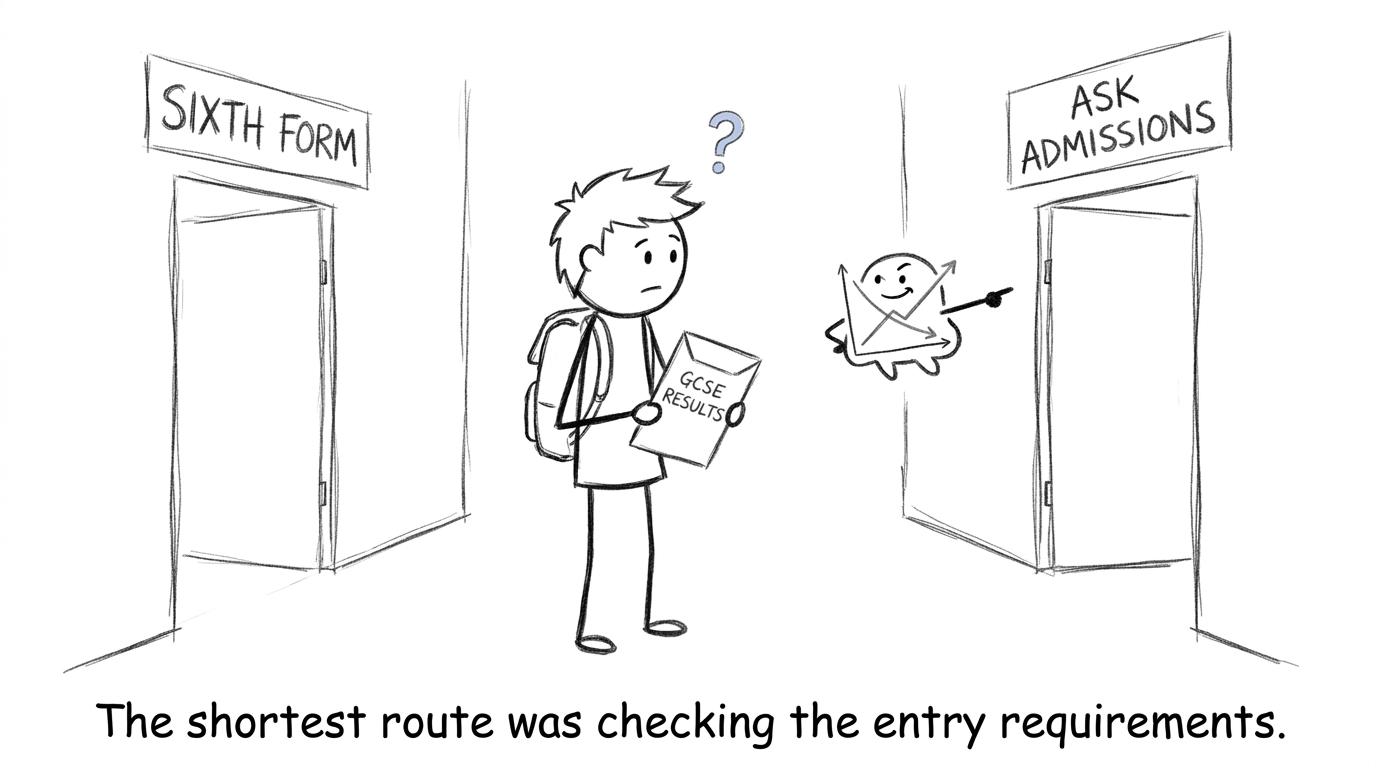 A student discovers that checking admissions is the shortest route to sixth form
Is a Grade 4 in GCSE Economics a pass?
In England's GCSE grading system, Grade 444 is described as a standard pass, while Grade 555 is described as a strong pass. GCSEs use grades 999 to 111, with Grade 999 being the highest.
However, “pass” and “eligible for a particular A Level” are not identical ideas. A qualification can be a valid pass while still falling below a course's entry threshold. Sixth forms often publish two layers of requirements:
- general entry requirements, covering the collection of GCSE grades needed to join the sixth form;
- subject-specific requirements, covering the grades needed for an individual A Level.
You must satisfy both where both apply. A Grade 444 in Economics might count towards the general requirement but fail a separate rule asking for Grade 555 or 666 in GCSE Economics, Maths or English.
Requirements also differ between institutions and can change between admissions cycles. Always use the prospectus or course page for the year in which you intend to enrol.
When Grade 4 GCSE Economics may be enough for sixth form
A Grade 444 may be sufficient in several situations.
GCSE Economics is not required
Many students begin A Level Economics without having taken the subject at GCSE. A provider may therefore place more weight on GCSE Maths, English or another essay-based subject than on prior Economics study.
If the published requirement says that GCSE Economics is not necessary, your Grade 444 does not automatically prevent admission. You must still meet the sixth form's overall and subject-specific conditions.
The course has a Grade 4 threshold
Some courses accept Grade 444 in the relevant GCSE, particularly where they are designed to support a broader range of learners. Read the wording carefully: the threshold may apply to Economics itself, to a set of related subjects, or only to the provider's general entry policy.
Admissions decisions include individual consideration
A school or college may invite students to discuss borderline results. That does not guarantee an exception, but it makes a prompt, factual conversation worthwhile. Ask whether your complete grade profile, teacher reference or performance in Maths and English can be considered.
Keep the message simple: state your result, name the exact course and ask whether you remain eligible. Admissions staff can answer that question more accurately than predictions on social media.
When a Grade 4 may not be enough
A Grade 444 is unlikely to secure the course if its published conditions explicitly require a higher grade in GCSE Economics and treat that condition as firm.
For example, providers sometimes require Grade 555 or 666 in Economics or Business if studied. Others do not specify Economics but require stronger GCSE Maths or English results. This reflects the character of A Level Economics: students interpret written arguments, analyse data, use percentages and index numbers, read diagrams and explain relationships between variables.
That is why your Maths grade deserves separate attention. A sixth form could accept your Economics result but decline the application because its GCSE Maths threshold has not been met. Conversely, a strong Maths and English profile may help where GCSE Economics is not an essential prerequisite.
Do not assume that requirements are identical across AQA, Edexcel, OCR or Eduqas courses. The provider chooses its admissions policy independently of the exam board specification it teaches.
Why GCSE Maths matters for A Level Economics
Economics is not simply a collection of definitions. Quantitative skills support topics such as inflation, unemployment, economic growth, costs, revenues, productivity and exchange rates.
You may need to understand:
- percentages and percentage changes;
- ratios and proportions;
- averages and index numbers;
- tables, charts and time-series data;
- gradients and relationships shown on diagrams;
- rearranging straightforward formulae;
- interpreting numerical evidence before reaching a judgement.
The important habit is not rushing towards a calculation. It is noticing what the figure means. A percentage change, for instance, compares the change with the original value:
percentage change=changeoriginal value×100\text{percentage change}=\frac{\text{change}}{\text{original value}}\times 100percentage change=original valuechange×100This is not included as a worked example, but as a reminder of the mathematical language that regularly appears in economic reasoning.
If Maths is the grade currently limiting your options, begin with the Maths Genie GCSE revision hub. Its grade-organised revision lessons and practice questions make it easier to identify the next topic rather than revising everything at once. Students working around the standard-pass threshold can use the Grade 4 GCSE Maths resources to focus their practice.
What to do if your result is below the requirement
A closed route is not the same as having no route. Your next move should be practical rather than panicked.
Contact the sixth form quickly
Ask these precise questions:
- Is the published grade a firm condition?
- Does it apply to GCSE Economics if the subject was taken?
- Would another course combination be available?
- Is there a waiting-list or review process?
- Are there suitable vocational or applied Level 333 alternatives?
Do not claim that you “nearly” achieved another grade unless the provider asks for your marks. Grade boundaries vary by exam board, qualification and examination series, and admission normally depends on the awarded grade.
Compare more than one provider
Nearby sixth forms and colleges may set different entry requirements for courses with the same title. Compare the qualification offered, course content, assessment approach, travel, available support and progression options, not only the minimum grade.
A different provider should still be a good educational fit. Accepting the first course with a lower threshold can solve the immediate problem while creating a less suitable two-year commitment.
Consider a related course
Depending on local provision, alternatives may include A Level Business or an applied business qualification. These are not interchangeable with Economics, so examine the specification and assessment method before deciding.
Think about the destination as well as the course title. If you have a particular university course, apprenticeship or career in mind, investigate its usual entry expectations before changing your programme.
Strengthen the grades you can still influence
If your GCSE exams have not happened yet, entry requirements are information, not a verdict. Turn them into targets. If your offer requires Grade 555 in Maths, revise towards secure performance above that boundary rather than hoping one paper suits you.
Use GCSE Maths past papers once you have revised the underlying topics. Complete papers under timed conditions, mark them carefully and record why marks were lost. Maths Genie predicted papers can provide further exam-style practice, but they should complement revision rather than replace full specification coverage.
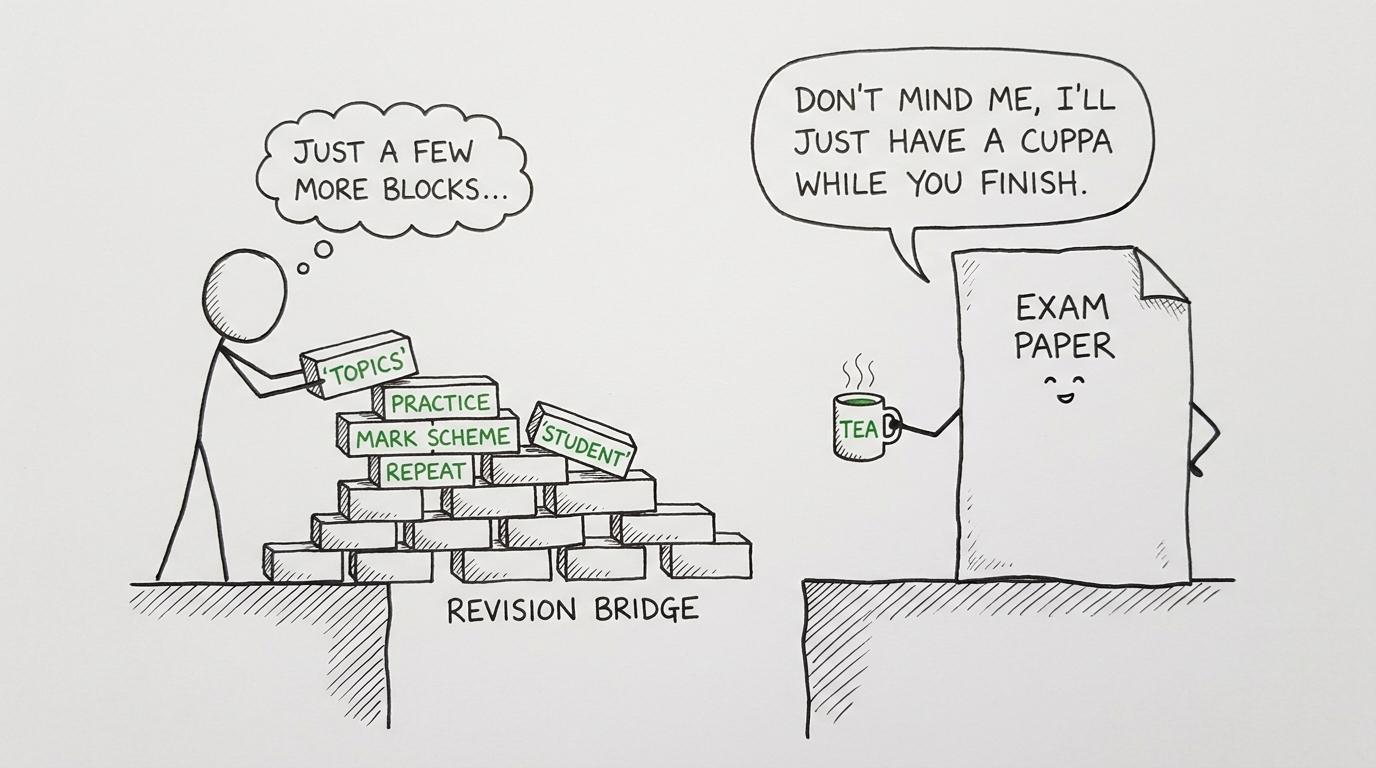 A student builds a revision bridge from topics, practice and mark schemes
Build a revision plan around evidence
The best revision plan begins with diagnosis. A vague feeling that you are “bad at graphs” is hard to act upon. A record showing repeated losses on percentages, ratio and data interpretation is much more useful.
Try this cycle:
- complete a short set of questions without notes;
- use the mark scheme to identify exact gaps;
- return to the relevant revision lesson;
- practise a fresh set of questions;
- revisit the topic several days later;
- test the skill within a full paper.
Mark schemes are especially valuable because they reveal the difference between understanding a topic and communicating it in a form that earns marks. Video solutions can then show how a clear method is organised.
If A Level Maths is also among your intended subjects, check its higher entry threshold separately. A pass in GCSE Maths is rarely the same as readiness for A Level Maths. You can explore the later course through the Maths Genie A Level revision resources, but your immediate priority should remain the GCSE knowledge and grades required by your chosen provider.
Common mistakes when judging sixth-form eligibility
Treating a standard pass as automatic admission
Grade 444 is an important achievement, but sixth forms can impose higher general or subject-specific requirements. Check both.
Looking only at the Economics requirement
Maths and English conditions may decide your eligibility even when GCSE Economics is not required. Read the complete course entry, including footnotes.
Using an old prospectus
Entry policies can change. Confirm that the document applies to your intended start year and ask admissions if two pages appear to conflict.
Assuming every sixth form applies the same rules
There is no single entry threshold used by every provider. One school may require Grade 666 in a related subject, while another may focus on Maths and English.
Revising only predicted topics
Predicted papers are useful practice, not promises about what will appear. Cover the full specification, then use predictions to build confidence and exam technique.
Waiting until enrolment day to ask
If your predicted or achieved grade is below the requirement, contact the provider early. You may need time to compare alternatives, gather information or adjust your subject choices.
Your grade is information, not your identity
So, is a Grade 444 in GCSE Economics good enough for sixth form? It is a standard pass and may be enough where GCSE Economics is not required or where the provider accepts Grade 444. It will not meet a firm subject condition asking for Grade 555 or 666.
The next step is concrete: open the current entry requirements for the exact course, check the general policy, Economics condition, Maths grade and English grade, then ask admissions to clarify anything uncertain.
If your exams are still ahead, use that information to direct your effort. MathsGenie offers free revision lessons, practice questions, mini tests, mark schemes, video solutions, past papers and predicted papers to help turn a target into a plan. Start with the free GCSE Maths revision resources, practise deliberately, and let each marked paper show you what to do next.