GCSE vs iGCSE Bengali: What's Actually Different?
GCSE vs iGCSE Bengali explained: compare papers, skills, tiers, timings and grading, then decide whether the qualification changes how you revise.
The name on an exam timetable can look like a minor detail. Then you open the specification and discover that one qualification tests speaking and listening, while the other puts the entire result into one long written paper.
That is the central difference in GCSE vs iGCSE Bengali. The current AQA GCSE Bengali assesses listening, speaking, reading and writing across four equally weighted components. Pearson Edexcel International GCSE Bangla assesses reading, writing and translation in one written examination. They involve the same language, but they reward different combinations of skills.
This matters because the best qualification is not simply the one that sounds easier. It is the one whose assessment format matches your strengths, your teaching and the entry available through your school or exam centre.
The short comparison
For students comparing the current qualifications, these are the details to check:
- Official title and board: AQA GCSE Bengali
8638or Pearson Edexcel International GCSE Bangla4BA0. - Skills assessed: four language skills at GCSE; reading, writing and translation at International GCSE.
- Number of assessments: four GCSE components compared with one International GCSE paper.
- Tiering: GCSE has Foundation and Higher tiers; International GCSE Bangla is untiered.
- Exam availability: AQA GCSE certification is available in the summer series; Pearson lists International GCSE Bangla assessment in January and June.
- Your strongest skills: speaking and listening may help or hinder you, depending on how you use Bengali.
- Your exam centre: availability, teaching and private-candidate arrangements can determine what you actually sit.
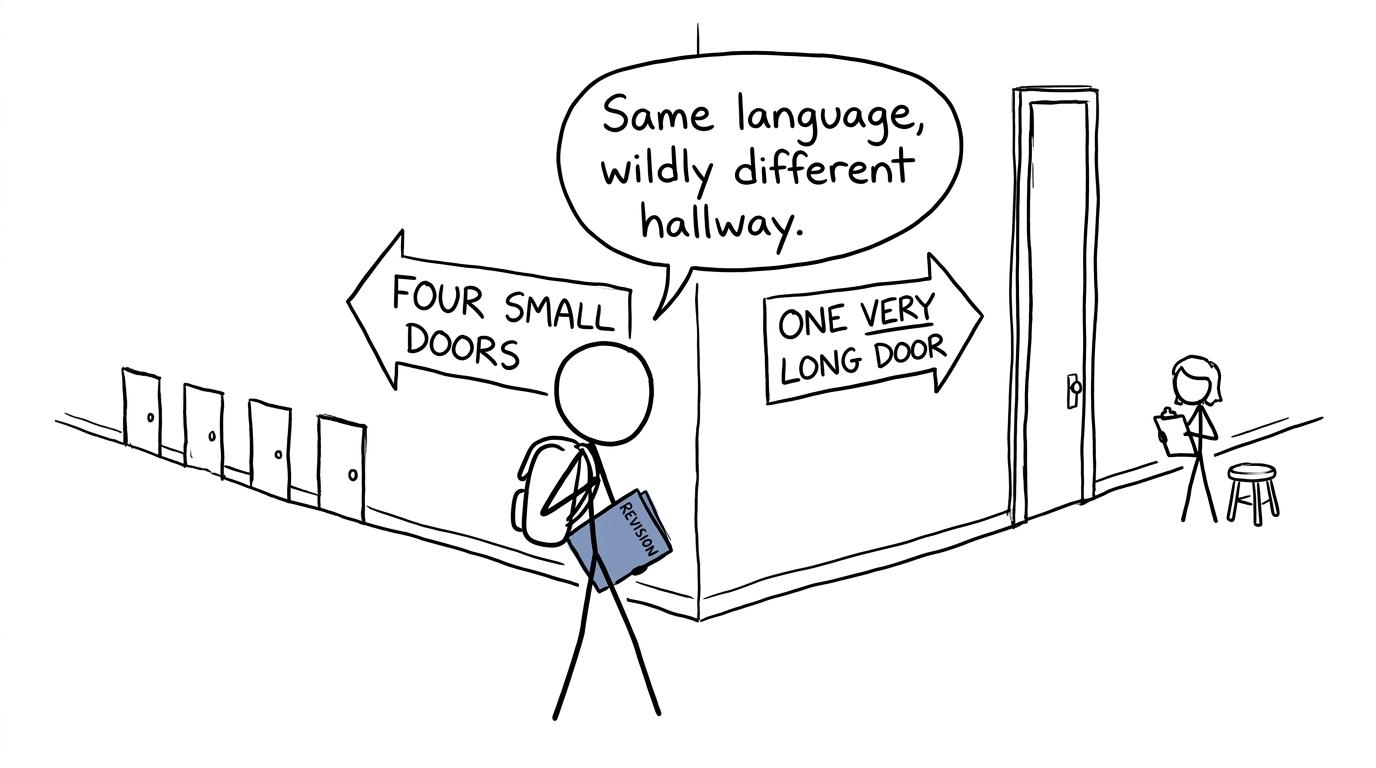 A student choosing between four small exam doors and one very long door
GCSE Bengali and International GCSE Bangla are not the same paper
The first useful distinction is hidden in the official names. AQA calls its qualification GCSE Bengali, while Pearson Edexcel calls its qualification International GCSE Bangla. Students may use Bengali and Bangla interchangeably in conversation, but the precise qualification title and specification code matter when finding past papers or confirming an entry.
As of August 2026, AQA is the awarding organisation listed for the current accredited GCSE Bengali in England. Pearson offers the established International GCSE Bangla qualification. You may also encounter announcements about newer international qualifications intended for later examination series, so always confirm the specification code rather than relying on a search result or old revision folder.
This is the same habit that protects your maths revision. A worksheet can be excellent but still wrong for your board or tier. MathsGenie's guide to GCSE maths topics by exam board and tier explains why checking the specification should come before collecting resources.
How AQA GCSE Bengali is assessed
AQA GCSE Bengali is a linear qualification. Students complete all assessments in the same series and must enter every component at the same tier.
Its four components each contribute approximately 25%25\%25% of the qualification:
| Component | Foundation tier | Higher tier | Weighting |
|---|---|---|---|
| Listening | 353535 minutes, including reading time | 454545 minutes, including reading time | 25%25\%25% |
| Speaking | 777 to 999 minutes, plus preparation | 101010 to 121212 minutes, plus preparation | 25%25\%25% |
| Reading | 454545 minutes | 111 hour | 25%25\%25% |
| Writing | 111 hour | 111 hour 151515 minutes | 25%25\%25% |
The speaking assessment includes a role-play, photo card and general conversation. Reading and writing also include translation tasks, so GCSE students cannot treat translation as an optional extra.
Foundation and Higher tier
Foundation tier provides access to grades 111 to 555, while Higher tier targets grades 444 to 999. The overlap does not mean tier choice is unimportant. Higher material demands greater linguistic range and more confident responses, while Foundation limits the highest available grade.
Your school should make the entry decision using evidence from classwork and assessments. Do not revise Higher material merely because the word sounds more ambitious, and do not assume Foundation means an easy paper. Accurate communication is still required.
How Pearson Edexcel International GCSE Bangla is assessed
Pearson Edexcel International GCSE Bangla 4BA0 concentrates the qualification into one externally assessed paper:
- Paper: Reading, Writing and Translation
- Duration: 222 hours 303030 minutes
- Total: 100100100 marks
- Weighting: 100%100\%100% of the qualification
- Tier: no Foundation or Higher split
- Dictionary: not permitted
The paper contains three sections:
| Section | Marks | Share of paper |
|---|---|---|
| Reading | 404040 | 40%40\%40% |
| Writing | 404040 | 40%40\%40% |
| Translation from English into Bangla | 202020 | 20%20\%20% |
There is no separately assessed listening or speaking component. That is not a small administrative change. It alters what preparation looks like and places much more pressure on sustained literacy, accurate written language and concentration across one long sitting.
The specification covers themes including home and abroad, education and employment, personal life and relationships, the world around us, and social activities, fitness and health.
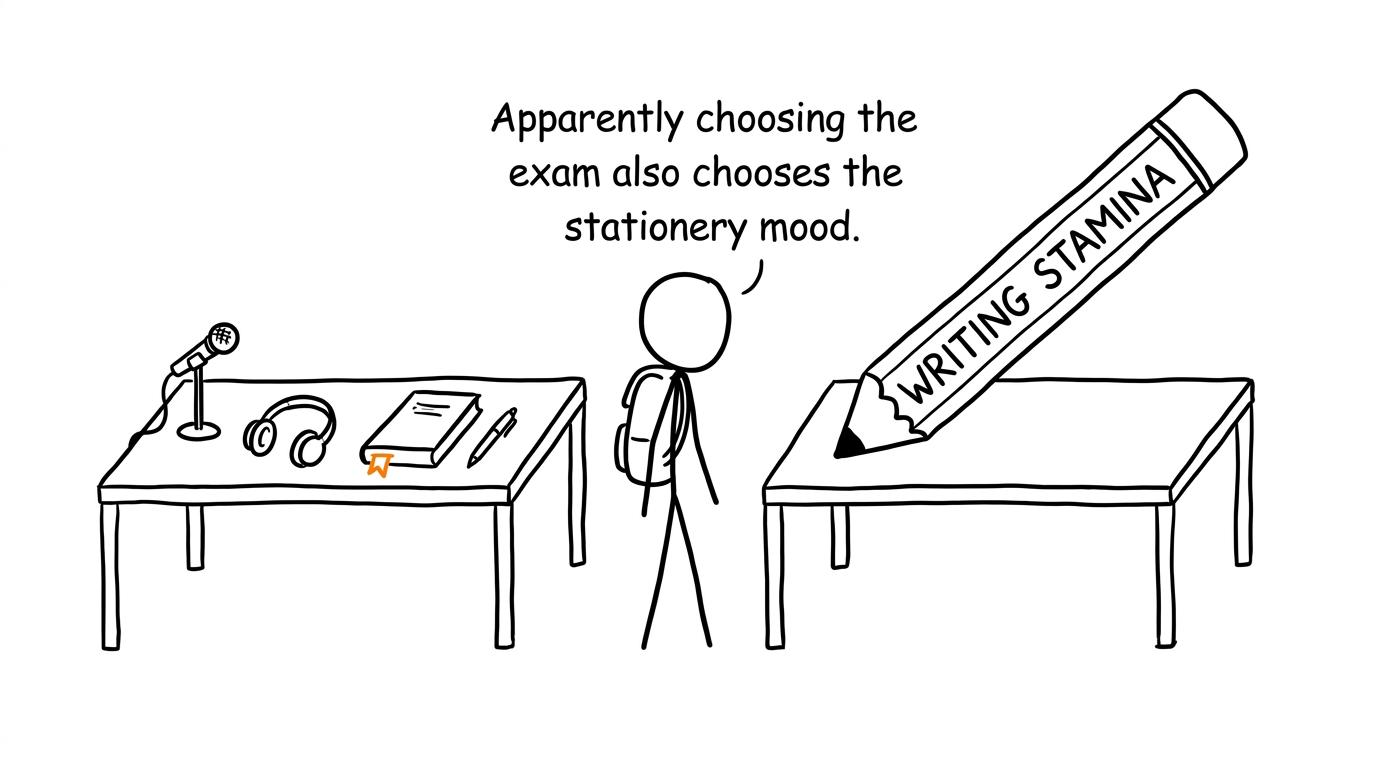 Two revision desks prepared for very different language assessments
Which differences genuinely matter to students?
Your spoken fluency may count in one course but not the other
If you speak Bengali confidently at home, the GCSE speaking component may allow that fluency to contribute directly to your result. However, everyday conversation is not automatically exam-ready speaking. A role-play, structured photo discussion and extended conversation require careful responses, suitable vocabulary and control of register.
Conversely, a student who reads and writes strongly but feels uncomfortable speaking under assessment conditions may prefer the International GCSE structure. That does not make it easier overall. The missing speaking and listening assessments are replaced by complete dependence on one written paper.
Writing stamina matters more in the International GCSE
A 222 hour 303030 minute examination demands sustained concentration. You must move between comprehension, extended writing and translation without allowing one difficult section to consume the rest of your time.
GCSE spreads the assessment across separate components. This reduces dependence on one sitting, but creates a broader revision burden: vocabulary must be recognised when heard, produced aloud, understood in texts and used accurately in writing.
Tiering changes the decision
AQA GCSE students must be entered for Foundation or Higher across the qualification. International GCSE Bangla has one untiered route for all candidates.
Some students prefer knowing that one paper provides access to the full grade range. Others benefit from a tier designed around a more appropriate level of demand. The right question is not, “Which label is better?” It is, “Which assessment gives me the fairest opportunity to demonstrate what I can do?”
Exam timing and availability can affect the practical choice
AQA GCSE Bengali is designed around summer assessment. Pearson International GCSE Bangla is listed as available in January and June. In practice, your centre must be willing to make the entry, provide the correct arrangements and support the chosen specification.
If you are entering independently, confirm availability before building a revision plan. GCSE speaking assessments create additional centre requirements, and not every centre accepts private candidates for every component.
Does it matter which one you sit?
Yes for revision, but usually not in the dramatic way students fear.
The qualification determines which skills earn marks, what paper format you face and which resources are relevant. Those differences should shape nearly every practice session. However, neither title rescues weak preparation, and neither automatically guarantees a better grade.
Before choosing or accepting an entry, ask:
- Which exact specification code will appear on my entry?
- Does my school teach all assessed skills?
- Am I stronger across speaking, listening, reading and writing, or mainly in written Bengali?
- Which course has reliable teacher support and suitable past papers?
- Does a future school, college or other institution have any specific requirement?
If an institution has stated entry conditions, check them directly rather than assuming all Level 111 and Level 222 language qualifications will be treated identically in every context.
How to revise for the version you are sitting
For AQA GCSE Bengali, divide revision across all four skills. Practise listening without pausing recordings, rehearse speaking tasks aloud, complete reading under timed conditions and write responses without relying on a dictionary.
For Pearson International GCSE Bangla, prioritise reading accuracy, controlled writing, English-to-Bangla translation and full-paper stamina. Individual topic exercises remain useful, but they must eventually be combined into uninterrupted timed practice.
In either course, use the same feedback loop recommended in MathsGenie's guide to using GCSE past papers properly: attempt, mark, identify the exact weakness, repair it and retest. A completed paper without analysis is only a record of what happened.
That routine also helps you keep maths moving alongside Bengali. Start from the free GCSE maths revision hub, use short sessions such as the 20-minute GCSE revision routine, and build towards board-specific papers. If you take Edexcel maths, the GCSE maths past-paper collection includes mark schemes and worked solutions where available.
Common mistakes when comparing the qualifications
Revising for the wrong specification code
Old Bengali resources remain online, including materials for replaced specifications. Check the board, qualification title and code on every paper before using it.
Assuming International GCSE means harder
“International” describes the qualification family, not a universal difficulty ranking. The International GCSE removes separately assessed speaking and listening, but concentrates the result into demanding reading, writing and translation work.
Assuming home fluency guarantees a high grade
Home language may be informal, regional or mainly spoken. Examinations reward accurate standard language, appropriate register, comprehension and responses that meet the task. Familiarity helps, but deliberate practice is still necessary.
Comparing grades without comparing assessment
A mock result from one specification cannot be transferred mechanically to another. Different skills, papers and mark schemes are being measured. Use the mark scheme belonging to the exact paper, a principle explored further in how to use GCSE mark schemes as a revision coach.
Treating predicted papers as certainty
Predicted papers can provide fresh practice, but they cannot tell you exactly what will appear. For maths, MathsGenie's Edexcel GCSE predicted papers work best after topic revision and official past-paper practice. Apply the same principle to Bengali: specification first, official assessment materials next, supplementary practice after that.
Choose the paper, then build the routine
The real GCSE vs iGCSE Bengali difference is not prestige. It is assessment design. AQA GCSE Bengali spreads equal weight across listening, speaking, reading and writing, with Foundation and Higher tiers. Pearson Edexcel International GCSE Bangla uses one untiered written paper focused on reading, writing and translation.
Confirm what you are entered for, study its current specification and practise the exact skills that produce marks. Then protect the rest of your timetable. MathsGenie gives you a free home for GCSE and A Level maths revision, with revision lessons, practice questions, mini tests, past papers, predicted papers, mark schemes, video solutions and a revision planner. Choose one weak maths topic today, complete a focused set of questions and let the feedback decide what comes next.