GCSE vs iGCSE Arabic: What's Actually Different?
GCSE vs iGCSE Arabic explained: compare skills, papers, tiers, grading and recognition, then build the right revision plan for your qualification.
The unsettling part of revising Arabic is not always the language. Sometimes it is discovering that the past paper in front of you bears little resemblance to the exam you will actually sit.
The short answer to GCSE vs iGCSE Arabic is that they are separate qualifications with substantially different assessments. Pearson Edexcel GCSE Arabic tests listening, speaking, reading and writing across four equally weighted papers. Pearson Edexcel International GCSE Arabic (First Language) concentrates on reading, summary, grammar and extended writing across two written papers. Other International GCSE boards use their own structures.
That difference matters. It changes which skills earn marks, the papers you should practise and how you should divide limited revision time.
The essential comparison
Before planning anything, check these details:
- the full qualification title
- the awarding body
- the specification or syllabus code
- whether it is a first-language qualification
- the papers and skills being assessed
- your tier, if the qualification is tiered
- the examination series in which you are entered
For the two current Pearson qualifications most likely to cause confusion, the broad comparison is:
| Feature | Pearson Edexcel GCSE Arabic | Pearson Edexcel International GCSE Arabic (First Language) |
|---|---|---|
| Specification code | 1AA0 | 4AA1 |
| Main purpose | Assessment across four language skills | First-language reading, grammar and writing |
| Papers | Four | Two |
| Skills | Listening, speaking, reading and writing | Reading, summary, grammar and extended writing |
| Weighting | Each skill contributes 25%25\%25% | Paper 1 contributes 60%60\%60% and Paper 2 contributes 40%40\%40% |
| Tiers | Foundation and Higher | Untiered |
| Grading | Grades 9-1 | Grades 9-1 |
| Speaking assessment | Yes | No |
| Listening paper | Yes | No |
These details reflect the official specifications available in 2026. Always confirm the code on your school’s entry information because “iGCSE Arabic” is not one universal paper.
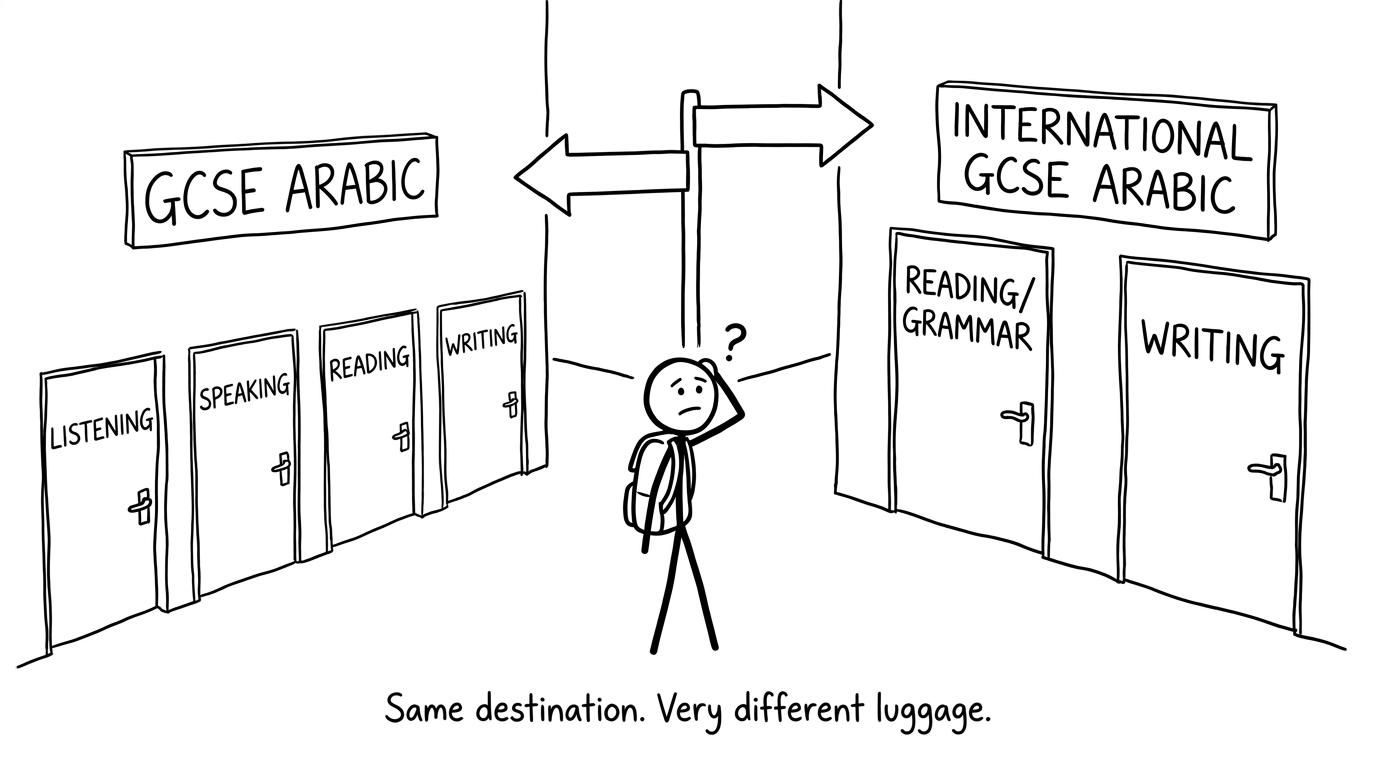 A student chooses between GCSE Arabic skills and International GCSE written papers
GCSE Arabic assesses four distinct skills
Pearson Edexcel GCSE Arabic follows a modern-language structure. Listening, speaking, reading and writing each contribute 25%25\%25% of the final qualification.
The listening paper assesses understanding of standard spoken Arabic in different settings. The speaking assessment includes tasks such as a role play, discussion of a picture stimulus and conversation. Reading includes different text types and translation from Arabic into English, while writing requires responses in Arabic and translation into Arabic.
There are Foundation and Higher tiers. A student must be entered for the same tier across all four papers, so this is not a decision to leave until exam week. The tier affects the demand of the questions and the grades available.
This structure rewards balanced communication. Strong writing cannot completely compensate for neglected listening or speaking because every skill has substantial weight. Your revision therefore needs regular exposure to audio, rehearsed spoken responses, reading comprehension, vocabulary retrieval, translation and written production.
International GCSE Arabic usually has a first-language focus
The label “iGCSE Arabic” needs care. International GCSE qualifications are designed by individual awarding organisations, so the exact content and assessment depend on the board and syllabus code.
Pearson Edexcel International GCSE Arabic (First Language), code 4AA1, is a linear qualification with two externally examined written papers. Paper 1 covers reading, summary and grammar. Paper 2 assesses extended writing. There is no listening examination or speaking assessment.
That makes it a very different test from GCSE Arabic. It expects students to interpret substantial Arabic texts, control grammar accurately, select and summarise information, and sustain effective writing for an audience and purpose. The qualification is explicitly designed for first-language speakers.
Cambridge also offers First Language Arabic, but its structure and grading should not be assumed to match Pearson. For examinations in 2026, Cambridge syllabus 0508 has two written components focused on reading and writing and uses grades A* to G. Cambridge has published revised arrangements for later examination years, illustrating why the year and syllabus code matter as much as the word “iGCSE”. OxfordAQA has also introduced an International GCSE Arabic: First Language course for first teaching from September 2026, with first examinations planned for 2028.
The practical lesson is simple: never revise from a resource merely because “Arabic iGCSE” appears in its title.
The biggest difference is what the exam rewards
One qualification is not simply a harder or more international version of the other. They reward overlapping language knowledge through different performances.
GCSE rewards breadth across communication
GCSE students must understand spoken language, respond orally, read accurately and write effectively. Revision needs to be distributed because a long gap in speaking or listening practice quickly becomes visible under examination conditions.
A student who communicates confidently but occasionally makes grammatical errors may still demonstrate valuable performance across the four skills. The mark schemes assess what is communicated as well as linguistic quality, with the precise criteria depending on the task.
International GCSE rewards written depth
A first-language International GCSE places much more pressure on reading maturity, grammatical control and sustained composition. There is no speaking paper to rescue weak writing and no listening component to reward strong aural understanding.
Summary is also a distinct examination skill. It requires selecting relevant ideas and expressing them concisely rather than copying large sections of a passage. Extended writing demands control of organisation, register, vocabulary and accuracy over a longer response.
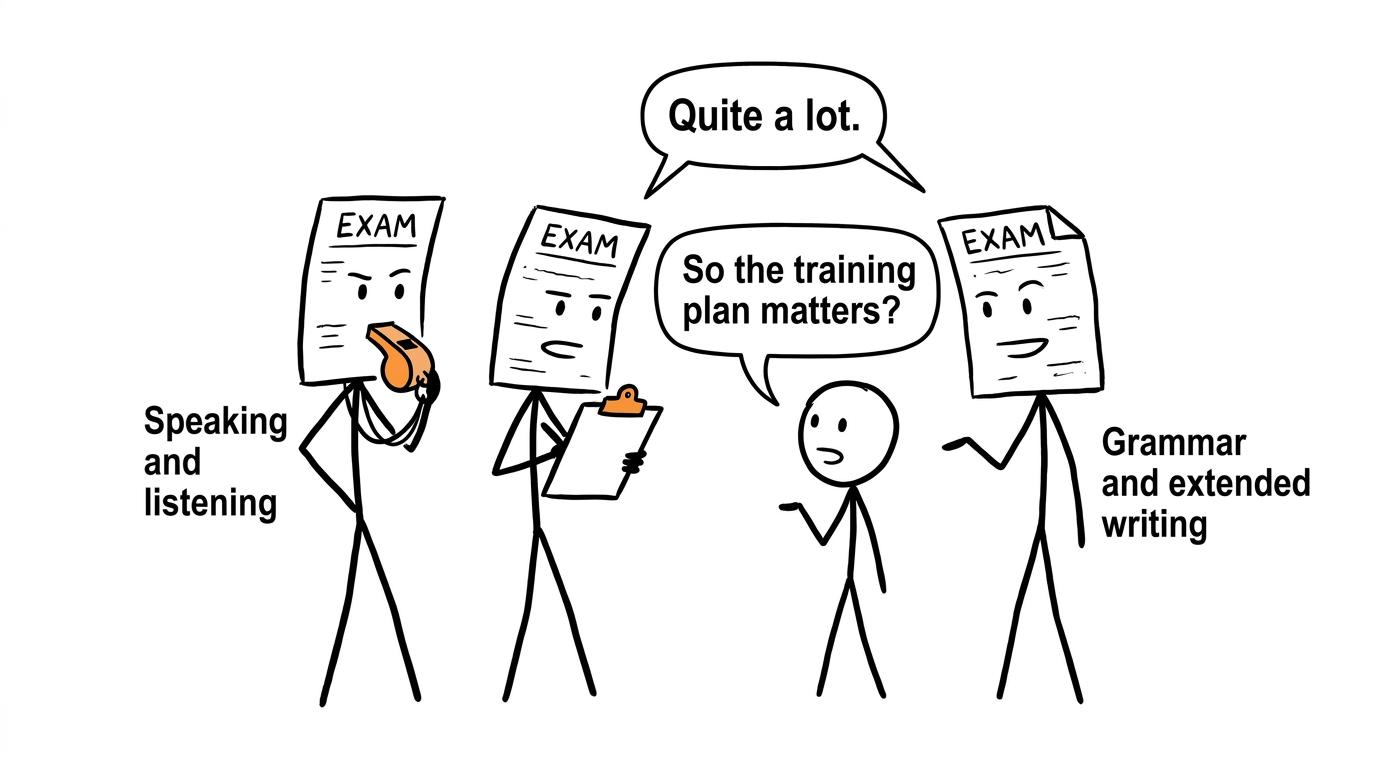 Two comic exam coaches demand different kinds of Arabic preparation
Are GCSE and iGCSE Arabic equivalent?
They occupy a similar stage of secondary education, but they are not the same qualification. GCSEs in England follow government subject content and Ofqual’s regulatory rules. International GCSE awarding bodies determine their own content and assessment, and Pearson’s International GCSE Arabic specification states that the qualification is not part of the UK Regulated Qualifications Framework.
Ofqual has cautioned against claiming that GCSE and International GCSE standards or individual grades can be aligned with precision. International GCSEs also do not count in English school performance tables in the same way as reformed GCSEs.
That does not mean an International GCSE is without value. Schools, colleges and other institutions commonly consider international qualifications, but each institution controls its own entry requirements. If Arabic is relevant to a sixth-form, university or employment application, check the published requirement or ask the institution directly rather than relying on a general claim of equivalence.
For most students, the decisive question is not which title sounds stronger. It is whether the course matches their language background and whether they are preparing for the assessment their centre has entered them for.
Does it matter which Arabic qualification you sit?
Yes, mainly because it determines your preparation. If your school has already made the entry, there is little value in worrying about which qualification is supposedly more impressive. Your job is to understand the paper in front of you.
It matters especially when:
- spoken Arabic is much stronger or weaker than your writing
- you use a regional dialect confidently but need greater control of formal written Arabic
- you have prepared for speaking and listening but are entered for a written first-language course
- you are using past papers from a different board
- a sixth form has a specific language-entry policy
If there is still a genuine choice, discuss it with your teacher or examinations officer. They can consider your prior experience, the teaching available, centre approval and examination-entry arrangements. A student should not attempt to choose solely from an online comparison.
Build a revision plan around the specification
Good revision begins with the right label. This principle applies just as strongly to maths. An Edexcel Higher paper is not interchangeable with an AQA Foundation paper, even though both are GCSE Maths.
Start by downloading the official specification and listing every assessed component. Then collect past papers for that exact code. Record weaknesses by skill rather than writing “Arabic” as one enormous problem.
For GCSE Arabic, your categories might include listening detail, spontaneous speaking, reading inference, translation and writing accuracy. For a first-language International GCSE, they might include comprehension, summary, grammar, register and extended composition.
Use a simple cycle:
- complete a short task under realistic conditions
- mark it using the correct mark scheme
- identify the specific reason for each lost mark
- practise that skill separately
- return to a different examination question later
This is the same evidence-led approach explained in MathsGenie’s guide to finding your weakest GCSE topics. It prevents revision from becoming hours of comfortable rereading.
If Arabic sits beside a busy maths timetable, use the GCSE Maths revision hub to choose your board and keep resources organised. The GCSE Maths topics by board and tier guide can help you confirm the parallel details for Edexcel, AQA, OCR or Eduqas.
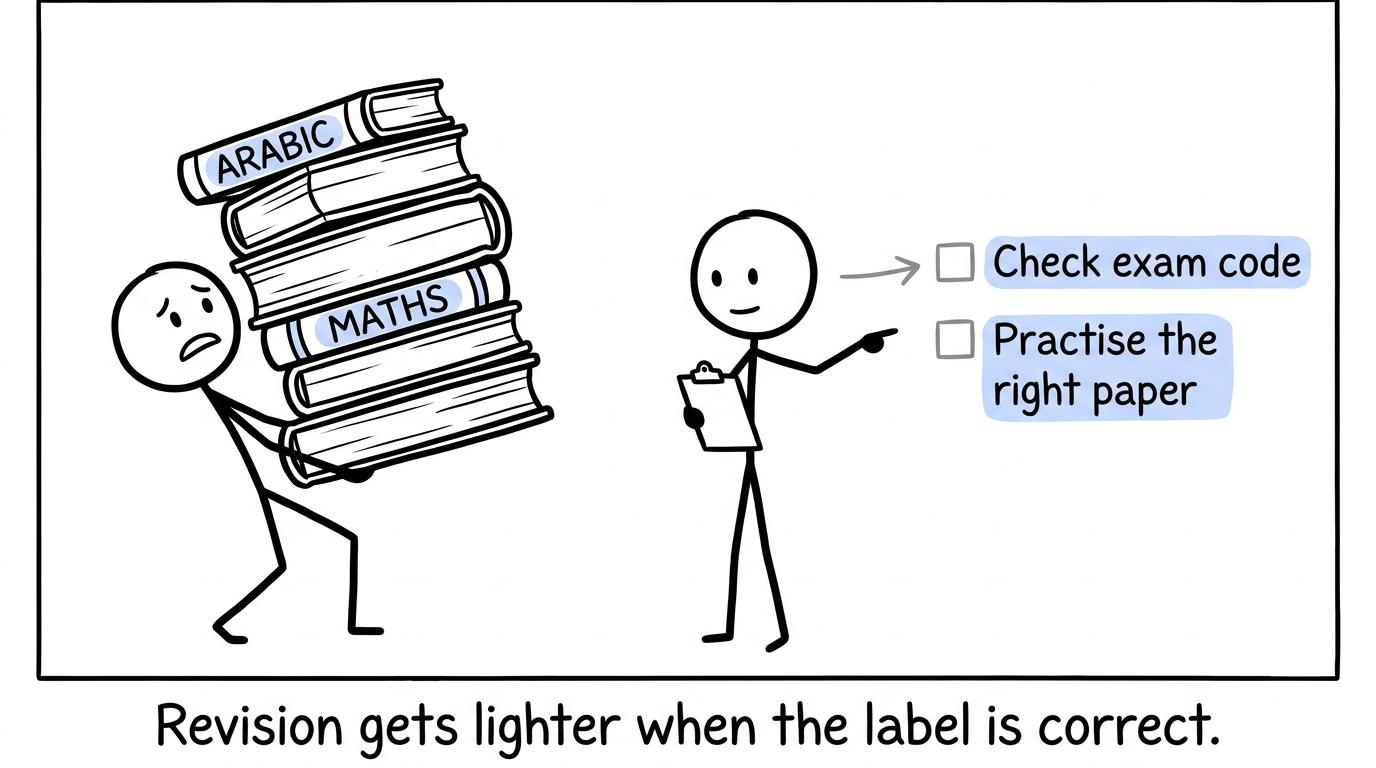 A checklist makes a student's pile of Arabic and maths revision feel lighter
Keeping Arabic and maths revision balanced
Language improves through frequent contact, while maths methods need repeated retrieval and problem practice. Neither benefits from disappearing from your timetable for two weeks.
A practical approach is to alternate substantial sessions while keeping short recall tasks for both subjects. For maths, use GCSE mini tests to maintain momentum when Arabic needs the longer session. Edexcel students can move from the Edexcel GCSE Maths revision area to Edexcel past papers and mark schemes when they are ready for timed practice.
Do not measure revision only in hours. Measure completed tasks, corrected errors and successful retests. MathsGenie’s one-month GCSE Maths revision plan offers a structure for combining lessons, practice and papers without allowing one subject to consume the whole week. The guide to when to start GCSE past papers can also help you move from topic work to timed assessment at a sensible point.
Common mistakes when comparing the qualifications
Treating “iGCSE” as one specification
Pearson, Cambridge and OxfordAQA do not automatically use identical papers, grading systems or examination schedules. Check the awarding body, code and examination year.
Assuming International GCSE means GCSE with harder questions
The central distinction is assessment design. A first-language written course and a four-skill modern-language GCSE test different performances, so a single difficulty ranking is misleading.
Revising speaking for a written-only qualification
Speaking can support language development, but it should not displace assessed grammar, summary and extended writing when no speaking marks are available.
Ignoring tier on GCSE Arabic
Pearson Edexcel GCSE Arabic is tiered. Confirm Foundation or Higher before selecting past papers and practising timings.
Using the wrong mark scheme
A polished answer can still miss task-specific requirements. Use the mark scheme belonging to the exact paper, series and specification.
Letting Arabic preparation displace maths completely
A language speaking assessment or long composition can feel urgent, but maths fluency weakens without retrieval. Keep one short lesson, practice set or mini test in the weekly plan even during an Arabic-heavy period.
Choose the paper, then prepare for it
The quiet truth behind GCSE vs iGCSE Arabic is that the name on the certificate matters less to your immediate revision than the skills named in the specification. GCSE Arabic spreads marks across listening, speaking, reading and writing. First-language International GCSE courses generally place far greater emphasis on reading, grammar and sustained written Arabic.
Confirm your board, code, tier and papers with your school. Then practise only with resources that match them.
For the maths exams competing for space in the same timetable, make MathsGenie’s free GCSE Maths resources your starting point. Use revision lessons and practice questions to repair individual topics, mini tests to keep skills active, and past papers, predicted papers, mark schemes and video solutions to turn preparation into reliable exam performance.