GCSE to A-level ICT Jump: How Hard Is It?
GCSE to A-level ICT jump explained: compare Computer Science and Level 3 IT, see what becomes harder, and build a practical plan for sixth-form.
A subject can keep a familiar name while changing almost everything underneath it. That is why the GCSE to A-level ICT jump can be confusing: in many schools and colleges, there is no direct course simply called A-level ICT. The next step may be A-level Computer Science, a Level 3 IT qualification or a digital technology course, depending on your nation and sixth-form provider.
The short answer is that the jump is substantial but manageable. You will meet more demanding theory, longer assessments and greater independence. If you choose Computer Science, programming and computational thinking usually create the steepest climb. If you choose an applied IT course, extended assignments, documentation and real-world contexts may be the larger challenge.
The important question is not whether the next course is universally “hard”. It is whether its particular demands match your experience, interests and working habits.
The GCSE to A-level ICT jump at a glance
Before comparing difficulty, identify the actual qualification offered by your sixth form. Titles, specifications and assessment arrangements can change, so always read the current course information and exam-board specification.
Your checklist should include:
- Is the course A-level Computer Science, Level 3 Information Technology or another digital qualification?
- Which exam board or awarding organisation runs it?
- How much programming is expected?
- How is it assessed: written examinations, non-exam assessment, assignments or a mixture?
- Are there local entry requirements for GCSE Maths, English or Computer Science?
- Which programming language does the department teach?
- How much independent work is expected each week?
This distinction matters. GCSE ICT, GCSE Computer Science and Level 2 digital qualifications are not interchangeable names for the same curriculum. A student who enjoys spreadsheets, databases and business applications may experience A-level Computer Science very differently from someone who already enjoys writing and debugging programs.
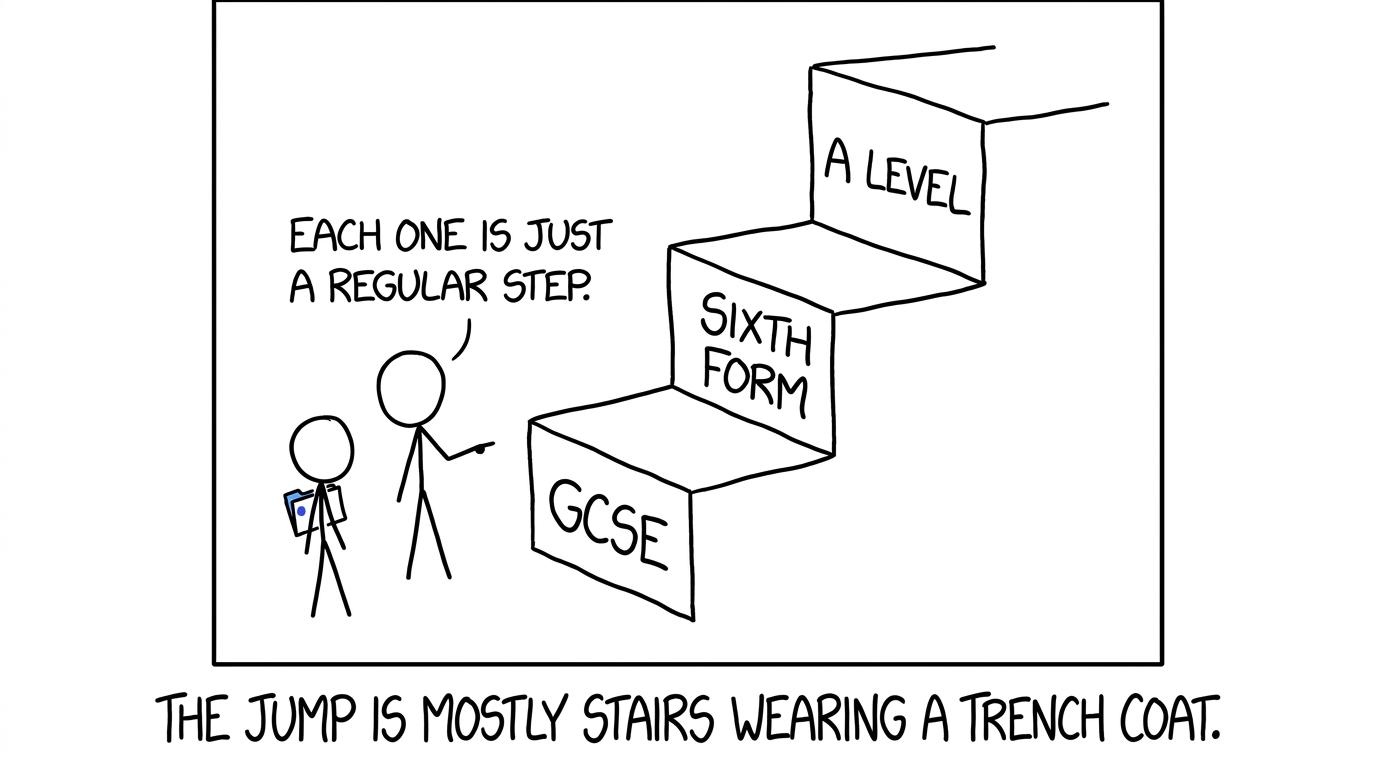 A student discovers that the intimidating sixth-form jump is really a staircase
What is the equivalent of GCSE ICT at A level?
There is no single UK-wide answer. Available qualifications depend on where you live, your provider and the specifications it currently offers.
A-level Computer Science
A-level Computer Science is the most academic route commonly associated with ICT. Current courses from major English exam boards such as AQA and OCR combine computer systems, algorithms, programming, data representation and computational thinking. They also include a substantial programming project or non-exam assessment.
This is not simply “more ICT”. It shifts attention from using technology towards understanding how computing systems work and how programs are designed.
Level 3 Information Technology
Applied or vocational Level 3 IT qualifications tend to place more emphasis on using technology in organisations. Depending on the qualification, topics may include information systems, databases, social media, cyber security, data analysis and project development.
These courses are not automatically easier. The challenge is different. You may need to produce detailed evidence, follow assignment criteria precisely, manage deadlines and explain why a technological solution is appropriate for a particular organisation.
Digital technology qualifications
Some providers and UK nations use titles such as Digital Technology rather than ICT. Course content and assessment can differ considerably, so the qualification title alone does not tell you enough. Compare the actual units, assessment methods and entry requirements.
How much harder is the equivalent A-level?
For most students, the step up feels significant rather than impossible. Four changes account for much of the difference.
Greater depth replaces simple recognition
At GCSE, a question may reward identifying a suitable technology or describing a familiar process. Level 3 questions are more likely to ask you to analyse a situation, justify a decision or evaluate competing solutions.
Knowing that cloud storage can support remote access is only a starting point. You may also need to discuss security, reliability, cost, legal responsibilities and the needs of a specific organisation. The best response depends on context.
This resembles the move from recalling a maths rule to selecting and applying it in an unfamiliar problem. Regular GCSE Maths revision lessons can strengthen that broader habit of reasoning rather than guessing from keywords.
Programming becomes more demanding
For students moving into A-level Computer Science, programming can create the largest gap. You may progress from short, guided tasks to planning, testing and refining larger programs.
You need to become comfortable with:
- decomposition and abstraction;
- selection, iteration and data structures;
- tracing algorithms carefully;
- validation and testing;
- finding logical and syntax errors;
- documenting decisions;
- improving efficiency and readability.
A program that runs is not necessarily a strong solution. At A level, you increasingly need to explain why it works, how it was tested and whether its design is appropriate.
The theory is more connected
GCSE topics can initially feel like separate folders: networks in one, security in another, data representation somewhere else. At A level, the folders begin to overlap.
A single problem might connect network architecture, protocols, cyber security and ethical consequences. Data representation may link binary digits such as 000 and 111 with storage, logic and processor behaviour. Algorithms connect programming with mathematical reasoning.
The difficulty comes from making these connections under exam pressure, not merely from learning a longer list of definitions.
Independence matters more
Sixth-form courses move faster and leave less room for forgotten work to remain invisible. A programming project cannot sensibly be rescued in one evening. Neither can a large vocational assignment with weak evidence and missing evaluation.
Students sometimes interpret this as a sudden increase in intelligence required. More often, it is an increase in organisation required. Small, regular sessions become more valuable because each stage depends on the previous one.
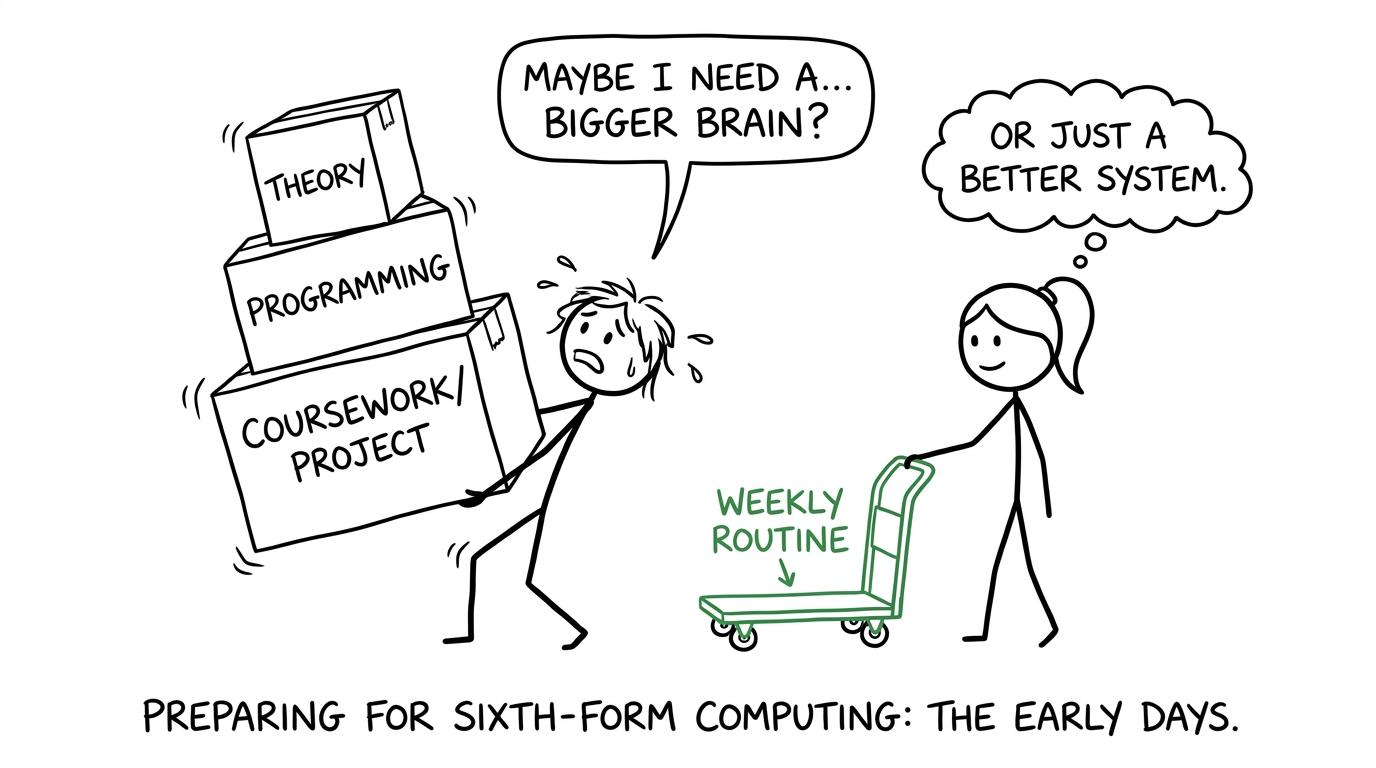 A student uses a weekly routine to move theory, programming and project work
How maths affects the step up
You do not need to treat A-level Computer Science as a disguised A-level Maths course. However, secure mathematical thinking helps considerably.
Useful foundations include:
- binary and place value;
- powers and indices;
- logic and truth tables;
- algebraic reasoning;
- interpreting tables and graphs;
- probability and basic statistics;
- following a multi-stage method accurately.
For instance, understanding why nnn binary digits can represent 2n2^n2n different patterns draws on powers. Algorithm questions require you to track changing values without losing the logical sequence. Data analysis requires careful interpretation rather than hurried calculation.
If these foundations feel uncertain, use the MathsGenie GCSE revision programme alongside GCSE Maths past papers. Students aiming for stronger higher-tier fluency can also organise topics through the grade 7 GCSE Maths resources. The aim is not to learn unrelated advanced mathematics. It is to make the necessary reasoning feel dependable.
How to prepare before sixth form
Confirm the course before revising for it
Ask for the exact qualification title, specification and programming language. A generic search for “A-level ICT revision” may lead you towards material that does not match your future course.
Look at the assessment structure as well. Written examinations reward concise explanations and application to context. Programming projects reward planning, iteration and testing. Vocational assignments require careful attention to criteria and evidence.
Build a small weekly routine
A useful routine might contain four short strands:
- one theory session;
- one programming session;
- one review of mistakes;
- one GCSE Maths session focused on reasoning or data.
Consistency matters more than a dramatic summer timetable. Twenty focused sessions spread across several weeks will usually teach you more than one exhausting weekend.
The MathsGenie revision planner can help you balance maths priorities instead of revising only the topics you already enjoy.
Practise explaining decisions
Do not stop at “this method is better”. Ask better for whom, under which conditions and at what cost. Strong computing and IT answers often follow a chain:
- identify the relevant feature;
- explain its effect;
- connect it to the stated context;
- acknowledge a limitation;
- reach a justified conclusion.
That same discipline improves GCSE Maths responses because it encourages you to show reasoning, check assumptions and answer the exact question.
Learn to debug calmly
Debugging is not evidence that you are bad at programming. It is part of programming. Develop a repeatable process: isolate the problem, trace the relevant values, test a smaller section and change one thing at a time.
This is close to checking a maths solution against a mark scheme. MathsGenie’s predicted GCSE Maths papers can provide additional exam-style practice, while official past papers remain essential for understanding established question styles.
Keep your maths options open
Some students combine Computer Science with A-level Maths, but subject choices and entry requirements are set locally. If you are considering that combination, preview the A-level Maths revision resources and explore A-level Maths past papers. This is useful for understanding the pace and style, not for trying to teach yourself an entire specification before September.
Common mistakes when planning the transition
Assuming ICT and Computer Science are the same
They overlap, but their emphasis differs. Choosing Computer Science because you enjoyed presentation software or spreadsheets may lead to an unexpected amount of programming and theory. Read the specification first.
Judging difficulty by the qualification title
A vocational IT course can involve demanding assignments, external assessments and strict evidence requirements. “Applied” does not mean effortless, just as “academic” does not mean unsuitable.
Memorising definitions without context
Long flashcard lists can create the feeling of progress while leaving application weak. After learning a term, ask how it affects a user, organisation or system and what trade-off it creates.
Avoiding programming until the course begins
You do not need an enormous project. Short, regular practice with variables, decisions, loops and testing is more useful. The objective is to become comfortable making and correcting mistakes.
Neglecting GCSE Maths revision
Your immediate GCSE exams still matter, and secure number, algebra, probability and data skills support later computing. Follow revision lessons with practice questions, mini tests and mark schemes rather than relying on passive watching.
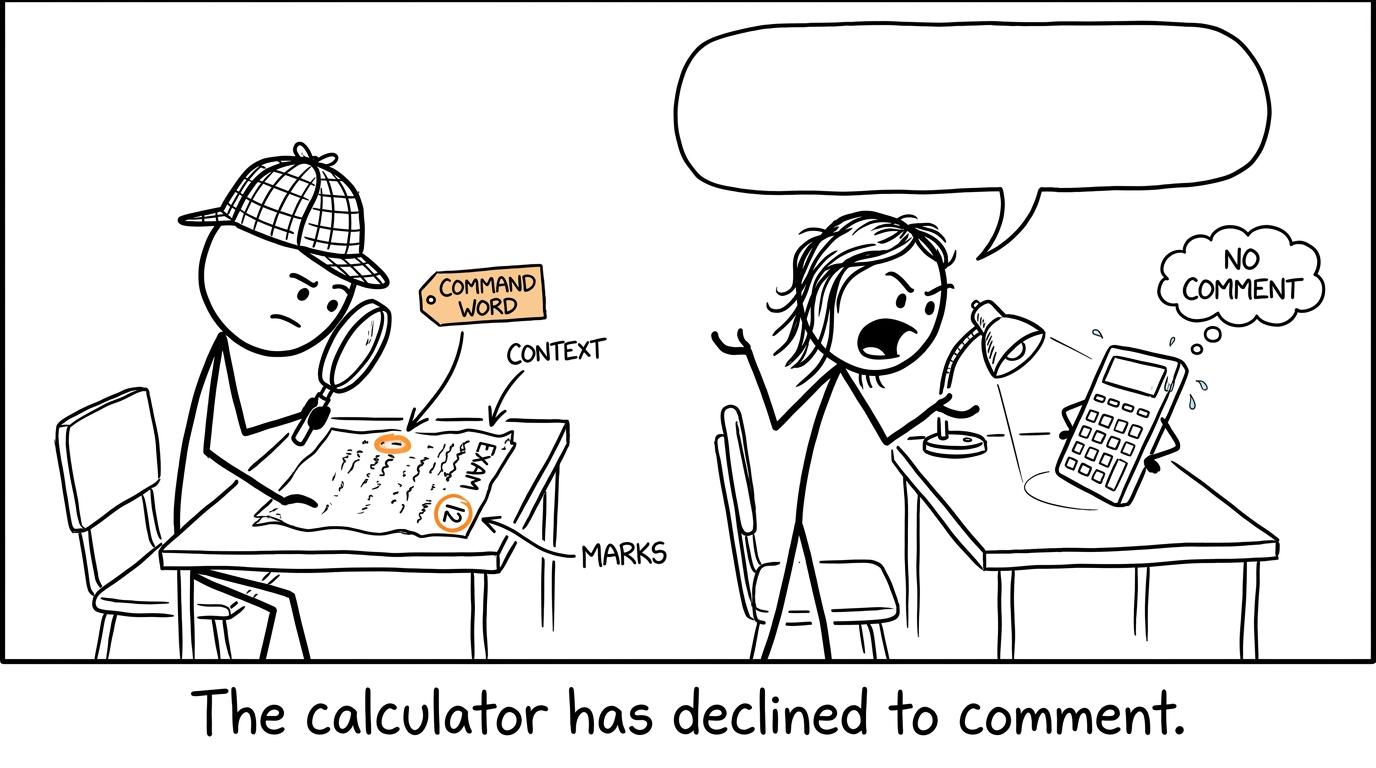 An exam-paper detective searches for command words while a calculator refuses to comment
The jump is easier when you can name it
The GCSE to A-level ICT jump is not one mysterious leap. It is a collection of smaller changes: deeper explanation, more independent work, larger programming tasks and closer links between topics. Once you identify which changes belong to your chosen qualification, preparation becomes much more precise.
Start by checking the current specification and your provider’s entry requirements. Then build a modest weekly routine, practise programming if your route requires it and protect the mathematical foundations that support logical thinking.
MathsGenie can help you handle that part of the transition for free. Begin with the GCSE Maths revision hub, then use practice questions, mini tests, video solutions and mark schemes to close specific gaps. As exams approach, combine revision lessons with past papers and predicted papers. The next step may be bigger, but it does not need to arrive as a surprise.