GCSE Statistics Revision Drop-In Sessions: Worth It?
GCSE statistics revision drop in sessions can be valuable with precise questions. Learn when teacher support wins and when solo practice is better for you.
A revision session can look useful from a distance. A teacher is there, your classmates are working, and you have technically given up part of your lunch or evening for statistics. Yet attendance alone does not earn marks.
So, are GCSE statistics revision drop in sessions worth attending? Usually, yes, when you arrive with a specific gap to fix, attempt questions yourself and leave knowing what to practise next. They are less valuable when you attend without a plan, wait passively for help or use them instead of independent exam practice.
The best choice is rarely drop-ins or revising alone. It is a deliberate combination of both.
The quick decision checklist
A school statistics drop-in is probably worth attending if:
- you have attempted questions and cannot identify why your method fails;
- a mark scheme uses language you do not understand;
- you repeatedly lose marks on the same topic;
- you need feedback on written interpretation or comparison questions;
- you are uncertain about your exam board, tier or specification;
- working beside a teacher will help you begin a task you keep avoiding.
Independent revision is probably the better use of that hour if:
- you already understand the method but need repetition and speed;
- you have not yet attempted the available questions;
- the drop-in is crowded and you have no focused question;
- you can complete and mark a past paper productively at home;
- travelling to the session would consume much of your revision time.
Before deciding, check the GCSE Statistics revision hub and list the topics that genuinely need attention. A vague feeling that statistics is difficult is not yet a revision plan.
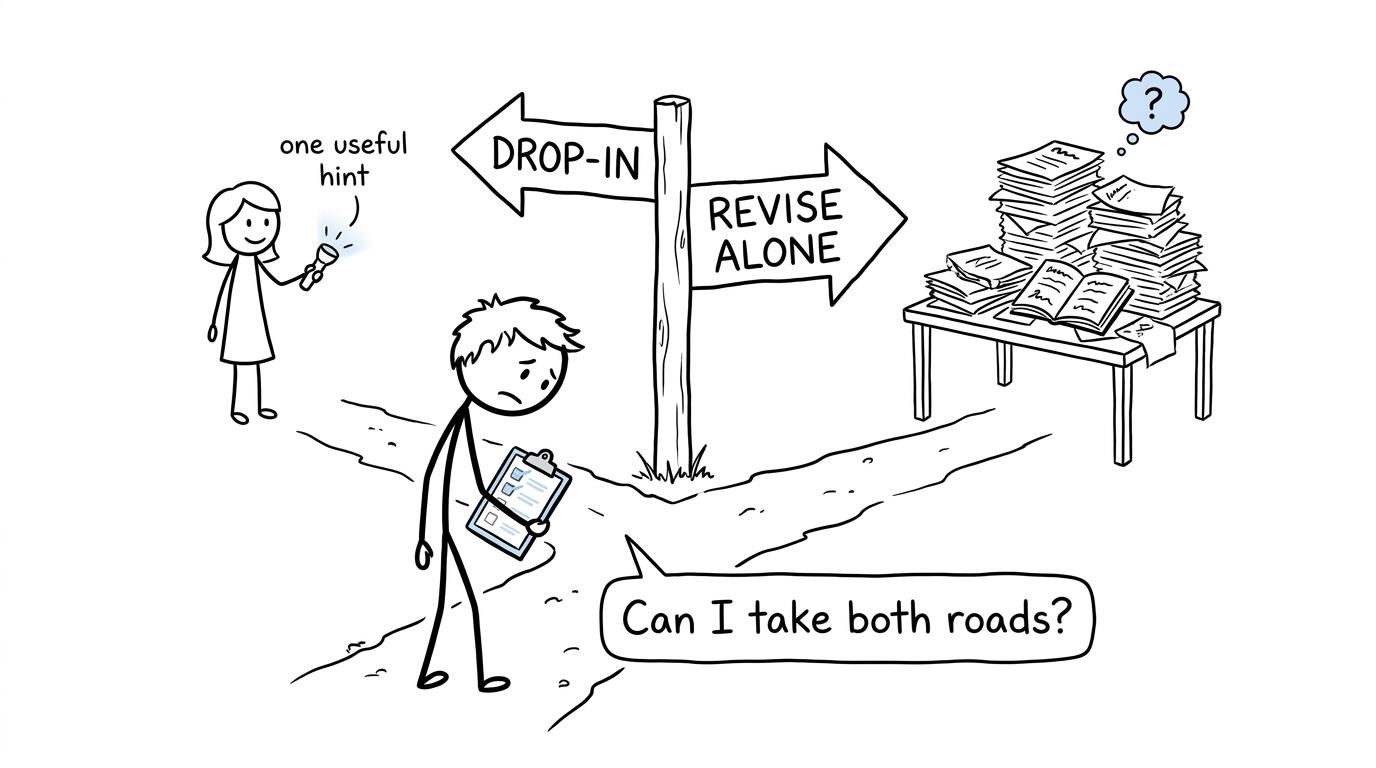 A student wondering whether drop-ins and independent revision can be combined
Why statistics drop-ins can be unusually useful
Statistics is not only a collection of calculations. Students must select suitable representations, interpret results, recognise limitations and communicate conclusions in context. A correct number may be only part of a complete answer.
For example, knowing formulas such as
frequency density=frequencyclass width\text{frequency density}=\frac{\text{frequency}}{\text{class width}}frequency density=class widthfrequencyor
interquartile range=Q3−Q1\text{interquartile range}=Q_3-Q_1interquartile range=Q3−Q1matters. But so does recognising when each idea is relevant and explaining what a result says about the data.
This is where a teacher can offer something a page of answers cannot: diagnostic feedback. They may notice that your calculation is sound but your comparison lacks context, that you are confusing correlation with causation, or that you are plotting class midpoints where upper class boundaries are required.
Authoritative GCSE subject content also gives considerable importance to statistical reasoning, data collection and the statistical enquiry cycle. In the separate GCSE Statistics qualification, students may meet ideas extending beyond the statistics strand of ordinary GCSE Maths. Always confirm which course you take before building a topic list. MathsGenie's GCSE Maths topics by exam board and tier can help students taking Edexcel, AQA, OCR or Eduqas GCSE Maths identify the relevant statistics content.
What the evidence can and cannot tell us
Research evidence does not provide a universal verdict on every informal school drop-in. Sessions vary too much: one may involve three pupils receiving targeted feedback, while another may involve twenty students quietly completing worksheets.
However, evidence reviewed by the Education Endowment Foundation supports targeted small-group tuition, particularly when teaching responds to specific pupil needs. Its evidence on metacognition also supports helping pupils plan, monitor and evaluate their learning within the subject they are learning.
That does not mean sitting in a classroom automatically improves a grade. It suggests that the valuable ingredients are:
- targeted support;
- clear feedback;
- appropriate challenge;
- active practice;
- reflection followed by independent application.
A drop-in containing those ingredients is likely to be more useful than an hour of unfocused solo revision. A focused independent session may be better than a drop-in containing none of them.
When attending beats revising alone
You cannot diagnose the error
Some mistakes are easy to correct from a mark scheme. Others are not. If your answer differs from the solution but you cannot locate the first incorrect decision, take the attempted question to a teacher.
This is especially worthwhile for histograms, cumulative frequency, sampling, probability distributions and extended interpretation. The cumulative frequency revision guide can help you review the method first; the drop-in can then resolve whatever remains unclear.
Your written answers keep missing marks
Questions involving bias, reliability, suitability and conclusions often depend on precise reasoning. Simply writing that a sample is “bad” is rarely enough. You need to identify the limitation and explain its likely effect in the context of the investigation.
Bring your complete answer rather than asking, “How do I do this question?” Ask which part is valid, which statement is too vague and what the command word requires. That turns the teacher's response into feedback you can reuse.
You need to choose between methods
A mark scheme can confirm an answer, but it may not explain why one representation or measure is more appropriate than another. A short conversation can clarify why the median may be preferable when extreme values distort the mean, or why the interquartile range and median form a useful pair when comparing distributions.
MathsGenie's statistical skills revision guide provides a concise review of averages, spread and data interpretation. Although written for statistical skills in geography, those core ideas can support cross-curricular understanding before you seek subject-specific guidance.
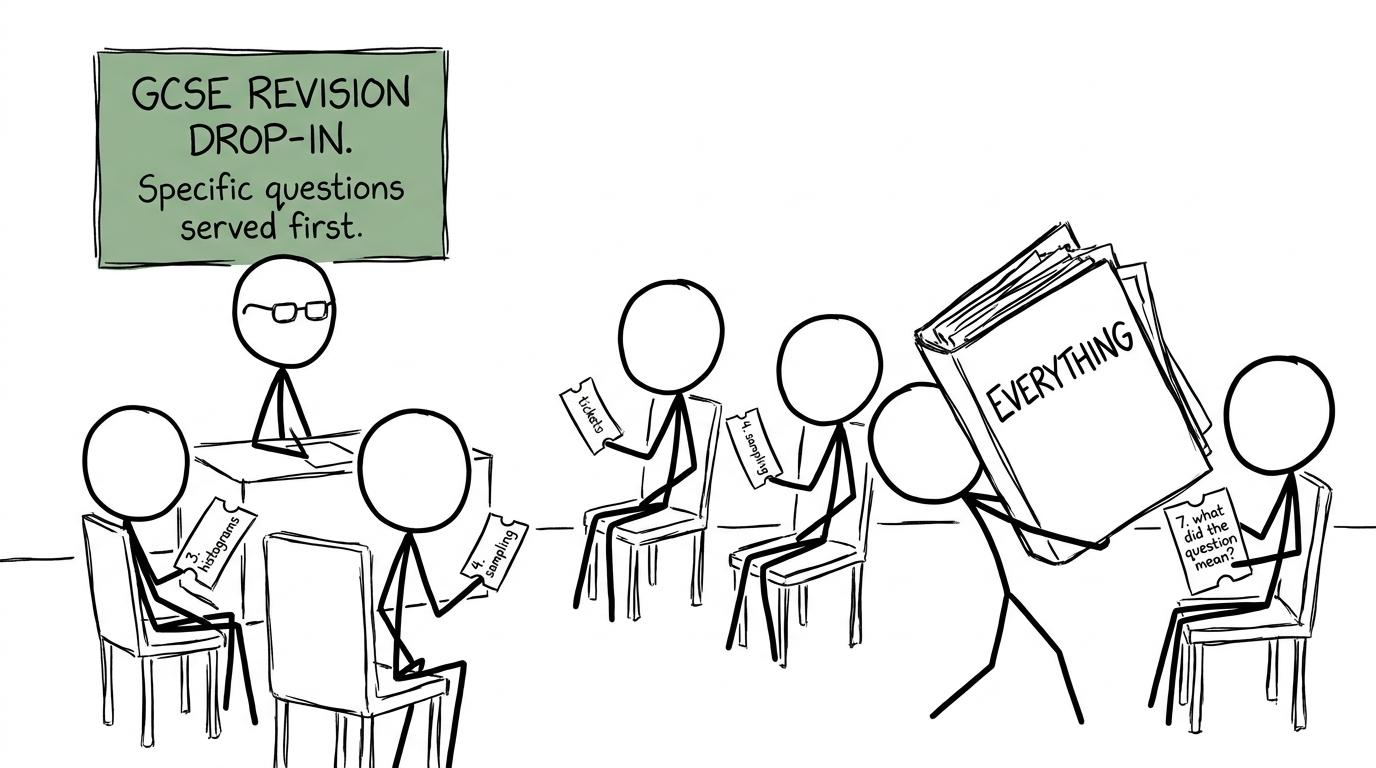 A revision drop-in where specific questions are served first
When independent revision is better
You need fluency rather than explanation
Once you understand a method, improvement usually comes from doing it. If you can calculate an estimated mean correctly but slowly, sitting beside a teacher may add little. Complete a focused set of questions, mark it and repeat the skill after a gap.
This is the quiet work drop-ins cannot replace. Exams require you to retrieve knowledge without prompts, choose a method independently and maintain accuracy under time pressure.
You have not attempted anything yet
A teacher cannot diagnose an invisible error. Arriving with a blank booklet often turns the session into another lesson, even when the real problem is that you have not started practising.
Use the Edexcel GCSE Statistics revision area to select an appropriate lesson, worksheet or exam-style question. Attempt it without copying the solution. If you then become stuck, you have created a useful question for the next drop-in.
The session carries a high opportunity cost
Time has alternatives. An hour spent travelling, waiting or listening to explanations of topics you already understand is an hour unavailable for a timed paper, sleep or another subject.
This is not an argument for avoiding help. It is an argument for comparing the session with the best realistic alternative. Ask: “What exact result should I have by the end of this hour?” If you cannot answer, redesign the session before attending.
How to make a revision drop-in worth your time
Prepare before you arrive
Bring no more than three priority questions. For each one:
- attempt the full question;
- mark what you can;
- circle the first uncertain step;
- write what you expected to happen;
- note the topic and command word.
“Why does the mark scheme use the upper boundary here?” gives a teacher somewhere precise to begin. “I do not understand statistics” does not.
Ask for diagnosis, not rescue
Try questions such as:
- “Where is the first point at which my reasoning becomes invalid?”
- “What would distinguish this answer from a complete answer?”
- “Is this a knowledge error, a reading error or an exam-technique error?”
- “Which question should I attempt next to test the same skill?”
The aim is not to leave with one corrected page. It is to leave able to recognise and solve the next version independently.
Test the advice immediately
After receiving help, close the model answer and complete a similar question. Then revisit the topic after a short gap. If you can only reproduce a method while the explanation remains visible, the method is not secure yet.
For students planning to continue with the subject, the representations of data revision guide also shows how familiar ideas such as histograms, box plots and cumulative frequency develop at AS Level. Treat this as future progression, not as required GCSE content.
Build a hybrid revision routine
A strong weekly cycle might look like this:
- Diagnose independently: complete mixed questions or part of a past paper.
- Record errors: separate missing knowledge from misreading, inaccurate calculation and weak explanation.
- Use the drop-in selectively: take the questions you cannot resolve alone.
- Practise again: answer fresh questions without teacher prompts.
- Review later: use a mini test or another mixed paper to check retention.
This approach protects the main advantage of revising alone, independent retrieval, while using teacher time for the problems where feedback has the greatest value.
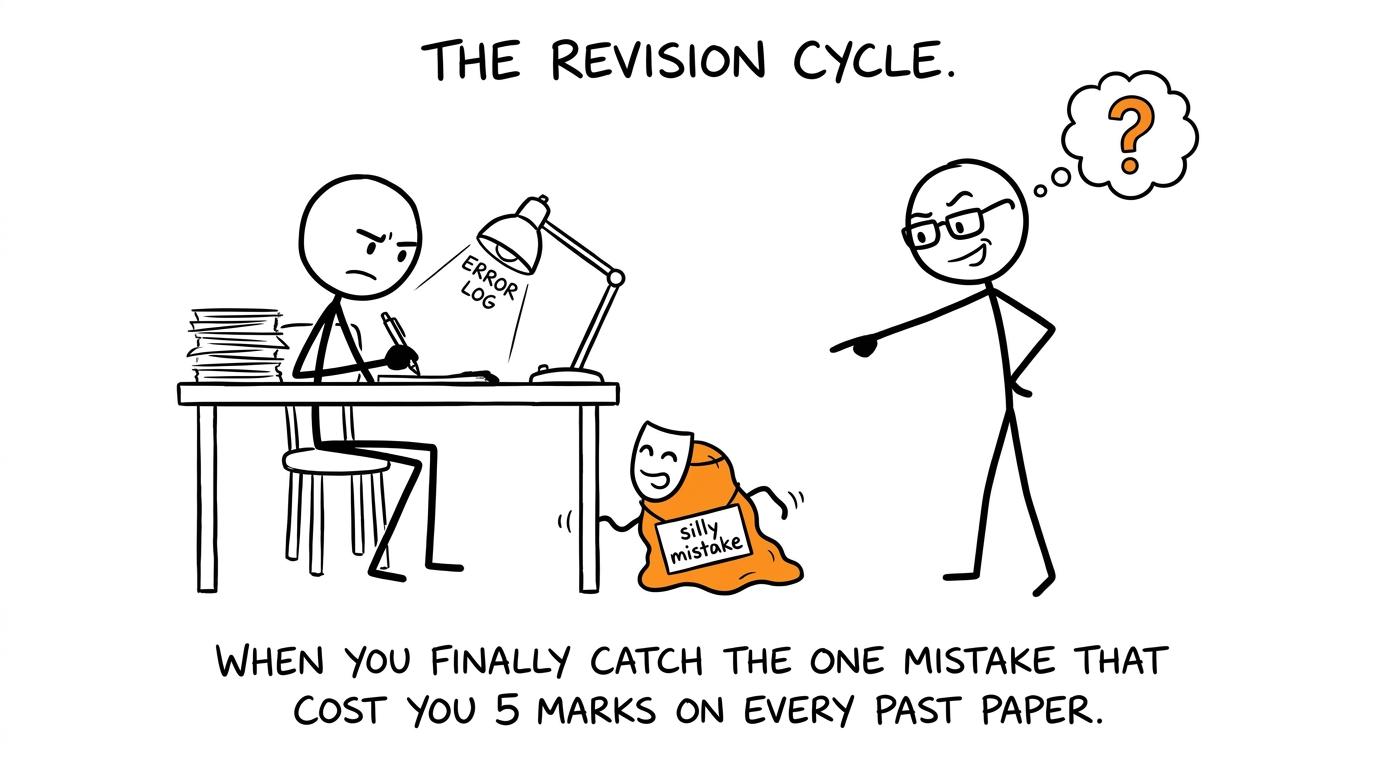 A disguised silly mistake being discovered by an error log
Common mistakes with GCSE statistics revision drop in sessions
Attending without evidence of what went wrong
Bring attempted work, marked papers or a short error log. Otherwise, much of the session may be spent discovering what you could have identified beforehand.
Copying the teacher's method
A neat copied solution creates familiarity, not necessarily understanding. Cover it and reproduce the reasoning independently before leaving.
Asking only about calculations
Do not neglect interpretation, sampling, misleading representations, assumptions and conclusions. These areas can expose weaknesses that repetitive calculator work will not fix.
Staying with friends rather than working
The social pressure of a session can help you begin, but conversation can also disguise inactivity. Choose a seat and task that make concentration more likely.
Treating attendance as a substitute for past papers
Drop-ins provide support; papers test independence. Use MathsGenie's past papers, practice questions, mark schemes and video solutions to find weaknesses, then take the stubborn ones to school. A GCSE Statistics past-paper collection is more useful when you mark honestly and record the reason for each lost mark.
Make the next session earn its place
School statistics drop-ins are worth attending when they shorten the distance between confusion and independent performance. They are not automatically better than revising alone, and solo revision is not automatically more disciplined. The quality of the task matters more than the location.
Begin with the MathsGenie revision lessons and practice questions. Mark your work using the available solutions and mark schemes. Use past papers and predicted papers to uncover gaps, mini tests to check whether learning has lasted, and the revision planner to decide what deserves your next hour.
Then take only the hardest, clearest questions to your school drop-in. Teacher feedback will have a precise job to do, and your independent practice afterwards will turn that feedback into marks.