

GCSE Statistics Remark: Results Day Guide
GCSE statistics remark guide: understand reviews of marking, check grade boundaries, assess your scripts and decide whether to request a review.
Results day can turn a single mark into the only number you can see. If your GCSE Statistics grade is below expectations, a GCSE statistics remark may be worth considering, especially when you are close to the next grade boundary and a teacher identifies a possible marking error.
The official service is called a review of marking, not a re-mark. Your school or college requests it from the exam board with your written consent. The result can rise, remain unchanged or fall, so the best decision begins with evidence rather than disappointment.
Your results-day decision checklist
Before requesting a review, ask:
- Which exam board and tier did I take?
- What was my total mark?
- How many marks am I below the next grade boundary?
- Can my teacher inspect copies of my marked scripts?
- Is there evidence that the mark scheme was applied incorrectly?
- Which paper should be reviewed?
- Could a lower mark affect my current grade?
- What are my school's deadline, fee and consent arrangements?
- Does the grade affect sixth-form entry or another important next step?
Start with the correct GCSE Statistics revision hub, then check either the AQA GCSE Statistics grade boundaries or Edexcel GCSE Statistics grade boundaries.
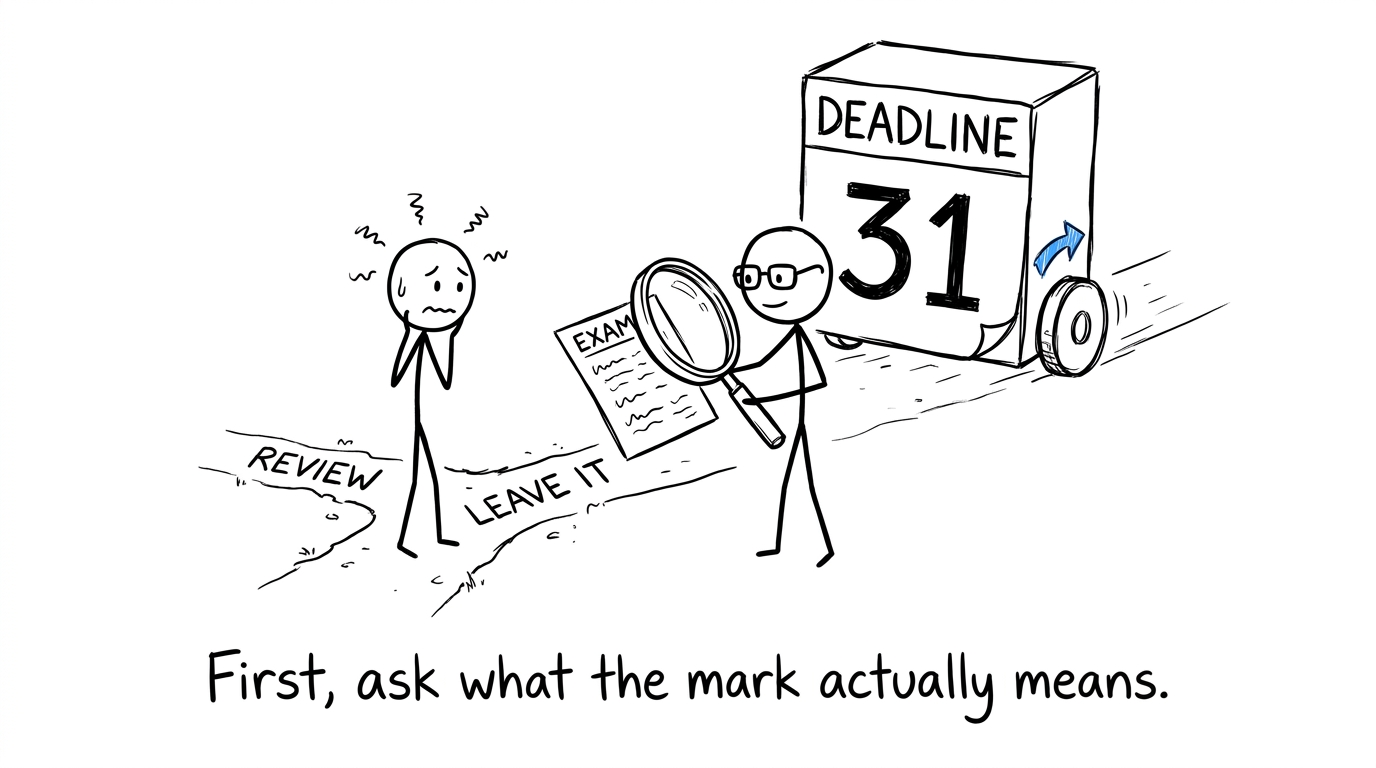 A student and teacher calmly investigate an exam result before a deadline
How the GCSE Statistics re-mark process works
Speak to your school immediately
For a student entered through a school or college, the exams officer normally submits the request. Tell your Statistics teacher promptly that you want to discuss the result. Schools often set internal deadlines earlier than the exam board deadline so staff have time to inspect scripts, collect consent and process applications.
For the June 2026 series, JCQ lists 24 September 2026 as the deadline for awarding bodies to receive standard reviews of results. Do not treat that as your personal deadline; confirm your school's date on results day.
Confirm your mark against the correct boundary
A grade boundary is the minimum total mark required for a grade in that examination series. Make sure you use the right board, year and tier. Previous years are useful context, but they cannot determine the grade awarded this year.
Statistics grades normally depend on the combined mark across the qualification, not a separate grade for each paper. Your results information and exams officer can confirm the component marks. A tool such as the AQA Statistics grade calculator can help you understand how paper marks combine, but the official result remains decisive.
Ask for access to your scripts
Where time permits, ask whether your centre can obtain copies of your marked papers. A Statistics teacher can compare your responses with the mark scheme and look for:
- a response or page that appears unmarked;
- a correct calculation that received no credit;
- valid working that may deserve method marks;
- an extended explanation where the statistical reasoning may not have been credited appropriately;
- a possible transcription or addition error.
This is particularly useful in GCSE Statistics because papers combine calculations with interpretation, evaluation and written conclusions. Some answers have one clearly correct outcome; others require an examiner to apply academic judgement reasonably.
Choose the appropriate service
A clerical re-check checks matters such as whether marks were added and recorded correctly. A review of marking includes clerical checks and considers whether the agreed mark scheme was applied correctly.
It is not a completely fresh re-mark. Under Ofqual's rules, reviewers correct genuine errors, but they do not replace a reasonable academic judgement merely because another examiner might have awarded a different mark.
A request is made for a particular paper or component. Reviewing every paper automatically can increase the cost and expose more marks to possible change. Ask your teacher where the clearest evidence lies.
Give informed written consent
Your centre must obtain your written consent after results have been published. This is required because the reviewed mark replaces the original outcome and may be higher, unchanged or lower. Your subject grade can therefore move in any of those directions.
Fees and payment policies vary by exam board and centre. Some schools pay in particular circumstances; others ask candidates to pay. Ask the exams officer for the current charge and whether it is refunded if the overall grade changes.
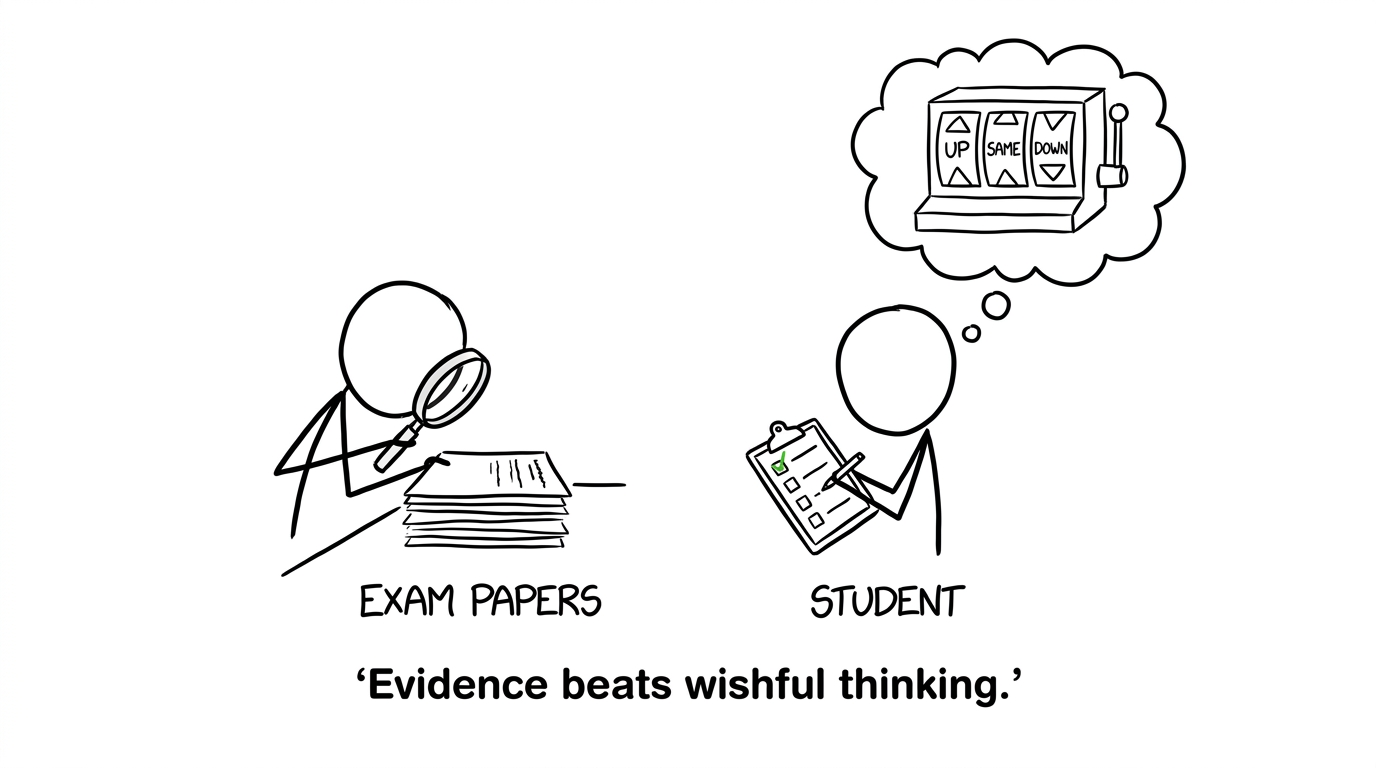 A student uses evidence and a checklist while a review could move a mark up, stay the same or move down
When requesting a review makes sense
A review is most defensible when several factors point in the same direction:
- you are close to the next qualification boundary;
- the higher grade matters for progression;
- your marked script contains a specific possible error;
- your teacher believes the mark scheme may have been applied incorrectly;
- the potential benefit justifies the fee and downside risk.
Being close to a boundary does not itself prove that anything went wrong. Equally, being several marks away does not make a review impossible. The central question is not simply, “How many marks do I need?” It is, “Where is there credible evidence that marks were missed?”
Students can revisit the expected standard through AQA GCSE Statistics revision resources or Edexcel GCSE Statistics revision resources, including past papers, exam-style questions and mark schemes.
Appealing a GCSE Statistics grade
An appeal is not normally the first step. Your centre must first receive the outcome of the relevant review of marking. If it then believes a marking error remains, or that the exam board did not follow its procedures consistently, properly and fairly, the head of centre can appeal.
You cannot appeal simply because you dislike the grade boundary. Ofqual guidance makes clear that the setting of a grade boundary is not itself a ground for appeal. Speak to your exams officer about the applicable process and deadline rather than contacting an examiner personally.
Common mistakes to avoid
- Calling the service a full re-mark and expecting every answer to be marked from scratch.
- Looking at boundaries from the wrong board, tier or examination series.
- Requesting a review solely because a result feels surprising.
- Forgetting that individual papers are reviewed separately.
- Assuming a grade cannot fall after written consent is given.
- Waiting for the awarding body's final date and missing the school's earlier deadline.
- Confusing a review of marking with an appeal.
Make the next decision calmly
A result matters, but urgency should not become guesswork. Check the boundary, obtain the component marks, inspect the scripts where possible and ask your teacher for a specific judgement. Then decide before your centre's deadline.
If a review is not appropriate, the paper can still become useful evidence for future revision. Use MathsGenie's GCSE Statistics past papers and question banks alongside mark schemes, revision lessons and practice questions. For wider preparation, explore the GCSE predicted papers, mini tests and video solutions. Most importantly, compare your result with the relevant GCSE Statistics grade boundaries and speak to your exams officer before taking action.











