

GCSE Statistics Grade: What It Means for Sixth Form
GCSE statistics grade sixth form guide: understand grades 9-1, typical entry expectations and routes into A Level Statistics and related subjects.
A results sheet can make one number feel like a verdict. It is not. The clearest GCSE statistics grade sixth form answer is that your grade shows your current statistical confidence, but colleges usually set their own entry requirements using GCSE Mathematics, English and your wider GCSE profile. A separate GCSE Statistics grade can strengthen your application, particularly for Statistics and data-heavy subjects, but it rarely decides your future by itself.
Current course information from UK sixth forms shows that requirements vary. Where standalone A Level Statistics is offered, published requirements commonly ask for GCSE Mathematics at grade 555 or 666. Always check the exact course page for the year you intend to enrol.
Your quick sixth-form checklist
Before choosing a post-161616 course:
- check whether the provider offers standalone A Level Statistics or statistics within A Level Mathematics;
- compare your GCSE Statistics grade with your GCSE Mathematics grade;
- read the provider's subject-specific and general entry requirements;
- ask whether Higher-tier GCSE Mathematics is required;
- identify weaknesses in probability, algebra, sampling and interpretation;
- use GCSE Statistics revision resources to close those gaps.
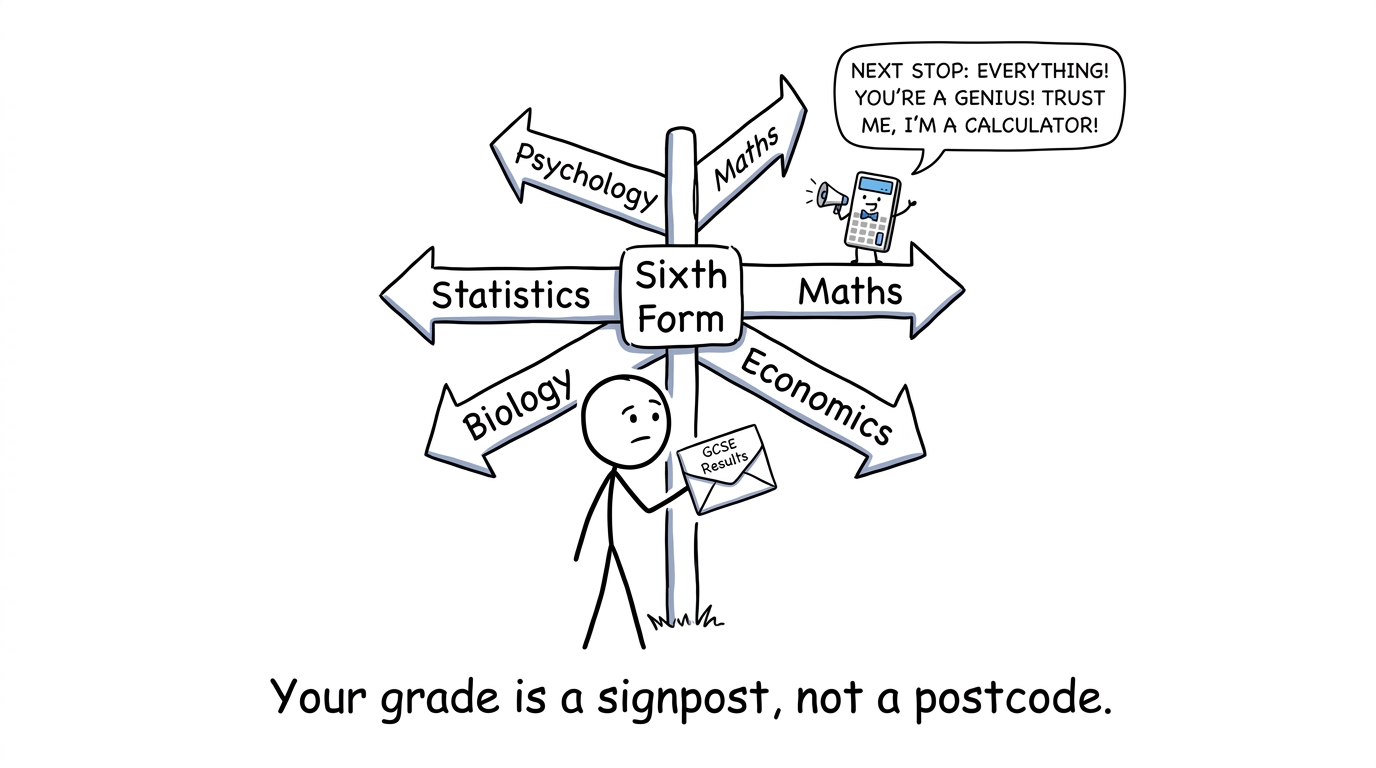 A student sees a GCSE grade as a signpost towards sixth-form subjects
GCSE Statistics grade meaning at a glance
GCSE Statistics uses the 999 to 111 grading scale, with 999 as the highest grade. On the Pearson Edexcel specification, Foundation tier offers grades 111 to 555, while Higher tier offers grades 444 to 999. The qualification assesses data collection, processing and representation, probability, interpretation and the statistical enquiry cycle.
The following breakdown is practical guidance, not a universal admissions policy.
| GCSE Statistics grade | What it may indicate | Suggested next step |
|---|---|---|
| 999 to 888 | Excellent statistical reasoning and confident interpretation | Consider A Level Statistics, A Level Mathematics or data-heavy subjects |
| 777 to 666 | Strong foundations with good readiness for further statistical work | Check the provider's GCSE Mathematics requirement and strengthen algebra |
| 555 to 444 | A pass showing useful statistical understanding | Progression may be possible, but course requirements and GCSE Mathematics matter |
| 333 to 111 | Some knowledge is present, but important gaps remain | Consolidate GCSE skills before taking a strongly quantitative course |
| U | The minimum standard for a numbered grade was not reached | Speak to your school or college about suitable courses and support |
What grades 999 to 888 could mean
A grade 999 or 888 suggests that you can do more than calculate an average. You are likely able to select methods, interpret unfamiliar information and judge whether a statistical conclusion is justified.
That is valuable preparation for progressing to A Level Statistics. It also supports subjects such as Biology, Psychology, Geography, Economics and Business, where students may need to analyse evidence rather than simply produce calculations.
Do not assume that a high Statistics grade automatically satisfies an A Level Mathematics entry requirement. Sixth forms normally distinguish between GCSE Statistics and GCSE Mathematics. If A Level Mathematics interests you, explore the Edexcel A Level Maths revision course to see how statistics sits alongside pure mathematics and mechanics.
What grades 777 to 666 could mean
Grades 777 and 666 indicate a secure platform for further statistics. You may already be comfortable comparing distributions, considering bias and interpreting probability in context.
The main question is whether your algebra and general number skills are equally secure. Post-161616 statistics introduces more formal probability models, correlation and hypothesis testing. Even when the context is data, algebra often carries the calculation.
Some sixth forms publish a GCSE Mathematics requirement of grade 666 for A Level Statistics; others accept grade 555. This is why your GCSE Mathematics result may carry more admissions weight than your separate Statistics grade.
You can preview the transition through MathsGenie's A Level regression, correlation and hypothesis-testing questions.
What grades 555 to 444 could mean
A grade 444 is officially regarded as a standard pass, while grade 555 is described as a strong pass. In GCSE Statistics, either grade shows that you have acquired meaningful data-handling skills.
Progression is still possible, but it depends on the institution. A college asking for grade 555 in GCSE Mathematics may accept a student whose Statistics grade is 444, provided every other requirement is met. Another provider may expect grade 666 in Mathematics. There is no single national sixth-form admissions threshold for the course.
Use your mark scheme diagnostically. Was the problem calculation, interpretation or exam timing? MathsGenie's Edexcel GCSE Statistics revision page brings together lessons, worksheets, questions and paper practice. Targeted work on standard deviation questions can also develop the precision expected after GCSE.
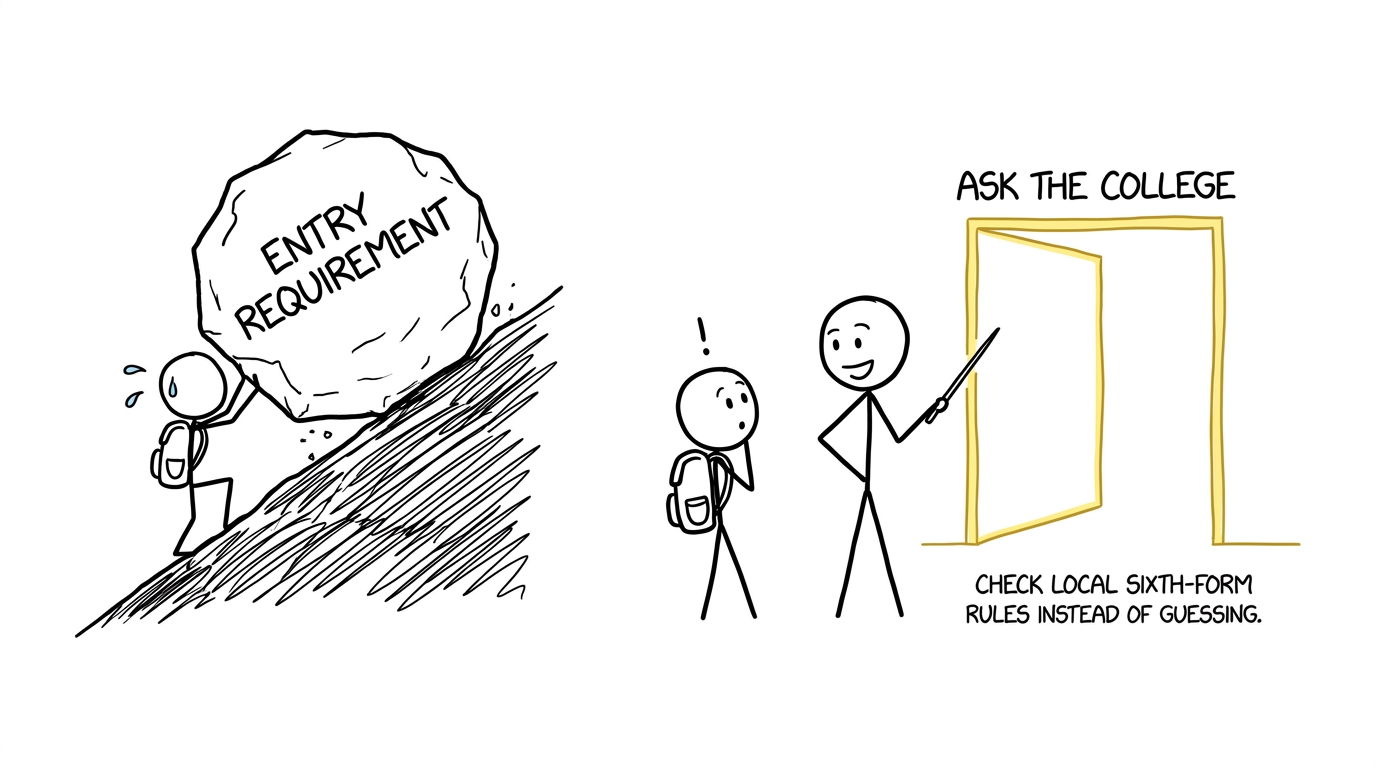 A student discovers that asking a college is easier than guessing its entry requirement
What grades 333 to 111 or U could mean
These results do not mean that you are incapable of understanding statistics. They mean that the examined evidence was not yet secure enough for a standard pass.
A demanding statistics course may not be the right immediate step, especially if GCSE Mathematics is also below the provider's threshold. Ask about alternative Level 222 or Level 333 routes, resit arrangements and courses with less mathematical content. The requirement to continue post-161616 study applies when a student has not achieved grade 444 in GCSE Mathematics or English, not because they received a lower grade in GCSE Statistics.
Return to the precise topics that cost marks. Use GCSE past papers, mark them carefully, and revise the gap before attempting another paper.
Progressing to A Level Statistics
Standalone A Level Statistics is not offered by every sixth form, so confirm local availability. A Level Mathematics also contains a substantial statistics component, although it includes pure mathematics and mechanics too.
At the next level, familiar ideas become more formal. Correlation develops into numerical measures and significance tests; probability develops into distributions; samples become the basis for inference. MathsGenie's hypothesis-testing revision guide provides a useful preview.
If your provider offers the standalone qualification, you can also inspect the style and demand of Edexcel A Level Statistics past papers. A paper is not an entry test, but it is an honest picture of where the course eventually leads.
Common mistakes when judging your options
- Treating one grade as a final decision: admissions teams consider published course rules and, often, a wider GCSE profile.
- Confusing Statistics with Mathematics: a strong GCSE Statistics grade may not replace the required GCSE Mathematics grade.
- Assuming every college uses the same threshold: entry requirements are set locally and can change between admissions years.
- Ignoring algebra: successful statistics students need calculation skills as well as thoughtful written interpretation.
- Choosing from the course title alone: compare the content of standalone A Level Statistics with the statistics component of A Level Mathematics.
Turn your grade into a plan
Your GCSE Statistics grade is best understood as evidence, not identity. A high grade opens an encouraging conversation. A middle grade shows where preparation could make progression realistic. A lower grade identifies foundations that need more time.
Check your chosen sixth form's current requirements, then build the skills within your control. Start with MathsGenie's free revision lessons and practice questions, move to mini tests, and finish with past papers, predicted papers, mark schemes and video solutions. The result on your sheet tells you where you are. Deliberate revision decides where you go next.











