GCSE Statement of Results Explained
GCSE statement of results explained clearly: understand grades, marks, subject codes, special symbols and your next steps on results day in the UK.
The envelope feels heavier than it is. Then you open it and find a page crowded with codes, columns and unfamiliar labels. This GCSE statement of results explained guide will help you read that page calmly: check your personal details, find each subject, identify the final grade, understand any marks shown and ask for help if a result is missing.
Your school’s layout may differ because centres prepare statements using results supplied by exam boards. However, the essential information is broadly consistent.
Your quick results-slip checklist
Before making any decisions:
- Confirm that your name, candidate details and subjects are correct.
- Read the overall grade for each qualification.
- Check whether a mark is displayed, not every slip shows one.
- Look for symbols such as Q, X or #.
- Keep the statement safe, but remember that it is provisional.
- Speak to your school’s exams officer about anything unexpected.
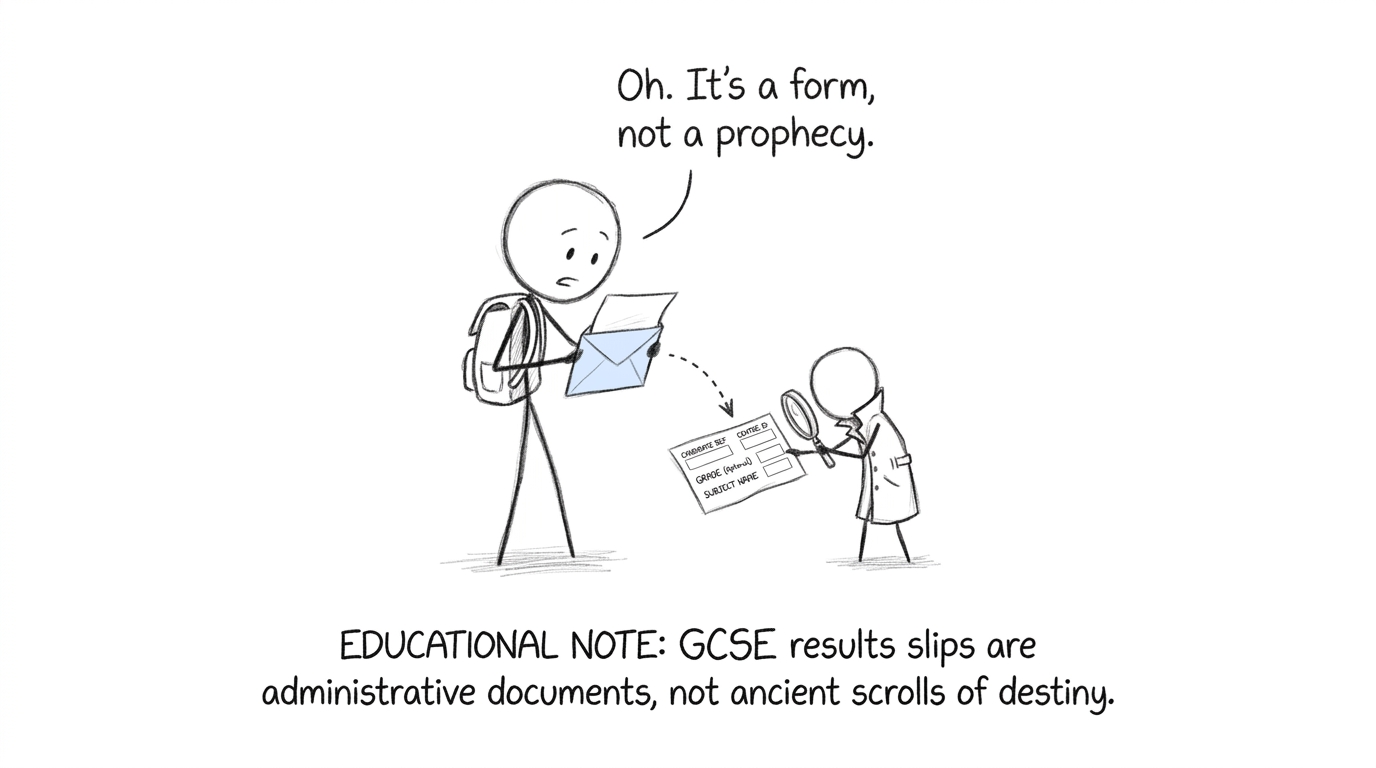 A student discovers that a results slip is a form rather than a prophecy
Reading a GCSE results slip field by field
Candidate and centre information
At the top, you will usually find your name, centre details, candidate number and Unique Candidate Identifier, often shortened to UCI. These details connect the results to you and your examination centre.
Check them carefully. A spelling difference may be harmless, but you should report incorrect personal details or an unfamiliar candidate number to the exams officer.
Exam board and specification code
A subject row may name the awarding organisation, such as Edexcel, AQA, OCR or Eduqas. It may also contain a specification, syllabus or entry code.
The code identifies the exact qualification and, where relevant, its tier or route. You do not need to memorise it. Use it to confirm that the listed qualification matches the course you took.
Subject or qualification title
This field names the qualification being awarded. Read the full title rather than relying only on the first familiar word. Separate qualifications, endorsements and combined awards can be reported differently.
For GCSE Maths, you might see a reference to foundation or higher tier. Foundation normally awards grades 111 to 555, while higher normally awards grades 444 to 999, with a narrow grade 333 safety net.
Grade
The grade column is the main outcome. GCSE qualifications in England generally use grades 999 to 111, with 999 the highest. U means unclassified: the minimum standard for grade 111 was not reached.
A grade is not calculated by comparing your total with last year’s boundary. Awarding organisations set boundaries after the papers have been marked, and they can change when paper difficulty changes. Use the MathsGenie GCSE grade boundaries page to select the correct board, subject and exam series.
Marks and maximum marks
Some statements display a raw mark, while others show only the qualification grade. A raw mark is the total credited by the exam board before it is compared with the relevant grade boundaries.
Do not assume that a displayed mark belongs to one paper or that every component boundary creates a separate grade. Your teacher or exams officer can confirm exactly what the figure represents. Edexcel students can explore how combined paper totals relate to historical outcomes with the GCSE Maths predicted grade calculator.
Status symbols and missing results
Certain symbols need prompt attention:
- Q means the result is pending because required information or marks are not yet available.
- X means no result has been issued.
- # indicates partial absence, although a grade may still have been awarded from the available assessment evidence.
These do not all mean the same thing. Ask your exams officer to investigate rather than trying to interpret an unusual code alone.
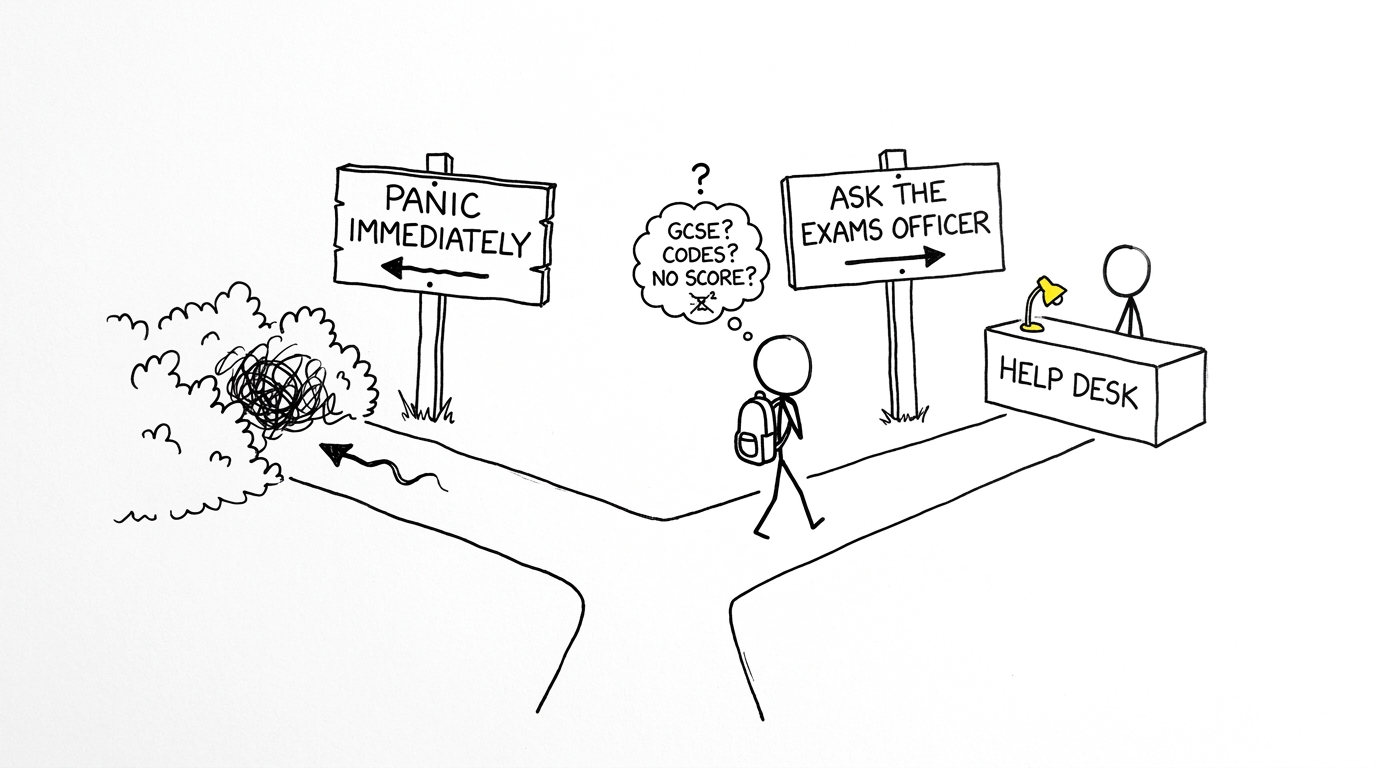 A student chooses the exams officer instead of the path marked panic
Why the statement says provisional
Your results slip is usually a Candidate Statement of Provisional Results, not the final certificate. Results can change through authorised post-results processes before certificates are issued.
If a grade appears surprising, speak to your teacher or exams officer quickly. Your school can obtain a script where available and consider an administrative check or review of marking. A review is not a request for extra marks because you were close to a boundary: it checks whether the marking rules were applied correctly. Your mark, and potentially your grade, can stay the same, rise or fall.
Common mistakes when reading GCSE results
- Comparing your mark with boundaries from the wrong board, tier or exam series.
- Treating a component mark as the final qualification total.
- Assuming U, Q and X are interchangeable.
- Believing a predicted grade overrides the awarded result.
- Leaving an unexplained code until post-results deadlines are close.
- Mistaking the provisional statement for the final certificate.
Read the result, then choose the next step
A results slip compresses years of work into a few columns, but it becomes manageable when you read one field at a time. Verify your identity, match each qualification, read the grade, understand any mark and query anything unclear.
If you are preparing for a resit, begin with the free GCSE Maths revision hub. Use the relevant Edexcel GCSE Maths resources, revision lessons and practice questions to repair specific gaps, then test them through past papers, mark schemes and video solutions. Near the next examination series, GCSE predicted papers can provide fresh practice.
Start by checking your result against the correct GCSE grade boundaries, then ask your school about the appropriate next step.