GCSE Sociology vs Psychology Grade Boundaries
GCSE sociology vs psychology grade boundaries compared using 2025 AQA data. See which looks lower, why boundaries move and how to set a safe target.
A grade boundary can feel like a price tag attached to a subject. If one GCSE appears to require fewer marks, it is tempting to call it the easier bargain. But that is not how grading works.
For students comparing GCSE sociology vs psychology grade boundaries, the short answer is this: neither subject has reliably more generous boundaries at every grade. In AQA's June 2025 results, Sociology had lower boundaries for grades 999, 888 and 777, while Psychology had lower boundaries from grades 666 to 222. Both required the same mark for grade 111.
Those figures describe how students performed on particular papers. They do not prove that one course is easier, and they cannot tell you next year's boundaries in advance.
The comparison at a glance
Here is what matters before you build a target around historical boundaries:
- Compare the same exam board and examination series.
- Use the overall qualification boundary, not a notional paper boundary.
- Convert marks to percentages when maximum marks differ.
- Examine several years rather than one isolated result.
- Remember that boundaries compensate for paper difficulty.
- Set a target above the historical boundary to allow for variation and mistakes.
- Choose between Sociology and Psychology according to content, assessment style and your strengths, not one attractive row of figures.
Students taking either course can begin with MathsGenie's free GCSE Sociology revision hub or AQA GCSE Psychology revision hub.
GCSE Sociology vs Psychology grade boundaries in 2025
AQA provides the cleanest direct comparison because its GCSE Sociology and GCSE Psychology qualifications were each marked out of 200200200 in June 2025. Each qualification consisted of two papers worth 100100100 marks, so no conversion is needed when comparing their overall boundaries.
The confirmed June 2025 subject boundaries were:
| Grade | AQA Sociology mark | Sociology percentage | AQA Psychology mark | Psychology percentage |
|---|---|---|---|---|
| 999 | 163163163 | 81.5%81.5\%81.5% | 170170170 | 85%85\%85% |
| 888 | 151151151 | 75.5%75.5\%75.5% | 156156156 | 78%78\%78% |
| 777 | 140140140 | 70%70\%70% | 142142142 | 71%71\%71% |
| 666 | 124124124 | 62%62\%62% | 122122122 | 61%61\%61% |
| 555 | 108108108 | 54%54\%54% | 103103103 | 51.5%51.5\%51.5% |
| 444 | 939393 | 46.5%46.5\%46.5% | 848484 | 42%42\%42% |
| 333 | 676767 | 33.5%33.5\%33.5% | 616161 | 30.5%30.5\%30.5% |
| 222 | 414141 | 20.5%20.5\%20.5% | 383838 | 19%19\%19% |
| 111 | 151515 | 7.5%7.5\%7.5% | 151515 | 7.5%7.5\%7.5% |
The percentage calculation is:
Boundary percentage=boundary markmaximum mark×100\text{Boundary percentage}=\frac{\text{boundary mark}}{\text{maximum mark}}\times 100Boundary percentage=maximum markboundary mark×100At grade 999, Sociology's boundary was 777 marks lower. At grade 444, however, Psychology's boundary was 999 marks lower. The apparent advantage changed according to the target grade.
That is the central finding: Sociology looked more favourable for the highest grades in 2025, but Psychology looked more favourable around the standard pass and middle grades.
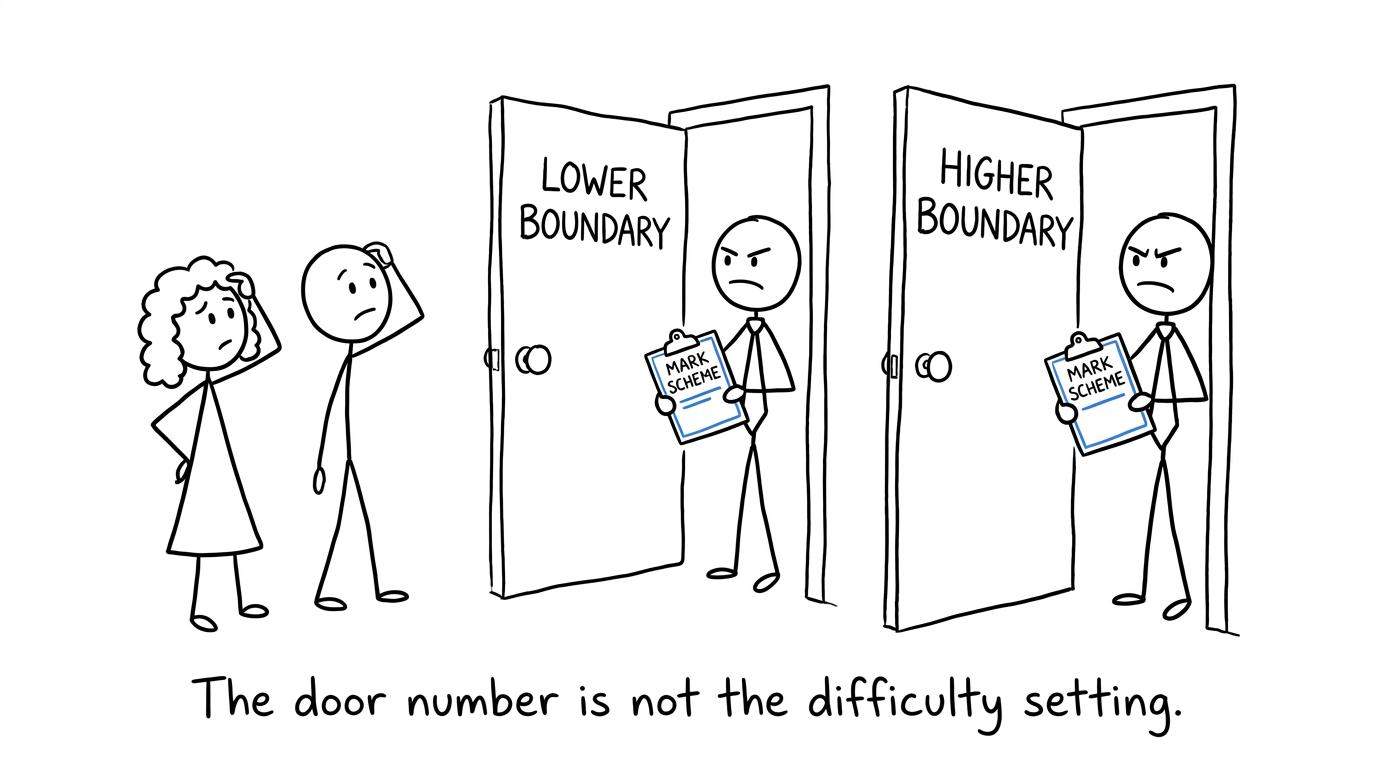 A lower grade boundary is not automatically an easier door
Do Sociology boundaries tend to be lower?
Not consistently. A comparison with June 2024 shows why one year should never become a rule.
In 2024, the AQA grade 999 boundary was 158158158 in both subjects. For grade 777, Psychology required 130130130, while Sociology required 136136136. At grade 444, Psychology required 747474, compared with 909090 for Sociology.
Between 2024 and 2025, the grade 999 Psychology boundary rose from 158158158 to 170170170. Sociology's rose from 158158158 to 163163163. This does not mean either specification suddenly became easier or harder as a permanent course. It means the evidence from that year's examinations supported different boundaries.
Official grading guidance explains that boundaries are set after papers have been taken and marked. Exam boards consider statistical evidence and senior examiners review work around possible boundaries. If a paper proves more demanding, its boundaries can be lower; if students find it less demanding, they can be higher.
A lower number is therefore often compensation for a harder assessment. It is not a discount on the standard required.
Why the subjects produce different boundary patterns
Sociology and Psychology overlap in places, but their assessments reward different combinations of knowledge and skills.
Sociology places substantial weight on application
In AQA GCSE Sociology, approximately 40%40\%40% of the qualification assesses knowledge and understanding, 40%40\%40% assesses application, and 20%20\%20% assesses analysis and evaluation. Students must use sociological theories, concepts, evidence and methods in the context of the question.
This can make apparently familiar questions demanding. Knowing a theory is not enough if the response does not apply it precisely or develop a supported argument. The AQA GCSE Sociology revision resources bring revision material and past papers together so that students can practise that transition from recall to application.
Psychology has a larger analysis and evaluation weighting
Across GCSE Psychology specifications, assessment objectives require knowledge, application, analysis and evaluation. For AQA, the weighting is 35%35\%35% for knowledge and understanding, 35%35\%35% for application, and 30%30\%30% for analysis and evaluation.
Research methods also matter. GCSE Psychology assessments must allocate at least 20%20\%20% of their marks to research methods and at least 10%10\%10% to mathematical skills at an appropriate level of demand. This can include handling data, ratios, fractions, percentages, averages and interpreting graphs.
That crossover is useful for students preparing for maths exams. MathsGenie's guides to handling data in AQA Psychology and arithmetic in AQA Psychology strengthen skills that also appear in GCSE Maths and Statistics.
What the boundaries mean for your target grade
A previous boundary should be treated as a reference point, not a promise.
If your target is a grade 777, the 2025 AQA boundaries were 140140140 for Sociology and 142142142 for Psychology. Planning to score exactly those totals would leave no room for a boundary increase, a misread question or a weaker-than-usual paper.
A safer approach is to add a working buffer. On a qualification worth 200200200 marks, a buffer of 5%5\%5% of the available marks is:
0.05×200=100.05\times 200=100.05×200=10That is not an official prediction or a guaranteed safety margin. It is simply a sensible planning device. Your school may suggest a different target based on mock papers, recent boundaries and the quality of your written responses.
Use three targets:
- Minimum target: the grade you need for your next step.
- Working target: a mark above recent boundaries that guides normal practice.
- Stretch target: a higher score for papers completed under favourable conditions.
The useful question is not, “What is the lowest mark that might be enough?” It is, “How consistently can I earn marks above the uncertain line?”
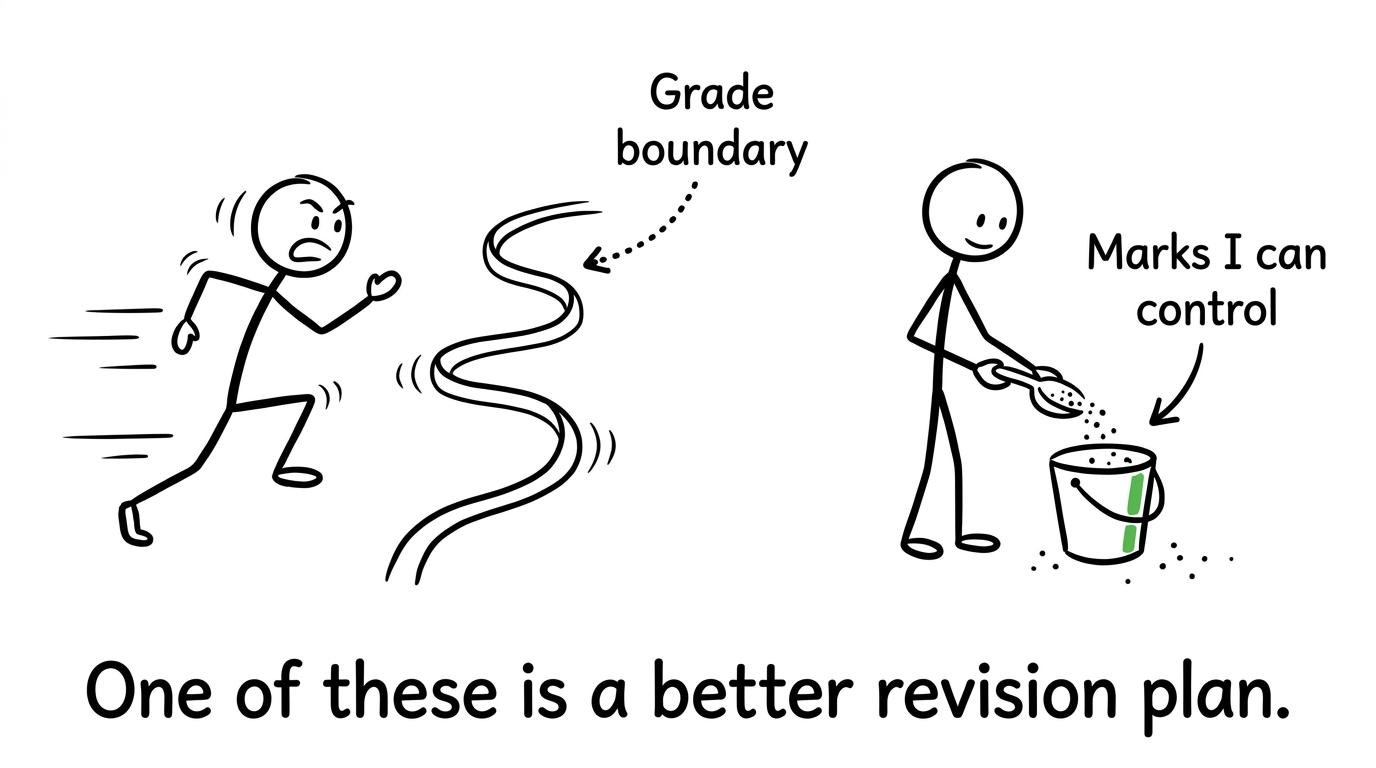 A student collects controllable marks while the boundary moves
Can you compare different exam boards?
You can compare percentages cautiously, but you should not use them to declare one board easier.
AQA offers both GCSE Sociology and GCSE Psychology. Eduqas offers GCSE Sociology, while Edexcel offers GCSE Psychology. OCR also offers GCSE Psychology. These qualifications differ in maximum marks, paper structures, question styles and specification content.
For example, Edexcel GCSE Psychology had a maximum of 180180180 marks in June 2025, whereas AQA Psychology had 200200200. Comparing raw marks alone would be meaningless. Even after converting them to percentages, a lower percentage may reflect a more demanding paper or different marking criteria.
There is another important distinction: Sociology and Psychology are not divided into foundation and higher tier. That terminology applies to subjects such as GCSE Maths. All candidates taking the same specification follow its common grading scale from 999 to 111.
For wider numerical practice, MathsGenie's GCSE Statistics revision resources can help you become more confident with percentages, averages and data interpretation.
How to use past boundaries productively
Past boundaries are useful when they support practice rather than replace it.
First, complete a full paper under timed conditions. Mark it strictly using the correct mark scheme, then total the marks from both papers before comparing the result with the overall subject boundary. Component boundaries published by exam boards are often notional: they illustrate performance on an individual paper but do not award a separate qualification grade.
Next, classify every lost mark:
- missing knowledge;
- weak application to the item or context;
- undeveloped evaluation;
- inaccurate terminology;
- research-method or numerical error;
- poor timing;
- misreading the command word.
Then revise the cause rather than celebrating or worrying about the estimated grade. MathsGenie's guide to using GCSE past papers properly explains the paper, mark, fix and retest cycle. For maths preparation, the main GCSE Maths revision hub provides board-specific lessons, questions and papers.
 A revision detective chooses evidence over highlighter vibes
Common mistakes when comparing grade boundaries
Calling the lower boundary more generous
This ignores paper difficulty. A lower boundary can be evidence that students found the assessment harder.
Comparing raw marks with different maximum totals
A boundary of 120120120 out of 180180180 is not directly comparable with 120120120 out of 200200200. Convert both to percentages first.
Mixing exam boards or examination series
Always check the qualification code, board and year. AQA, Edexcel, OCR and Eduqas use different specifications and assessment structures.
Treating paper boundaries as final grades
Your qualification grade is normally based on the combined subject total. Notional component boundaries are guides, not separately awarded grades.
Revising towards the exact historical boundary
Boundaries move. Build a buffer and measure consistency across several papers rather than relying on one successful attempt.
Choosing a subject from one table
Your likely performance depends on far more than the boundary: interest in the content, memory, evaluation, application, research methods, written fluency and willingness to practise all matter.
The better question to ask
In the 2025 AQA comparison, Sociology had lower top-grade boundaries, while Psychology had lower boundaries across much of the middle of the scale. In 2024, the pattern was different again. There is no permanent winner.
Choose the subject whose content and assessment style fit you. Then stop trying to predict a moving line and start collecting the marks within your control.
MathsGenie makes that process easier. Use the free Sociology and Psychology revision lessons, practice questions, past papers and mark schemes for your subject. Alongside them, use MathsGenie's maths revision planner, mini tests, predicted papers and video solutions to strengthen the numerical skills that support Psychology research methods and your GCSE Maths exams.
Pick one paper, complete it honestly, mark it carefully and turn every lost mark into your next revision task. Boundaries move. Better preparation travels with you.