

GCSE Sociology Revision Timetable: Is It Worth It?
GCSE sociology revision timetable worth it? Learn when a written plan helps, when flexibility wins, and how to protect time for GCSE maths revision.
Revision timetables can create a peculiar kind of comfort. You colour the boxes, assign every topic and briefly feel as though the work is already under control. Then Tuesday changes, one session is missed and the whole plan begins to look like evidence against you.
So, is a GCSE sociology revision timetable worth it? Usually, yes, but only if it helps you start, revisit material and test yourself. A timetable does not improve results merely by existing. A flexible weekly plan can work just as well as a detailed written schedule, provided it turns intentions into effective revision and adapts to what you are getting wrong.
That distinction matters when sociology is competing with maths, English and science for the same limited evenings.
The short answer: timetable or flexible revision?
Use a written timetable if you often postpone revision, forget topics or give too much time to your favourite subjects. Use a flexible weekly task list if fixed times make you anxious or your commitments change frequently.
Whichever format you choose, keep this checklist:
- List the content from your own exam board specification.
- Give each session one specific outcome.
- revisit topics across several days or weeks.
- Include self-testing and exam-question practice.
- Protect time for every subject, including GCSE maths.
- Review the plan weekly rather than treating it as permanent.
- Leave empty space for rest, schoolwork and missed sessions.
The timetable is the container. Retrieval, practice, feedback and repeated review are what go inside it.
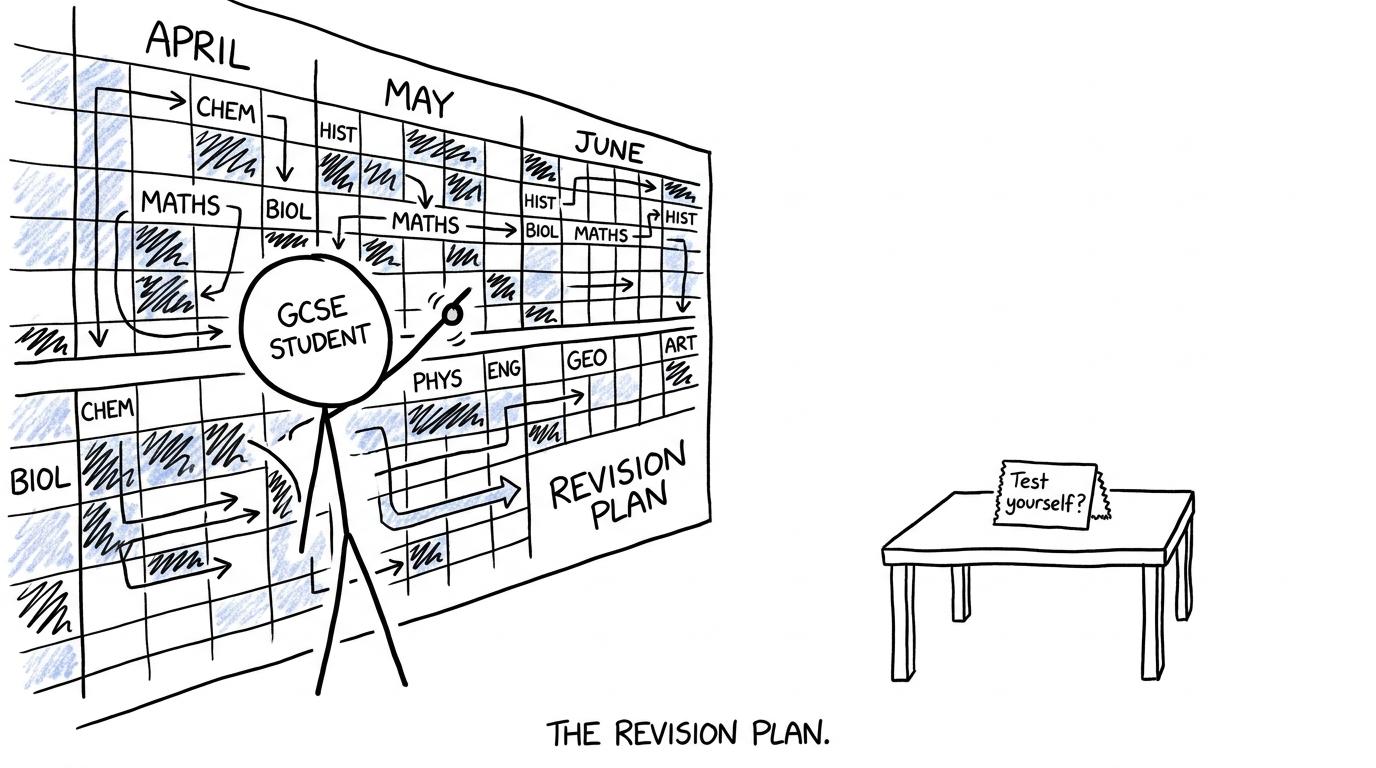 A student discovers that designing a giant timetable is not the same as testing themselves
What a revision timetable can actually change
There is good reason to plan. Government exam-pressure guidance recommends breaking revision into manageable topics, setting time-limited targets, testing learning and reviewing progress. Evidence-informed guidance from the Education Endowment Foundation similarly emphasises planning, monitoring and evaluating learning as parts of self-regulated revision.
Research on learning techniques gives an important qualification. Practice testing and distributed practice, spreading learning over time, have much stronger support than passive rereading or highlighting alone. A timetable can make distributed practice easier because it reminds you to return to families, education or research methods after the first session.
However, the evidence does not mean that drawing a grid independently causes higher grades. A beautiful schedule filled with passive tasks may be less useful than a rough weekly list filled with recall, timed writing and corrections.
A plan can improve the conditions around revision by:
- reducing the daily decision about what to do;
- making neglected topics visible;
- spreading practice instead of leaving everything until the end;
- balancing sociology with maths and other GCSE subjects;
- creating a moment to check whether revision is working.
Its value is behavioural. It helps the right work happen more consistently.
Why GCSE Sociology needs more than a list of topics
Sociology revision can appear straightforward because much of the course can be arranged under recognisable headings. Yet knowing the headings is not the same as being ready to answer an examination question.
Your plan must reflect your specification. For example, AQA GCSE Sociology has two written papers. Each lasts 111 hour 454545 minutes, carries 100100100 marks and contributes 50%50\%50% of the qualification. Across the qualification, AO1 knowledge and understanding accounts for approximately 40%40\%40%, AO2 application for 40%40\%40%, and AO3 analysis and evaluation for 20%20\%20%.
Eduqas also assesses GCSE Sociology through two written components, each lasting 111 hour 454545 minutes and contributing 50%50\%50%. Its content organisation and question demands are not identical to AQA's, so do not build a timetable from somebody else's social-media checklist without checking your board.
This means a useful sociology session should name both content and skill. “Revise education” is vague. “Recall explanations of educational achievement, then plan an applied extended response” gives you a visible finish line.
A balanced rotation might include:
- recalling concepts, studies and perspectives without notes;
- applying knowledge to an item or social context;
- comparing explanations;
- planning extended responses;
- writing selected answers under time pressure;
- checking work against a mark scheme or teacher feedback;
- revisiting research methods within substantive topics.
The timetable should train what the assessment asks you to do, not merely record which chapter you opened.
Written timetables work best when they stay flexible
A rigid timetable assumes that energy, homework and life will behave predictably. They rarely do. The answer is not to abandon planning, but to plan at the right level of detail.
Start with a weekly framework
Decide which subjects need attention on which days, but choose the precise task during a short weekly review. This prevents you from trying to predict every weakness several weeks in advance.
For example, reserve one sociology block for knowledge retrieval and another for exam practice. Reserve separate blocks for maths topic work and a timed paper section. Add a catch-up space that can absorb a missed task without pushing the whole schedule backwards.
For the maths side of your plan, the GCSE maths revision hub lets you select the correct exam board and move between revision lessons, questions and papers. That removes one of revision's quietest time-wasters: searching for the next resource after the session has begun.
Plan outputs, not just time
Writing “sociology” or “maths” in a box records attendance, not learning. Give each block an outcome you can check.
A sociology outcome could be a completed recall grid, an essay plan or a marked response. A maths outcome could be a completed mini test, a corrected question set or a list of two methods that need reteaching.
MathsGenie's guide to finding your weakest GCSE topics shows how evidence from marked work can shape the next session. The same principle transfers to sociology: let errors, not mood, determine priorities.
Build in repeated contact
Do not schedule a topic once and declare it finished. Return to it later with less support. The first session might rebuild knowledge, the next might require recall, and a later session might apply it in an examination response.
That is where a timetable earns its keep. Memory fades quietly. A planned return makes the fading visible before the examination does.
When flexible revision works just as well
Some students interpret a missed timetable box as failure. If that leads to abandoning the week, a fixed schedule has stopped being useful.
A flexible system can instead use three lists:
- Must do: urgent weaknesses or approaching assessments.
- Should do: important maintenance and repeated retrieval.
- Could do: extra practice if time and energy remain.
You then choose the highest-priority task that fits the available period. The plan still has structure, but it does not depend on completing “crime and deviance at precisely Tuesday evening”.
Flexible revision is effective when it retains four controls: coverage, spacing, active practice and review. Without those controls, “being flexible” can become repeatedly choosing the easiest task.
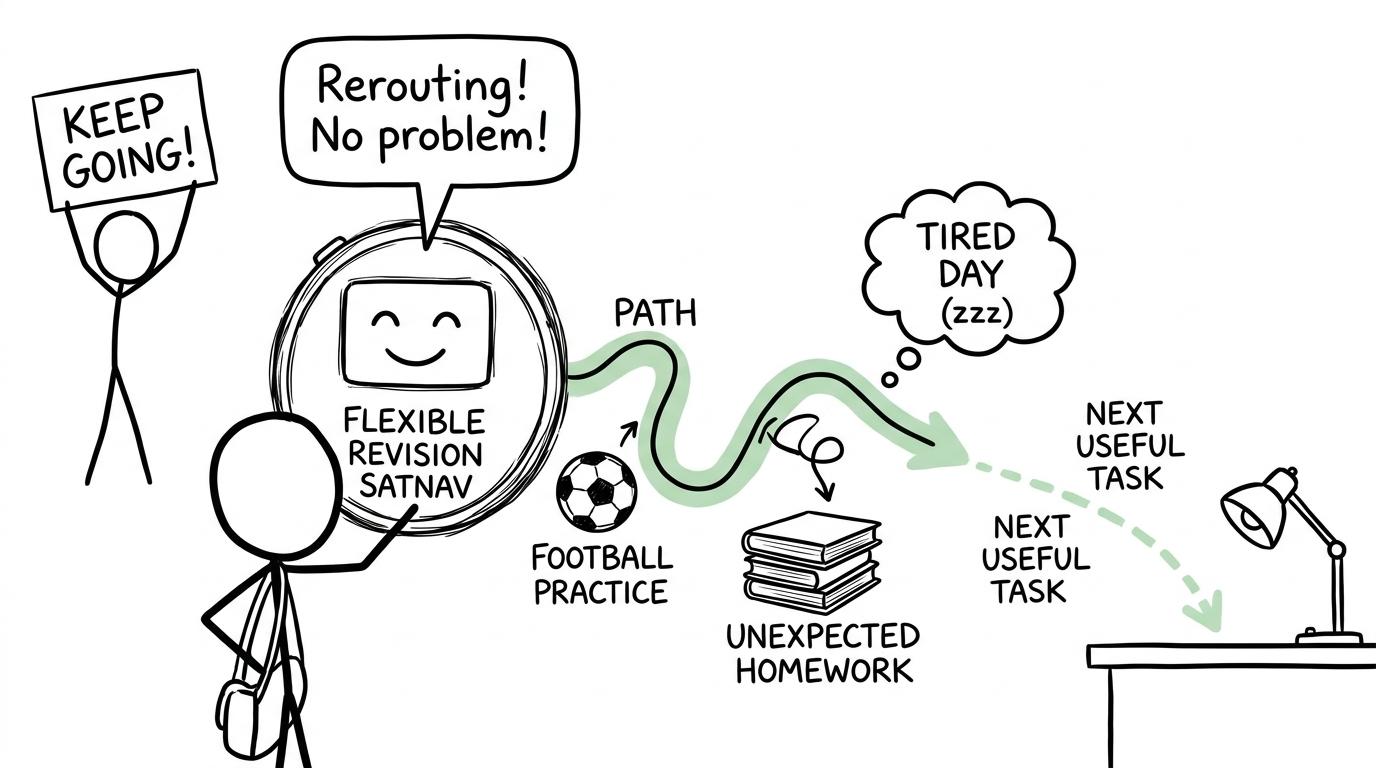 A revision satnav calmly reroutes around real life without abandoning the destination
Protecting GCSE maths inside a sociology timetable
A sociology plan cannot be judged in isolation. Every extra hour allocated to one subject comes from somewhere else, and maths improves through repeated practice rather than occasional heroic sessions.
Start by checking your maths tier and board. Foundation and higher tier students should practise material appropriate to their entry, while Edexcel, AQA, OCR and Eduqas papers should be matched to the relevant specification and format.
The GCSE maths revision timetable guide offers a practical framework for combining topic work, marking and timed practice. If exams are close, the one-month GCSE maths revision plan can provide a shorter planning horizon.
A reliable maths session has a simple rhythm:
- identify one weak skill;
- use a revision lesson to restore understanding;
- complete practice questions;
- mark the work honestly;
- correct the specific error;
- retest it on another day.
Short assessments are useful when sociology or another subject has already taken much of the evening. The Edexcel GCSE maths mini tests provide focused practice without requiring a full paper.
Longer sessions should gradually introduce timed papers. Students following Edexcel can use the Edexcel GCSE maths past papers, while OCR students can select from the OCR GCSE maths past papers. Choose the paper matching your tier and use its mark scheme rather than judging performance by how familiar the questions felt.
How to tell whether your timetable is working
Do not measure success by the number of coloured boxes completed. Look for evidence of learning.
At the end of each week, ask:
- Can I recall more without looking at notes?
- Can I apply sociology knowledge to unfamiliar items?
- Are my extended responses becoming more focused?
- Which feedback appears repeatedly?
- Am I losing fewer maths marks on the same skills?
- Did I revisit older material?
- Is the workload sustainable?
If the answers are mostly no, change the tasks before adding more hours. If the plan is repeatedly disrupted, reduce its detail or shorten the sessions. A timetable should adapt to evidence in the same way a satnav adapts to a closed road: the destination remains, but the route changes.
For maths papers, MathsGenie's guide to using GCSE past papers properly explains the paper, mark, fix and retest cycle. That cycle is more informative than simply collecting raw marks.
Common revision timetable mistakes
Spending too long making the plan
A timetable should remove friction, not become a creative project. Keep the design plain and use the saved time for retrieval or questions.
Filling every available hour
Plans fail when they assume perfect energy and no unexpected homework. Include breaks, sleep, existing commitments and catch-up space.
Scheduling subjects rather than tasks
“Maths” and “sociology” are too broad. Name the topic, skill and intended output so that starting requires less thought.
Treating reading as proof of learning
Recognition can feel like knowledge. Close the book, retrieve what you know, answer questions and check the result.
Refusing to change the timetable
A weak topic may need another session; a secure one may need less. Updating the plan is not cheating. It is evidence that you are monitoring your learning.
Completing papers without reviewing them
A paper identifies weaknesses, but the improvement happens afterwards. Use mark schemes, corrections and another attempt. MathsGenie's past-paper library brings papers and official mark schemes together so that feedback becomes part of the session rather than an optional extra.
The timetable is a tool, not a promise
A GCSE sociology revision timetable is worth making when it helps you cover the specification, spread revision and practise the skills that earn marks. A flexible weekly plan can be equally effective if it preserves those same principles. What matters is not whether the plan is handwritten, digital or held together with sticky notes. What matters is what you repeatedly do because of it.
Keep sociology specific: retrieve knowledge, apply it, evaluate explanations and practise responses. Keep maths active: learn, practise, mark, correct and retest.
To organise the maths part of your GCSE plan, begin with the MathsGenie GCSE maths revision hub. Choose your exam board and tier, then combine free revision lessons and practice questions with mini tests, past papers, predicted papers, mark schemes and video solutions. Build a plan that can survive real life, and let every completed session tell you what to do next.










