GCSE Sociology Revision Book Reviews: Buying Guide
GCSE sociology revision book reviews only help if you know what to check. Compare exam-board coverage, questions, answers and usability before buying.
A revision guide can look reassuring long before it becomes useful. The cover promises complete coverage. Online ratings glow. Then you open it during revision and discover that the explanations are too brief, the questions do not resemble your exam, or the book was written for a different specification.
That is why reading GCSE sociology revision book reviews before buying is worthwhile, but star ratings alone are not enough. The best guide is one that matches your exam board, covers the current specification, explains the required knowledge clearly and helps you practise applying and evaluating sociology. Check those things directly before spending money.
For students balancing sociology with GCSE maths, this decision matters more than it may seem. Every unsuitable resource costs money, but it also consumes revision time that could have been spent answering questions, reviewing mistakes or using a free resource such as the MathsGenie GCSE Sociology revision hub.
Your pre-purchase checklist
Before buying a GCSE Sociology revision book, check:
- the exam board and exact qualification;
- the specification or publication date;
- whether every required topic is covered;
- whether research methods are integrated appropriately;
- the balance between knowledge, application and evaluation;
- the quantity and style of exam questions;
- whether answers, mark guidance or model responses are included;
- the readability of sample pages;
- whether the book complements resources you already have;
- what detailed reviews say about specific strengths and weaknesses.
A book does not need to do everything. It does need to do the job you are buying it to do.
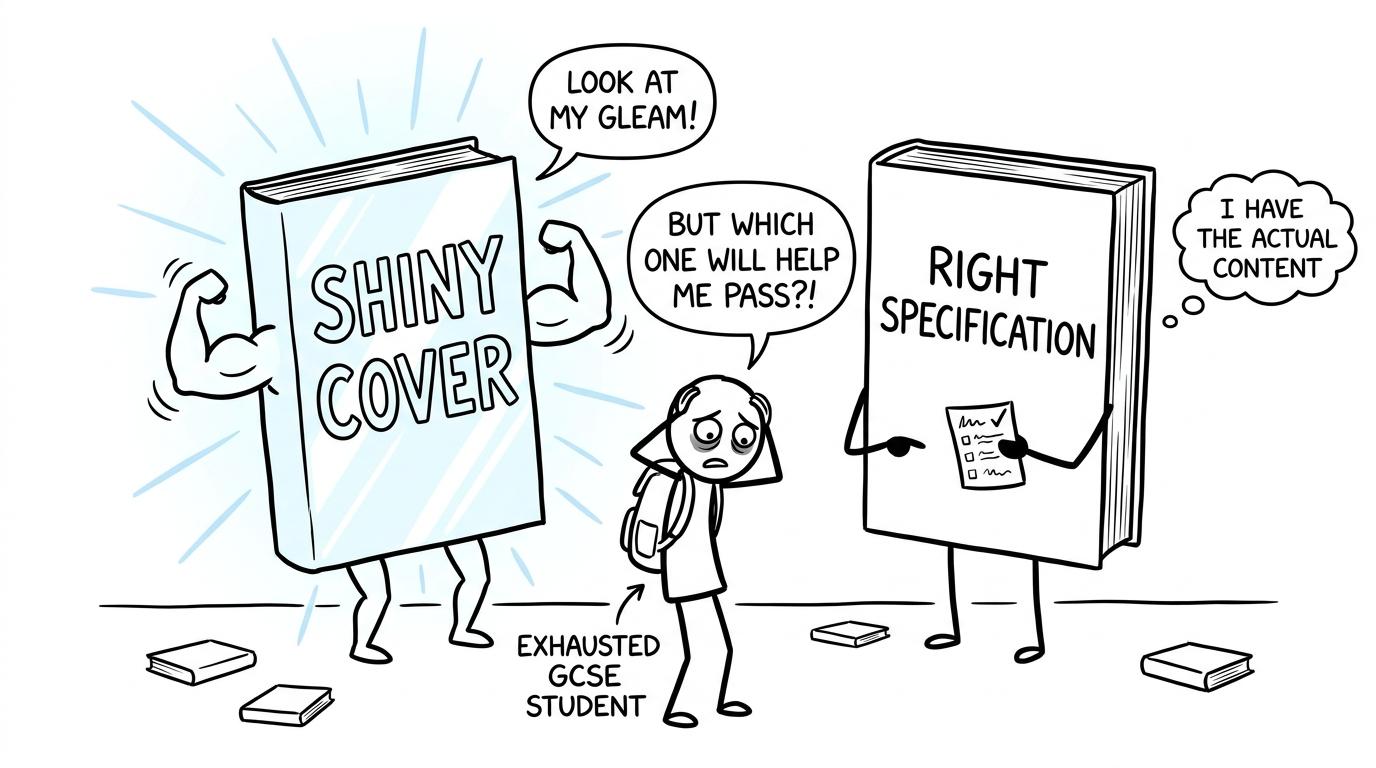 A student choosing between a shiny book and the correct specification
Begin with the exam board, not the rating
The most important detail is printed less dramatically than any star rating: the exam board.
GCSE Sociology courses offered by AQA and Eduqas are not interchangeable. They share broad sociological concerns, but their specifications organise content and assessments differently. AQA GCSE Sociology is qualification 819281928192. It assesses families and education in Paper 1, then crime and deviance and social stratification in Paper 2. Both written papers are worth half of the qualification.
Eduqas uses two components titled Understanding Social Processes and Understanding Social Structures. Its organisation and question structure differ from AQA. You can compare the relevant resources through the AQA GCSE Sociology revision page and Eduqas GCSE Sociology revision page.
Do not assume that a book labelled simply “GCSE Sociology” matches your course. Look for the exam-board name, qualification details and a contents page that maps clearly onto your specification. Ask your teacher if you are uncertain.
Unlike GCSE maths, GCSE Sociology is not divided into foundation and higher tiers. A Sociology guide advertising itself with foundation or higher language would therefore deserve careful scrutiny. In maths, however, choosing the right tier is essential; the GCSE maths revision hub lets students choose resources appropriate to their board and course.
Check whether the book teaches the assessed skills
A thin summary of theories may help with recall, but GCSE Sociology is not assessed through recall alone.
Ofqual’s assessment objectives require students to demonstrate knowledge and understanding, apply that knowledge, and analyse and evaluate theories, evidence and methods. Research methods must also form a meaningful part of the assessment. A useful guide should therefore help you move through three distinct kinds of thinking:
- Knowledge: Can you define the concept and explain the theory or evidence accurately?
- Application: Can you connect that knowledge to the source, issue or context in the question?
- Analysis and evaluation: Can you develop an argument, consider limitations and reach a supported judgement?
Read a sample spread. If every page consists of compressed bullet points followed by simple recall questions, the guide may be useful as a quick reference but insufficient as your main revision tool. Conversely, a book containing long model essays without accessible explanations may be difficult to use when you are still building knowledge.
The strongest guide usually makes the relationship between content and exam performance visible. It should show not merely what sociologists argued, but how that material can be selected and developed in response to different command words.
Inspect the questions and answers
A revision guide earns its place when it makes you retrieve knowledge rather than merely recognise it.
Look for a mixture of short-answer, source-based and extended-response tasks suited to your board. Questions should cover the whole course instead of repeatedly testing the easiest definitions. Research methods should not be treated as an isolated afterthought if your specification assesses them within sociological contexts.
Answers matter just as much. Check whether the book includes:
- complete answers rather than unexplained final statements;
- mark guidance connected to the question asked;
- examples of application and evaluation;
- support for planning longer responses;
- clear distinctions between acceptable and strong answers.
A page of questions with no usable feedback can create activity without much learning. You finish the task, but you do not know what to improve.
This principle also applies to maths. MathsGenie combines revision lessons with practice questions, mark schemes and video solutions because an attempt becomes valuable when you can diagnose the error afterwards. The MathsGenie resources collection includes mini tests, papers and other structured practice for building that feedback loop.
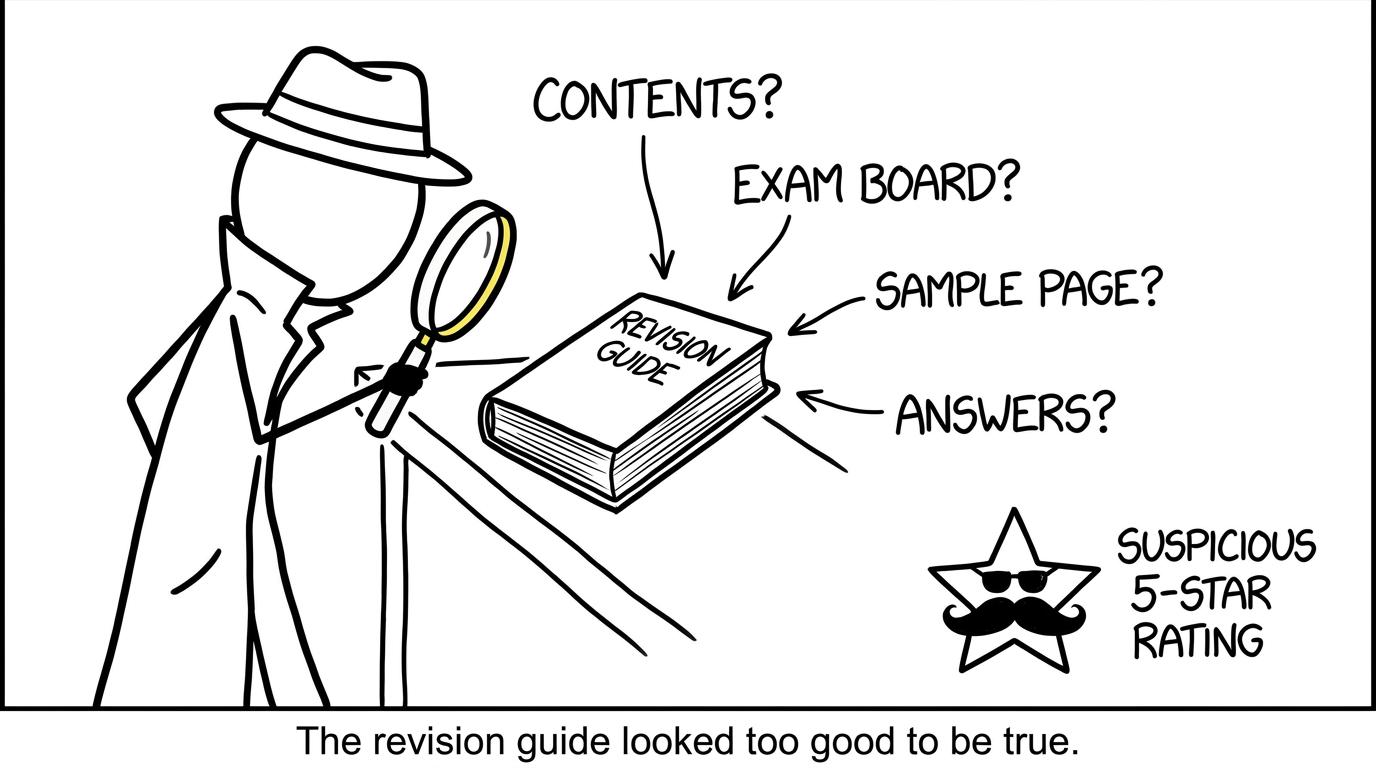 A revision-guide detective investigating contents and answers
Read the sample pages like a student, not a shopper
Shopping encourages quick judgements. Revision demands slower ones.
Do not ask only, “Does this page look attractive?” Ask whether you could learn from it on a tired Tuesday evening. Read one explanation of an unfamiliar idea and then close the sample. Can you reconstruct its main argument? Can you distinguish the theory from its criticism? Do headings, diagrams and summaries clarify the material, or simply decorate it?
Useful design is personal. Some students need generous spacing and short sections. Others prefer denser explanations that preserve nuance. Colour can help organise perspectives, but colour is not evidence of quality. A visually plain book may be excellent; a beautiful book may reduce complex debates to slogans.
Also inspect the index and contents page. You should be able to find a particular concept, sociologist, study or research method quickly. During revision, search time is hidden waste.
Look beyond average star ratings
A high average can conceal the information you need. Reviews may refer to delivery speed, physical condition or price rather than academic quality. Some may have been written before the reviewer used the book for an entire course.
When reading GCSE sociology revision book reviews, prioritise comments that answer specific questions:
- Which exam board and specification did the reviewer take?
- Were any required topics missing or too brief?
- Did the questions resemble the relevant assessment style?
- Were the answers detailed enough for self-marking?
- Did the guide work for independent revision?
- Were there factual errors or confusing explanations?
- Did the reviewer describe actual features rather than general satisfaction?
Read a spread of positive, mixed and critical reviews. Repeated observations are more informative than one dramatic complaint or one enthusiastic sentence. Treat reviews as clues, then verify those clues against the contents page, sample pages and official specification.
Decide what role the book will play
Many disappointing purchases begin with an undefined expectation. One student wants a complete course explanation; another needs condensed notes for the final month; a third mainly wants exam questions. The same book can be helpful for one and unsuitable for another.
Choose its intended role before buying:
A teaching guide
This needs clear explanations, examples of sociological reasoning and enough depth to introduce material you do not yet understand.
A concise revision guide
This should condense the course accurately, organise key theories and evidence, and make quick retrieval manageable. It may not replace lessons or a fuller textbook.
A practice workbook
This needs abundant board-appropriate questions and useful answers. Large empty answer spaces are not valuable unless the questions and feedback are strong.
A final reference book
This should make facts, terms, perspectives and methods easy to locate. Portability and organisation may matter more than extended prose.
First check what your school already provides. A second book that duplicates your class notes may add less value than free question practice or a different format. Maths students can apply the same logic by using revision lessons and active-recall techniques before deciding whether another printed guide fills a genuine gap.
Test whether the guide supports active revision
Owning a book feels like progress because it is visible. Learning is less visible. It happens when you attempt to remember, apply, check and improve.
A useful Sociology guide should support a repeatable cycle:
- read a short section with a clear purpose;
- close the book and retrieve the main concepts;
- answer a relevant question;
- check the response against guidance;
- record the missing knowledge or weak reasoning;
- revisit the topic later without notes.
You can test this cycle with one sample chapter before purchasing. If the book is only comfortable to read, it may become a source of passive familiarity. Familiar words can create the feeling of knowledge without proving that you can produce an answer independently.
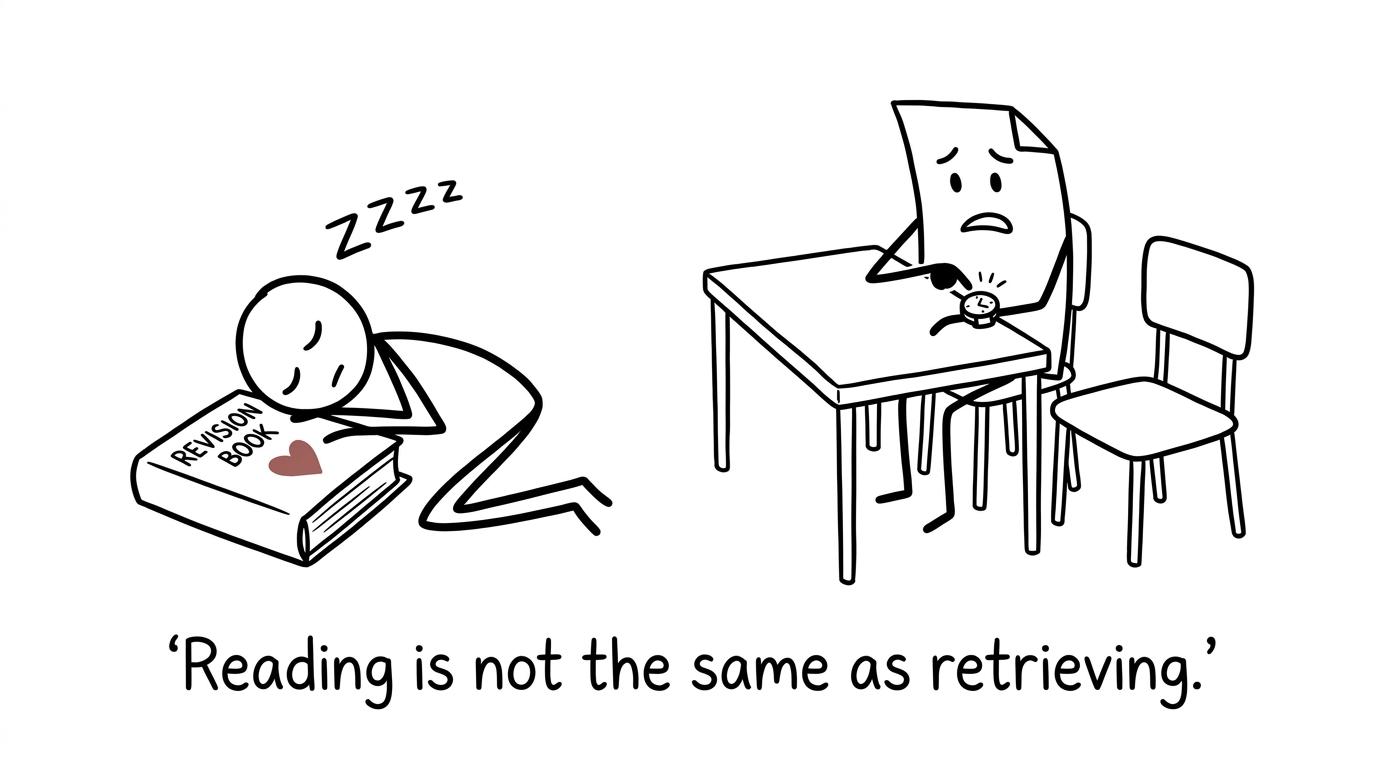 A revision book acting as a pillow while the exam waits
The same distinction is vital in GCSE maths. Watching a method or reading a solution is the beginning, not the end. Use questions to reveal what you can do without support. MathsGenie’s guide to finding your weakest GCSE topics explains how diagnostic practice can turn vague worry into a focused revision list.
Common mistakes when choosing a revision guide
Buying for the wrong specification
A respected publisher cannot rescue a mismatch. Confirm the board, qualification and current course before paying.
Treating “complete” as a verified fact
Compare the contents page with the specification. Marketing language is not a curriculum checklist.
Judging the book by its thickness
A long book may contain useful depth or unnecessary repetition. A short one may be efficient or incomplete. Inspect actual coverage.
Ignoring the answer section
Questions without instructive answers are difficult to use independently. Look at the feedback before looking at the number of exercises.
Choosing only from the average rating
The average does not reveal whether a guide suits your board, learning style or intended use. Detailed, board-specific comments matter more.
Expecting one resource to carry the whole course
Books are references, not revision plans. Combine explanation with retrieval, timed responses, past papers and careful marking. Maths students can use the one-month GCSE maths revision plan to see how different resource types can fit into a realistic schedule.
Continuing to reread after understanding
Once the idea is clear, move to independent recall and exam practice. Revision should gradually become less supported.
Make the purchase only after a short trial
If sample pages are available, spend ten focused minutes using them. Read one section, close it, write down what you remember and inspect one question with its answer guidance. This reveals more than scrolling through dozens of ratings.
Then make a simple decision. Buy the guide if it matches your specification, fills a real gap and supports the kind of practice you need. Borrow it, buy it second-hand where appropriate, or skip it if your existing resources already cover the same role. The goal is not to own the most revision material. It is to remove the next obstacle to useful practice.
Choose evidence over reassurance
Yes, it is worth reviewing a GCSE Sociology book before buying it. But the review process should extend beyond stars. Confirm the exam board, map the contents against the specification, inspect sample explanations, assess the question quality and decide exactly how the guide will fit into your revision routine.
Then use it actively. Recall before rereading. Answer before checking. Turn every mistake into a next step.
For free support, begin with MathsGenie’s GCSE Sociology resources. If maths is your immediate priority, open the GCSE maths revision hub and combine revision lessons, practice questions and video solutions with mini tests, past papers, predicted papers and mark schemes. A good resource should not merely sit on your desk. It should help you decide what to do next.