

GCSE Sociology Results Day Wrong Grade: What Next?
GCSE sociology results day wrong grade? Learn what to do in the first hour, how marking reviews work, and which risks and deadlines to check first.
Results day can change mood in a single line. You open the envelope expecting one grade and find another. It may be lower than your mock result, your predicted grade or the standard your teacher thought you were reaching.
If you are searching for GCSE sociology results day wrong grade advice, the immediate answer is this: do not assume that an unexpected grade is automatically incorrect, but do speak to your sociology teacher or exams officer before leaving school. Ask for your overall mark, component marks, the official grade boundary and information about accessing your marked scripts.
A predicted grade is an estimate. Your awarded grade comes from the marks credited in the live assessment and the boundary for that examination series. Yet genuine administrative or marking errors can occur, which is why formal post-results services exist.
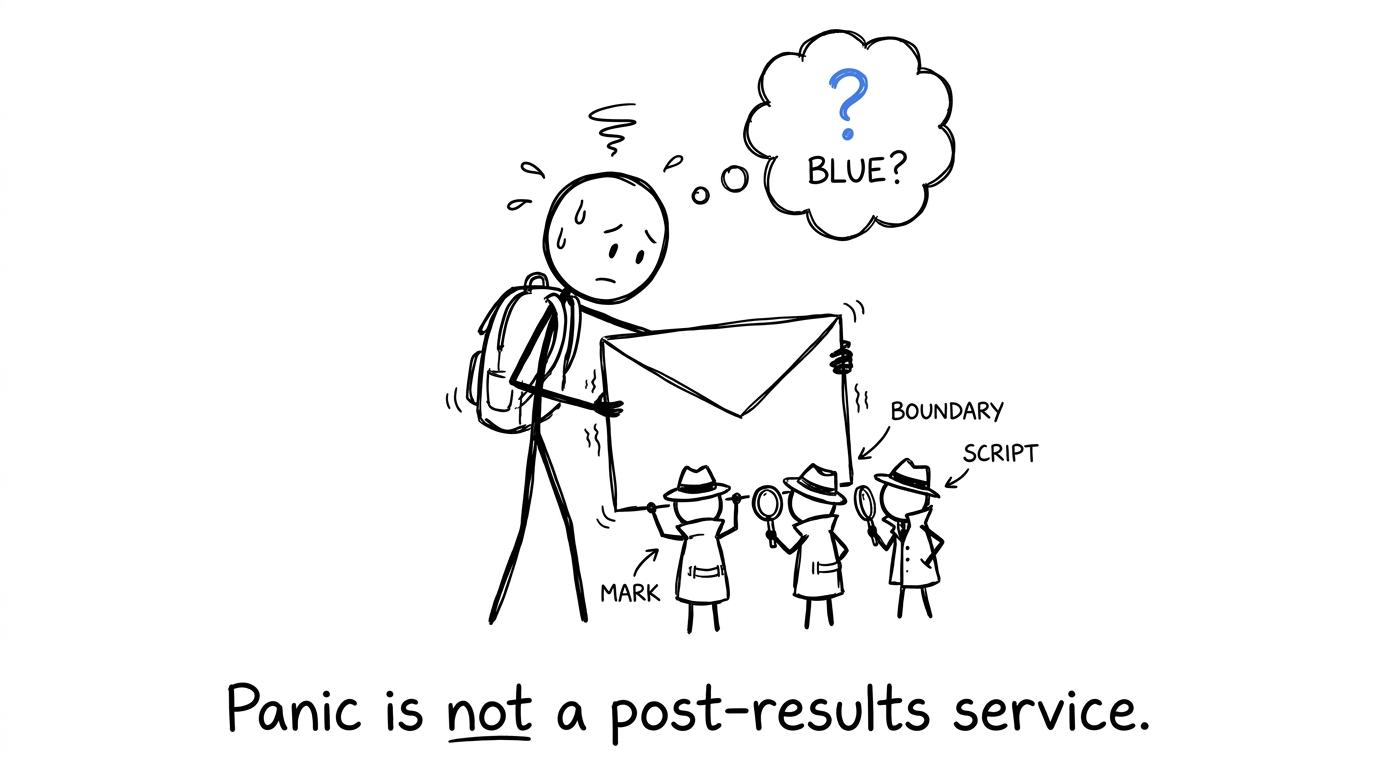 Stick-figure detectives investigating a surprising GCSE result
Your results-day checklist
In the first hour:
- Check that the result belongs to the correct subject, specification and exam board.
- Ask for your total mark and marks for each sociology paper or component.
- Find the official grade boundary for your exact qualification and examination series.
- Tell your sociology teacher why the result appears unusual.
- Ask whether your centre can obtain your marked scripts.
- Confirm your school’s internal deadline for post-results requests.
- Contact your sixth form or college if the grade affects your place.
- Do not submit or authorise a review until you understand that your mark can rise, stay unchanged or fall.
The same evidence-first approach is useful when checking maths. MathsGenie’s guide to GCSE maths grade boundaries on results day explains why the correct board, tier and series matter.
What to do in the first hour
Read the result before reacting to it
Begin with the information actually printed on your results documentation. Check the subject title, qualification, awarding body and grade. If component marks are shown, keep a copy or take a clear photograph where your school permits it.
Do not compare your grade with a friend’s without checking whether you completed the same specification. Grade boundaries belong to a particular qualification and examination series. A boundary from another year, subject or board cannot establish that your result is wrong.
For summer 2026, GCSE results are released to candidates on Thursday 20 August. Post-results services become available from results day, but your school may set an earlier internal deadline than the awarding body so its exams team has time to process requests.
Find the marks behind the grade
A grade alone tells you the outcome, not where the marks were lost. Ask your teacher or exams officer for:
- your total subject mark;
- the mark for each examined component;
- the maximum available mark;
- the published grade boundary;
- the distance between your mark and the next boundary.
Being close to a boundary can make further investigation sensible, but it does not prove an error. Equally, being several marks away does not make an error impossible. The more useful question is whether a teacher can identify a credible marking or administrative issue.
This distinction matters in essay-based subjects. Sociology answers can involve levels-based marking and academic judgement. A review is not an opportunity to reward an answer simply because a different teacher might have been slightly more generous. It checks whether the original marking contained an error and whether the mark scheme was applied correctly.
Speak to the right person
Your first conversation should usually be with your sociology teacher, head of department or exams officer. Explain calmly:
- what grade you expected;
- what grade you received;
- whether one component looks particularly low;
- whether the result affects a sixth-form or college offer;
- whether there was an examination-day issue already reported to the centre.
Most students cannot send a review request directly to the exam board. The school or college normally submits it and must obtain your written consent after results have been published. Private candidates should contact the centre through which they entered, or follow the awarding body’s private-candidate arrangements.
Protect your next destination
If your sociology grade affects enrolment, contact the sixth form or college promptly. Give them the confirmed result and explain that you are discussing post-results options with your school. Ask what evidence they require and whether they can keep your application under consideration.
Do not promise that a grade will change. A review has no guaranteed outcome. The useful goal in the first hour is to keep communication open while gathering evidence.
Is the grade wrong or simply unexpected?
Mocks and predictions are valuable, but they answer a different question. A mock estimates likely performance, sometimes using a past paper and historical boundaries. The final grade reflects your live assessments and the boundaries set for that series.
A result may differ from your prediction because:
- the live questions suited you less well than the mock;
- timing affected one paper;
- an extended response did not meet the higher level descriptors;
- relevant knowledge was included but not applied directly to the question;
- the official boundary differed from the one used for school assessments;
- a mark was recorded, totalled or awarded incorrectly.
Only the final possibility points directly towards a post-results correction. That is why script evidence is more valuable than the feeling that the grade is surprising.
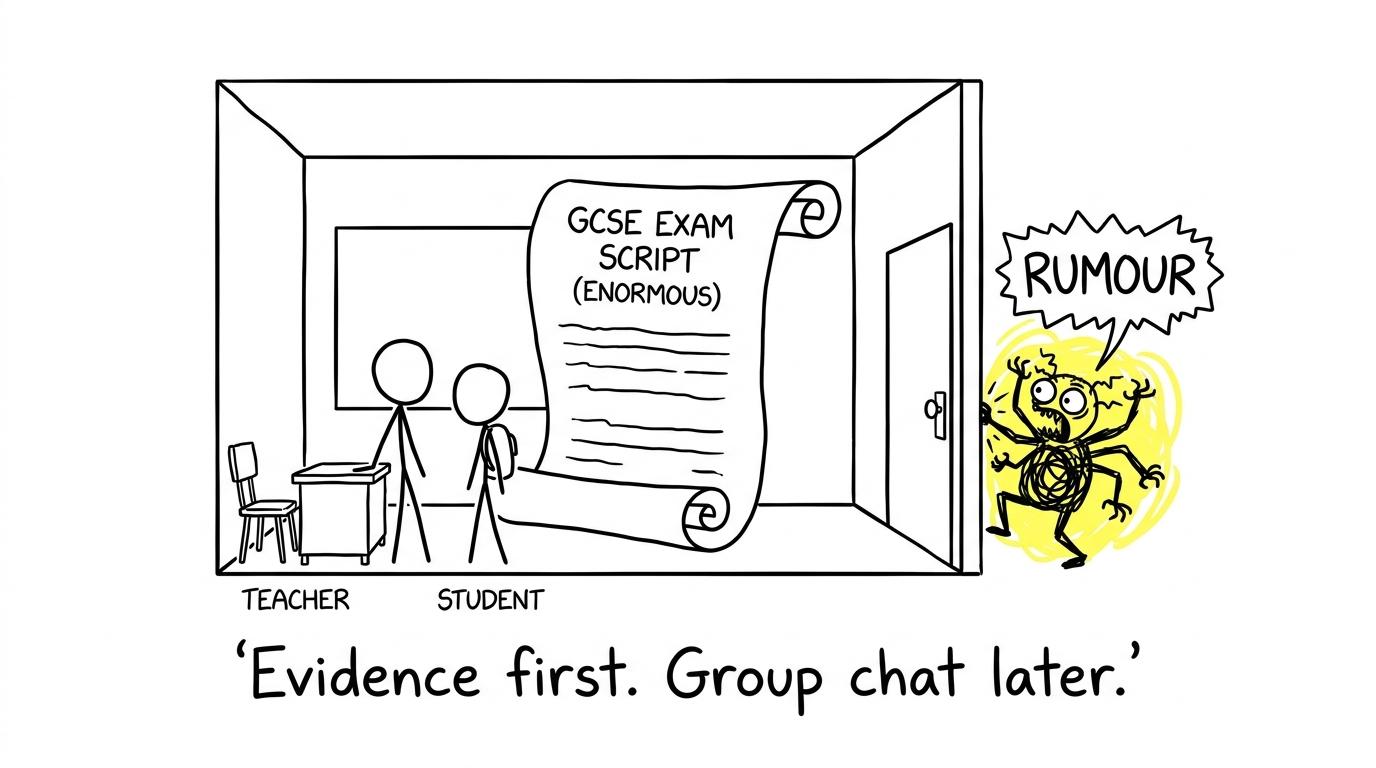 A student and teacher choosing evidence over results-day rumours
Understand the post-results options
Access to scripts
Access to Scripts allows your centre to obtain a copy of your marked examination paper. Your teacher can compare your responses with the mark scheme and consider whether there is a defensible reason to request a review.
This is often the most informative first step, especially for sociology essays. However, script-access deadlines vary by awarding body and can arrive before the final review deadline. Ask your exams officer for the dates and charges that apply to your board rather than relying on a date shared online.
Clerical re-check
A clerical re-check looks for administrative issues, such as whether all parts of the script were marked, marks were totalled correctly and the recorded mark matches the result. It does not reconsider the quality of an essay in the way a review of marking can.
Review of marking
A review of marking checks the original marking to ensure the mark scheme was applied correctly. Under JCQ rules, it is not a completely fresh re-mark. The reviewer considers the original decisions and corrects identified marking errors.
Your mark and grade can increase, remain unchanged or decrease. Written consent is therefore required. Fees also vary by awarding body and centre policy, although an exam board may waive its fee when the overall subject grade changes.
For the June 2026 series, the JCQ deadline for awarding bodies to receive standard reviews of results is Thursday 24 September 2026. Your school will probably require your decision earlier. Current procedures, fees and script deadlines should always be confirmed with its exams officer.
Appeal after a review
An appeal is not normally the first stage. If concerns remain after a review of marking, the school or college can consider an appeal on permitted grounds, including an alleged marking or procedural error. Students should follow their centre’s internal appeals process if the centre decides not to request a review.
Ofqual’s Examination Procedures Review Service is a later safeguard after the awarding body’s final appeal stage. It checks whether procedures and regulatory requirements were followed; Ofqual does not re-mark your work or directly change your grade.
How to decide whether a review is sensible
A calm decision uses three kinds of evidence:
- Boundary evidence: how far is the total mark from the next grade?
- Script evidence: can a teacher identify a question where the mark scheme may not have been applied correctly?
- Progression evidence: does the result affect a confirmed course requirement?
The strongest case is not simply, “I usually get a higher grade.” It is, “The marked script appears to contain a specific error that could affect the result.”
Ask whether one paper is the source of concern. Reviews are generally requested for individual components, so reviewing every paper may be unnecessary. Your exams officer can explain the available services for your exact entry.
Maths students can see the same decision process in the MathsGenie GCSE maths remark guide. Sociology marking involves different subject judgements, but the principles of checking component marks, scripts, consent and deadlines still apply.
Common mistakes on sociology results day
Treating a predicted grade as proof
A prediction can justify asking questions, but it cannot establish that the awarded grade is incorrect. Use it as context, then investigate the actual marks.
Looking at the wrong boundary
Check the precise exam board, qualification, specification and series. Do not use last year’s boundary or a figure circulated in a group chat.
Asking for an “appeal” immediately
The usual first formal steps are script access, a clerical re-check or a review of marking. An appeal generally follows a completed review rather than replacing it.
Forgetting that marks can go down
A review can lower a mark or grade. Read the consent information carefully and discuss the risk with your teacher.
Waiting until the published deadline
The exam board’s deadline is not necessarily your deadline. Schools need processing time and may close requests earlier.
Ignoring your next plan
Do not wait silently for a possible review outcome. Contact your intended sixth form or college and ask about alternatives, flexibility and enrolment arrangements.
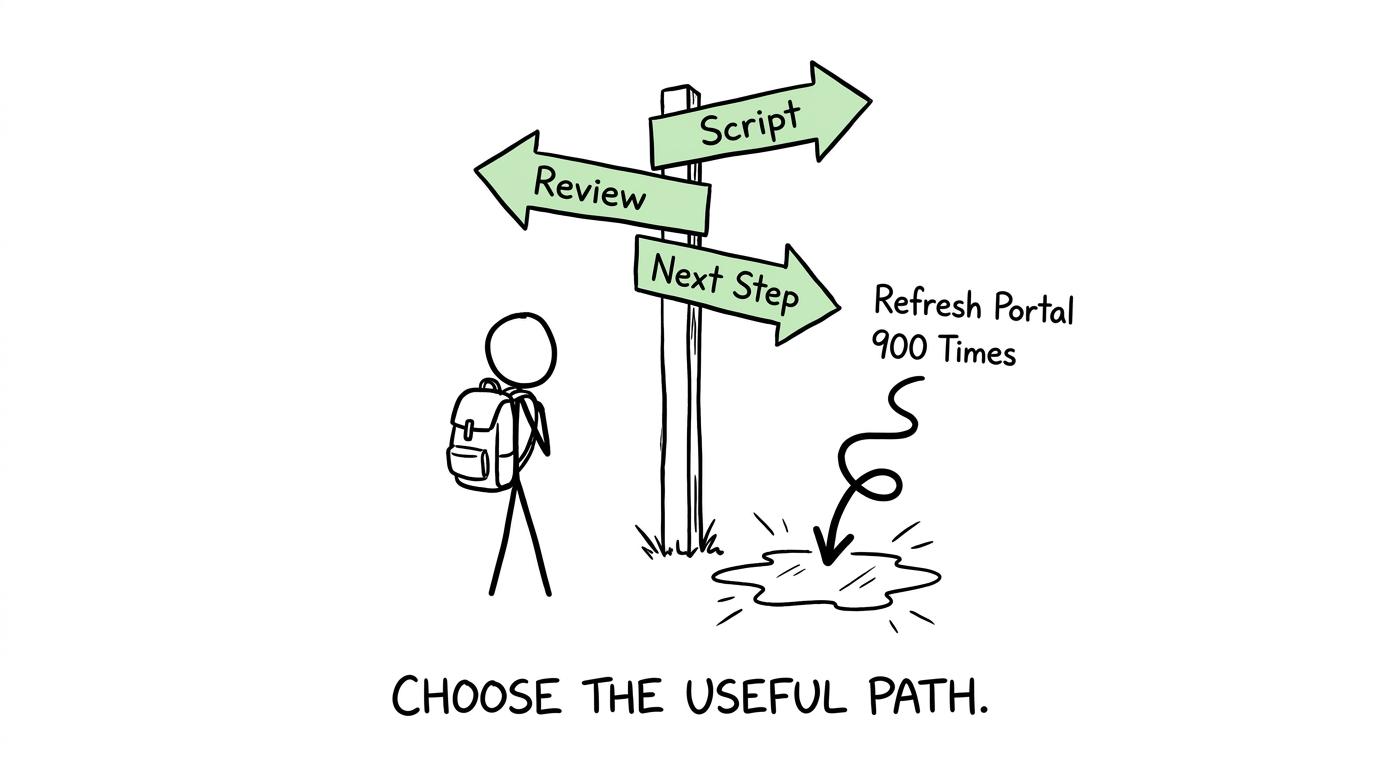 A student choosing useful post-results steps instead of refreshing a portal
Turn results-day evidence into better maths revision
A surprising sociology result can teach a broader lesson: improvement begins when a vague disappointment becomes specific evidence. The same is true in GCSE maths.
If maths is also a concern, start with the GCSE maths resit results-day plan. Then use Edexcel GCSE maths past papers, where applicable, to identify the topics and question types costing marks.
A productive revision cycle is simple: complete a paper, mark it carefully, classify each lost mark, revisit the relevant revision lesson and practise the skill again. MathsGenie’s one-month GCSE maths revision plan and GCSE maths revision timetable help turn that cycle into a manageable schedule.
Once your foundations are secure, Edexcel GCSE maths predicted papers can provide fresh exam-style practice. Predicted papers should supplement official past papers, not replace them.
Move from shock to evidence
An unexpected grade feels personal because it arrives as a judgement compressed into one character. But the next step is procedural, not emotional: check the entry, obtain the marks, compare the correct boundary, speak to your teacher and ask about the script.
If there is credible evidence of an error, your school can guide you through the appropriate post-results service. If the grade remains unchanged, you still have choices about courses, future qualifications and revision.
For maths, make MathsGenie’s free revision hub your next stop. Use revision lessons to rebuild weak methods, practice questions and mini tests to develop accuracy, then past papers and predicted papers with mark schemes and video solutions to prepare for the next exam with better evidence and fewer surprises.










