

GCSE Maths Remark: Process, Risks and Timing
GCSE maths remark explained: learn how reviews of marking work, check grade boundaries, weigh the risks and follow the correct results-day process in 2026.
Results day can compress months of work into one uncomfortable number. If your GCSE Maths grade is lower than expected, pause before assuming the marking is wrong. A GCSE maths remark, officially called a review of marking, may be sensible when you are close to a grade boundary and there is evidence of a marking error. It is not an automatic second chance, and your mark can rise, stay unchanged or fall.
The best first step is simple: speak to your maths teacher or exams officer, check your component marks against the published boundary, and ask whether the school can obtain your marked scripts.
GCSE maths remark decision checklist
Before requesting a review, ask:
- How many marks am I below the next overall grade boundary?
- Which paper appears unexpectedly low?
- Has a maths teacher examined the marked script and mark scheme?
- Is there evidence that working, method marks or an answer were overlooked?
- Would a higher grade affect sixth-form entry, a course requirement or another important decision?
- Do I understand that my mark and grade could go down?
- What are my school's earlier internal deadline and the exam board's fee?
You can find current and historical figures in the GCSE grade boundaries hub. Always use the boundary for your exact exam board, tier and series.
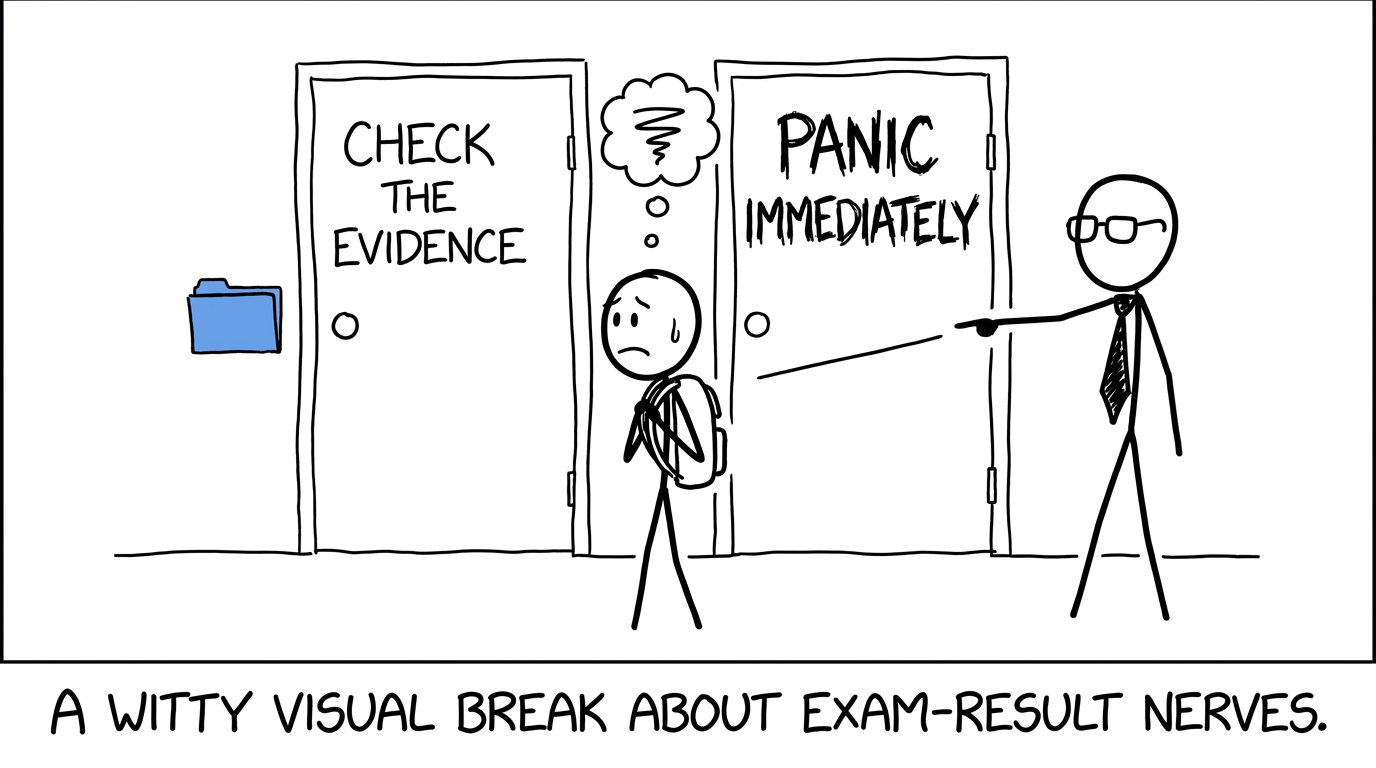 A student choosing evidence instead of panic on results day
How the GCSE maths re-mark process actually works
The word “remark” is widely used, but it creates the wrong picture. In a review of marking, an independent reviewer checks whether the original mark scheme was applied correctly. The paper is not marked afresh without reference to the original decisions.
For GCSE Maths, post-results services normally include:
- Administrative error review, or Service 1: checks that every question was marked and that marks were totalled and recorded correctly.
- Review of marking, or Service 2: checks the application of the mark scheme and includes the administrative checks if they have not already been completed.
- Access to scripts: allows the school to obtain the marked paper, often before deciding whether a review is justified.
Maths may appear completely objective, but some decisions still require care. A reviewer might need to decide whether your algebraic working earns a method mark, whether subsequent work follows correctly from an earlier error, or whether a response is equivalent to an answer allowed by the mark scheme.
The step-by-step process
- Collect your results information. Ask for your overall mark, the mark for each paper and the relevant grade boundary.
- Identify the paper causing concern. A review is requested by component, so you do not necessarily need every paper reviewed.
- Request access to the script. Your teacher can compare your working with the official mark scheme and look for a credible error.
- Discuss the evidence. Being 111 mark below a boundary makes a review relevant, but it does not prove that a mark was missed.
- Give written consent. The school must explain that the result can go down as well as up. Candidate consent is required after results are published.
- Let the centre submit the request. Most students apply through their school or college. Private candidates should contact their entering centre or follow their awarding body's instructions.
- Wait for the outcome. A standard review should normally be completed within 202020 calendar days of the exam board receiving it.
The exam board sends the decision to your centre. Your overall grade changes only if the revised total crosses a subject grade boundary.
When should you request a review?
A review is most convincing when evidence and consequences point in the same direction. For example, your teacher may identify uncredited valid working on a particular paper, while the additional mark could move your total across the next boundary.
It may also deserve prompt attention if a grade affects your sixth-form place. Tell the sixth form that a review is pending rather than waiting silently.
A review is less compelling when:
- you are several marks from the next boundary;
- your paper has been checked and no plausible marking error is visible;
- the request is based only on a mock grade or how the exam felt;
- gaining marks on one paper would still leave the overall grade unchanged.
Your mock results are useful context, not proof. If you want to understand how totals compare with boundaries, MathsGenie's GCSE Maths revision hub brings exam-board resources together. Edexcel students can also read the detailed Edexcel grade boundaries guide.
GCSE review deadlines for 2026
GCSE results are released to candidates on 20 August 2026. Under the published JCQ timetable, awarding bodies must receive standard June 2026 reviews of results by 24 September 2026. A standard review is expected within 202020 calendar days, while an administrative check is expected within 101010.
Your school will probably set an earlier deadline so its exams officer can collect consent, payment and component details. Ask on results day rather than relying on the final national date.
Priority GCSE reviews are not universally available. Current government guidance states that Pearson offers a priority GCSE service, while all boards offer priority reviews for AS and A Level. Availability, fees and access-to-script dates can vary across Edexcel, AQA, OCR and Eduqas, so confirm the current position with your exams officer.
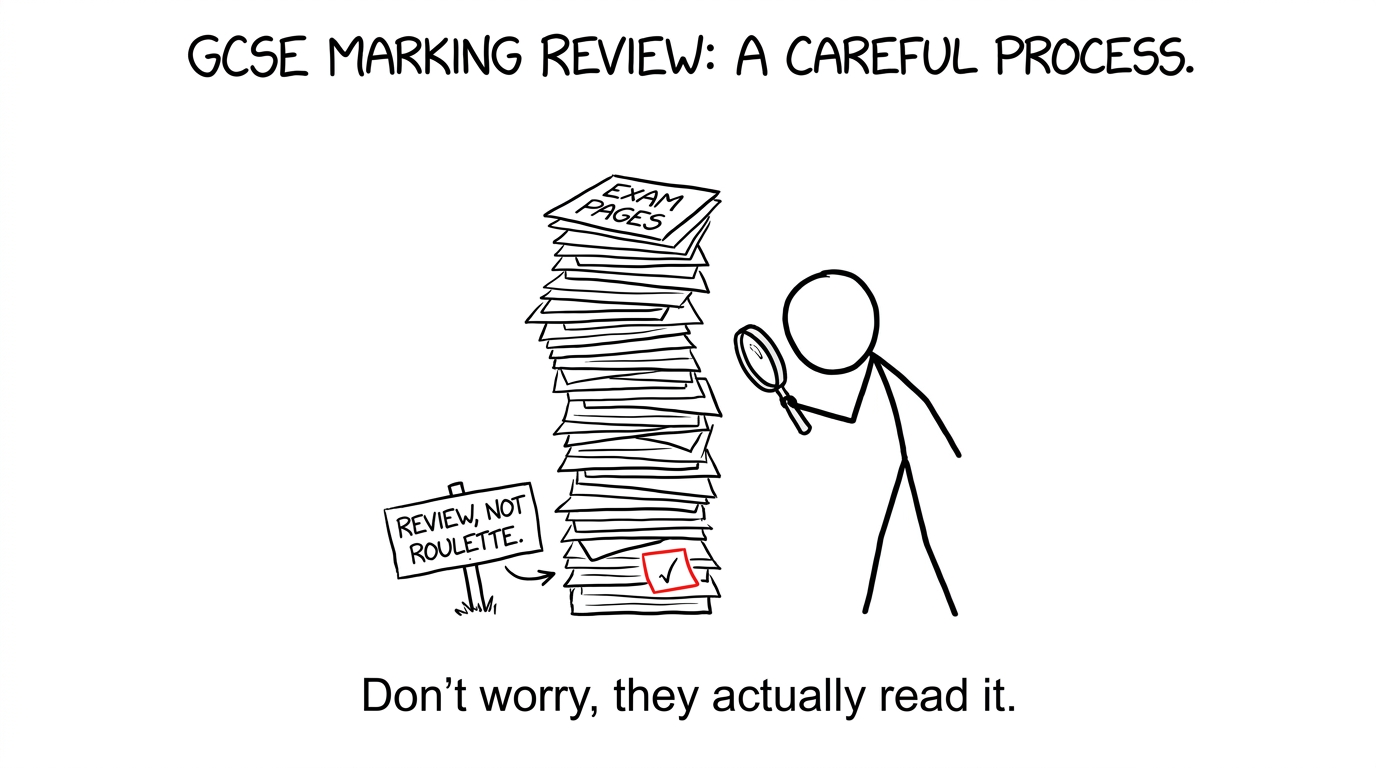 An examiner carefully reviewing a paper rather than playing remark roulette
Could appealing a GCSE maths grade lower it?
Yes. Written consent is required because a reviewed component mark can rise, remain unchanged or fall. A lower component mark could also lower the overall subject grade if your new total crosses a lower boundary.
This does not mean a review is reckless. It means the decision should be based on the script, mark scheme and boundary rather than hope alone. Ask your school about the fee and refund policy because charges differ by board and may also reflect the centre's administration arrangements.
If the review outcome still appears wrong, an appeal is a separate later stage. Usually, your school challenges whether the exam board followed its procedures properly or made an error that the review failed to correct. You cannot normally skip the review and begin with an appeal.
Common mistakes when requesting a GCSE maths remark
Reviewing every paper automatically
Start with the component where the evidence lies. Each reviewed paper may carry a separate fee and a separate possibility of losing marks.
Looking only at the paper mark
GCSE Maths grades are based on the combined subject total. Compare the possible revised total with the correct boundary for your board, series and tier.
Treating closeness as evidence
Being 111 or 222 marks short makes a change more consequential, not more likely. A teacher's inspection of the script provides stronger grounds.
Missing the school's deadline
The JCQ deadline is the date by which the exam board must receive the request. Your school needs time to process it, so its own cut-off will usually be earlier.
Assuming a review guarantees a higher grade
Most reviews do not produce a grade change. The purpose is to correct an error, not to award generous extra marks.
Make your next move calmly
On results day, gather facts before making a decision: component marks, the correct boundary, your scripts, your teacher's view, the fee and the deadline. That is the whole GCSE maths re-mark process in its most useful form: evidence first, decision second.
Whatever the outcome, your result is information rather than a verdict on your ability. If a resit or further maths preparation is next, return to the habits that make marks less mysterious: use Edexcel GCSE Maths past papers, shorter GCSE Maths mini tests, and MathsGenie's predicted papers and revision resources. Revision lessons, practice questions, mark schemes and video solutions turn each lost mark into a specific next step.
Start by checking the GCSE Maths grade boundaries, then speak to your school before its post-results deadline.











