

GCSE Sociology Grade 7 Meaning Explained
GCSE sociology grade 7 meaning explained clearly: learn the ability it represents, its old letter-grade equivalent, and how UK exam boundaries shape results.
A result can look precise while still feeling strangely unclear. You open the page, see a grade 7 beside GCSE Sociology and wonder what it says about your actual ability. Is it an old grade A? Is it considered a strong result? How close is it to an 8?
The gcse sociology grade 7 meaning is straightforward: it is a strong GCSE result, broadly aligned with the old grade A. It indicates that you can usually demonstrate secure sociological knowledge, apply ideas to unfamiliar material and construct reasoned analysis supported by evidence. It does not correspond to one permanent raw mark because grade boundaries can change between exam boards and examination series.
Just as importantly, a grade describes performance in particular assessments. It does not measure your intelligence, fix your future grades or define how capable you are.
Grade 7 at a glance
Here is the practical answer before we look more closely at what sits behind the number:
- Grade 7 is broadly equivalent to the old grade A.
- It is above the standard and strong pass benchmarks associated with grades 4 and 5.
- It normally reflects secure knowledge alongside effective application, analysis and evaluation.
- It is not tied to a universal percentage or fixed number of marks.
- Exact grade boundaries depend on the exam board, paper and examination series.
- The jump to grades 8 and 9 generally requires greater consistency, precision and depth rather than simply writing more.
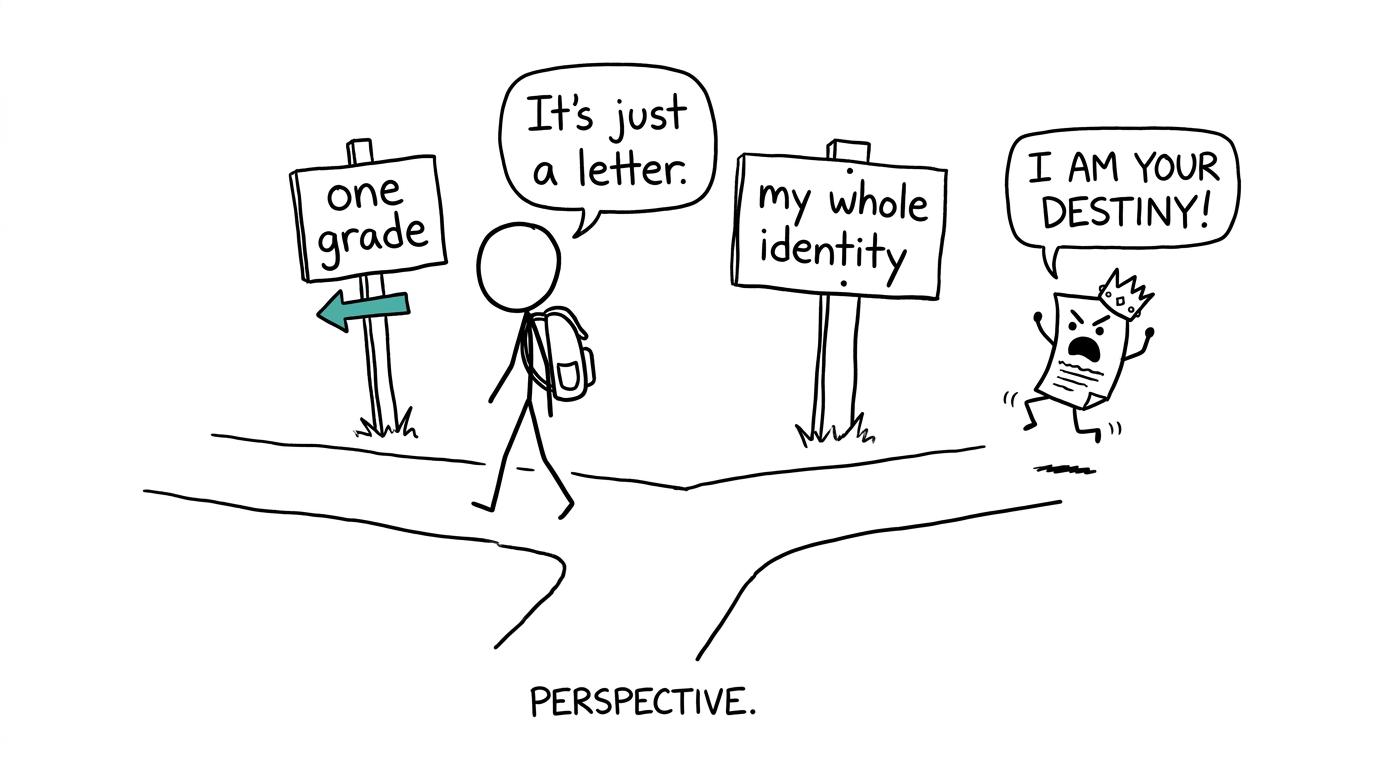 A student keeping one GCSE grade in perspective
How does grade 7 compare with the old letter grades?
When GCSEs in England moved from letter grades to the grades 9-1 system, the new scale was not designed as a simple one-for-one renaming exercise. However, several important reference points were established to help schools, colleges and employers understand the change.
The bottom of grade 7 is aligned with the bottom of the old grade A. This is why grade 7 is commonly described as being equivalent to an A. The comparison is useful, but “broadly equivalent” is more accurate than saying the grades are identical.
A simplified comparison looks like this:
| Current GCSE grade | Broad comparison with old grades |
|---|---|
| Grade 9 | Above the old A* threshold |
| Grade 8 | Between grades A and A* |
| Grade 7 | Broadly equivalent to grade A |
| Grade 6 | Above grade B, below grade A |
| Grade 5 | Strong pass, between grades B and C |
| Grade 4 | Standard pass, broadly aligned with grade C |
| Grades 3-1 | Broadly cover the former D-G range |
This comparison explains the headline meaning, but it should not be used to convert every historical mark mechanically. The qualifications, assessments and grade distributions changed with the reformed GCSEs.
For a student receiving a 7 today, the sensible interpretation is simple: you have achieved a high grade and demonstrated performance comparable with the standard historically associated with an A.
What ability does a grade 7 in GCSE Sociology represent?
Sociology rewards more than remembering terminology. Strong answers connect knowledge to the exact question, use evidence selectively and recognise that social issues can be interpreted from competing perspectives.
Although specifications differ, a grade 7 student will typically show strength across four connected areas.
Secure sociological knowledge
You should be able to explain key concepts accurately rather than relying on vague everyday meanings. Depending on your specification, this may include areas such as families, education, crime and deviance, social stratification and research methods.
Secure knowledge also means understanding relationships between ideas. For example, it is not enough to name a sociological perspective. You need to explain how that perspective interprets an institution, pattern or inequality.
Relevant application
Application means using knowledge in the context set by the question. A response can contain accurate sociology and still lose marks if it does not address the item, source or precise wording provided.
At grade 7 level, application is usually purposeful. Examples, studies and concepts are selected because they help answer the question, not simply because they have been memorised.
Developed analysis
Analysis explains connections. It may show how one social factor produces an outcome, why groups have different experiences or how evidence supports a particular argument.
The important shift is from assertion to reasoning. Rather than leaving an idea unexplained, a strong student follows its consequences and shows why it matters to the argument.
Balanced evaluation
Evaluation considers strengths, limitations and alternative interpretations. Effective evaluation is not an automatic sentence added to the end of every paragraph. It directly tests the argument being made.
A grade 7 does not require every sentence to be perfect. It suggests that these skills are demonstrated securely enough across the papers to reach the boundary set for that examination series.
Why there is no fixed grade 7 percentage
Students understandably want a single target: “What percentage is a 7?” The difficulty is that the answer can change.
Exam boards set grade boundaries after papers have been taken and marked. Boundaries account for differences in paper demand between examination series, helping to maintain comparable qualification standards. If one paper proves more demanding, the boundary may be lower; if it proves less demanding, it may be higher.
Your grade is therefore based on your total raw marks and the boundaries for your specific board and series. A boundary from a previous year is useful for interpreting a past paper, but it is not a guaranteed prediction of the boundary in your own examination.
This is similar to using GCSE maths past papers. The boundary helps you judge a completed paper, while the questions and mark scheme reveal the more valuable information: which skills are secure and where marks are still being lost.
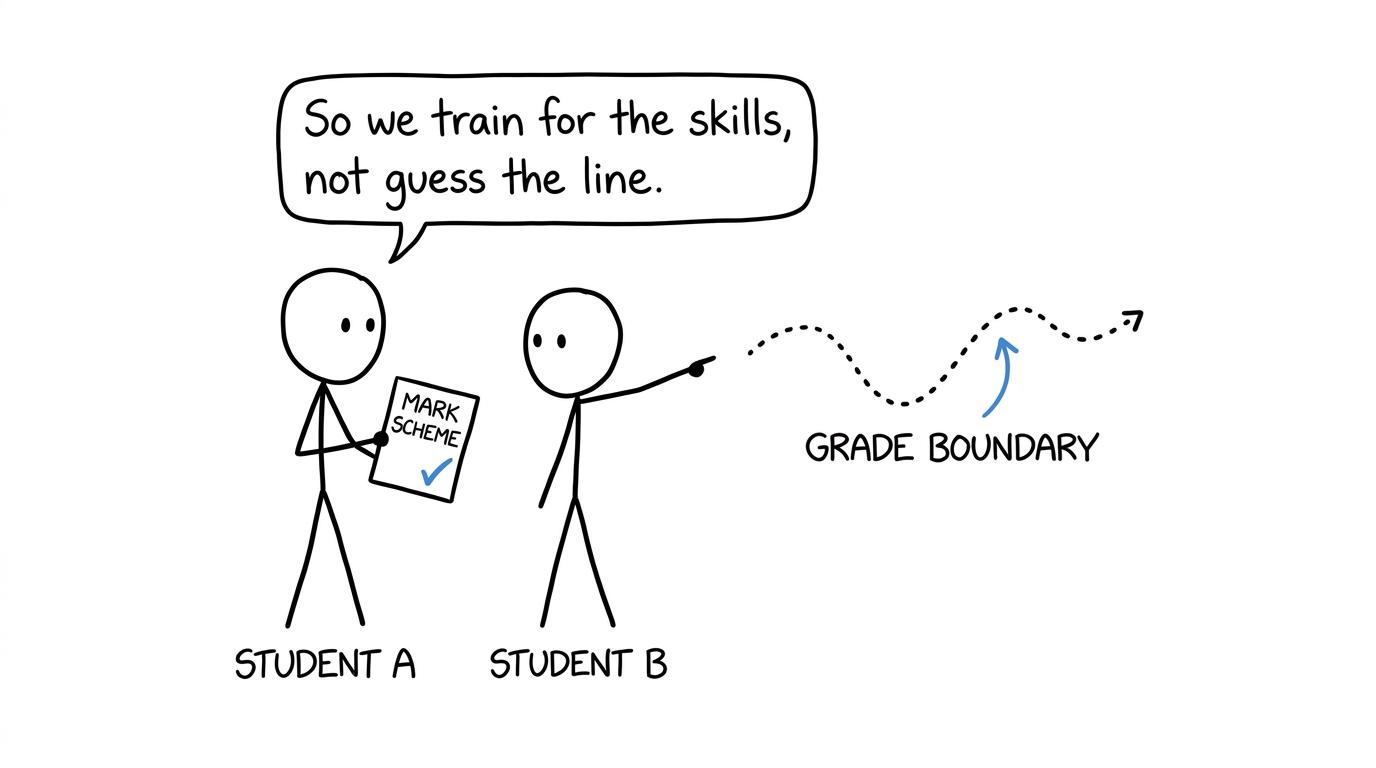 Students learning not to guess a moving grade boundary
Does grade 7 mean the same thing for every exam board?
The national grade scale has a shared meaning, but specifications and assessments are not identical. GCSE Sociology courses offered by boards such as AQA and Eduqas can differ in their topic organisation, question styles, assessment structure and mark allocations.
That makes your own specification essential. Check:
- the topics included in your course;
- the assessment objectives being tested;
- the command words used in questions;
- the marks available for each response;
- whether source material or an item must be used;
- the level descriptors in the official mark scheme.
Do not revise from a resource merely because it says “GCSE Sociology”. Confirm that it matches your exam board and current specification. Equally, do not assume a boundary from one board applies to another.
How to move from a grade 7 towards an 8 or 9
A grade 7 often means that the main knowledge is already present. Improvement usually comes from making that knowledge more precise and dependable under timed conditions.
Diagnose marks instead of collecting scores
After completing a question, separate mistakes into categories: missing knowledge, weak application, undeveloped analysis, limited evaluation or poor timing. A total score tells you where you finished. A diagnosis tells you what to practise next.
This principle works across subjects. MathsGenie's free GCSE maths revision lessons organise practice by topic and grade, making it easier to address a specific weakness rather than repeatedly revising comfortable material.
Use mark schemes carefully
A mark scheme is not merely a list of phrases to memorise. Read the level descriptors and notice what separates a reasonable response from a developed one. Look for requirements such as sustained analysis, relevant evidence and a supported judgement.
When revising maths, the same habit can be developed through GCSE paper mark schemes and model solutions. Understanding where marks come from is more useful than glancing at the final answer.
Practise retrieval and extended writing
Knowledge must be available without notes before it can be applied fluently in an examination. Use short retrieval sessions for concepts, perspectives, evidence and research methods. Then practise turning that knowledge into planned and timed responses.
Do not measure revision only by hours spent. Measure whether you can retrieve an idea, select it for the right question and explain it accurately.
Improve consistency
Higher grades are often built by reducing avoidable variation. One excellent essay cannot entirely compensate for several rushed or incomplete answers. Plan your time using the marks available and leave enough space for extended responses.
Maths students can build the same consistency with GCSE predicted papers, while those progressing beyond GCSE can explore A Level maths revision resources and A Level past papers.
 A student training evidence and timing in a revision gym
Common mistakes when interpreting a grade 7
Treating it as a fixed percentage
There is no permanent percentage that always produces a grade 7. Use the published boundary for the correct exam board, qualification and series when marking a past paper.
Calling it an A*
Grade 7 is broadly aligned with the old grade A, not A*. Grade 8 sits between the old A and A*, while grade 9 represents performance above the old A* threshold.
Assuming it guarantees the same grade next time
A grade reflects performance across particular papers. It is strong evidence of current attainment, but future outcomes still depend on topic coverage, examination technique and consistency.
Revising only content
Knowing definitions is necessary but insufficient. GCSE Sociology also tests whether you can apply, analyse and evaluate sociological material in response to a specific question.
Comparing raw marks across different papers
A mark from one examination series cannot be interpreted reliably using another series' boundary. Paper demand and boundaries vary, so compare like with like.
Seeing the grade as a judgement of personal ability
A grade 7 is a meaningful academic achievement, but it remains an assessment result. It identifies a current standard of performance, not a permanent limit.
What should you do after receiving a grade 7?
First, recognise it accurately: grade 7 is a strong result, broadly comparable with an old A. Then look beyond the headline number.
If it came from a mock, review every lost mark and decide whether the cause was knowledge, application, analysis, evaluation or timing. If it is a final result, check the entry requirements for your intended sixth form, college or course directly, because individual institutions set their own policies.
The most useful revision question is rarely “Am I a grade 7 student?” A better question is “Which skill would earn my next mark?” That turns a label into an action.
MathsGenie can help you apply that approach across your maths revision. Begin with the GCSE revision hub, use practice questions and mini tests to identify gaps, then move to past papers, video solutions and predicted GCSE papers. A grade tells you where one assessment ended. Deliberate practice decides where the next one can begin.











