GCSE: Should You Memorise Formulas?
GCSE revision: should you memorise formulas? Learn what to learn, what’s given, and how to practise retrieval with worked examples and papers.
You can feel it in the last ten minutes of revision: the tug-of-war between understanding and panic. One part of you wants to learn maths properly. The other wants to stuff your head with a page of formulas and hope the exam is kind.
If you’re revising for GCSE maths (or stepping up into A Level), the better question isn’t “Should I memorise formulas?” It’s: which formulas are worth memorising, which ones are given, and which ones you can reliably rebuild under pressure.
That distinction is where marks live.
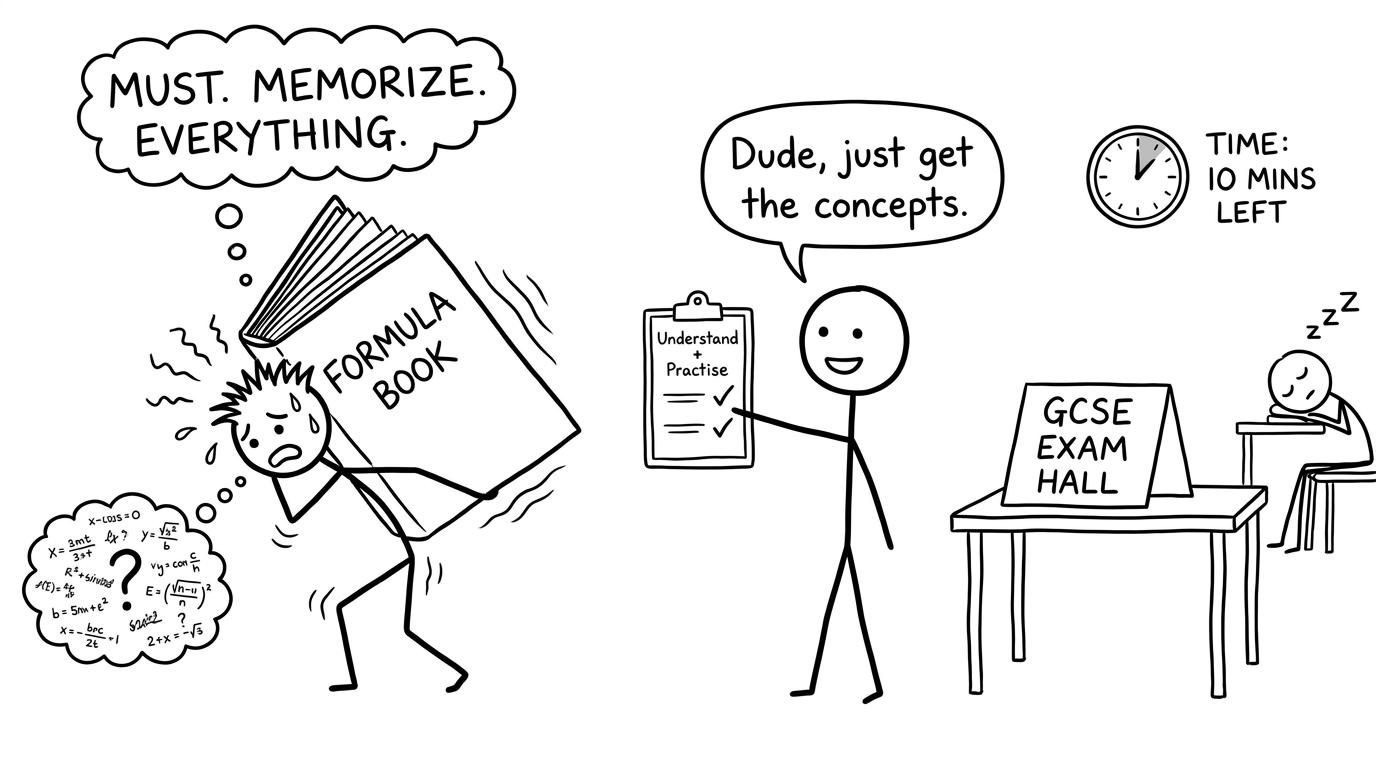 A student weighs a huge formula book against a simple checklist
The quick checklist (save this for your next revision session)
Use this three-bucket system for any formula you meet in GCSE or A Level maths:
- Bucket A: Given in the exam: know how to use it, not just what it says.
- Bucket B: Not given but used often: memorise it and practise applying it in exam questions.
- Bucket C: Can be derived quickly: learn the derivation once, then practise rebuilding it from first principles.
A strong revision plan uses all three. Maths Genie makes this easy because you can move from a revision lesson to practice questions and solutions, then on to predicted papers and mark schemes.
GCSE formulas: what you’re expected to know vs what’s provided
In GCSE maths, the formula sheet is helpful, but it’s not a safety net for everything. Across exam boards (Edexcel, AQA, OCR, Eduqas), students often lose marks not because the formula wasn’t there, but because:
- they couldn’t rearrange it,
- they mixed up symbols,
- they substituted incorrectly,
- they didn’t connect it to the diagram or the context.
Maths Genie even provides a clean self-test list: GCSE Formulae to Remember. Use it like a mirror, not a blanket: circle what you can’t recall quickly, then turn those into targeted practice.
Bucket A: the formulas you should treat as “tools”, not “facts”
Even when formulas are provided, you still need fluency. Typical examples include circle measures and sector formulas. If you know that
A=πr2 A=\pi r^2 A=πr2then you should also be able to:
- find rrr when AAA is given,
- decide whether to use radius or diameter,
- apply a fraction like θ360\frac{\theta}{360}360θ correctly.
This is why revision lessons followed immediately by exam-style questions work so well: your brain learns the decision-making, not just the statement.
Memorising is not the enemy; memorising without meaning is
There’s a quiet trick top students use. They don’t “cram formulas”. They build compression.
Compression means turning several steps of reasoning into one reliable move. A formula is just a compressed idea.
For example, Pythagoras is a compressed idea about right-angled triangles:
a2+b2=c2 a^2+b^2=c^2 a2+b2=c2But if you don’t see which side is ccc (the hypotenuse), the compression breaks and you guess.
The solution isn’t to ban memorising. It’s to memorise the right things, in the right way:
- one line of meaning,
- one example you can replay,
- then spaced practice.
Worked example: using a formula sheet still requires algebra
A huge chunk of GCSE and A Level success is rearranging. It’s where “I know the formula” turns into “I can earn the marks”.
Let’s use the classic speed formula:
v=dt v=\frac{d}{t} v=tdExample
A cyclist travels d=12 kmd=12\text{ km}d=12 km in t=30 minutest=30\text{ minutes}t=30 minutes. Find the speed in km/h\text{km/h}km/h.
Step 1: Convert time into hours
30 minutes=3060=0.5 hours 30\text{ minutes}=\frac{30}{60}=0.5\text{ hours} 30 minutes=6030=0.5 hoursStep 2: Substitute into the formula
v=120.5=24 v=\frac{12}{0.5}=24 v=0.512=24So the speed is 24 km/h24\text{ km/h}24 km/h.
Notice what earned the marks: units, conversion, substitution. Not just recalling v=dtv=\frac{d}{t}v=td.
If rearranging is a weakness, Maths Genie has focused exam booklets such as Rearranging Harder Formulae (Exam Questions) so you can practise the exact skill that shows up again and again.
The formulas you really should memorise for GCSE
For GCSE higher tier especially, a small set of formulas appear so frequently that memorising them reduces cognitive load in the exam.
Here are good candidates for Bucket B:
- Pythagoras: a2+b2=c2a^2+b^2=c^2a2+b2=c2
- Trigonometry: sinθ=opphyp\sin\theta=\frac{\text{opp}}{\text{hyp}}sinθ=hypopp, cosθ=adjhyp\cos\theta=\frac{\text{adj}}{\text{hyp}}cosθ=hypadj, tanθ=oppadj\tan\theta=\frac{\text{opp}}{\text{adj}}tanθ=adjopp
- Circle basics: A=πr2A=\pi r^2A=πr2, C=2πrC=2\pi rC=2πr and C=πdC=\pi dC=πd
- Quadratic formula (higher tier):
- Straight line: y=mx+cy=mx+cy=mx+c (and what mmm and ccc mean)
To make these stick, pair each one with a single “anchor question” from your practice. The anchor question becomes the memory hook.
Worked example: when it’s better to derive than memorise
Some formulas are easier to rebuild than to carry around in your head.
Example: deriving the midpoint formula
Suppose you have points A(2,1)A(2,1)A(2,1) and B(8,7)B(8,7)B(8,7). The midpoint is “halfway in xxx and halfway in yyy”.
Halfway in xxx:
2+82=5 \frac{2+8}{2}=5 22+8=5Halfway in yyy:
1+72=4 \frac{1+7}{2}=4 21+7=4So the midpoint is (5,4)(5,4)(5,4).
Yes, you could memorise the midpoint formula. But the derivation is so fast, and so intuitive, that it belongs in Bucket C.
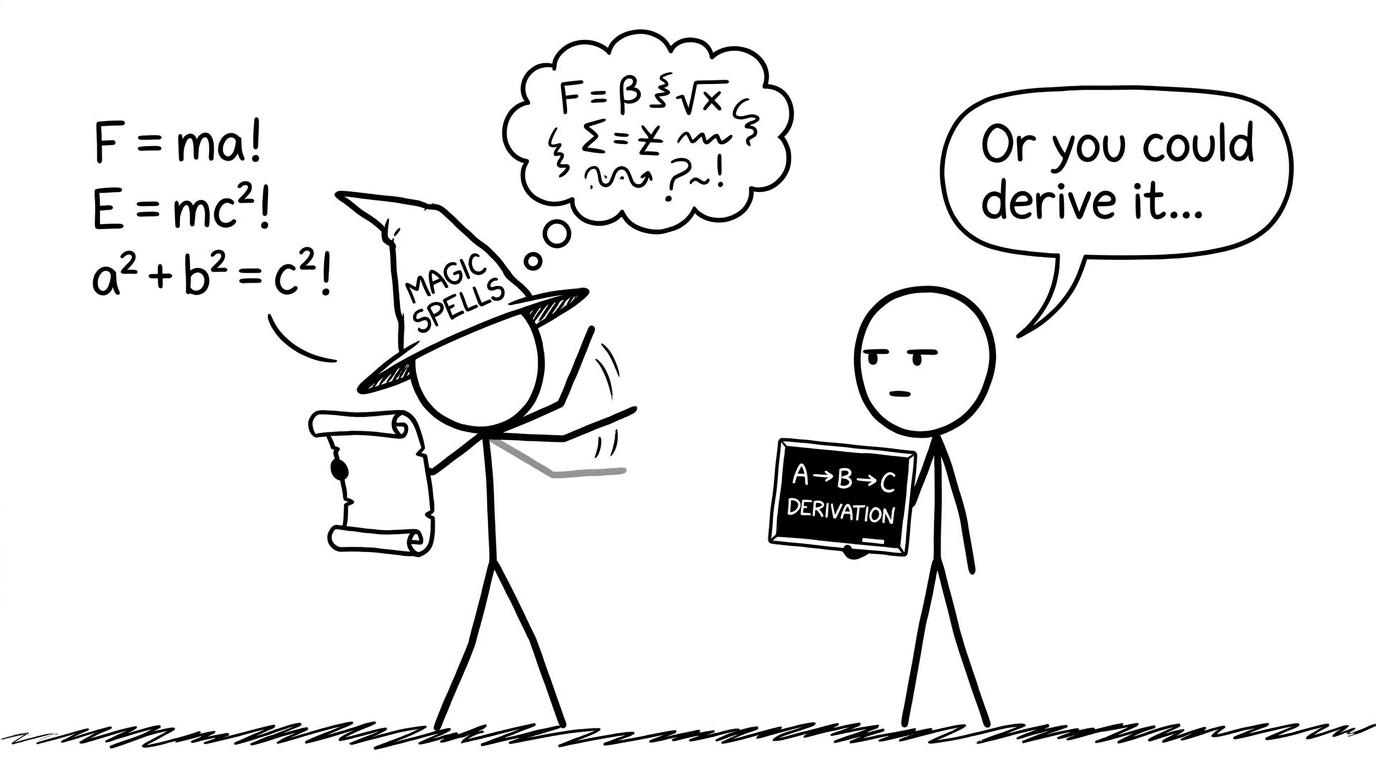 Wizard tries to memorise formulas like spells; friend suggests deriving
A Level: formula books exist, but the expectation rises
At A Level, especially Edexcel, you typically have access to a formula booklet, such as the Edexcel Formula Book (New Spec). That can lull students into thinking memorisation doesn’t matter.
But A Level questions rarely ask you to just “use the formula”. They ask you to:
- choose the right model,
- combine ideas (e.g. trig + differentiation),
- rearrange efficiently,
- interpret the answer.
So the A Level version of this article is: memorise the core methods, not just the printed formulas. Maths Genie’s A Level revision and topic pages like A Level (Edexcel) content and questions are built exactly around that idea: method first, then exam questions, then solutions.
How to memorise formulas the way exam conditions demand
Your brain doesn’t forget because it’s “bad at maths”. It forgets because you learned in a way the exam doesn’t require.
Here’s a GCSE-friendly method that works for A Level too.
Use retrieval, not rereading
- Close the notes.
- Write the formula from memory.
- Check, correct, rewrite.
Do this in short bursts. Five minutes of retrieval beats thirty minutes of highlighting.
Add a “use case” straight away
After recalling a formula, do one exam-style substitution or rearrangement. For example, if you recalled C=2πrC=2\pi rC=2πr, immediately answer:
“If r=7r=7r=7, what is CCC?”
C=2π×7=14π C=2\pi\times 7=14\pi C=2π×7=14πNow the formula has a job, not just a shape.
Space it out
Come back tomorrow, then three days later, then a week later. Maths Genie supports this naturally because you can cycle between:
- revision lessons,
- exam questions,
- mini tests,
- then full papers.
For short, focused practice, use the Target Tests to keep retrieval consistent.
Common mistakes students make with formulas
Even strong students drop marks here because formulas feel “familiar”, so they rush.
- Using diameter instead of radius in A=πr2A=\pi r^2A=πr2 or C=2πrC=2\pi rC=2πr. If you’re given ddd, convert first with r=d2r=\frac{d}{2}r=2d.
- Forgetting to square the radius in circle area and sector area problems.
- Mixing degrees and radians in A Level trig work. If your calculator is in the wrong mode, everything looks plausible but is wrong.
- Rearranging incorrectly by doing different operations to both sides. A reliable method is to undo operations in reverse order and keep each line clear.
- Substituting without brackets. For example, if x=−3x=-3x=−3 and you compute x2x^2x2, you must write (−3)2=9(-3)^2=9(−3)2=9, not −32=−9-3^2=-9−32=−9.
- Rounding too early. Keep exact values like 14π14\pi14π until the final step unless the question demands a decimal.
If these mistakes sound familiar, build a short routine: choose one weak formula skill, watch the lesson, do a page of exam questions, check the solutions, then repeat two days later.
How to practise formulas with Maths Genie (without wasting time)
The calmest students in the exam hall aren’t the ones who “know everything”. They’re the ones who have seen enough exam questions that nothing feels new.
A simple path:
- Start at GCSE revision and pick the topic linked to your formula weakness.
- Use the practice questions and mark scheme style solutions to learn what gets marks.
- Then move to Predicted GCSE Revision Papers when you want mixed practice under timed conditions.
- Finally, use exam board papers where relevant (for example, OCR GCSE papers) to match the wording you’ll actually face.
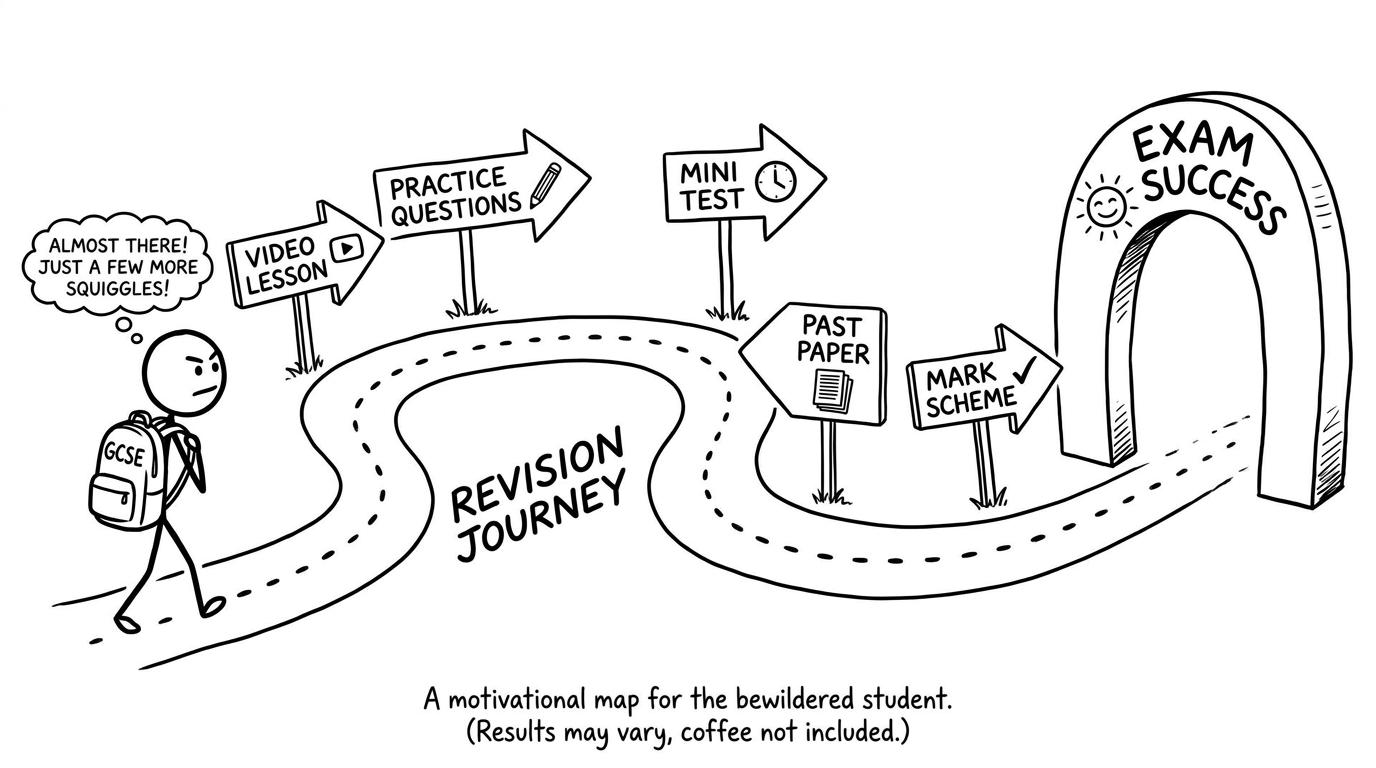 Revision planner map with signposts: Video Lesson, Practice Questions, Mini Test, Past Paper
Conclusion: memorise less, practise smarter (and score more)
If you’re revising for GCSE, the winning strategy isn’t to memorise every formula you’ve ever seen. It’s to build a short list of high-value formulas, understand what each symbol means, and then practise using them until your brain treats them like familiar tools.
Memorisation is a kind of confidence. But confidence comes from evidence. And in maths, the best evidence is solved questions.
So use Maths Genie like a ladder: start with the revision lesson, practise with exam questions, check the solutions, then climb into Target Tests and Predicted GCSE Revision Papers when you’re ready for timed, mixed practice. If you want to match your exam board wording, move on to relevant papers (for example, OCR GCSE papers).
Your next step: pick one formula you “sort of know”, and prove you know it by doing five exam questions on it today. That’s how GCSE grades move.