GCSE Russian Grade 7 Meaning and Old Grades
GCSE Russian grade 7 meaning explained: discover the ability it represents, how it compares with an old grade A and what marks and boundaries mean.
A result can look wonderfully precise while leaving you unsure what it means. You open the envelope, see a grade 7 in Russian and immediately wonder: is that an A, near fluency, or simply a strong pass?
The short answer to the GCSE Russian grade 7 meaning is this: it is a high GCSE grade showing strong performance across listening, speaking, reading and writing. Its lower boundary is officially comparable with the lower boundary of the old grade A. It does not mean complete fluency, and it is not tied to one permanent raw-mark percentage.
That distinction matters. A grade is evidence of performance against a GCSE specification, not a final verdict on everything you can do with a language.
Grade 7 in GCSE Russian at a glance
- Grade 7 is one of the upper grades on England's GCSE scale, which runs from 9 to 1.
- The bottom of grade 7 is comparable with the bottom of the old grade A.
- Grades 7, 8 and 9 collectively cover the range previously occupied by grades A and A*.
- A grade 7 demonstrates strong GCSE-level Russian, but it does not certify native or complete real-world fluency.
- In Pearson Edexcel GCSE Russian, the overall result combines listening, speaking, reading and writing.
- A grade 7 is available through higher tier, not foundation tier.
- The raw-mark boundary can change between exam series, so an old boundary should never be treated as a future target guaranteed to remain unchanged.
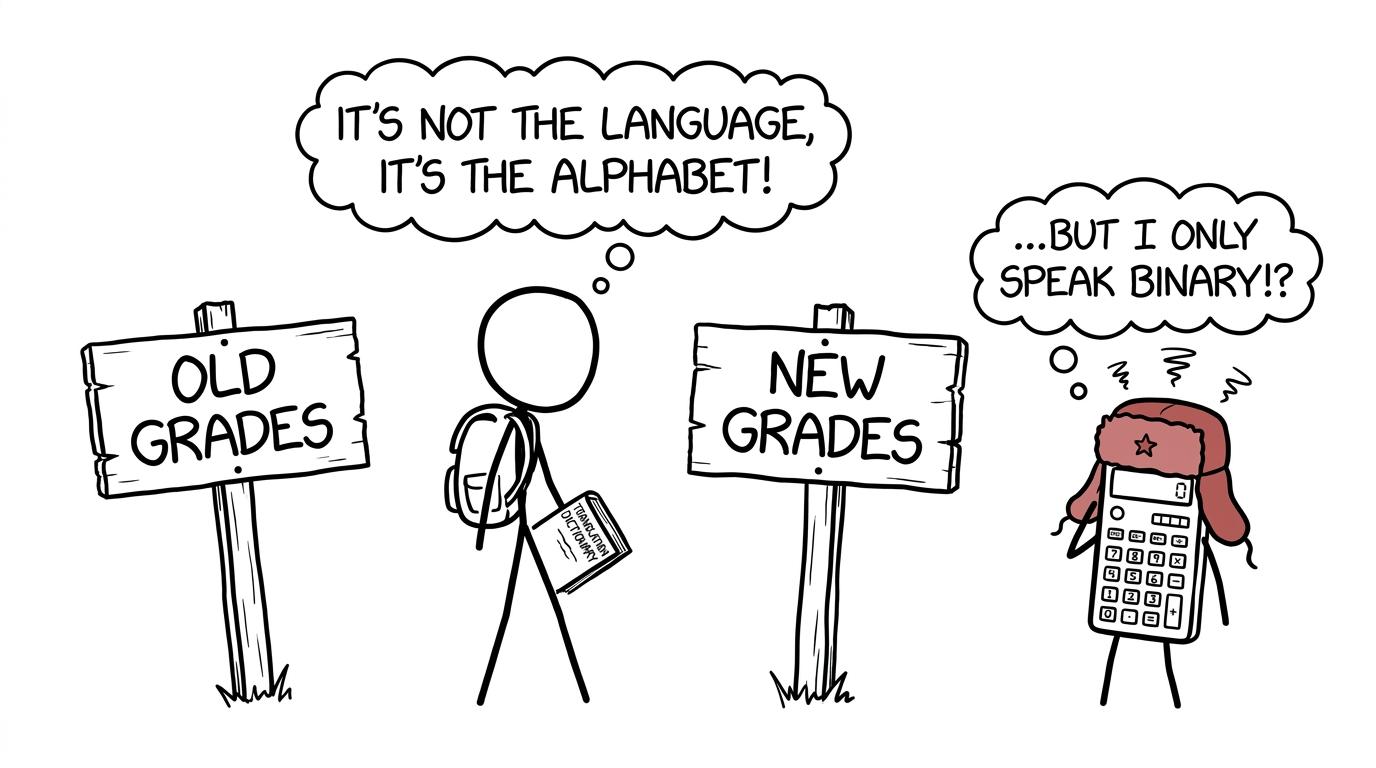 A student and calculator attempt to translate between old and new GCSE grades
What does a grade 7 actually represent?
A grade 7 represents secure, strong achievement within the GCSE Russian course. It suggests that the student can understand and communicate more than memorised phrases. They can generally identify important information and opinions, deal with some extended material, and use vocabulary and grammar across familiar and less familiar situations.
Official modern foreign language grade descriptors do not define grade 7 through a completely separate checklist. Instead, grade 7 performance securely meets the grade 6 description, with stronger performance in most or all of those areas, without yet meeting most of the minimum demands associated with grade 8.
That places grade 7 in an important position. The student is not merely surviving predictable tasks, but may not yet show the consistency, complexity and control expected at grades 8 and 9.
Listening ability
At around this level, a student should be able to follow spoken Russian containing overall messages, key details, views and reasons. The material may include longer passages, some complex language and less familiar vocabulary.
This does not mean understanding every word. Strong listening often involves continuing after an unfamiliar phrase, using context and recognising whether a speaker is describing an event, expressing an opinion or explaining a reason.
Speaking ability
A grade 7 suggests an ability to communicate effectively across the speaking tasks, give developed responses and move beyond a narrow bank of rehearsed sentences. The student should be able to express ideas and opinions, provide reasons and respond with a useful degree of spontaneity.
Errors may still occur, especially when attempting complex grammar. What matters is whether communication remains clear and whether pronunciation, vocabulary and grammatical control support the response.
Reading ability
In reading, grade 7 performance indicates that a student can locate messages, details and opinions in a range of Russian texts. They may also need to interpret meaning rather than match isolated words mechanically.
Translation contributes another layer. It tests whether the student understands how meaning fits together across a passage, including tense, cases, agreement, word order and context.
Writing ability
A grade 7 writer can usually develop ideas for the required purpose, use more than basic vocabulary and attempt a range of structures. The writing should remain sufficiently accurate and coherent to communicate clearly.
Perfect Russian is not required. A successful answer can contain mistakes while still demonstrating ambition, range and control. However, repeated errors that obscure meaning or answers that rely entirely on memorised material will restrict performance.
Is a GCSE Russian grade 7 the same as an A?
The safest answer is broadly comparable at the lower boundary, but not identical.
Ofqual's official comparison states that the bottom of grade 7 is comparable with the bottom of the old grade A. It does not provide a complete one-to-one conversion in which every numerical grade is simply a renamed letter.
The relationship is better understood like this:
| Current GCSE grade | Broad comparison with old grades |
|---|---|
| Grades 9, 8 and 7 | Together cover the former A* and A range |
| Bottom of grade 7 | Comparable with the bottom of old grade A |
| Bottom of grade 4 | Comparable with the bottom of old grade C |
| Bottom of grade 1 | Comparable with the bottom of old grade G |
So it is reasonable to describe grade 7 informally as being comparable with an A. It is less accurate to claim that grade 7 and grade A are identical in every respect. The qualifications, assessments and grading scale changed, while the newer scale created more differentiation among high-performing candidates.
How GCSE Russian is assessed
Pearson Edexcel's current GCSE Russian qualification assesses four language skills:
- listening;
- speaking;
- reading;
- writing.
Each skill contributes 25%25\%25% of the overall qualification. The GCSE is awarded from the total subject mark rather than by assigning a separate official grade to every paper.
This has an important consequence: two students with the same final grade may have different skill profiles. One might be particularly confident in speaking and listening, while another gains more marks through reading and writing. The overall grade shows the combined outcome, not identical ability in every component.
Foundation tier offers grades 1 to 5. Higher tier normally offers grades 4 to 9, with a possible grade 3 for a candidate falling narrowly below the grade 4 boundary under the specification's grading rules. A student targeting grade 7 therefore needs to be entered for higher tier.
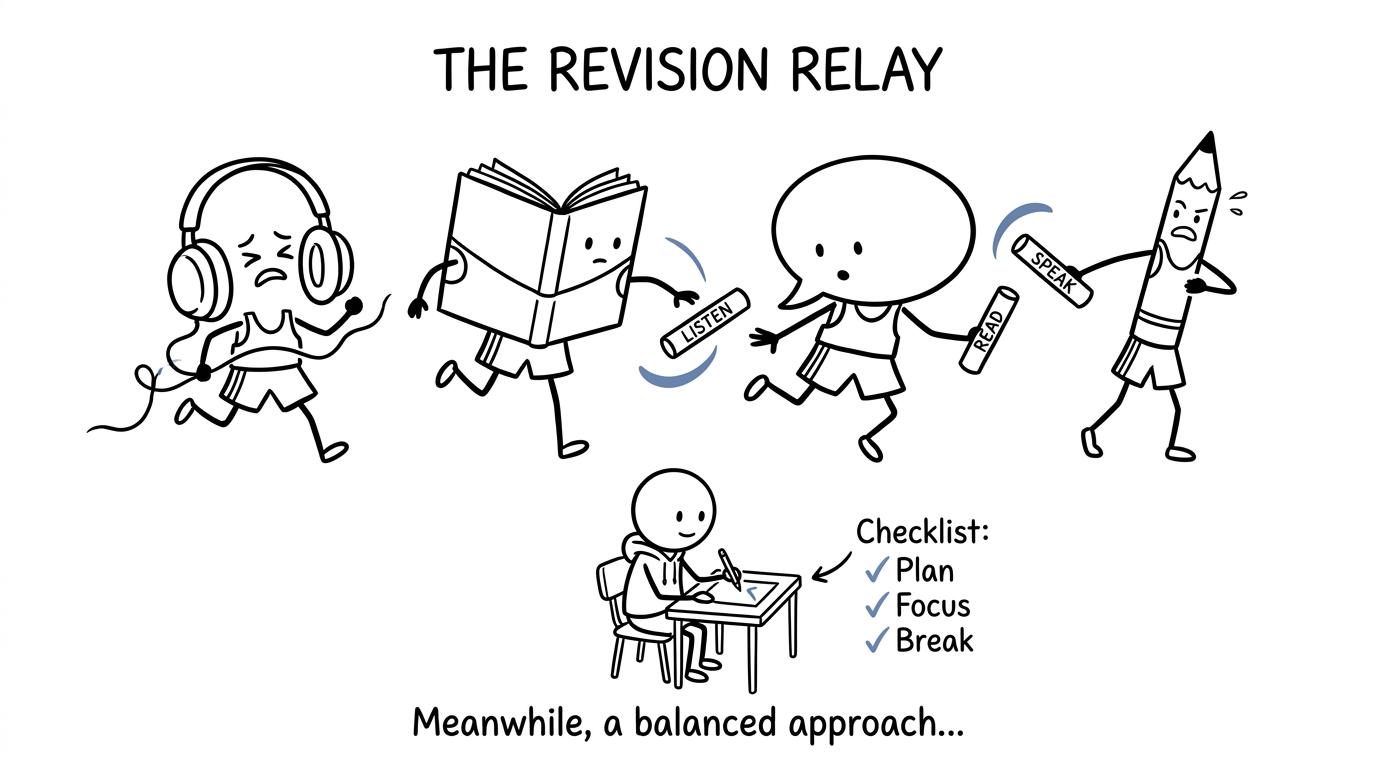 Four language skills form a slightly chaotic revision relay team
Why a grade 7 is not a fixed percentage
Students often search for a single percentage that guarantees a grade. Unfortunately, grade boundaries do not work that way.
A grade boundary is the minimum raw mark needed for a grade in a particular exam series. Boundaries are confirmed after the papers have been taken and marked, allowing awarding bodies to account for differences in paper demand while maintaining the qualification standard.
For Pearson Edexcel GCSE Russian higher tier, the published grade 7 boundary was 154154154 out of 280280280 in June 2024 and 173173173 out of 280280280 in June 2025. Those figures are evidence that boundaries move; they are not predictions for the next examination.
You can inspect the latest published figures on the Edexcel GCSE Russian grade boundaries page. Use previous boundaries to understand historical outcomes, but use the specification and mark schemes to guide revision.
The lesson is familiar to maths students. A mock percentage is useful data, but it is not a promise. Your more valuable questions are:
- Which skill lost the marks?
- Was the problem knowledge, accuracy, timing or interpretation?
- Can you correct the same weakness without notes?
- Does the improvement survive in a new timed task?
What grade 7 does not mean
A grade 7 does not necessarily mean that you can discuss every subject effortlessly with a native speaker. GCSE assessment covers defined themes, vocabulary, grammar and task formats. Real conversations can move beyond those limits immediately.
It also does not mean that every part of your Russian is at exactly the same standard. Because marks are combined, stronger performance in one component can compensate for weaker performance elsewhere.
Nor does grade 7 mark the end of meaningful progress. Grades 8 and 9 generally demand greater consistency, more accurate manipulation of language, better handling of complex or extended material and stronger responses to less predictable questions.
The grade is best seen as a strong platform. It shows that the student has developed substantial GCSE knowledge and can apply it successfully under assessment conditions.
How maths students can balance Russian and maths revision
The subjects look different, but effective revision has the same shape: retrieve, attempt, check, correct and return later.
Begin by placing both subjects in a realistic timetable. The free MathsGenie revision planner can help prevent maths from disappearing during language revision, or Russian from being pushed aside by an approaching maths paper.
For maths, use the GCSE Maths revision hub to select your exam board and tier. Edexcel students can follow the structured Edexcel GCSE Maths revision journey, while students across Edexcel, AQA, OCR and Eduqas can use board-appropriate papers and resources.
A balanced weekly cycle might include:
- short Russian vocabulary retrieval;
- one focused listening, reading, speaking or writing task;
- one MathsGenie revision lesson followed immediately by practice questions;
- a timed section in each subject;
- careful marking and a short error log;
- a later attempt to confirm that the correction has lasted.
Maths students short on time can use GCSE maths mini tests or 45-minute maths tests. As examinations approach, learn how to use GCSE past papers properly rather than simply collecting scores.
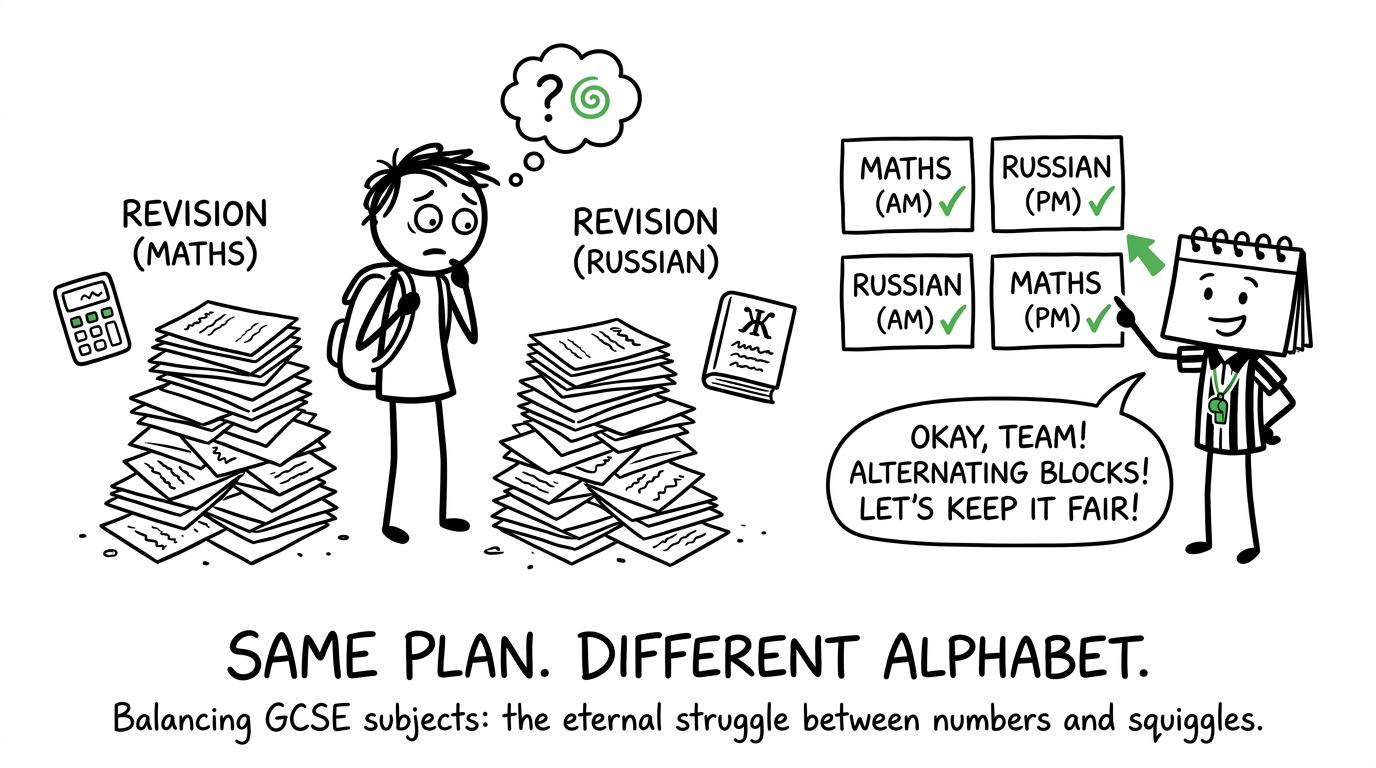 A calendar referee helps a student balance maths and Russian revision
Common mistakes when interpreting a grade 7
Calling it exactly the same as an old A
The lower boundaries are comparable, but the scales are not direct replacements at every position. Say that grade 7 is broadly comparable with an old A, particularly at the lower boundary.
Treating one past boundary as a permanent target
Boundaries vary between series. A previous raw mark can provide context, but it cannot guarantee a future grade.
Assuming the grade proves complete fluency
A GCSE measures performance against its specification. Grade 7 is strong GCSE achievement, not a universal certificate of fluency in every real-life setting.
Ignoring weaker components
An overall grade can hide an uneven profile. Review listening, speaking, reading and writing separately so that one fragile skill does not become a future obstacle.
Revising by rereading alone
Recognition can feel like knowledge until the paper asks you to produce an answer independently. Use active recall, timed practice and immediate feedback. The same principle applies in maths: past-paper practice with proper review is more valuable than passively reading solutions.
A strong grade, understood properly
A grade 7 in GCSE Russian means that a student has achieved a high standard across the assessed language skills. It aligns broadly with the lower end of the old grade A, but it is neither a direct letter substitution nor proof of complete fluency.
Most importantly, it is evidence that structured effort has become dependable performance. That idea travels well between subjects. In Russian, you strengthen vocabulary, comprehension and communication. In maths, you strengthen methods, reasoning and accuracy.
Make MathsGenie your free maths revision base alongside your Russian preparation. Start with revision lessons and practice questions, diagnose gaps with mini tests, then build exam confidence through past papers, predicted papers, mark schemes and video solutions. One well-reviewed mistake is worth more than another hour spent wondering what your grade might be.