GCSE Resit Motivation: Stay Consistent All Year
GCSE resit motivation strategies for building habits, handling setbacks and staying consistent with Maths and English Language revision without burning out.

Resitting can feel like being asked to return to a place you had already hoped to leave. The textbooks look familiar. The exam language is familiar. Even the doubts may be familiar. But GCSE resit motivation does not come from pretending the previous result never happened. It comes from turning that result into useful information, then building a routine that works even when enthusiasm disappears.
The practical answer is simple: make revision regular, specific and small enough to begin. Use practice to identify gaps, measure progress by what you can now do, and treat setbacks as feedback rather than verdicts.
Your resit year checklist
A sustainable resit plan should include:
- a clear reason for wanting the qualification
- small Maths and English Language revision habits
- specific tasks rather than vague intentions
- regular exam-style practice
- a record of mistakes and improvements
- support from teachers, tutors or trusted adults
- planned rest and a realistic response to difficult weeks
You do not need to feel confident before you begin. Confidence is often the result of keeping a few manageable promises to yourself.
Build a resit mindset around progress
A useful resit mindset separates a result from an identity. A disappointing grade describes what happened in one assessment period. It does not define your intelligence, effort or future.
The more useful question is not, “Why am I bad at this?” It is, “What prevented me from collecting marks?”
In Maths, the answer might involve weak knowledge of fractions, algebra or geometry. It might be difficulty interpreting questions, showing working or managing time. Start with the free GCSE Maths revision hub, where you can choose your exam board and find relevant revision resources.
In English Language, the barrier might be planning responses, analysing evidence, organising paragraphs or completing the final question. Ask your teacher to help you identify the smallest skill that would make the biggest difference.
This approach matters because “improve Maths” is too large to act on. “Complete one worksheet on expanding brackets and check every answer” is clear. Specificity reduces the distance between intending to revise and actually starting.
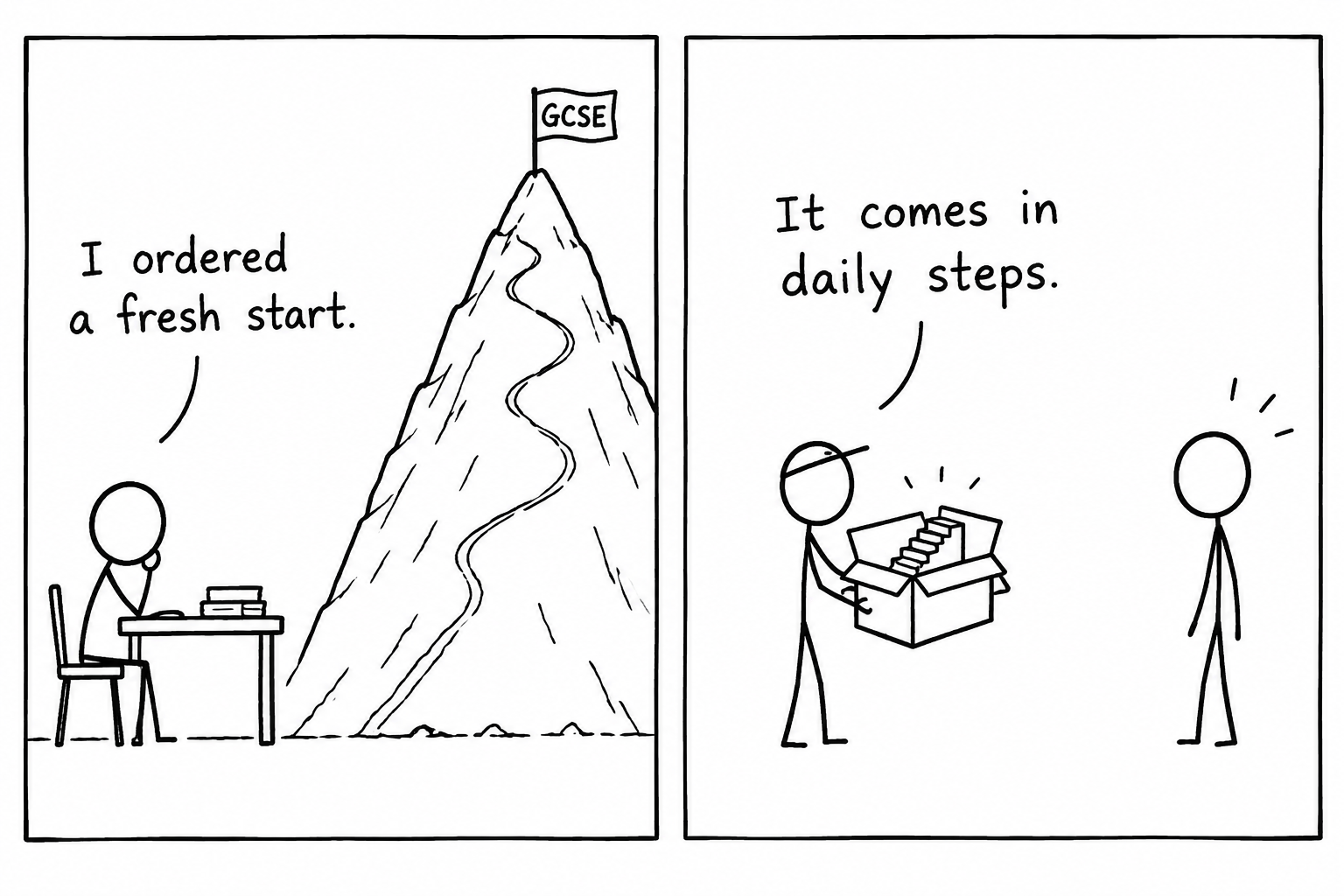 A GCSE mountain arrives as a box of manageable daily steps
Create habits that do not depend on motivation
Motivation rises and falls. Habits give your effort somewhere to land when it falls.
Choose a regular cue for revision. It might be arriving home, finishing dinner or sitting down in the library after college. Attach a short task to that cue. For example:
- after dinner on Monday, complete one Maths worksheet
- on Wednesday morning, plan one English Language response
- on Friday afternoon, correct mistakes from the week
- at the weekend, complete part of a timed paper
Keep the starting point deliberately easy. Open the resource, write the date and attempt the first question. Beginning is often the moment with the greatest resistance.
A revision planner can help you decide in advance, rather than negotiating with yourself each evening. MathsGenie also organises GCSE worksheets by topic, making it easier to turn “revise Maths” into one concrete action.
Use a minimum version of the habit
Some days will be crowded or emotionally difficult. Decide what the minimum version of revision looks like before those days arrive.
Your minimum might be one exam question, one paragraph plan or five minutes reviewing an error log. This is not your ideal session. It is a way to keep the routine alive without pretending every day has equal energy.
A small session can grow once you begin. If it does not, you have still protected the habit.
Make revision active and measurable
Reading notes can feel comfortable because nothing is demanding an answer. Exams do demand answers. Effective revision therefore needs retrieval, application and correction.
For GCSE Maths, use this cycle:
- watch or read a focused revision lesson
- attempt questions without copying the method
- mark the work carefully
- classify each mistake
- retry missed questions later without support
The MathsGenie home page provides free videos and worksheets arranged by topic and grade, alongside past papers and mark schemes. If you need a concise explanation before practising, use the GCSE revision guides to revisit the relevant idea.
For English Language, active revision might mean annotating a fresh extract, planning under time pressure, writing one developed paragraph or comparing your response with feedback from a teacher. Do not repeatedly rewrite an entire paper when one skill needs attention.
Track completed tasks, but also track learning. At the end of each week, answer three questions:
- What can I now do more securely?
- Which errors keep returning?
- What should I practise next?
This plan, monitor and review cycle turns revision into a process you can adjust. That is more dependable than waiting to feel inspired.
Use past papers without letting scores control you
Past papers are valuable because they reveal how knowledge must be used under exam conditions. They are less useful when every score becomes a judgement on your future.
Begin with topic questions if a full paper feels overwhelming. Move towards mixed questions, timed sections and then complete papers. Always use the mark scheme, but do more than count marks. Record why each mark was lost.
Useful categories include:
- knowledge gap
- misunderstood instruction
- incomplete working
- careless arithmetic
- timing problem
- answer not expressed clearly
This creates a revision plan from evidence. For Maths, your exam board matters because paper structures and specifications differ. The Edexcel GCSE Maths revision page, for example, separates Foundation and Higher tier resources and includes exam-style questions, past papers and mark schemes.
Predicted papers and mini tests can add variety closer to the examination, but they should complement topic revision and official past papers rather than replace them. Marking, correcting and retrying are what convert a paper into progress.
Handle setbacks without abandoning the plan
A setback is an event. The greater danger is the story built around it.
Missing one session can become, “I have ruined the week.” A disappointing mock can become, “Nothing has changed.” Neither conclusion is required.
Use a simple reset:
Name what happened
Be factual. You missed revision because you were exhausted, avoided a difficult topic or underestimated another commitment.
Reduce the next step
Do not attempt to repay every missed hour immediately. Choose the next useful action, such as correcting one question or planning one paragraph.
Adjust the system
If the same problem keeps appearing, change the plan. Move the session, shorten it, remove distractions or ask for support. A plan that repeatedly fails needs redesigning, not defending.
Return quickly
The aim is not a perfect streak. It is a short recovery time. Consistency means returning often enough for learning to accumulate.
Common mistakes that weaken GCSE resit motivation
Revising only when you feel ready
Readiness often arrives after starting. Use a fixed cue and a small first task instead.
Repeating comfortable topics
Familiar work protects confidence but may leave important gaps untouched. Mix secure topics with weaker ones, and use exam questions to decide what needs attention.
Measuring progress only through grades
Grades matter, but they change slowly and can hide smaller improvements. Notice when you complete more of a paper, choose methods more accurately or explain ideas more clearly.
Treating one bad result as proof
A mock is evidence about current performance under particular conditions. Review it question by question. The paper can show you where marks are available next time.
Creating an impossible timetable
An ambitious plan may feel motivating for a day, then become a source of guilt. Build around your real week, including work, travel, responsibilities and rest.
Revising alone when you are stuck
Ask a teacher to explain feedback, identify priorities or check whether your practice matches the specification. Support is part of a sensible strategy, not evidence that you have failed.
Keep the reason visible
A resit year is long enough for the original urgency to fade. Write down what passing would make possible: a course, apprenticeship, job application or simply the freedom to move forward.
Then connect that distant reason to today’s action. You cannot complete the whole year this evening. You can complete the next worksheet, mark it honestly and learn from the errors.
That is how staying motivated in revision usually looks from the inside. It is less dramatic than a sudden transformation. It is a series of ordinary returns.
MathsGenie gives you a free place to make those returns count, with revision lessons, worksheets, practice questions, video solutions, past papers and mark schemes. Choose one topic from the free GCSE Maths resources, complete a manageable task today, and let progress become the reason you continue.