GCSE Resit Certificate: How Your Grades Appear
GCSE resit certificate explained: see how grades appear, why exam series create separate records, what employers see and how to replace lost proof.

Opening a resit result can bring two emotions at once: relief about the new grade, followed by uncertainty about what happens to the old one. The short answer is that your GCSE resit certificate records the confirmed grade awarded in that exam series. It does not normally rewrite or erase an earlier certificate.
If you took GCSE Maths or English Language in a later series, you will usually receive a new certificate from the relevant exam board. Your earlier certificate remains valid, so keep both documents safely.
GCSE resit certificate checklist
- Your resit grade is recorded as a GCSE result, not labelled as a lesser qualification.
- Certificates are issued for a particular exam board and exam series.
- A later certificate does not normally replace or amend your original one.
- Employers see the grade you declare and any evidence they ask you to provide.
- Lost proof must usually be requested from the exam board that awarded the qualification.
How does a resit grade appear on your certificate?
A resit certificate normally shows the qualification title, subject and final grade. The certificate confirms that you achieved that GCSE through the awarding organisation. It is not generally stamped with a warning or marked as an inferior result simply because it came from a resit.
The certificate will be associated with the series in which the result was awarded. For example, if you originally sat GCSE Maths in a summer series and resat it in a later November series, those are separate awarding periods.
This distinction matters because exam certificates are records, not live profiles. An old certificate cannot update itself when you improve later. Instead, the later result creates another official record.
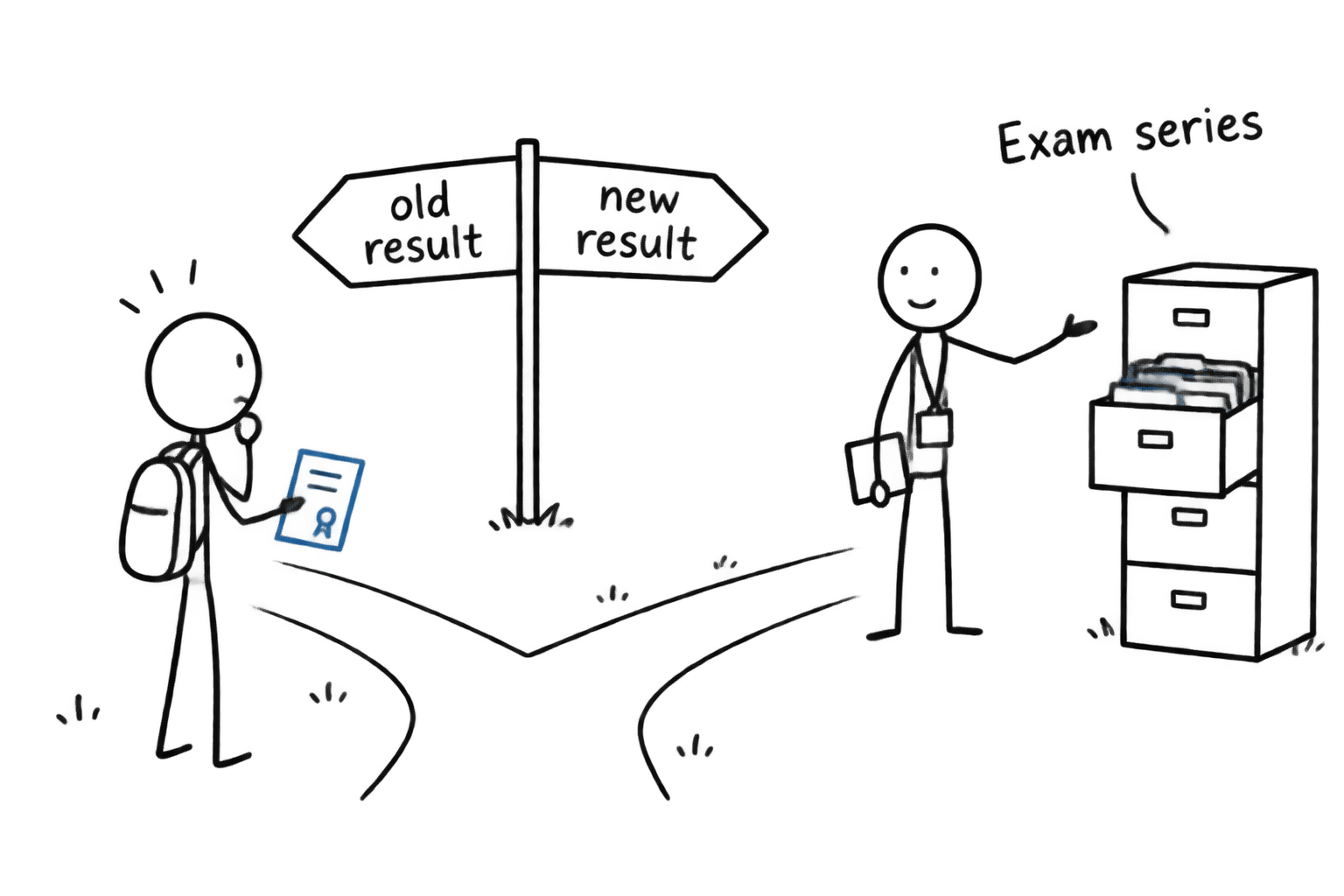 A GCSE student uses a certificate as a map while an exam officer points towards files organised by exam series
Why you may receive separate certificates
Exam-board guidance treats an exam series as a defined assessment period. Certificates are produced for confirmed results from that series. AQA, for example, explains that its certificates show final confirmed results for each exam series. OCR also organises replacement result documents by series.
You may therefore have separate certificates when:
- you resit in a later exam series;
- your subjects were awarded by different exam boards;
- you took one qualification through school and another through a college or private exam centre.
Imagine that your original English Language result was awarded by AQA in the summer, while your Maths resit was awarded by Edexcel in November. You would not expect one combined national certificate. Each awarding organisation maintains its own records and issues its own evidence.
Keep every certificate, even if one contains a lower grade. The documents record different awards made at different times.
Do resit grades show to employers?
Employers do not usually gain automatic access to a single record containing every GCSE attempt. They generally see the information you put on your application and the certificates or official confirmation they request.
If your grade improved, you can normally state the later grade as the qualification you achieved. Include the correct subject, grade and awarding date where requested. If an application specifically asks for every result, every sitting or full educational history, answer accurately rather than assuming only the highest grade is required.
An employer may ask to inspect an original certificate, request a copy or use an exam board's verification service with the necessary information and permission. The practical answer to “do resit grades show?” is therefore: the later grade appears on its own official certificate, but what an employer sees depends on the evidence and information requested.
The same principle applies to colleges, universities and apprenticeship providers. Follow the wording of the application rather than trying to guess what the organisation wants.
What happens if the resit grade is lower?
Your earlier grade does not disappear merely because a later attempt produced a lower result. Both awards remain part of their respective records and certificates.
However, organisations set their own admissions or recruitment requirements. If you need a particular grade, check whether they ask for your highest result, most recent result or complete history. Never alter dates or combine a grade from one series with details from another.
The safest approach is simple: retain both certificates and provide accurate evidence for the grade you are claiming.
How to replace a lost GCSE certificate
Start by identifying the exam board. Your former school, college or exam centre may be able to help if you cannot remember whether it was AQA, Edexcel, OCR or Eduqas/WJEC.
Then apply directly through that board's certificate service. Depending on the awarding organisation, qualification date and circumstances, you may receive a replacement certificate or an official certifying statement of results. These documents can provide formal proof, although the exact service, fee and identification requirements vary.
Have the following ready:
- your full name when you took the exam;
- your current name and evidence of any change;
- date of birth;
- school, college or exam-centre name;
- approximate exam year and series;
- subject and qualification type;
- proof of identity and payment where required.
Do not apply randomly to every board. Separate boards hold separate records, and applications may be charged individually. If several certificates are missing, list the subjects by board and exam series first.
Common GCSE certificate mistakes
Treating a results slip as the final certificate
A results slip gives provisional results on results day. The certificate is the later formal document showing confirmed results. Store it somewhere secure once your school or college releases it.
Throwing away the older certificate
The new GCSE certificate resit document does not usually cancel the old one. Keep both, particularly when they also contain other subject results.
Assuming every grade will be combined
There is no universal certificate that automatically gathers your best grades from different boards and years. Separate series and awarding organisations can mean separate documents.
Waiting until an application deadline
Replacement evidence can take time to obtain. Request it early if an employer, university or apprenticeship provider needs official proof.
Turn the resit into the result you want to keep
Certificate rules feel important because the grade can open a practical next step. Yet the document only records the work already done. The useful decision now is how to prepare for the next series.
Start with free GCSE Maths revision or GCSE English Language revision. Edexcel students can use the Edexcel GCSE Maths revision programme and Edexcel Maths past papers, including mark schemes and worked solutions. For English, choose the relevant AQA English Language resources or Edexcel English Language resources.
MathsGenie brings revision lessons, practice questions, past papers, mark schemes and video solutions into one free place. Build a realistic routine, learn from each marked attempt and let the next certificate record the progress you have earned.