GCSE Religious Studies Study Group: Make It Work
GCSE Religious Studies study group guide: choose the right people, plan focused sessions, practise exam answers and stop the group chat taking over.
A study group often begins with good intentions and one harmless message: “When is everyone free?” Three days later, there are 848484 notifications, several unrelated videos and no meeting.
A GCSE Religious Studies study group works when it has a small membership, a fixed meeting time, a precise agenda and tasks that produce evidence of learning. The group should retrieve knowledge, plan and answer exam questions, use mark schemes and finish by agreeing what happens next. It should not become a shared form of procrastination.
That distinction matters especially if you are balancing Religious Studies with maths. Both subjects require more than reading: you must recall knowledge, apply it to unfamiliar questions and learn from mistakes. The details differ, but the productive revision cycle is remarkably similar.
The study group checklist
Before arranging the first session, agree these essentials:
- Keep the group to roughly three to five committed students.
- Check that everyone follows the same exam board and specification.
- Meet at the same time and place each week where possible.
- Give every meeting one narrow topic and one exam skill.
- Ask everyone to prepare something before arriving.
- Use closed-book recall before opening notes.
- Complete at least one timed exam task.
- Review answers against the correct mark scheme.
- Record mistakes and assign the next actions.
- Keep social conversation for a planned break or the end.
A group without these rules depends on motivation. A group with them depends on routine. Routine is usually more reliable.
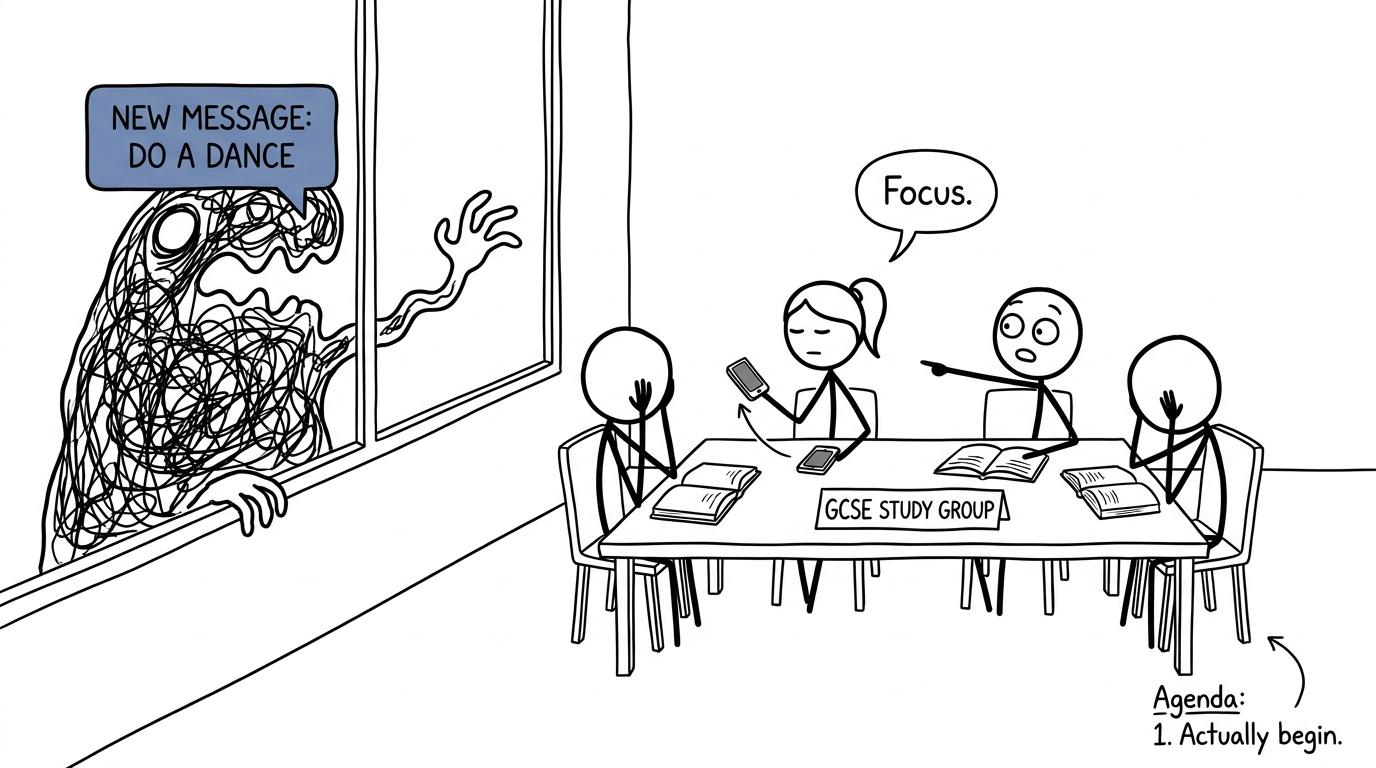 A GCSE study group resists a giant group-chat distraction and begins its agenda
Choose people who want the same kind of session
Your closest friends are not automatically your best revision partners. Friendship is valuable, but a working group needs members who arrive, prepare and accept correction without turning every disagreement into a debate about who is cleverest.
Three to five people is usually manageable. It provides enough variety for questioning and discussion without making organisation needlessly difficult. If the group is larger, divide it into smaller teams for recall and answer review.
Before inviting anyone, ask:
- Are we studying the same religions and themes?
- Are we following AQA, Edexcel, OCR or Eduqas?
- Will everyone complete a short preparation task?
- Can we attend regularly?
- Are we willing to attempt questions individually before discussing them?
The exam-board question matters. Current GCSE specifications share broad assessment aims: students need knowledge and understanding of religion and belief, then must analyse and evaluate ideas. However, paper structures, command words, topic combinations and mark tariffs vary. Use the specification, past papers and mark schemes for the qualification your school actually teaches.
Turn the group chat into a noticeboard
A revision chat becomes distracting when it is expected to perform two incompatible jobs: social conversation and session management.
Keep the revision channel functional. Pin one message containing:
- the next date, time and location;
- the religion or theme being revised;
- the exact preparation task;
- the resources everyone must bring;
- the person leading each activity.
Use a simple rule: logistical questions belong in the revision chat; general conversation belongs elsewhere. If a message does not help somebody prepare, attend or complete the session, it probably does not need to be there.
Do not spend several days searching for a time that suits everybody perfectly. Choose a repeatable slot that works for most members. Consistency reduces the number of decisions required before each meeting.
Build every meeting around an output
“Revise peace and conflict” is not an agenda. It describes a hope.
A useful agenda names what members will produce. For example, the group might finish with a checked quotation bank, individual plans for an evaluation question and a list of misconceptions to revisit.
A focused 606060-minute meeting could follow this structure:
| Time | Activity | Evidence produced |
|---|---|---|
| 000 to 555 minutes | Settle, put phones away and state the target | One shared objective |
| 555 to 151515 minutes | Closed-book retrieval | Individual recall sheets |
| 151515 to 252525 minutes | Compare and correct knowledge | Checked facts and sources |
| 252525 to 404040 minutes | Plan or answer an exam question independently | One response per student |
| 404040 to 525252 minutes | Use the mark scheme and discuss improvements | Annotated answers |
| 525252 to 606060 minutes | Log gaps and assign preparation | Next-session task list |
The independent stage is essential. If one confident student speaks while everyone else nods, the group may feel productive without showing whether each member can answer alone. The examination is individual, so part of every meeting must be individual too.
Revise knowledge through retrieval, not rereading
Religious Studies contains beliefs, practices, teachings, sources of authority, influences and differences within and between traditions. These need accurate recall. Yet reading the same page together is a weak use of group time because nobody has to reveal what they actually know.
Close the books first. One member can ask short questions while everyone writes an answer. Useful prompts include:
- What does this key term mean?
- Which teaching supports this belief?
- How might the belief influence a believer?
- What is a contrasting religious or non-religious view?
- Is this difference between religions or within one tradition?
Then check the specification-approved material and class resources. Correct inaccuracies immediately, especially misattributed teachings or quotations.
The same principle supports maths revision. MathsGenie’s guide to turning GCSE notes into active recall explains why attempting a method before consulting notes exposes gaps that rereading can hide. For topic-based follow-up, the free MathsGenie worksheets and full solutions let each student practise rather than simply watch someone else work.
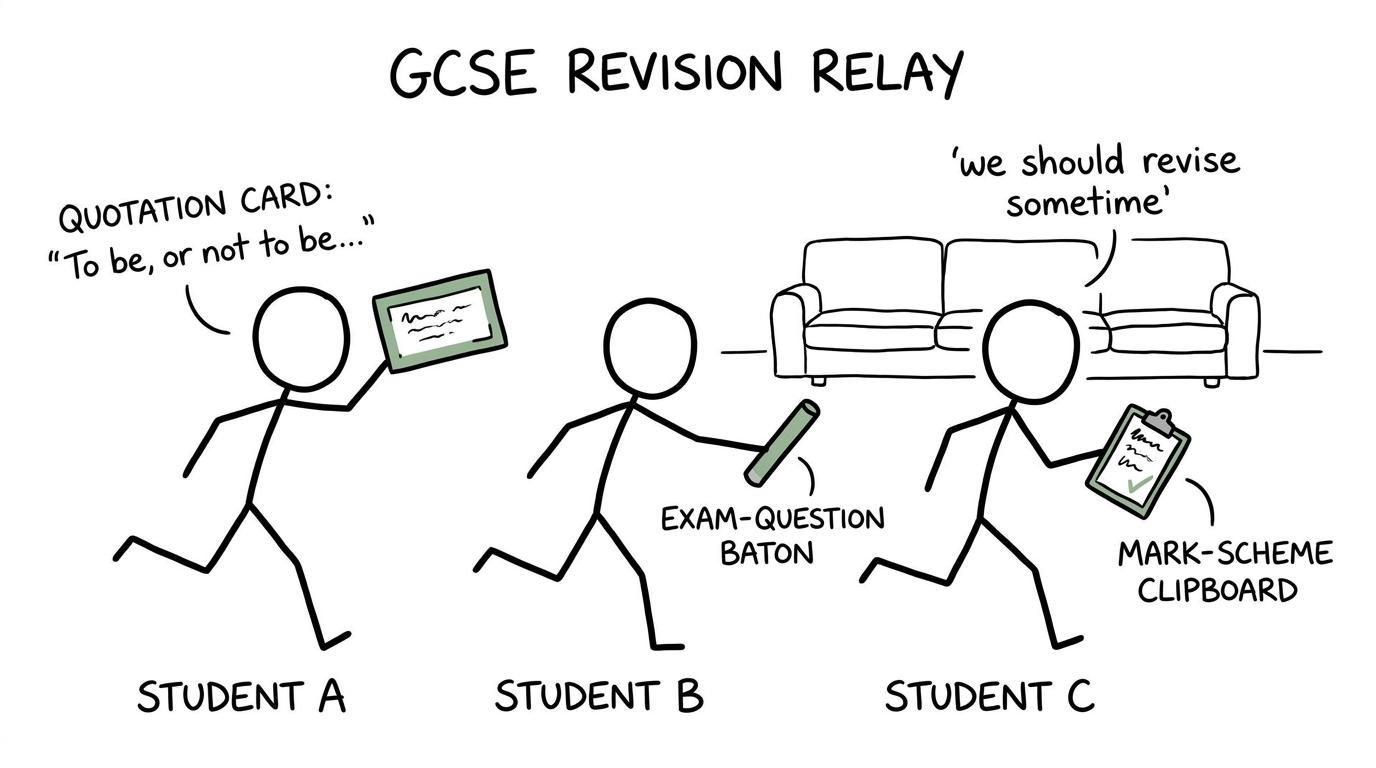 Students run a revision relay with quotation cards, an exam question and a mark scheme
Make discussion serve the assessment objectives
Religious Studies invites discussion, but an interesting conversation is not automatically an exam-ready one. The aim is to convert ideas into accurate, reasoned and balanced writing.
When discussing an evaluative statement, assign roles:
- one student argues in support;
- one challenges the argument;
- one supplies religious teaching or another source of authority;
- one checks whether each point explains significance or influence;
- one records the strongest reasoning on each side.
Rotate the roles each week. This prevents one person from becoming the permanent “quotation student” while another does all the evaluation.
After discussion, everyone should plan or write independently. Compare structure and reasoning, but do not search for one magical model answer. Strong responses may use different evidence while remaining accurate, relevant and well reasoned.
Use the official mark scheme for the paper rather than awarding marks based on confidence or writing length. Highlight where an answer demonstrates knowledge, develops analysis, considers different viewpoints and reaches a justified conclusion. Exact expectations depend on the board and question type, so never transfer one board’s formula blindly to another.
Give each member a job
A group becomes dependable when responsibility is visible. Assign four rotating roles:
The chair
The chair keeps the session moving and stops one discussion consuming the meeting.
The question setter
This student prepares retrieval prompts and selects the exam question before the session.
The accuracy checker
The checker brings the relevant specification, trusted class materials and mark scheme. Their job is to verify claims, not to win arguments.
The tracker
The tracker records attendance, common gaps and agreed preparation. Avoid recording personal marks in a public document unless everybody genuinely wants that. Track actions rather than creating a league table.
If there are fewer than four members, combine roles. If there are five, add a timekeeper or sceptic who tests whether conclusions are properly justified.
Connect group revision with your maths timetable
The target audience for this plan is not revising Religious Studies in isolation. Maths exams still need regular individual practice, and a long RS meeting should not consume the entire evening.
Use one revision system across both subjects:
- identify a narrow weakness;
- recall or attempt without help;
- check against reliable solutions or a mark scheme;
- record why marks were lost;
- practise the gap again later.
For maths, begin at the free GCSE and A Level MathsGenie revision hub. Use GCSE mini tests for contained practice or follow the method in finding your weakest GCSE topics. Nearer the exams, the guide to when to start GCSE past papers can help you move from topic repair to timed practice.
A practical evening might contain one 606060-minute RS group session, a break and one short maths mini test followed by marking. The purpose is not to fill every minute. It is to finish specific tasks properly.
Decide whether the group is improving
At the end of each meeting, ask three questions:
- What can each person now recall or explain without help?
- Which exam skill did we practise under time pressure?
- What mistake will determine the next session?
Every few meetings, complete a short individual check on previously revised material. If the same errors continue, change the method. More meetings are not automatically better meetings.
This diagnostic mindset also works in maths. The MathsGenie weakest-topics process shows how to turn lost marks into focused revision, while the GCSE revision loop for reluctant starters keeps the learn, practise, mark and repair cycle manageable.
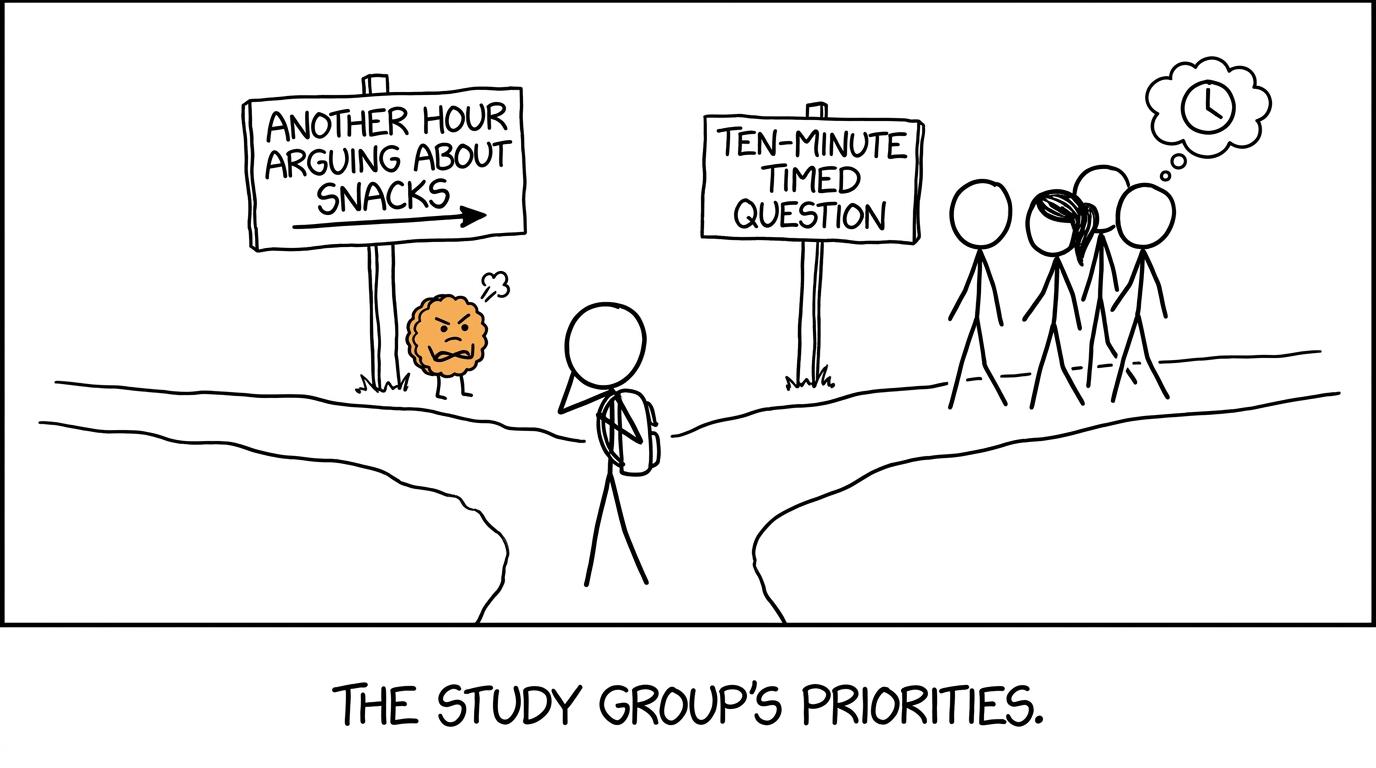 A study group chooses a timed question over another long discussion about snacks
Common GCSE Religious Studies study group mistakes
Inviting too many people
A large group creates more scheduling problems and gives quieter members places to hide. Split into smaller groups when everyone needs to answer questions.
Arriving without preparation
The meeting should not begin with everybody searching for the specification. Select the topic, questions and resources beforehand.
Letting one student teach everything
Explanation can strengthen understanding, but passive listening does not prove recall. Require written individual attempts from every member.
Debating without precise evidence
Personal views may begin a discussion, but GCSE answers need accurate knowledge, relevant religious or non-religious perspectives and reasoned evaluation.
Memorising quotations without understanding them
A quotation is useful only if you can explain its meaning, connect it to the question and identify the belief or viewpoint it supports.
Using the wrong mark scheme
Question structures vary across AQA, Edexcel, OCR and Eduqas. Check the qualification, paper and question type before judging an answer.
Avoiding timed work
Conversation feels safer than writing. Make a short timed response a normal part of the session so exam conditions do not feel unfamiliar later.
Revising only the subject the group prefers
A successful RS meeting should not quietly replace your maths revision. Protect separate time for individual maths practice, marking and corrections.
Make the next meeting real
A productive study group does not need matching stationery, a complicated shared drive or endless motivational messages. It needs a date, a narrow target, individual effort and honest feedback.
Choose three to five people. Confirm the exam board. Fix a recurring time. Prepare retrieval questions and one exam task. Then leave the first meeting with corrected answers and a clear next action.
For the maths part of your GCSE timetable, make MathsGenie your free revision base. Move from revision lessons to practice questions, check your work with mark schemes and video solutions, then build timing through mini tests, past papers and predicted papers. A revision system works when it turns intention into visible practice: one focused session at a time.