GCSE Religious Studies Remark: Should You Request One?
GCSE Religious Studies remark guide covering reviews of marking, 2026 deadlines, possible grade changes and how to decide using your marked script.

Opening a results envelope can turn months of work into one small line on a page. If your Religious Studies result is lower than expected, a GCSE Religious Studies remark may be worth considering, but only when there is evidence of a marking error.
The official service is called a review of marking, not a fresh re-mark. Your school normally requests it from AQA, Pearson Edexcel, OCR or Eduqas after discussing the result with you. Marks can rise, fall or remain unchanged, so the best first step is usually to obtain your marked script and ask an RS teacher to review it.
Your results-day decision checklist
Before requesting anything, check the following:
- Confirm your exam board, specification and paper combination.
- Find your exact total mark and the boundary for the next grade.
- Ask for your marks on each individual paper or component.
- Request access to the marked script where time allows.
- Ask an RS teacher to compare the responses with the mark scheme.
- Consider whether the grade affects sixth-form entry or another important decision.
- Check your school's deadline, fee and consent arrangements.
- Accept that your mark and grade could go down.
MathsGenie's GCSE Religious Studies revision hub helps you identify the correct board and course before making the decision.
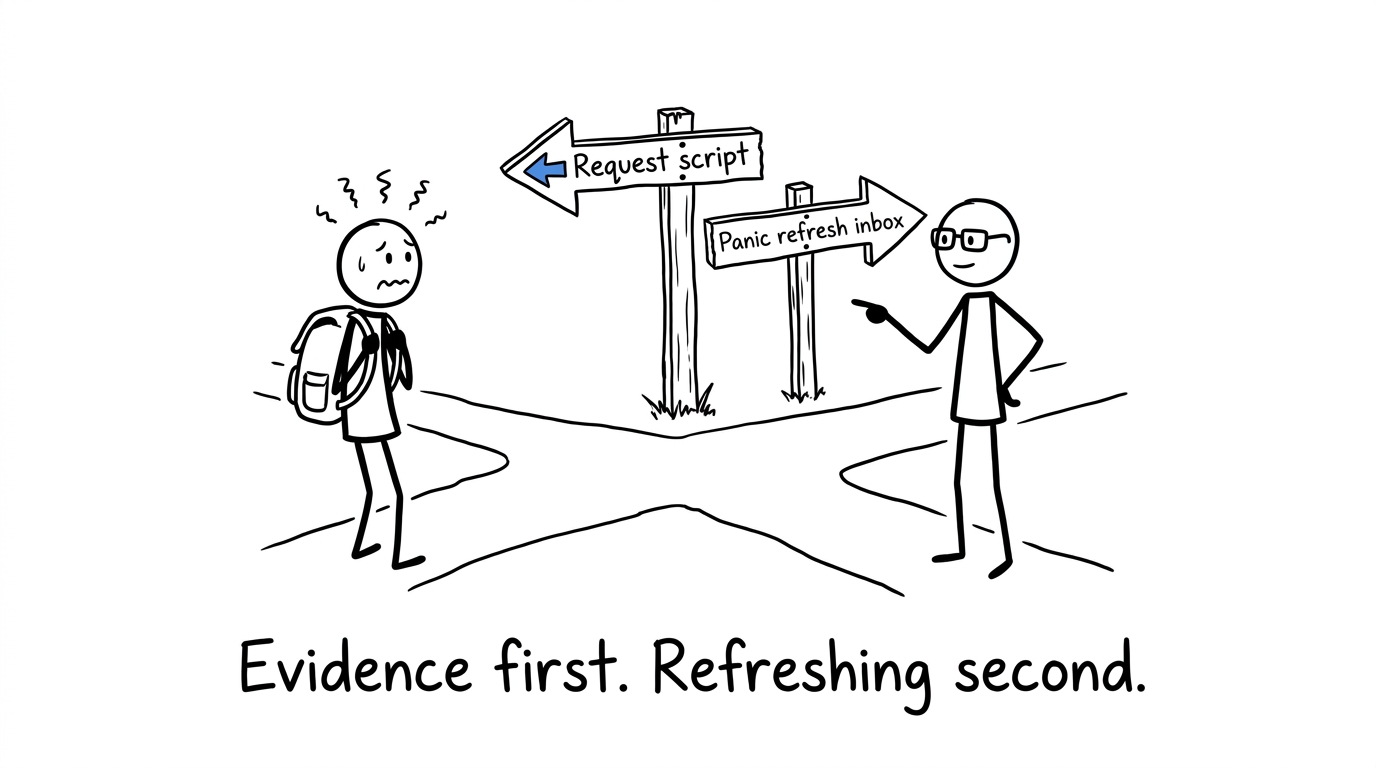 A student choosing evidence before panic on results day
How the GCSE Religious Studies re-mark process works
Check the correct grade boundary
Grade boundaries differ between exam boards, specifications, options and exam series. Do not rely on a friend's boundary or a figure from a previous year.
Use the relevant MathsGenie page, such as the AQA GCSE Religious Studies grade boundaries, Edexcel GCSE grade boundaries or WJEC GCSE Religious Studies grade boundaries. Eduqas students can also use the Religious Studies grade calculator.
Being close to a boundary matters because a small correction may change the final grade. However, closeness alone is not evidence of an error. An exam board cannot add marks simply because you missed the next grade by 111 mark or received a higher predicted grade.
Ask for your component marks and script
A review is requested for an individual paper or component. Your total result might therefore hide an unexpectedly low mark on one paper.
Ask your exams officer whether your script can be accessed before the review deadline. Then let an experienced RS teacher inspect it. For extended responses, they should consider whether the examiner applied the levels-based mark scheme reasonably, credited relevant religious teachings and assessed analysis or evaluation correctly. They can also check whether every answer was marked and whether any applicable spelling, punctuation and grammar marks were included.
This subject-specific check is more useful than simply saying that an answer “felt strong”. Religious Studies involves academic judgement, but that judgement must still be reasonable and consistent with the mark scheme.
Choose the correct service
A clerical re-check checks administrative matters such as whether all marks were recorded and totalled correctly. It does not reconsider the quality of an extended argument.
A review of marking includes administrative checks and examines whether the original marking contained an error. The reviewer considers the existing marking rather than marking the whole paper afresh. A reasonable mark is not replaced merely because another examiner might have awarded a slightly different one.
For most concerns about levels awarded to RS essays, evaluation or use of religious evidence, a review of marking is the relevant service.
Give consent and let your centre apply
Your school or college usually submits the request. It must obtain your written consent after results have been published because the mark and subject grade may be lowered. Private candidates should contact their entering centre or exam board about the route available to them.
For the June 2026 series, the awarding body must receive standard review requests by 24 September 2026. Schools often impose earlier internal deadlines, so speak to the exams officer promptly. A standard review is normally completed within 202020 calendar days of receipt.
Fees vary by board, paper and centre policy. Ask whether you must pay in advance and under what circumstances a fee is refunded or waived.
When requesting a review makes sense
A review may be sensible when:
- you are close to the next boundary;
- one component mark is unexpectedly different from your usual performance;
- a teacher identifies a specific possible marking error;
- a response, page or additional sheet appears to have been missed;
- the grade affects a confirmed progression requirement.
It is less persuasive when the only reason is disappointment, a predicted grade or the belief that RS answers are entirely subjective. Strong evidence matters more than hope.
 An exam paper facing a calm review rather than results-day roulette
Appealing a GCSE Religious Studies grade
An appeal is not the first stage. If concerns remain after a review of marking, your school can consider appealing to the awarding body. Under the 2026 JCQ process, an appeal normally has to be submitted within 303030 calendar days of the review outcome.
An appeal must identify a possible marking or procedural error. It cannot challenge the setting of the grade boundary simply because the boundary seems high. If the awarding body's final appeal process has been completed, a school may then ask Ofqual's Exam Procedures Review Service to examine whether the correct procedures were followed. Ofqual does not re-mark the script or directly award a new grade.
Common mistakes to avoid
- Calling it an automatic re-mark: the reviewer checks for errors in the existing marking.
- Looking at the wrong boundary: confirm the board, route, options and exam series.
- Applying without seeing the evidence: request the script and involve an RS teacher where possible.
- Ignoring the downside: marks and grades can fall as well as rise.
- Missing the school's deadline: its internal cut-off may be earlier than 24 September 2026.
- Assuming every paper must be reviewed: target the component where the evidence suggests an error.
Make the decision calmly, then move forward
A result can feel personal, but the decision to request a review should be practical: check the boundary, inspect the script, seek subject-specialist advice and weigh the possible outcomes.
Start with MathsGenie's GCSE Religious Studies grade boundaries and revision resources. Once the decision is made, return your attention to the exams still ahead. MathsGenie's GCSE Maths revision lessons and GCSE predicted papers provide free practice questions, past papers, mark schemes, video solutions and focused exam preparation.