

GCSE Psychology vs Sociology for Sixth Form
GCSE psychology vs sociology sixth form choices explained: learn what admissions teams value, compare both subjects and make your decision with confidence.
Choosing a GCSE can feel strangely permanent. One option box is ticked in Year 9, yet it is easy to imagine a sixth form admissions team examining that decision years later. If you are comparing GCSE psychology vs sociology for sixth form, the reassuring answer is simple: sixth forms do not generally regard one as automatically better than the other.
Admissions decisions are normally driven by your overall GCSE grades, the published entry requirements for your intended A Level subjects and evidence that you can manage the course. Local policies vary, so always read the current prospectus for every sixth form you are considering.
The better choice is usually the subject whose content and assessment style suit you. A stronger grade in a subject you genuinely engage with is more useful than choosing a supposedly impressive option and struggling to sustain your effort.
The short answer: neither GCSE has universal priority
There is no national admissions rule saying that GCSE Psychology carries more value than GCSE Sociology, or vice versa. Sixth forms and colleges set their own entry requirements. These may include:
- a minimum number of GCSE passes at specified grades;
- particular grades in GCSE English language and maths;
- subject-specific requirements for your chosen A Levels;
- higher requirements for oversubscribed courses;
- additional rules for internal or external applicants.
Most importantly, taking a subject at GCSE is not automatically required before taking the corresponding A Level. Many schools do not offer GCSE Psychology or GCSE Sociology at all, so sixth forms cannot normally assume that every suitable applicant had access to them.
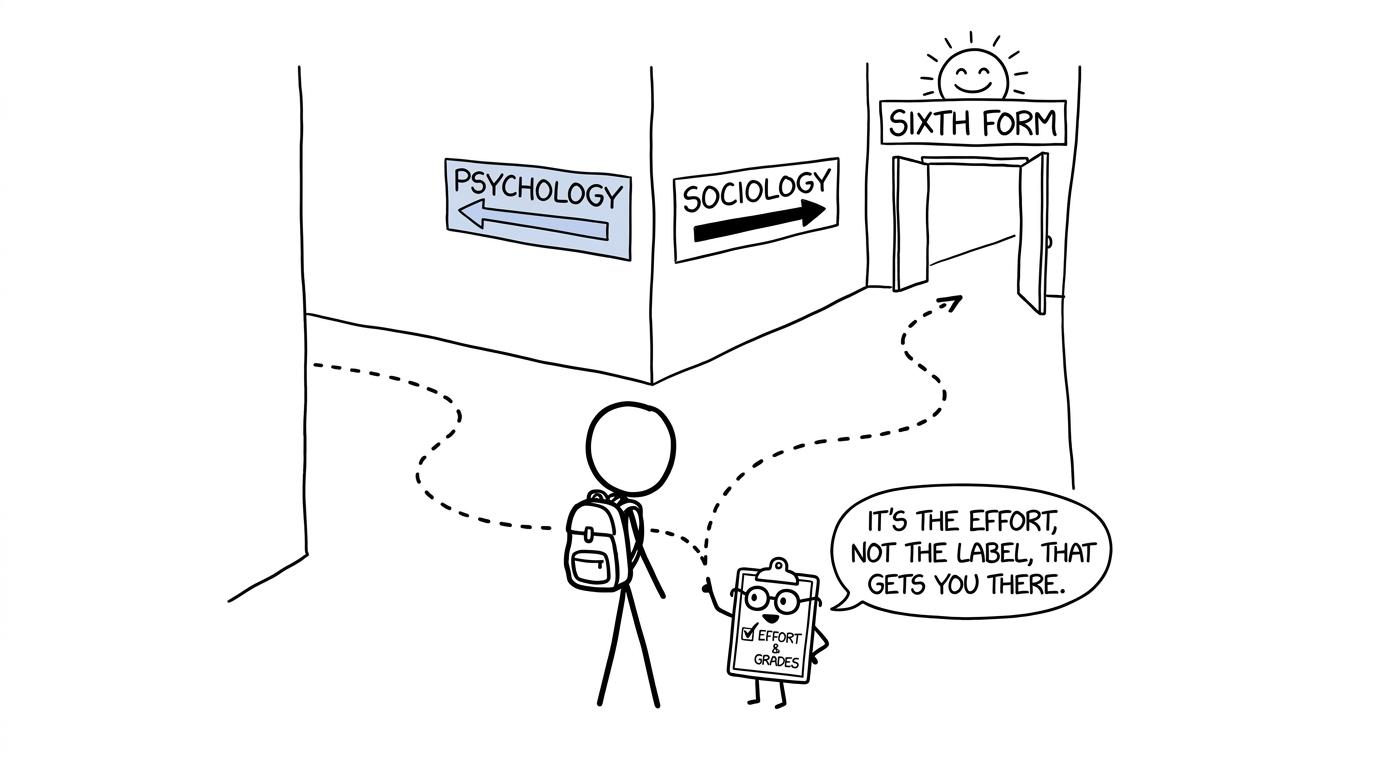 Two GCSE subject paths leading to the same sixth form door
Your decision checklist
Before choosing, ask yourself:
- Which specification and exam board does my school use?
- Which course content interests me more?
- Do I prefer evaluating studies or discussing social institutions and viewpoints?
- How much extended writing does each course require?
- What do my possible sixth forms actually require?
- Which option fits sensibly beside my other GCSE subjects?
- Where am I most likely to produce consistently strong work?
That last question matters. Applications are usually judged using visible evidence, including grades and stated entry criteria, rather than assumptions about which subject sounds more academic.
What sixth forms are likely to notice
An admissions team does not usually examine one GCSE in isolation. Your application is a collection of signals: attainment, subject readiness and whether your intended programme is realistic.
Your overall GCSE profile
Secure grades across your subjects show that you can organise revision, learn demanding material and perform under timed conditions. For many A Level programmes, English and maths are especially important because they support communication, analysis and quantitative reasoning across the curriculum.
That is one reason not to let an optional subject decision distract you from core preparation. MathsGenie's GCSE maths revision resources organise topics by grade and include videos, practice questions and answers. They can help you build the consistency that admissions criteria are more likely to reward.
The requirements for your proposed A Levels
If you hope to study A Level Psychology, a sixth form might specify grades in English, maths or science because the course combines extended writing, scientific ideas, research methods and numerical interpretation. Another provider may set a broader general entry requirement.
For A Level Sociology, providers may place particular emphasis on English because students must construct arguments, use evidence and evaluate sociological explanations. Requirements still vary considerably.
Do not guess. Find the current entry table for the exact institution and year in which you will apply. If the wording is unclear, ask its admissions team directly.
Evidence that you can manage the assessment style
A strong result in either subject can demonstrate useful abilities. Psychology may show that you can understand research, evaluate evidence and communicate explanations. Sociology may show that you can compare perspectives, analyse social issues and develop supported arguments.
Neither skill set belongs exclusively to one course. Both involve careful reading, accurate terminology, evidence and structured writing. The difference lies mainly in what you investigate and how questions are framed.
GCSE Psychology and Sociology compared
Specifications differ by exam board, so use your school's current course outline rather than relying on a friend's experience elsewhere. Broadly, however, the subjects tend to have the following characteristics.
| Consideration | GCSE Psychology | GCSE Sociology |
|---|---|---|
| Main focus | Behaviour, mental processes and psychological research | Society, institutions, groups and sociological explanations |
| Typical thinking | Applying theories, interpreting studies and evaluating evidence | Comparing perspectives, discussing social patterns and evaluating arguments |
| Quantitative content | Research data, graphs, averages and other numerical ideas may appear | Data, trends, research evidence and interpretation may appear |
| Writing | Explanations and evaluation using psychological knowledge | Structured arguments using concepts, evidence and contrasting viewpoints |
| Best fit | Students curious about behaviour and research | Students curious about society, inequality and institutions |
This is not a difficulty ranking. One student may find research studies memorable but struggle with competing sociological perspectives. Another may enjoy social debates but find psychological terminology less intuitive. Difficulty is partly a relationship between the course and the learner.
When Psychology may be the better choice
Psychology may suit you if you enjoy asking why people behave as they do and want to examine claims through theories and evidence. It also has natural connections with science and maths through research methods, data and the interpretation of findings.
That does not make it a substitute for strong core GCSE grades. If A Level Psychology is a possibility, keep developing numerical confidence through MathsGenie practice questions and check whether your intended sixth form names a minimum maths or science grade.
When Sociology may be the better choice
Sociology may suit you if you are interested in how education, families, social groups and other institutions shape people's experiences. You need to move beyond personal opinion: effective sociology uses concepts, evidence and competing explanations.
Students who enjoy discussion often assume this automatically makes Sociology easier. Discussion helps, but examinations reward precise written analysis. You must answer the question set rather than simply describe an interesting issue.
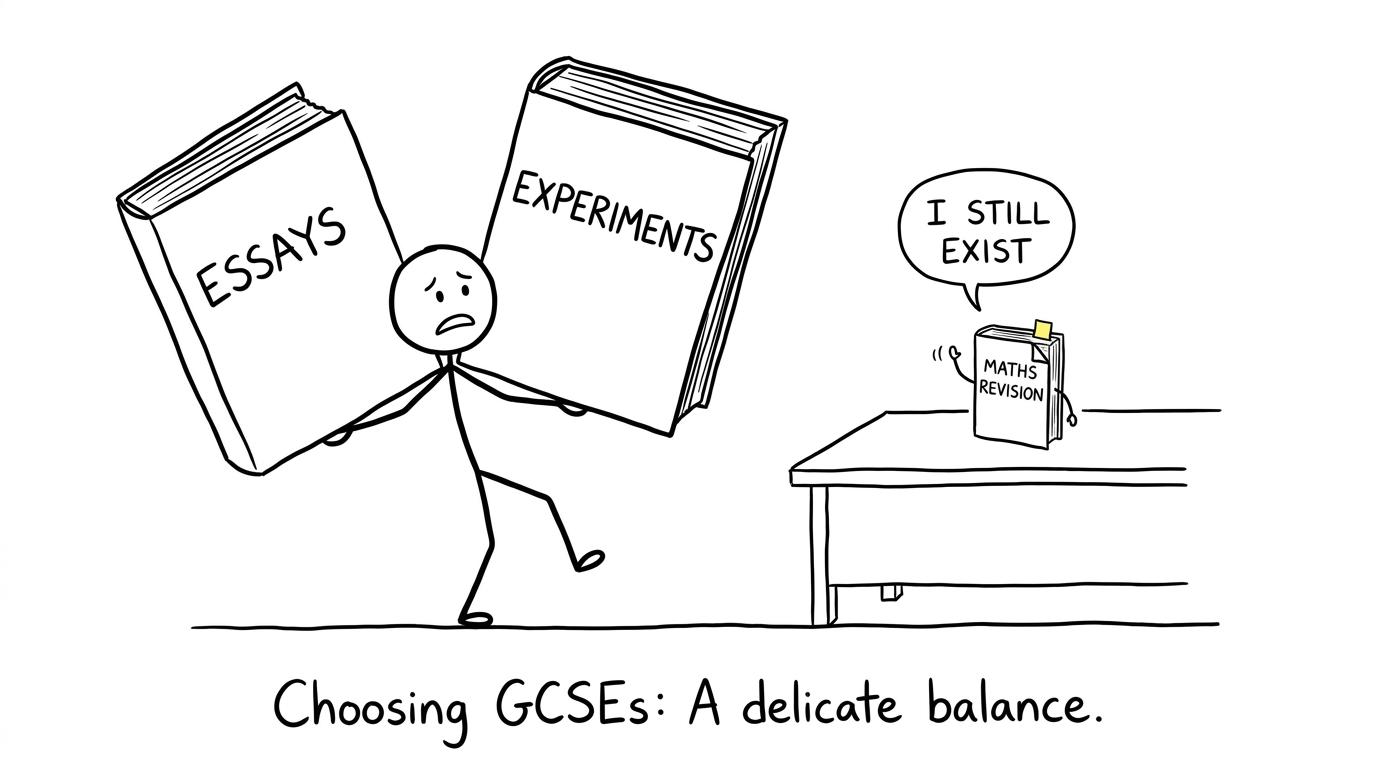 A student balancing essays, experiments and maths revision
Does either subject help with A Level applications?
Taking the matching GCSE can give you useful familiarity. You may already recognise terminology, research methods or styles of evaluation when you begin the A Level. That can make the opening weeks feel less unfamiliar.
But familiarity is not the same as an admissions advantage. Where the GCSE was unavailable, students can still be well prepared through strong English, maths, science or humanities results, depending on the A Level and provider. A sixth form's published criteria are more reliable than rumours about what it secretly prefers.
If you are considering A Level Maths alongside either social science, look ahead at MathsGenie's A Level maths revision. It gives you a realistic view of the transition beyond GCSE, including the greater emphasis on algebra, proof and multi-stage reasoning.
How maths fits into both choices
Maths may not be the first subject you associate with Psychology or Sociology, but evidence often arrives in numerical form. You may need to interpret tables, compare data, understand graphs or reason about research conclusions.
The most useful preparation is not memorising isolated procedures. It is becoming comfortable asking what a number represents, whether a comparison is fair and what the available data can actually support.
Your GCSE maths grade may also form part of a sixth form's general or subject-specific entry criteria. Prepare for the exam format with GCSE maths past papers, then use the mark schemes to identify whether lost marks came from knowledge, method, notation or time management.
A productive cycle is straightforward:
- complete a paper under realistic conditions;
- mark it carefully;
- list the topics behind your lost marks;
- revisit the corresponding revision lesson;
- answer fresh questions without looking at the solution;
- return to timed papers later.
MathsGenie's predicted GCSE maths papers can provide additional exam-style practice, but they should complement rather than replace official past papers and full specification coverage.
How to make the final decision
Start with the facts. Obtain the course outlines from your school, identify the exam board and look at the kinds of questions used in assessment. Course titles can conceal the detail that determines whether you will enjoy two years of lessons.
Next, investigate sixth forms you might realistically attend. Record their general entry standard and any requirements for subjects you may choose at A Level. Policies can change between admissions cycles, so date your notes and check them again before applying.
Finally, consider the entire GCSE timetable. A balanced programme is not necessarily the one with the most impressive-sounding subjects. It is the one in which you can work steadily without sacrificing English, maths, science and your other commitments.
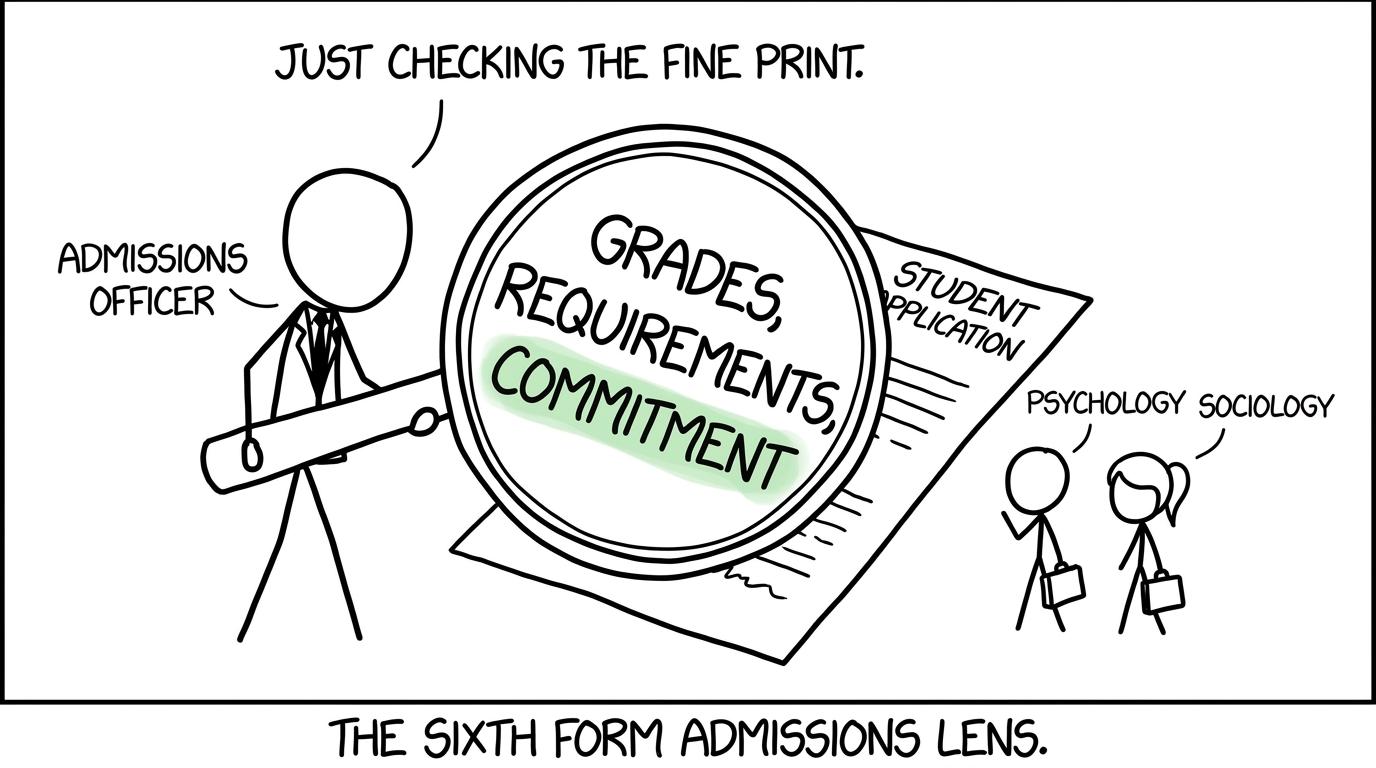 An admissions magnifying glass revealing grades and requirements
Common mistakes when comparing the subjects
Believing one option always looks more academic
Subject prestige is often discussed more confidently than it is defined. Unless a sixth form explicitly names a requirement or preference, do not assume that Psychology or Sociology earns an automatic advantage.
Choosing solely because of a possible career
Your interests may change. Either GCSE can develop transferable reading, analysis, evaluation and communication skills. Choose a course you can engage with now while keeping future entry requirements in view.
Ignoring the actual specification
A subject's name is only a label. Content, assessment and question styles may vary by exam board. Read the specification summary provided by your school and, if possible, inspect a past paper before deciding.
Assuming an interesting subject requires little revision
Enjoyment helps you return to the work, but it does not replace retrieval practice, accurate terminology or timed writing. Both courses reward organised revision.
Neglecting core GCSE requirements
A borderline core grade may affect more sixth form options than the difference between two optional subjects. Use the MathsGenie GCSE exam resources to protect your maths preparation while making broader choices. You can also review grade boundaries and exam information without trying to predict an exact future boundary, which is only set after an examination series.
Choose fit over imagined prestige
In the comparison between GCSE Psychology and GCSE Sociology for sixth form, neither subject is universally favoured. What matters is whether you meet each provider's published requirements and can demonstrate strong, consistent attainment.
Choose Psychology if behaviour, studies and evidence hold your attention. Choose Sociology if social structures, institutions and competing explanations make you want to ask better questions. If both appeal, compare the specifications and assessment styles rather than relying on reputation.
Then return your attention to the part you can control: your preparation. Use MathsGenie's free revision lessons and practice questions to repair topic gaps, complete past and predicted papers under timed conditions, and learn from mark schemes and video solutions. Start with the GCSE maths revision hub, build a manageable routine and let your grades provide the strongest argument on your application.










