

GCSE Psychology Resit: Your Results Day Plan
GCSE psychology resit guidance with a clear results day checklist, weekly milestones, active recall, past-paper practice and exam technique for success.
Results day can make one grade feel larger than everything around it. But a disappointing result is information, not a verdict. If you are planning a GCSE psychology resit, your first steps are practical: confirm your exam board, arrange an entry through an approved centre and use your previous performance to build a targeted revision plan.
Unlike GCSE English language and maths, Psychology is not normally available in the November series. You will generally need to enter the next summer series, but your school, college or exam centre must confirm availability, deadlines, fees and access arrangements. That gives you time. The important question is how you use it.
Your GCSE Psychology resit checklist
Before restarting the course, complete these actions:
- Ask your school or college whether it will enter you for the resit.
- If necessary, find an approved centre that accepts private candidates.
- Confirm whether you studied AQA, Pearson Edexcel or OCR Psychology.
- Download the correct specification and list every required topic.
- Request your component marks and, where available, a copy of your exam script.
- Identify whether you lost marks through missing knowledge, weak application, limited evaluation or timing.
- Put regular sessions into the MathsGenie revision planner.
- Record entry deadlines and examination dates provided by your centre.
Do not assume that changing exam boards will make the retake easier. Specifications organise content differently, and switching may create more material to learn. Remaining with your original board is often the most efficient option, provided a centre can enter you.
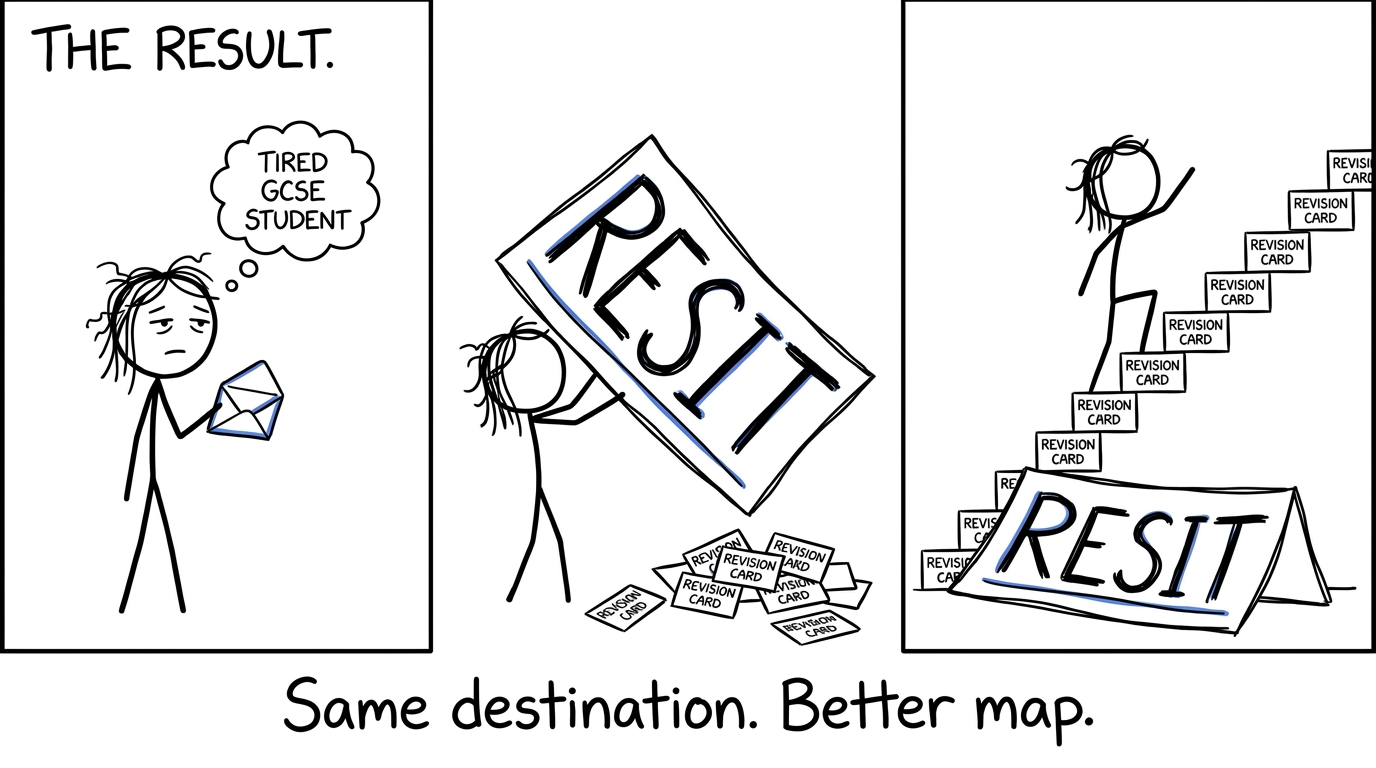 A student turns a resit sign into a practical revision staircase
Milestone one: diagnose the result
The temptation after results day is to begin rewriting every note. Resist it. First discover what actually went wrong.
Complete one paper without revision, using the board you originally studied. AQA students can begin with the AQA GCSE Psychology past papers, while Pearson students should use the Edexcel GCSE Psychology past papers. There is also a dedicated collection of OCR GCSE Psychology past papers.
Mark the paper carefully and classify every lost mark:
- Knowledge: the fact, study, theory or definition was missing.
- Application: the answer did not use details from the scenario.
- Analysis or evaluation: the response made an unsupported judgement.
- Research methods: the method, variable, sampling technique or data skill was insecure.
- Exam technique: the answer ignored the command word, ran out of time or lacked enough developed points.
This diagnosis becomes your revision priority list. It is more useful than simply writing down the overall mark.
Milestone two: rebuild knowledge through retrieval
During the first main phase of gcse psychology retake revision, work through the specification topic by topic. Your exam board matters: AQA, Edexcel and OCR do not assess identical content in identical ways.
Use the appropriate AQA GCSE Psychology revision hub, Edexcel GCSE Psychology revision hub or OCR GCSE Psychology revision hub. These pages bring together lessons, revision materials, questions and assessment resources.
A productive session has four parts:
- Review one narrow section of content.
- Close the resource and recall it without help.
- Answer topic questions or use a worksheet.
- Mark the work and schedule another attempt.
Psychology contains many terms that sound familiar in everyday language but have precise academic meanings. Flashcards can help with definitions, yet they should also test studies, procedures, findings, conclusions, strengths and weaknesses. A card that only asks you to recognise a word is easier than the examination.
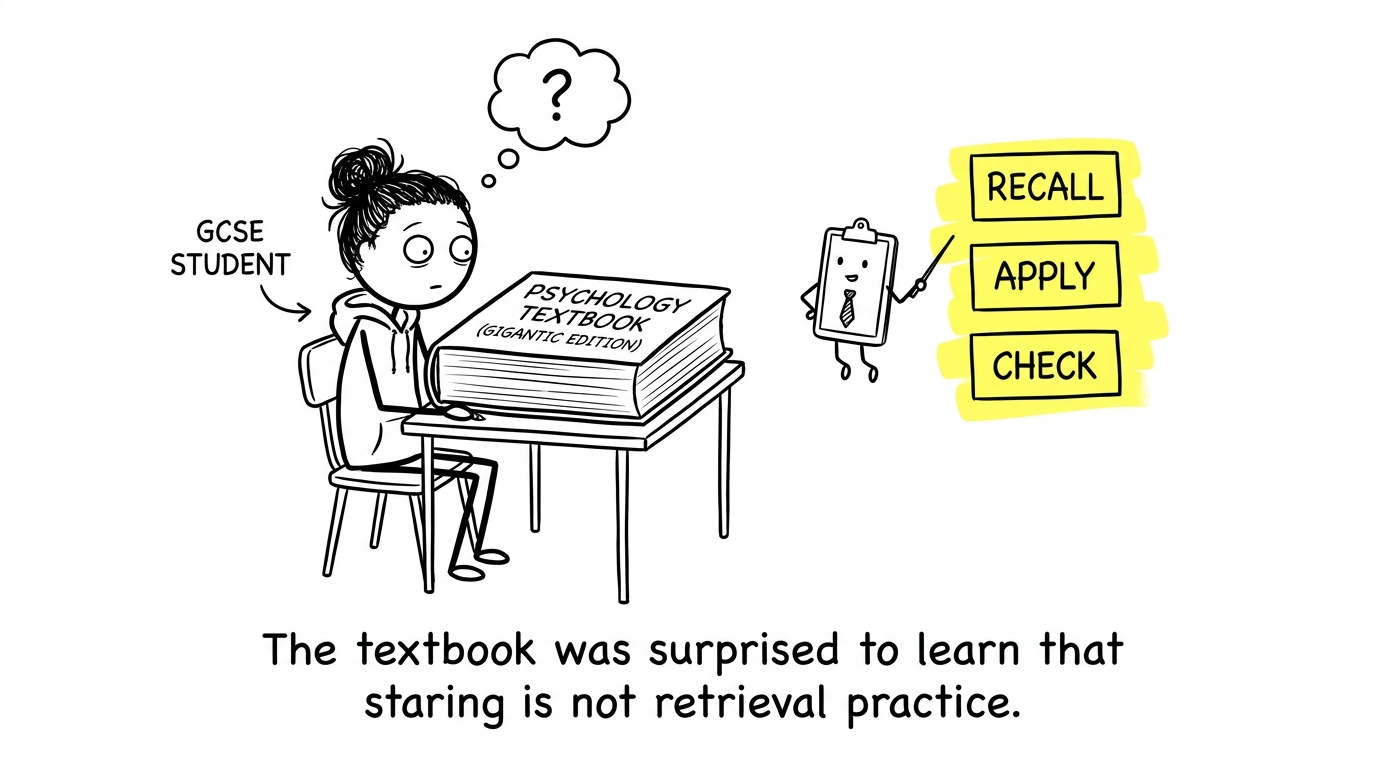 A textbook discovers that staring is not retrieval practice
Milestone three: strengthen research methods
Research methods should not be left until the final weeks. They connect to multiple topics and may require you to interpret unfamiliar investigations rather than repeat memorised notes.
Practise identifying hypotheses, variables, sampling methods, experimental designs, ethical issues, reliability and validity. You should also be comfortable interpreting tables, graphs and basic descriptive data at the level required by your specification.
AQA students can use the focused Designing Research revision resources for lessons, revision guidance and active-recall practice. After reviewing a method, answer a question in context. Knowing a definition is only the beginning; examinations often ask whether a choice was suitable for a particular investigation.
Milestone four: turn knowledge into exam answers
Once your topic knowledge is secure, move from isolated recall to mixed exam questions. Pay close attention to command words.
A question asking you to identify needs a concise response. Explain requires a developed chain of reasoning. Evaluate requires a relevant judgement supported by psychological evidence. If a scenario is provided, application must be visible: use its people, behaviour or circumstances rather than writing a generic textbook paragraph.
When resitting GCSE Psychology, mark schemes should become part of the lesson. Compare what you wrote with what the mark scheme rewards, then improve the answer without copying it mechanically. Examiner language can show the required precision, but your final response still needs to answer the exact question.
Milestone five: rehearse complete papers
In the final phase, complete full papers under timed conditions. Put your phone elsewhere, use only permitted equipment and do not pause the clock.
AQA GCSE Psychology is assessed through two written papers, each covering different parts of the specification. Pearson Edexcel also uses two externally examined papers, with different weightings and durations. OCR has its own content and assessment structure. Always practise the correct paper rather than treating every GCSE Psychology course as interchangeable.
After each paper, create a short repair list. Revisit the weakest topic, complete targeted questions and then test it again. One carefully analysed paper is worth more than several papers that are scored and forgotten.
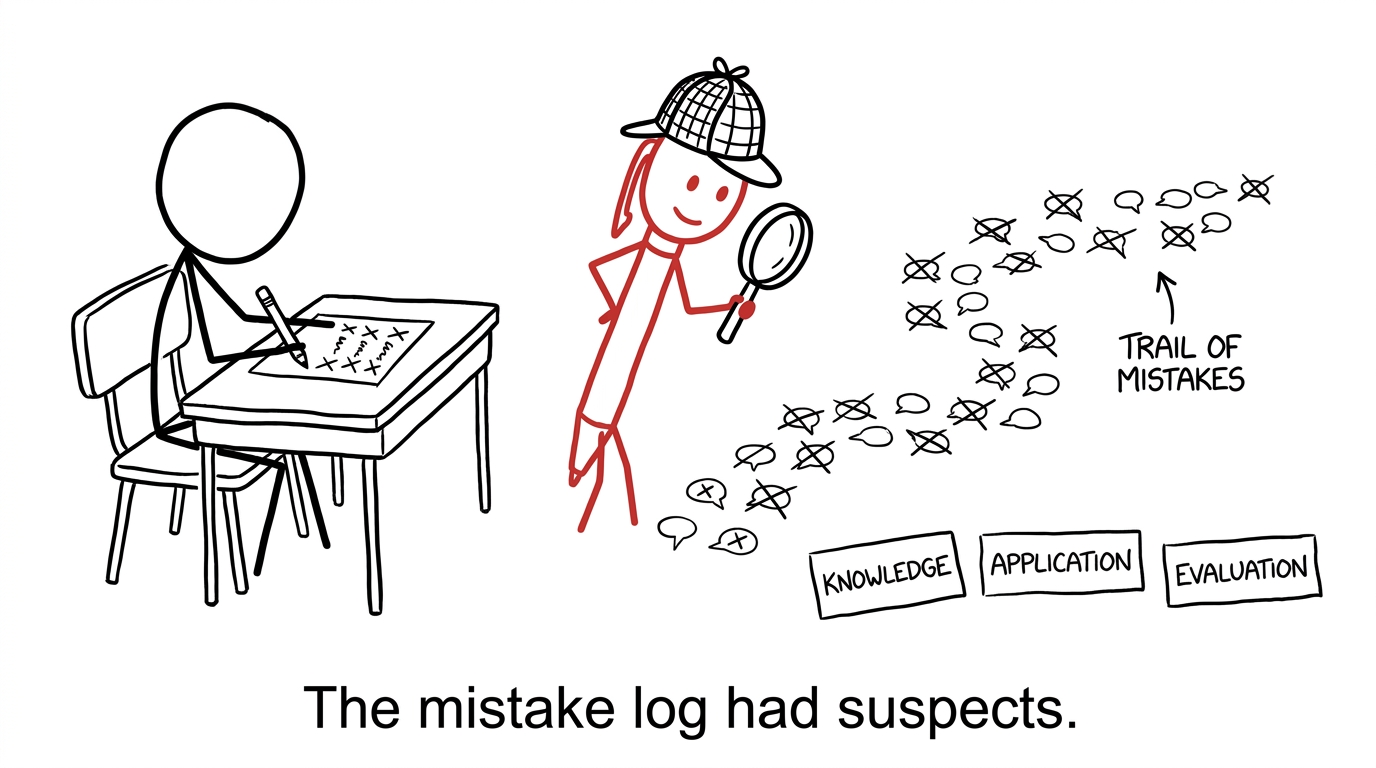 A red pen detective investigates lost Psychology marks
Common GCSE Psychology resit mistakes
Waiting for motivation
A resit can feel distant after results day. Use fixed weekly sessions rather than relying on enthusiasm. Consistency makes the workload smaller.
Revising from the wrong specification
Check the qualification title and code with your centre. Topics, optional content and paper structures vary between boards.
Making notes without testing recall
Neat notes may feel productive, but they do not prove that you can retrieve or apply knowledge. Every session should include closed-book recall or questions.
Ignoring extended responses
Longer answers require selection, structure and judgement. Practise them regularly and compare them with the level descriptors in the mark scheme.
Completing papers without corrections
Your score describes the past attempt. Corrections improve the next one. Keep a mistake log and retest recurring weaknesses.
Turn the resit into a better system
A GCSE Psychology retake is not about repeating the same year more intensely. It is about replacing vague revision with a visible cycle: learn, retrieve, apply, mark and revisit.
Start today by confirming your entry arrangements and choosing the correct MathsGenie Psychology hub. Use the free revision lessons and topic practice to rebuild weak areas, then move into AQA Psychology past papers, Edexcel Psychology past papers or OCR Psychology past papers. Add mark schemes, worksheets, mini tests and predicted papers when available, and let each mistake decide what you practise next.











