

GCSE Psychology Remark: Process and When to Request
GCSE psychology remark guidance explaining reviews of marking, grade boundaries, risks, deadlines and when asking your exams officer makes sense.
Opening a results envelope can compress two years of work into one small number. If your Psychology grade is lower than expected, particularly by only a few marks, a GCSE psychology remark may feel like the obvious next step. The short answer is this: speak to your teacher or exams officer, check your distance from the grade boundary and ask whether they can inspect your marked scripts before requesting a review.
A “remark” is officially called a review of marking. It does not mean that an examiner marks the paper again from the beginning. A reviewer checks whether the original mark scheme was applied correctly. Your mark can rise, stay unchanged or fall, so the decision should be based on evidence rather than disappointment alone.
GCSE psychology remark decision checklist
Before submitting a request, work through this checklist:
- Confirm your exam board and component marks.
- Check the correct grade boundary for your exam series.
- Calculate how many additional marks would change your overall grade.
- Ask whether your school can obtain and inspect your scripts.
- Discuss extended responses with a Psychology teacher.
- Check the school's internal deadline and likely fee.
- Understand that marks and grades can decrease.
- Give written consent only when you understand the risk.
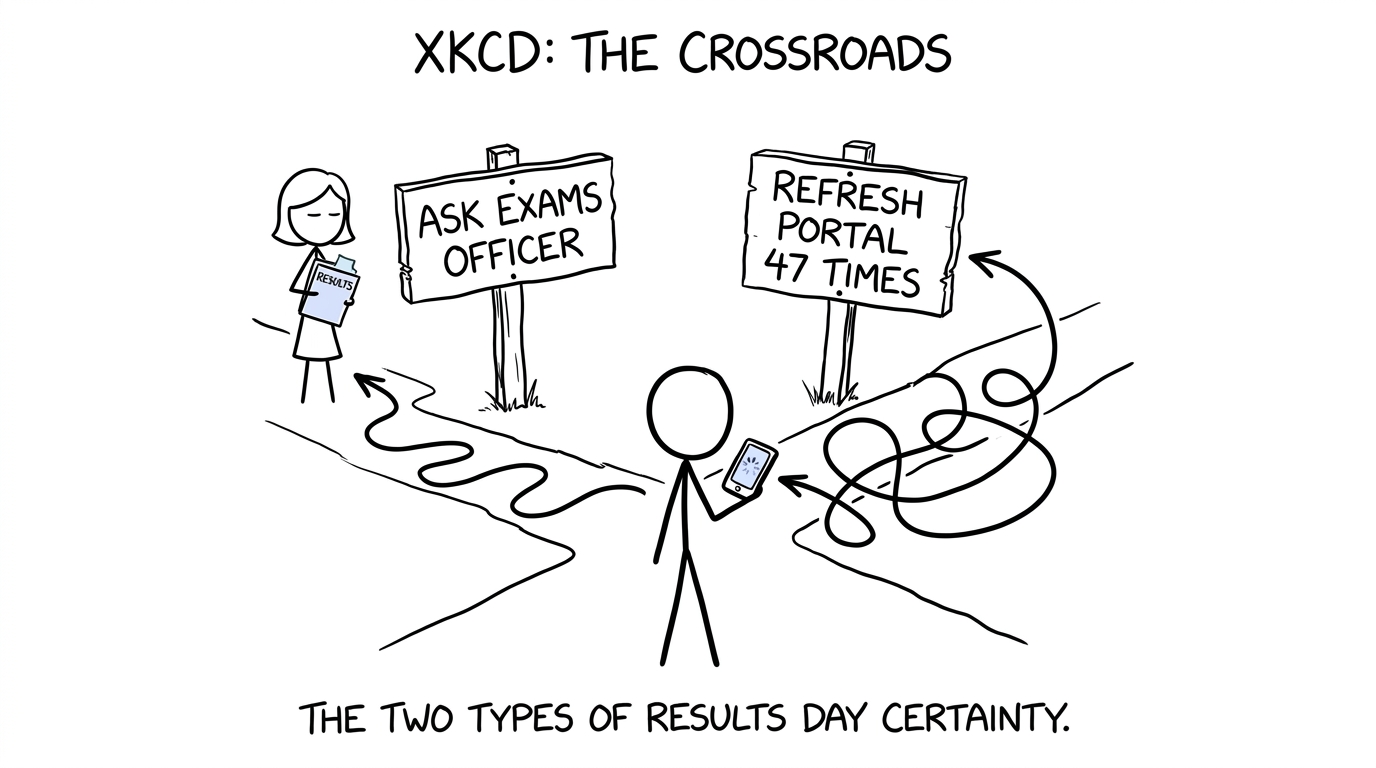 A student choosing between asking an exams officer and endlessly refreshing a results portal
How the GCSE psychology re-mark process works
Check the grade boundary
Start with the boundary for your board, subject and exam series. Do not compare your result with a previous year's boundary or with another board's specification.
MathsGenie publishes dedicated AQA GCSE Psychology grade boundaries and Edexcel GCSE Psychology grade boundaries. You can also use the wider GCSE grade boundaries hub to confirm that you are viewing the right qualification.
Your useful calculation is:
marks needed=next grade boundary−current total mark\text{marks needed} = \text{next grade boundary} - \text{current total mark}marks needed=next grade boundary−current total markBeing close to a boundary does not prove that marking is wrong. It simply tells you whether a small, justified mark change could affect the final grade.
Ask for your component marks and scripts
Your results slip may show only the overall grade. Ask your exams officer for the marks awarded to each paper and whether access to scripts is available. Your teacher can then compare the responses with the mark scheme.
This matters in Psychology because papers combine short answers, research-method questions and longer responses involving knowledge, application and evaluation. A teacher may identify a response where credit appears to have been missed. Equally, the script may show that the original mark is reasonable.
Reviewing AQA GCSE Psychology past papers and mark schemes can help you understand how assessment objectives are rewarded, although only your teacher and exams officer can advise on the live post-results request.
Choose the correct service
A clerical re-check checks matters such as whether every question was marked and whether marks were totalled and recorded correctly. A review of marking goes further by checking whether the mark scheme was applied correctly. The review normally includes the clerical checks.
For the June 2026 series, the JCQ deadline for standard reviews of results is 24 September 2026. Schools usually set earlier internal deadlines so staff have time to collect consent and submit requests. Always follow the date given by your exams officer rather than waiting for the awarding body's final deadline.
GCSE candidates normally use the standard service. The JCQ priority review timetable is designed for relevant Level 3 qualifications, such as A Levels where a higher education place may depend on the outcome, rather than ordinary GCSE Psychology requests.
Give written consent
Your school or college normally submits the request to the exam board. It must obtain your written consent after results have been published because the reviewed mark and final subject grade can go down as well as up.
Fees vary by exam board, paper and school policy, so ask for the current charge before agreeing. A review is generally requested for a particular paper or component, not automatically for every Psychology paper.
Wait for the outcome
JCQ's standard completion target for a review of marking is within twenty calendar days of the awarding body receiving the request. Your school receives the decision and tells you whether the mark and qualification grade have changed.
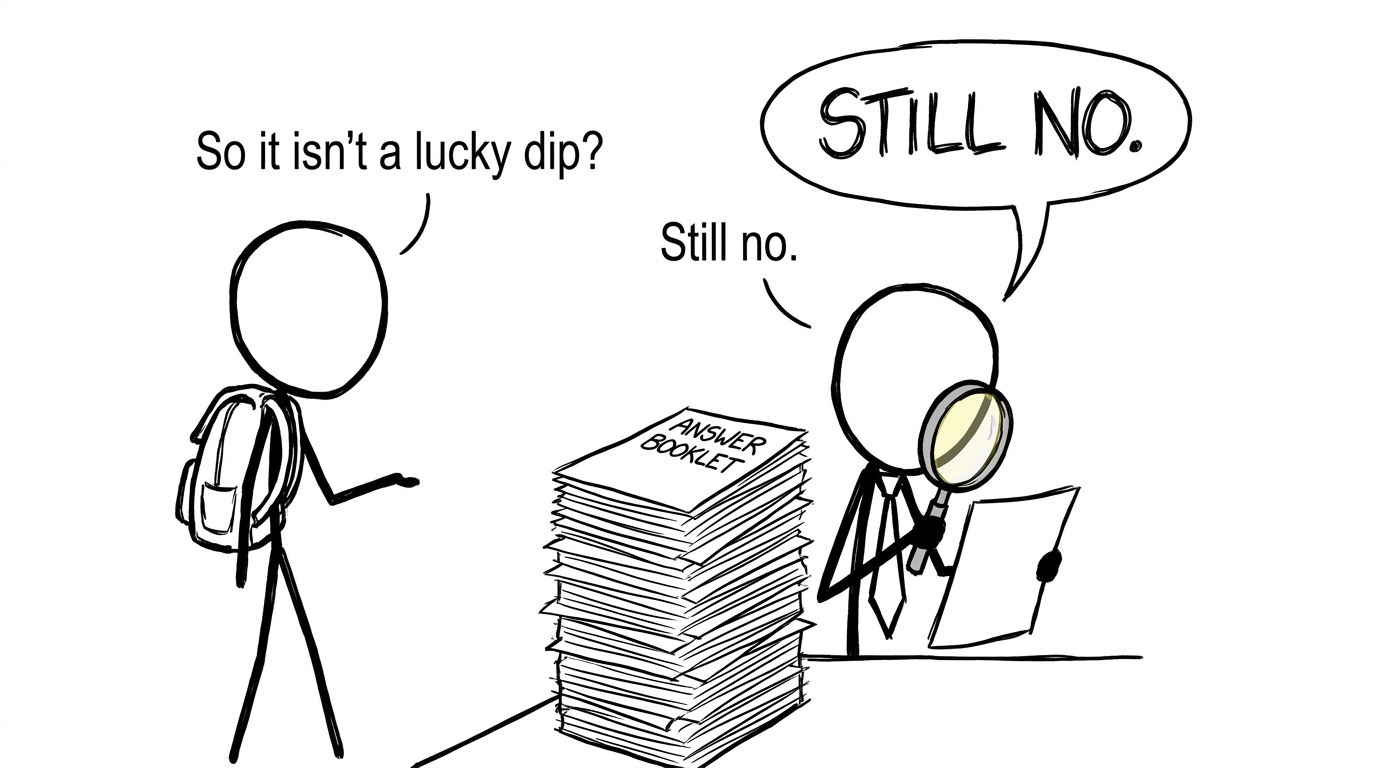 An examiner inspecting an answer booklet while confirming that a review is not a lucky dip
When requesting a review makes sense
A request is more defensible when:
- you are close enough to the next boundary for a realistic mark change to matter;
- a qualified teacher has inspected the script and identified a plausible marking issue;
- an extended response appears inconsistent with the published level descriptors;
- a question may have been missed or marks may have been recorded incorrectly;
- the higher grade affects sixth-form entry or another confirmed progression requirement.
It may be less sensible when you are many marks from the boundary, no specific concern can be found, or a lower mark could put your existing grade at risk. The AQA GCSE Psychology predicted grade calculator is useful for understanding how paper marks combine, but the official result and current-series boundary must guide a post-results decision.
Appealing a GCSE Psychology grade
Appealing a GCSE Psychology grade is not the first step. An appeal can normally be made only after the relevant review of results has been completed. It must identify a possible error or a concern that procedures were not applied consistently, properly or fairly; simply disagreeing with an examiner's academic judgement is not enough.
Under the JCQ process for 2026, an appeal against a post-results outcome must normally be submitted within thirty calendar days of the awarding organisation issuing that outcome. Your centre submits it unless the applicable private-candidate arrangements say otherwise.
Common mistakes to avoid
- Treating a review as a guaranteed increase: the mark may rise, remain unchanged or fall.
- Looking only at the overall grade: obtain the paper marks before deciding which component to review.
- Using last year's boundary: boundaries can change between exam series.
- Missing the school deadline: it is often earlier than the exam board deadline.
- Requesting every paper automatically: evidence may point towards one component only.
- Confusing an appeal with a review: the review comes first; an appeal challenges the process or outcome on permitted grounds.
Make the decision calmly
A result can be important without every disappointing result being wrong. The best decision sits where evidence, grade boundaries and consequence meet. Ask for the breakdown, inspect the script where possible and listen to your teacher's assessment before consenting.
Start with MathsGenie's GCSE Psychology revision resources, then check the relevant GCSE Psychology grade boundaries. For your next qualification, MathsGenie remains your free revision base for revision lessons, past papers, predicted papers, practice questions, mark schemes, video solutions, mini tests and structured exam preparation. If you are also planning your maths pathway, explore the GCSE Maths revision hub and turn today's result into a clearer plan for what comes next.











