

Cramming vs Learning GCSE Dance: Know the Difference
Cramming vs learning GCSE Dance explained: spot false confidence, test what has stuck and build revision that still works under exam pressure.
The night before an exam, almost any revision can feel productive. Notes look familiar. Definitions seem obvious. A dance phrase flows while the video is playing. Then the support disappears, and so does the confidence.
That is the practical difference between cramming vs learning GCSE Dance: cramming helps material feel available now, while genuine learning helps you retrieve and apply it later, without prompts. On exam day, only the second kind is dependable.
This distinction matters to GCSE Dance students, but it also offers a powerful lesson for anyone preparing for GCSE maths. Whether you are recalling performance terminology or choosing a method for an unfamiliar algebra question, the real test is not whether you recognise the content. It is whether you can produce the right response independently.
The quick cramming vs learning checklist
You are probably cramming if you:
- reread or watch the same material repeatedly without testing yourself;
- can answer only when your notes, teacher or video provide cues;
- practise everything in one long session and rarely return to it;
- avoid questions or routines that expose uncertainty;
- judge progress by time spent rather than what you can do unaided.
You are more likely to be learning if you:
- retrieve terminology, ideas or movement from memory;
- practise across several days rather than in one burst;
- use feedback to make a precise correction;
- can explain why an answer or artistic choice works;
- perform under conditions that resemble the assessment;
- revisit weak areas after enough time has passed for them to feel difficult again.
The difference is not effort. Cramming can be exhausting. The difference is what the effort leaves behind.
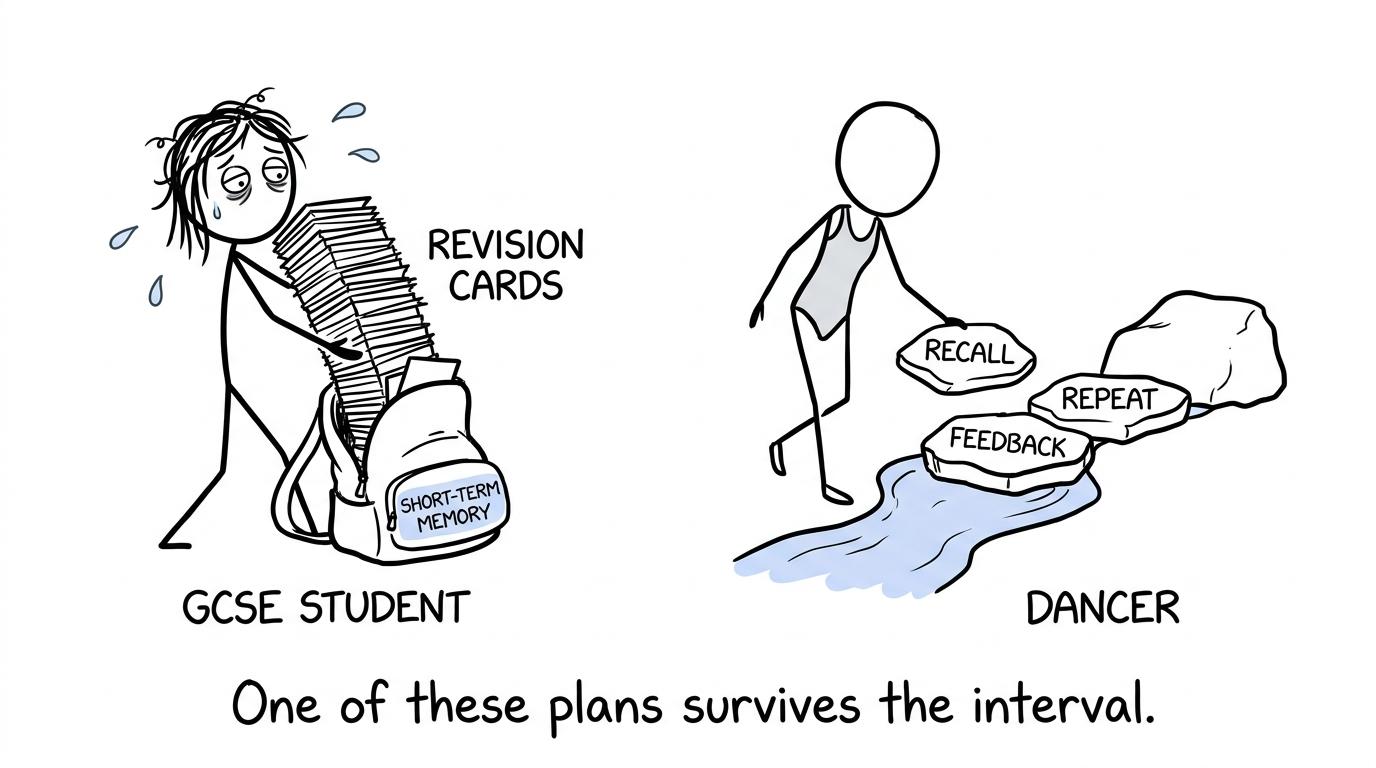 A student cramming revision cards while another builds stepping stones through recall, feedback and repetition
Why cramming feels more effective than it is
Cramming creates familiarity. After reading the same page several times, the words become easy to recognise. After copying a dance phrase repeatedly alongside a demonstration, the sequence can feel secure. That ease is comforting, but it may belong to the prompt rather than to you.
Close the book. Turn off the video. Wait until tomorrow. Can you still recall the material?
This is why passive revision can produce false confidence. Recognition asks, “Have I seen this before?” Retrieval asks, “Can I bring it back without help?” An exam normally demands retrieval, followed by application, analysis or evaluation.
Current educational guidance supports active retrieval, feedback and practice distributed over time. Repeated rereading alone is less reliable because it does not require the effortful act of recalling knowledge. Spacing matters too: returning to material after a delay is generally more useful for long-term retention than repeating it immediately in one sitting.
Difficulty is not always evidence that revision is failing. Sometimes it is evidence that learning is finally being tested.
What genuinely learning GCSE Dance looks like
For AQA GCSE Dance, performance and choreography together account for 60%60\%60% of the qualification, while dance appreciation is assessed through a written paper worth 40%40\%40%. The written examination lasts one hour and thirty minutes and is marked out of 808080.
That structure makes genuine learning broader than memorising a glossary. Students need knowledge that can survive different demands: physical execution, creative decision-making, analysis of their own work and critical appreciation of professional works.
You can retrieve precise terminology
Knowing a term means more than recognising it on a flashcard. You should be able to recall it without seeing the answer, distinguish it from related terms and use it accurately in context.
A stronger retrieval routine is:
- choose a small group of terms;
- write or say what each means without notes;
- compare your response with an accurate source;
- correct missing or vague language;
- test the same terms again on another day.
The maths equivalent is recalling a formula and knowing when it applies. A formula copied perfectly from a revision guide is not yet useful knowledge. It becomes useful when you can select it inside a problem.
You can connect knowledge to evidence
Dance appreciation requires more than lists of facts about a professional work. Genuine learning means connecting an observation to its effect, meaning or choreographic intention.
Ask yourself:
- What specific feature can I identify?
- What evidence supports my interpretation?
- How does it communicate an intention?
- Can I compare it with another moment or work?
- Could I defend my judgement if the question were phrased differently?
That final question matters. Cramming often prepares one remembered answer. Learning prepares the underlying idea, so you can adapt when the wording changes.
Your performance survives without prompts
In practical work, learning becomes visible when a phrase remains accurate without copying another dancer, following a video or relying on an immediate reminder. It also includes physical, technical, expressive and mental skills, not movement memory alone.
Practise complete sections independently. Record them where permitted, compare the result with the assessment criteria and choose one correction at a time. “Improve everything” is not actionable feedback. “Maintain focus through the transition” is.
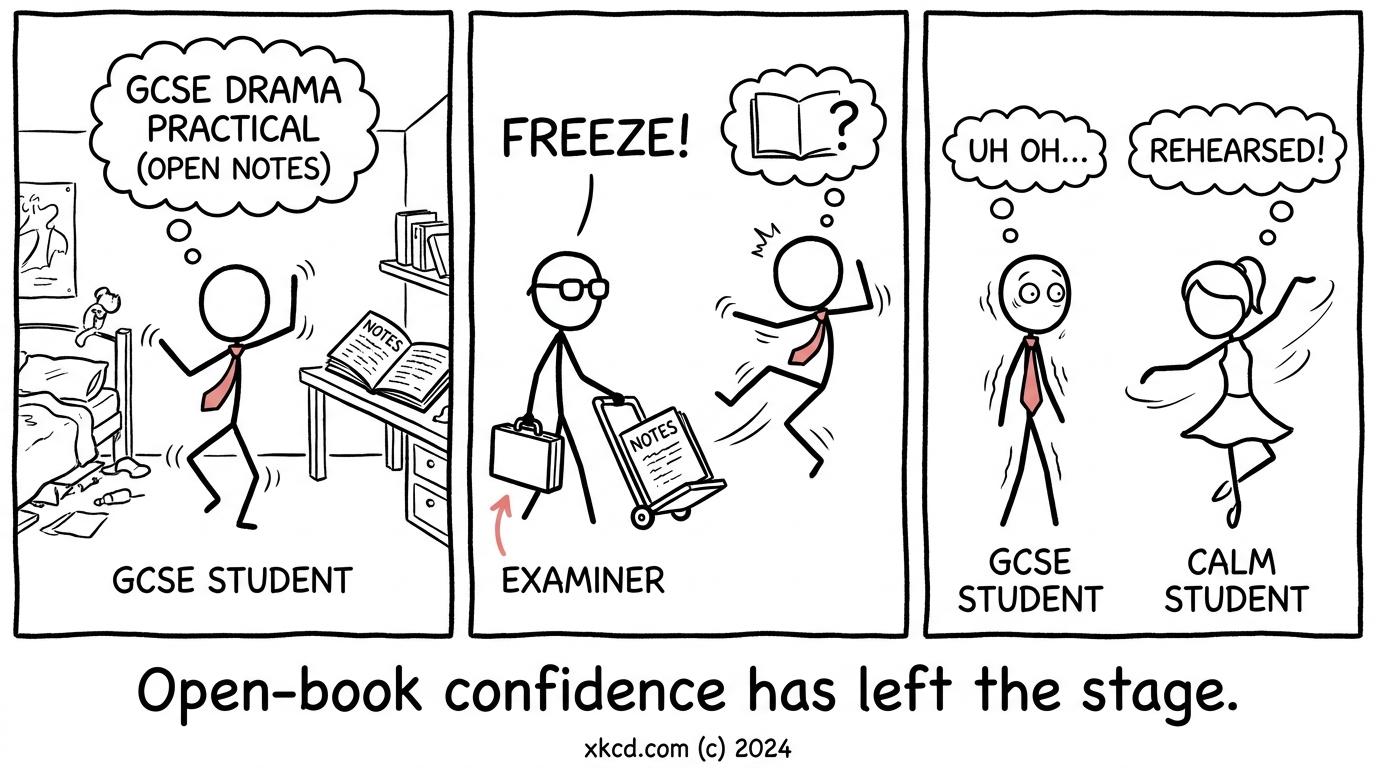 A student discovers that open-book confidence disappears when the notes leave the stage
The no-notes test: your clearest learning check
If you want to know whether revision has stuck, remove the support.
For written Dance content, take a blank page and reconstruct what you know about a topic. For practical material, perform a section without following anyone. For analysis, answer a fresh question under a short time limit. Then check the result against reliable notes, teacher feedback or assessment criteria.
Use four questions:
- Recall: What could I produce without help?
- Accuracy: Which details were correct or incorrect?
- Application: Could I use the knowledge in a new question or context?
- Delay: Can I still do it after several days?
This is also an honest way to revise maths. The MathsGenie GCSE maths revision hub brings together lessons, exam questions, worksheets and board-specific resources. Learn a method, close the explanation and attempt questions independently. If you need constant hints, the method is not secure yet.
Short checks are often more revealing than another hour of reading. The GCSE maths mini tests provide focused opportunities to retrieve methods and expose gaps without committing to a complete paper.
Turn cramming into a learning cycle
A useful revision session has a loop rather than an endpoint:
Retrieve, attempt, check, correct, revisit.
Begin with one clearly defined area. Retrieve what you know before opening your notes. Attempt a relevant task under independent conditions. Check it carefully, identify one or two weaknesses, then revisit those weaknesses after a delay.
For Dance, that could mean recalling choreographic devices, analysing a professional work or rehearsing a difficult transition. For maths, it could mean selecting one weak topic, completing exam-style questions and using the mark scheme to diagnose lost marks.
MathsGenie's guide to finding your weakest GCSE topics explains how to turn assessment evidence into a focused revision list. Once you have identified a gap, use revision lessons and practice questions before retesting it.
Spacing does not require a complicated system. Revisit the content later in the week, then again the following week. The important feature is the delay: you are checking whether the learning remains available after the feeling of familiarity has faded.
A structured timetable makes this easier. The GCSE one-month maths revision plan shows how retrieval, topic practice and paper practice can fit into a manageable routine.
Use assessment conditions before assessment day
Learning needs to work in the environment where it will be assessed. That means gradually removing help and adding realistic constraints.
For GCSE Dance, practise writing with the command word, available time and mark allocation in mind. Rehearse practical material from a genuine starting position rather than repeatedly polishing the easiest section. Ask your teacher which specification and assessment requirements apply to your course.
For maths, choose papers that match your exam board and tier. The Edexcel GCSE maths past papers and AQA GCSE maths past papers include official mark schemes and worked solutions where available.
A paper is most valuable when you review it. The guide to using GCSE past papers properly follows a simple principle: attempt, mark, fix and retest. A score tells you where you are. The correction process changes where you will be next time.
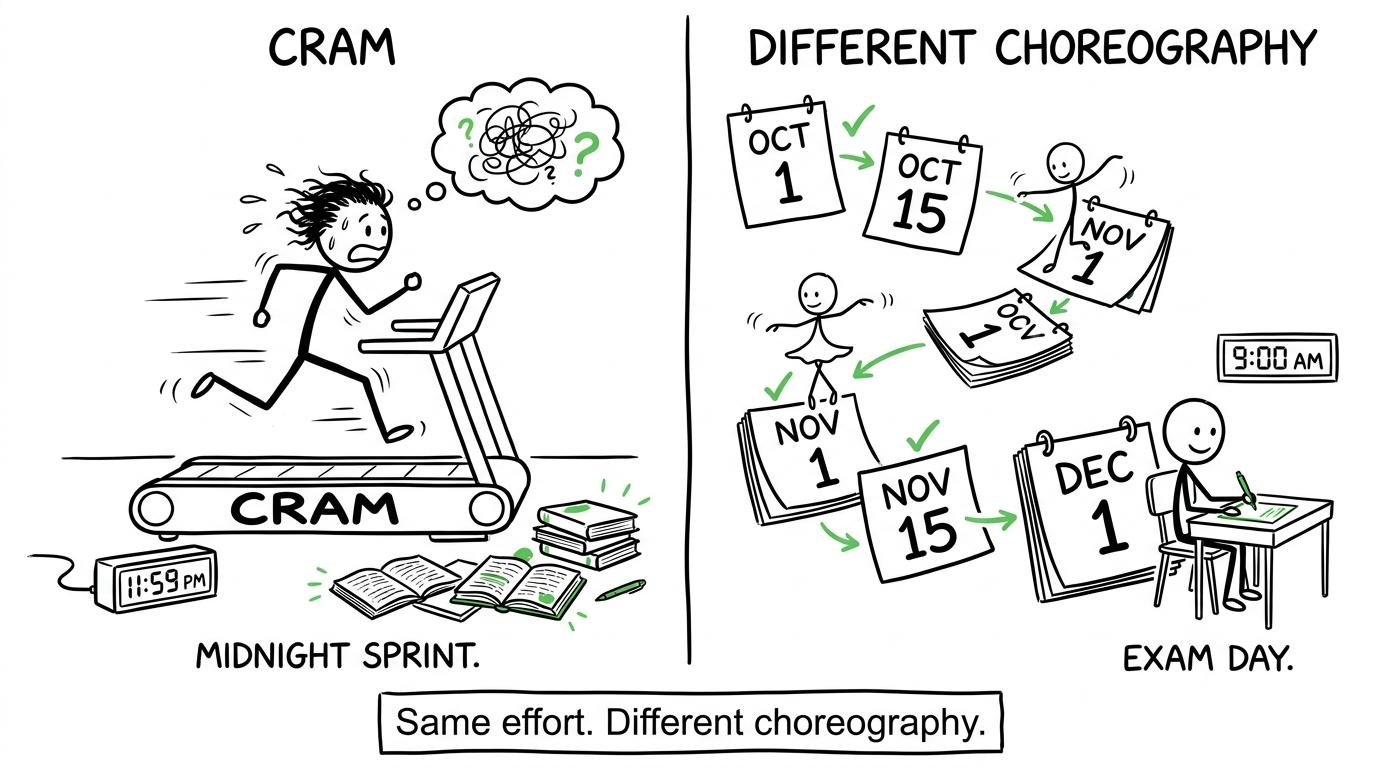 One student crams at midnight while another spreads practice calmly across several days
Common mistakes when trying to learn rather than cram
Mistaking repetition for retrieval
Repeating something while looking at it is supported performance. Try it without the source before deciding it is secure.
Testing yourself too soon
Immediate success can reflect short-term memory. Test again after a meaningful delay. Learning should survive tomorrow, not merely the next ten minutes.
Correcting without retesting
Reading the right answer feels satisfying, but it does not prove that you can now produce it. Close the solution and attempt the task again later.
Revising only comfortable material
Confidence grows fastest when you repair specific weaknesses. Begin with evidence from feedback, mini tests or past papers, not the topic you most enjoy.
Doing full papers without rebuilding weak skills
Full papers develop timing and stamina, but repeated papers will not automatically teach a missing method. Use the MathsGenie past-paper library to diagnose gaps, then return to focused revision and practice.
Sacrificing sleep for one more session
Late-night cramming may increase the amount you see while reducing how effectively you perform the next day. A short, focused review followed by proper rest is usually a better final plan than an all-nighter. If the exam is close, use this calm GCSE maths night-before plan to prioritise rather than panic.
Make your revision durable
Cramming asks, “How much can I cover tonight?” Learning asks a quieter, more useful question: “What will I still be able to do when the help is gone?”
For GCSE Dance, the answer should include accurate independent performance, precise terminology and adaptable analysis. For GCSE maths, it means recognising the problem, choosing a method, showing clear working and recovering when a question looks unfamiliar.
Start small. Retrieve one topic without notes. Attempt one task independently. Check it honestly. Correct one weakness. Return to it later.
Then let MathsGenie support the same cycle across your maths revision. Use free revision lessons to understand, practice questions to build independence, mini tests to check retrieval, and past papers or predicted papers to test performance. Mark schemes and video solutions show where your method needs to change.
The goal is not to make revision feel easy tonight. It is to make exam day feel familiar when it matters.











